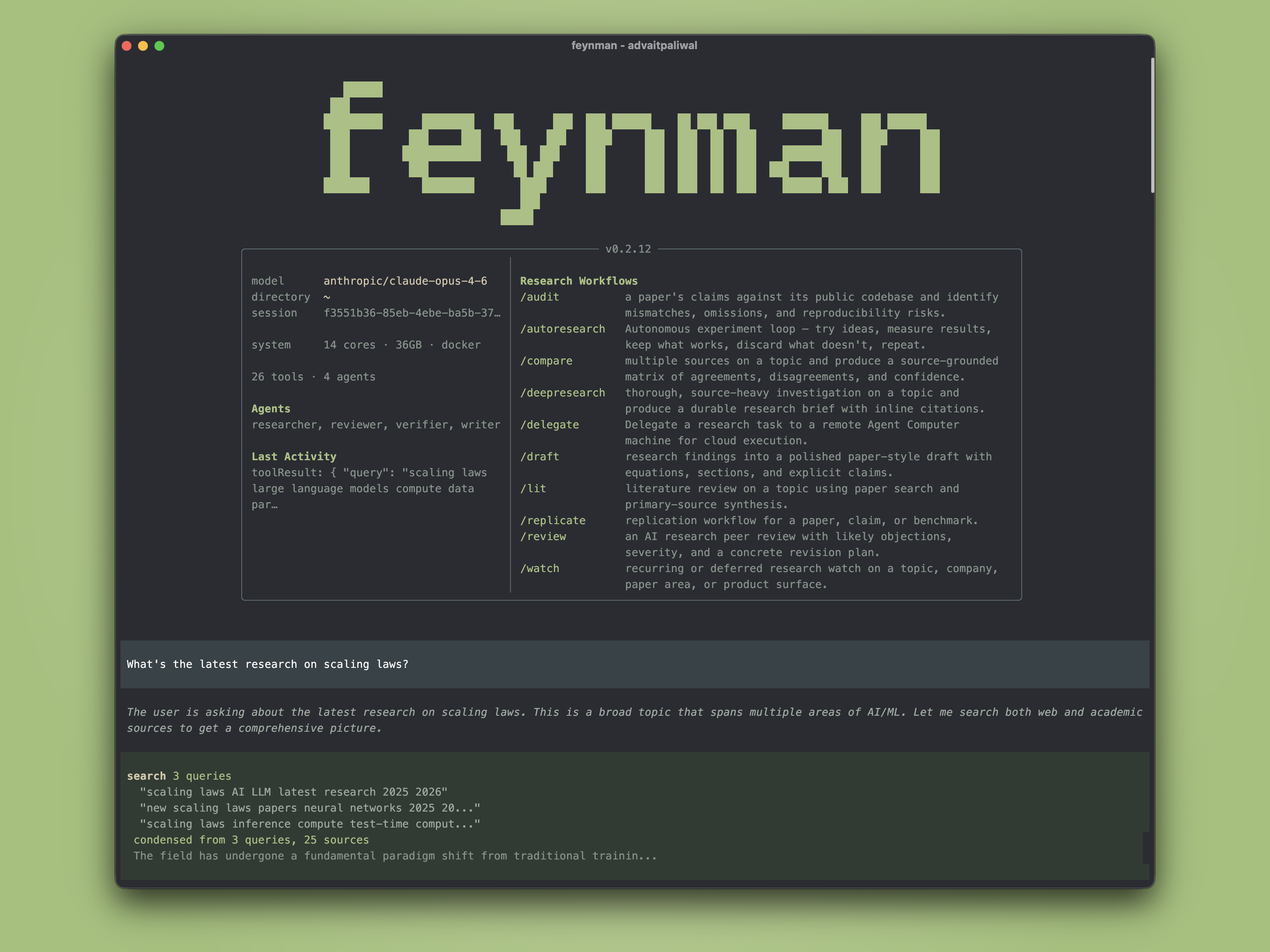
The open source AI research agent.



Installation
macOS / Linux:
curl -fsSL https://feynman.is/install | bash
Windows (PowerShell):
irm https://feynman.is/install.ps1 | iex
The one-line installer fetches the latest tagged release as a standalone bundle with its own Node.js runtime and verifies its SHA-256 before installing. To pin a version, pass it explicitly, for example curl -fsSL https://feynman.is/install | bash -s -- 0.5.3. Rerun the installer to upgrade; feynman update only updates optional Pi packages you installed.
npm alternative (uses your local Node.js >=22.22.0):
npm install -g @companion-ai/feynman
If you installed the interim @advaitpaliwal/feynman package, migrate once:
npm uninstall -g @advaitpaliwal/feynman
npm install -g @companion-ai/feynman
Then run feynman setup to sign in to a model provider. To use Feynman in an ACP editor such as Zed, run it through pi-acp: "agent_servers": { "Feynman": { "command": "npx", "args": ["-y", "pi-acp"], "env": { "PI_ACP_PI_COMMAND": "feynman" } } }. See the installation guide for uninstalling and the setup guide for local models (LM Studio, LiteLLM, Ollama, vLLM) and Amazon Bedrock.
Skills Only
If you want just the research skills without the full terminal app:
macOS / Linux:
curl -fsSL https://feynman.is/install-skills | bash
Windows (PowerShell):
irm https://feynman.is/install-skills.ps1 | iex
That installs the skill library into ~/.codex/skills/feynman for Codex. For other targets, pass a scope:
curl -fsSL https://feynman.is/install-skills | bash -s -- --codex     # ~/.codex/skills/feynman (default)
curl -fsSL https://feynman.is/install-skills | bash -s -- --repo      # .agents/skills/feynman in the current repo
curl -fsSL https://feynman.is/install-skills | bash -s -- --opencode  # .opencode/skills/feynman in the current repo
& ([scriptblock]::Create((irm https://feynman.is/install-skills.ps1))) -Scope Codex # or -Scope Repo, -Scope OpenCode
These installers download the bundled skills/ and prompts/ trees plus the repo guidance files referenced by those skills. They do not install the Feynman terminal, bundled Node runtime, auth storage, or Pi packages.
What you type → what happens
$ feynman "what do we know about scaling laws"
→ Searches papers and the web, answers with cited sources

$ feynman deepresearch "mechanistic interpretability"
→ Plan-first investigation with parallel researchers, synthesis, and citation verification

$ feynman lit "RLHF alternatives"
→ Literature review with consensus, disagreements, open questions, and lab/PI corpus mode when the input names a research group

$ feynman audit 2401.12345
→ Compares paper claims against the public codebase

$ feynman replicate "chain-of-thought improves math"
→ Plans replication checks and runs them only after an explicit environment choice

$ feynman recipe "fine-tune a small model for math reasoning"
→ Finds ranked, implementable ML training recipes from papers, datasets, docs, and code
Workflows
Ask naturally or use slash commands as shortcuts.
| Command | What it does |
|---|---|
/deepresearch |
Source-heavy multi-agent investigation |
/lit |
Literature review from paper search and primary sources; lab/PI inputs map publication trajectories and originality-ranked papers |
/review |
Research review with severity and revision plan |
/audit |
Paper vs. codebase mismatch audit |
/replicate |
Plan replication checks; execute only after choosing an environment |
/recipe |
Ranked ML training recipes with dataset, method, code, and verification status |
/compare |
Source comparison matrix |
/draft |
Paper-style draft from research findings |
/autoresearch |
Bounded experiment loop with benchmark evidence |
/summarize |
Summarize a paper, report, repo, or PDF without loading it raw into context |
/btw |
Side conversation while the main research agent is busy, with optional handoff back into the main thread |
/outputs |
Browse all research artifacts |
Agents
Four bundled research agents, invoked by workflow prompts when decomposition helps.
- Researcher — gather evidence across papers, web, repos, docs
- Reviewer — internal research critique with severity-graded feedback
- Writer — structured drafts from research notes
- Verifier — inline citations, source URL verification, dead link cleanup
Skills & Tools
- alphaXiv — paper search, Q&A, code reading, and annotations (via Feynman's
alphatools andfeynman alphacommand) - Literature databases — read-only Semantic Scholar, OpenAlex, arXiv ID lookup, PubMed, Europe PMC full text, bioRxiv/medRxiv, and Crossref, with stable identifiers. Set the free
OPENALEX_API_KEY(create one) and optionallySEMANTIC_SCHOLAR_API_KEY(request one) to use your own rate limits - Hugging Face Hub — dataset metadata, split/schema inspection, and small file reads from model, dataset, and Space repos
- Web research — search, page fetching, and PDF extraction through pi-web-access; Exa works without a key, and
feynman search setconfigures Perplexity, Exa, or Gemini - Documents — local PDF and office-document parsing through pi-docparser
- Compute — Docker, plus Modal or RunPod when their CLIs are installed, for replication and experiment runs you explicitly approve
How it works
Feynman runs on stock Pi (@earendil-works/pi-coding-agent). Its prompts, skills, agents, and research tools load as a Pi package alongside the bundled pi-subagents, pi-web-access, pi-docparser, and pi-btw packages. Paper search and analysis use alphaXiv. Research claims link to papers, docs, or repos with direct URLs.
Telemetry
Feynman sends anonymous usage telemetry to PostHog by default and prints a one-time notice on first run. It sends commands, workflow names and outcomes, tool names, model and provider names, token counts, latency, and error flags under a random install ID. It never sends prompts, model output, paper content, file paths, or tool arguments. Set FEYNMAN_TELEMETRY=off (or DO_NOT_TRACK=1) to disable it; feynman status shows the current setting. The full event list is in the configuration docs.
Star History
The bundled Pi packages are pinned and update with Feynman, not through feynman update. See the package stack and release notes.
Contributing
See CONTRIBUTING.md for the full contributor guide.
git clone https://github.com/Companion-Inc/feynman.git
cd feynman
nvm use || nvm install
npm install
npm test
npm run typecheck
npm run build