Etherpad — the editor for documents that matter
Real-time collaborative editing where authorship is the default, your server is the only server, and you decide what AI (if any) ever touches your text.
About
Etherpad is a real-time collaborative editor for documents that matter.
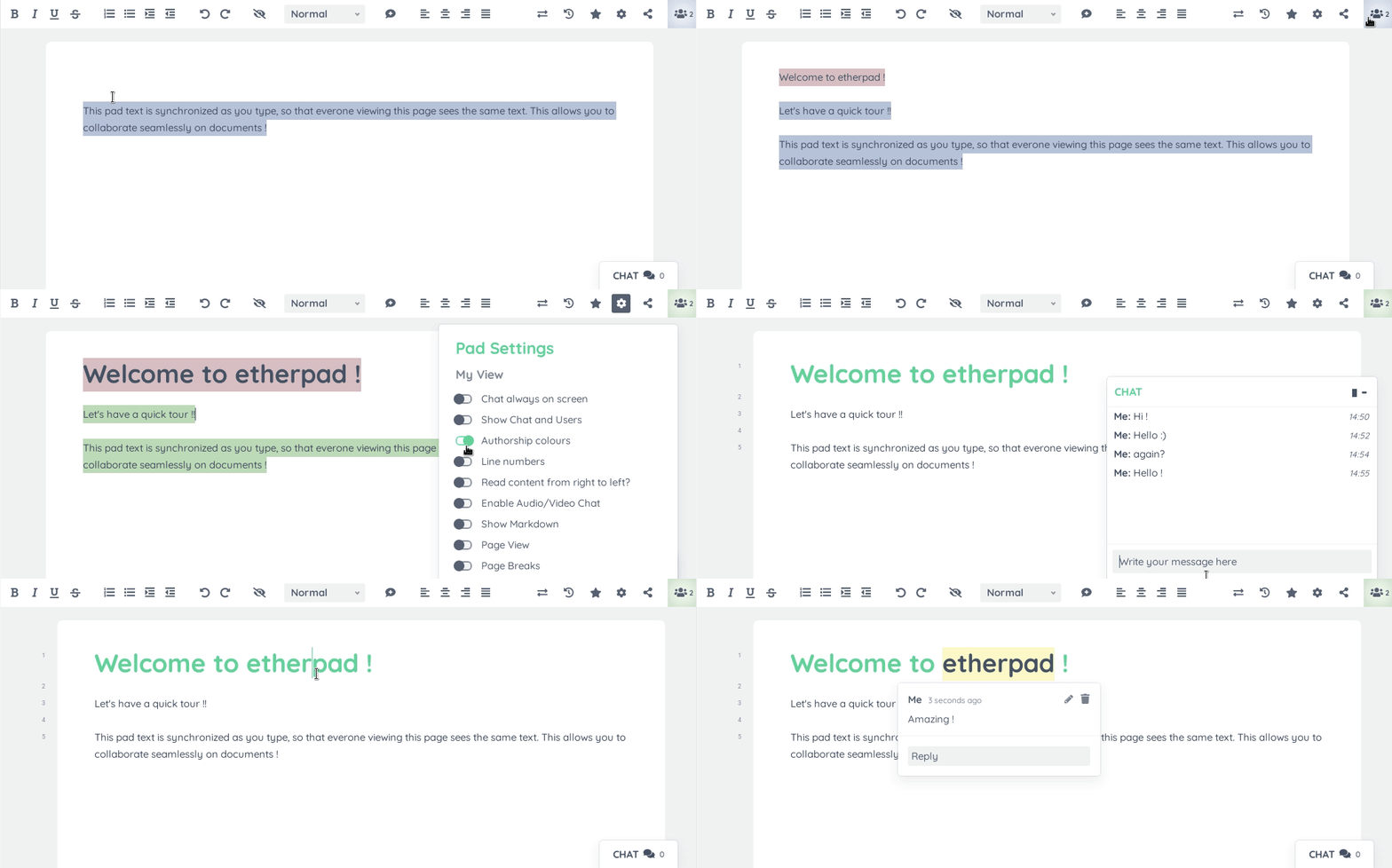
Every keystroke is attributed to its author. Every revision is preserved. The timeslider lets you scrub through a document's entire history, character by character. Author colours make collaboration visible at a glance — not buried in a menu.
Etherpad runs on your server, under your governance. No telemetry. No upsells. AI is a plugin you install, pointed at the model you choose, running on infrastructure you control — not a feature decided for you in a boardroom you weren't in. See PRIVACY.md for the two opt-out network calls Etherpad's own code makes and how to disable each.
The code is Apache 2.0. The data format is open. It scales to thousands of simultaneous editors per pad. Translated into 105 languages. Extended through hundreds of plugins. Used by Wikimedia, governments, public-sector institutions, and self-hosters worldwide since 2009.
Full data export is built in. The history is yours.
Try it out
Try out a public Etherpad instance
Project Status
Etherpad has been doing the same thing — well — since 2009. No pivots, no acquisitions, no enshittification. Maintained by a small volunteer team.
We are actively looking for maintainers. If you have experience with Node.js, real-time systems, or institutional collaboration tooling and you want to work on infrastructure that thousands of organisations quietly depend on, please open an issue or contact John McLear.
Code Quality

Testing


Engagement





Who uses Etherpad
For more than a decade, Etherpad has quietly underpinned the documents that matter to:
- Wikimedia Foundation — collaborative drafting across editor communities.
- Public-sector institutions across the EU — including organisations that legally cannot use US-cloud SaaS for sovereignty and GDPR reasons.
- Universities and schools worldwide — including jurisdictions where Google Workspace is no longer permitted in education.
- Civic-tech and democratic-deliberation projects — citizen assemblies, participatory budgeting, public consultations.
- Newsrooms and investigative journalism teams — where authorship and editing history matter for legal and editorial integrity.
- Tens of thousands of self-hosted instances worldwide, run by IT teams who chose Etherpad because it is theirs.
Installation
Quick install (one-liner)
The fastest way to get Etherpad running. Requires git and Node.js >= 24.
macOS / Linux / WSL:
curl -fsSL https://raw.githubusercontent.com/ether/etherpad/master/bin/installer.sh | sh
Windows (PowerShell):
irm https://raw.githubusercontent.com/ether/etherpad/master/bin/installer.ps1 | iex
Both installers clone Etherpad into ./etherpad-lite, install dependencies, and
build the frontend. When the installer finishes, run:
cd etherpad-lite && pnpm run prod
Then open .
To install and start in one go:
# macOS / Linux / WSL
ETHERPAD_RUN=1 sh -c "$(curl -fsSL https://raw.githubusercontent.com/ether/etherpad/master/bin/installer.sh)"
# Windows
$env:ETHERPAD_RUN=1; irm https://raw.githubusercontent.com/ether/etherpad/master/bin/installer.ps1 | iex
Docker-Compose
The official image is published to both Docker Hub (etherpad/etherpad) and GitHub Container Registry (ghcr.io/ether/etherpad) with identical tags. Use whichever suits your environment; GHCR avoids Docker Hub's anonymous pull rate limits.
services:
  app:
    user: "0:0"
    image: etherpad/etherpad:latest  # or: ghcr.io/ether/etherpad:latest
    tty: true
    stdin_open: true
    volumes:
      - plugins:/opt/etherpad-lite/src/plugin_packages
      - etherpad-var:/opt/etherpad-lite/var
    depends_on:
      - postgres
    environment:
      NODE_ENV: production
      ADMIN_PASSWORD: "${DOCKER_COMPOSE_APP_ADMIN_PASSWORD:?Set DOCKER_COMPOSE_APP_ADMIN_PASSWORD to a strong value}"
      DB_CHARSET: ${DOCKER_COMPOSE_APP_DB_CHARSET:-utf8mb4}
      DB_HOST: postgres
      DB_NAME: ${DOCKER_COMPOSE_POSTGRES_DATABASE:-etherpad}
      DB_PASS: "${DOCKER_COMPOSE_POSTGRES_PASSWORD:?Set DOCKER_COMPOSE_POSTGRES_PASSWORD to a strong value}"
      DB_PORT: ${DOCKER_COMPOSE_POSTGRES_PORT:-5432}
      DB_TYPE: "postgres"
      DB_USER: ${DOCKER_COMPOSE_POSTGRES_USER:-admin}
      # For now, the env var DEFAULT_PAD_TEXT cannot be unset or empty; it seems to be mandatory in the latest version of etherpad
      DEFAULT_PAD_TEXT: ${DOCKER_COMPOSE_APP_DEFAULT_PAD_TEXT:- }
      DISABLE_IP_LOGGING: ${DOCKER_COMPOSE_APP_DISABLE_IP_LOGGING:-false}
      SOFFICE: ${DOCKER_COMPOSE_APP_SOFFICE:-null}
      TRUST_PROXY: ${DOCKER_COMPOSE_APP_TRUST_PROXY:-false}
    restart: always
    ports:
      - "${DOCKER_COMPOSE_APP_PORT_PUBLISHED:-9001}:${DOCKER_COMPOSE_APP_PORT_TARGET:-9001}"

  postgres:
    image: postgres:15-alpine
    environment:
      POSTGRES_DB: ${DOCKER_COMPOSE_POSTGRES_DATABASE:-etherpad}
      POSTGRES_PASSWORD: "${DOCKER_COMPOSE_POSTGRES_PASSWORD:?Set DOCKER_COMPOSE_POSTGRES_PASSWORD to a strong value}"
      POSTGRES_PORT: ${DOCKER_COMPOSE_POSTGRES_PORT:-5432}
      POSTGRES_USER: ${DOCKER_COMPOSE_POSTGRES_USER:-admin}
      PGDATA: /var/lib/postgresql/data/pgdata
    restart: always
    # Exposing the port is not needed unless you want to access this database instance from the host.
    # Be careful when other postgres docker container are running on the same port
    # ports:
    #   - "5432:5432"
    volumes:
      - postgres_data:/var/lib/postgresql/data

volumes:
  postgres_data:
  plugins:
  etherpad-var:
Requirements
Node.js >= 24.
Windows, macOS, Linux
- Download the latest Node.js runtime from nodejs.org.
- Install pnpm:
npm install -g pnpm(Administrator privileges may be required). - Clone the repository:
git clone -b master - Run
pnpm i - Run
pnpm run build:etherpad - Run
pnpm run prod - Visit
http://localhost:9001in your browser.
Docker container
Find here information on running Etherpad in a container.
Plugins
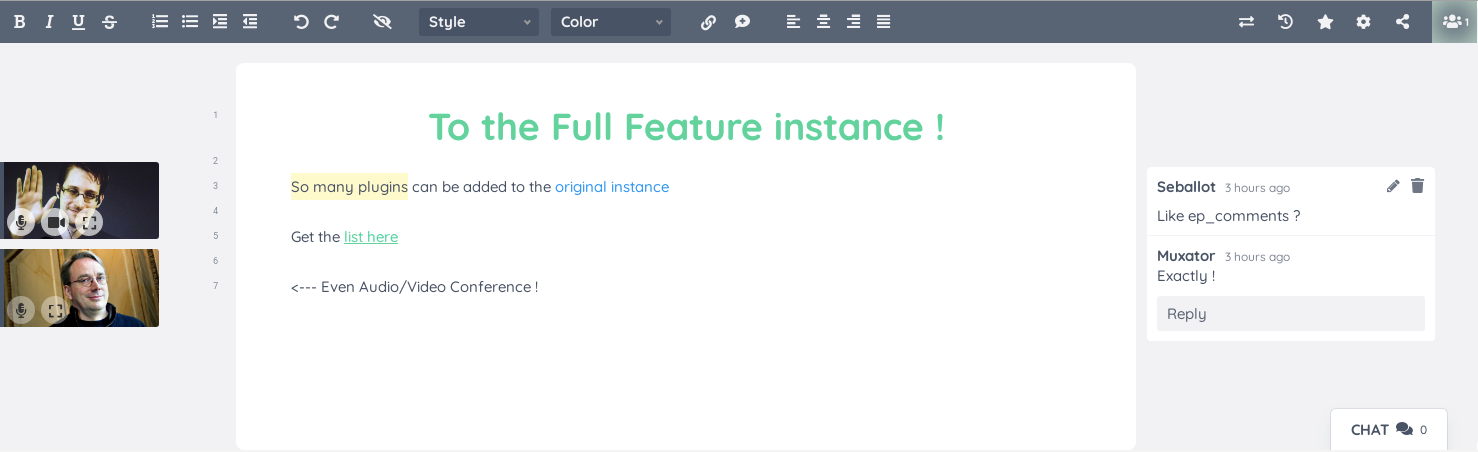
Etherpad is very customizable through plugins.