Epiq
Issue tracking as code. Open source, distributed, local-first, and code-native.
Epiq provides issue tracking as a portable, integrated part of the development environment, with access to all the powerful tooling developers are used to.
Kanban to review workflows in your terminal or in your browser - while keeping all state local, Git-backed, and versioned.
With great attention to user ergonomics and developer experience, epiq strives to make project management painless and friction free.
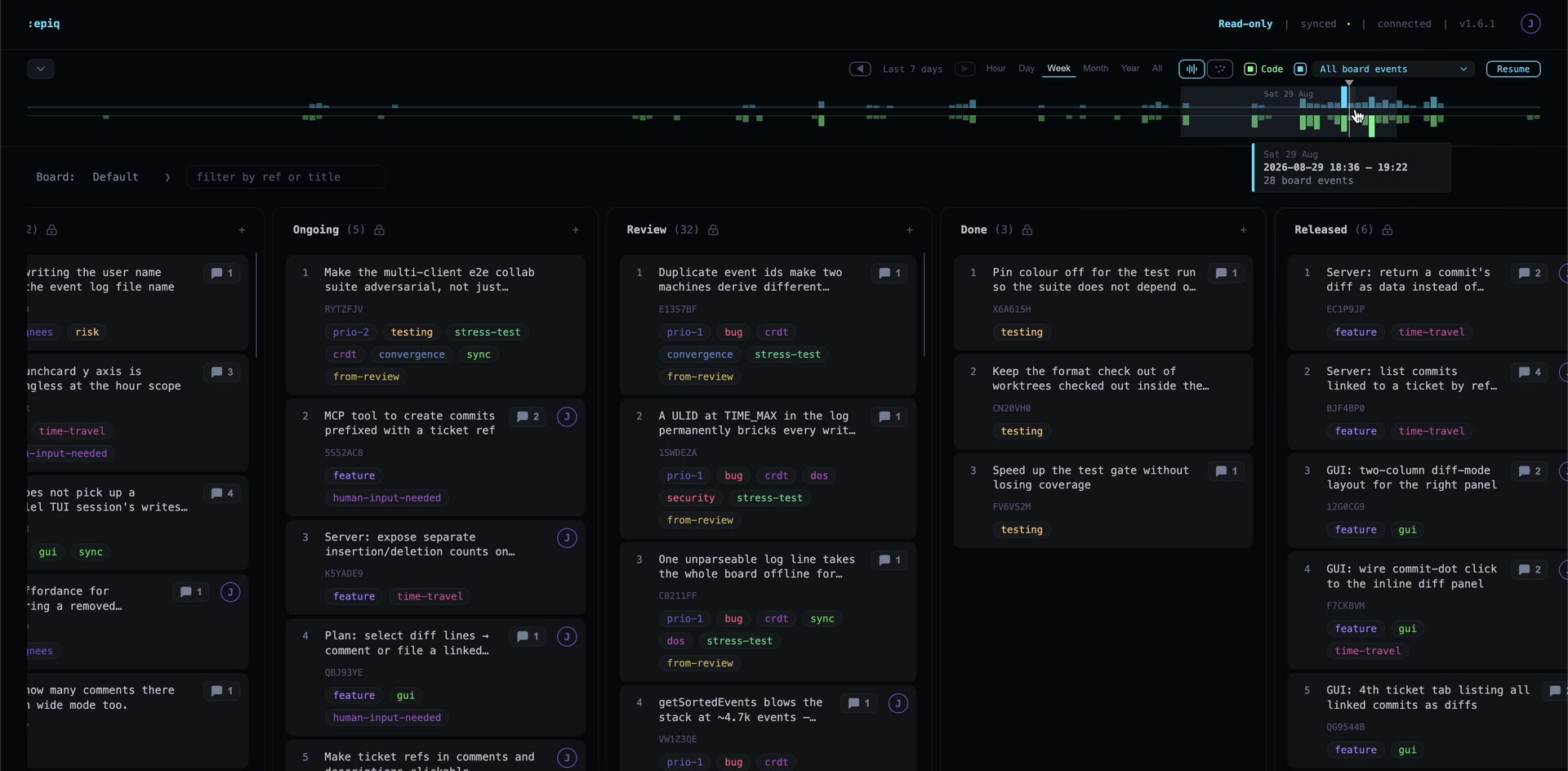
Audit the workflow
Agents now run whole sprints unattended. Because state is a full event log, you can replay the board to find out what moved when, who moved it, and what changed along the way.
Code, linked to tickets
Prefix a commit's subject with the ticket's ref to link the two:
git commit -m "1YRTG8T ...<some message>"
Linking makes a commit show up in the ticket code-diff tab. You can comment on selected lines, and also file a new ticket straight from the selection. The MCP exploses this reference as a ref property agents can refer to.
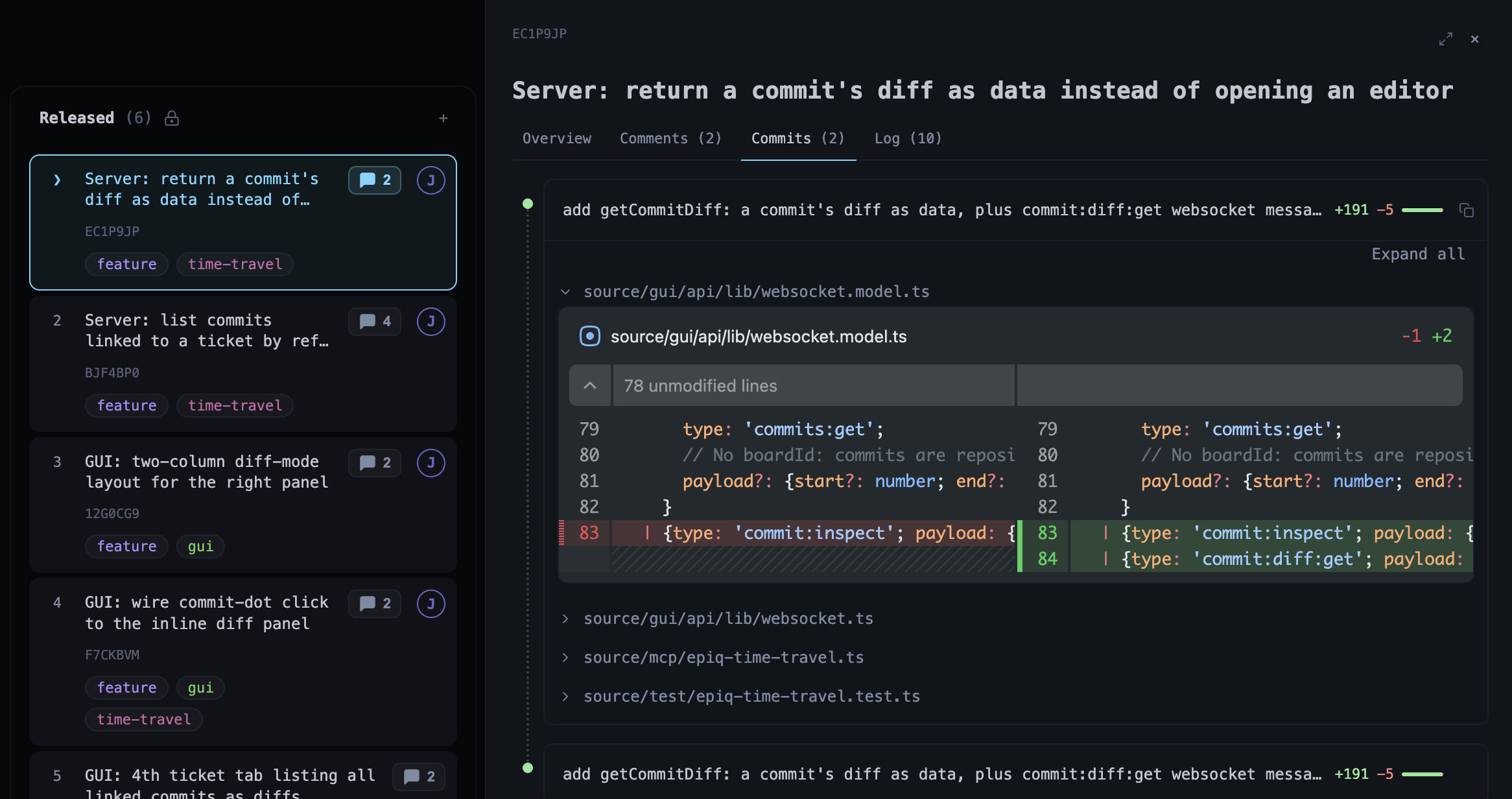
Preserve the linking post-merge via conventions:
- Rebase-merge It is advised to rebase-merge so the ref-prefixed commits land on
mainas they are, preserving linking post-merge. - Squashing within one ticket's commits is fine as long as the result keeps the prefix. Do not squash commits carrying different refs into one.
Terminal + Browser
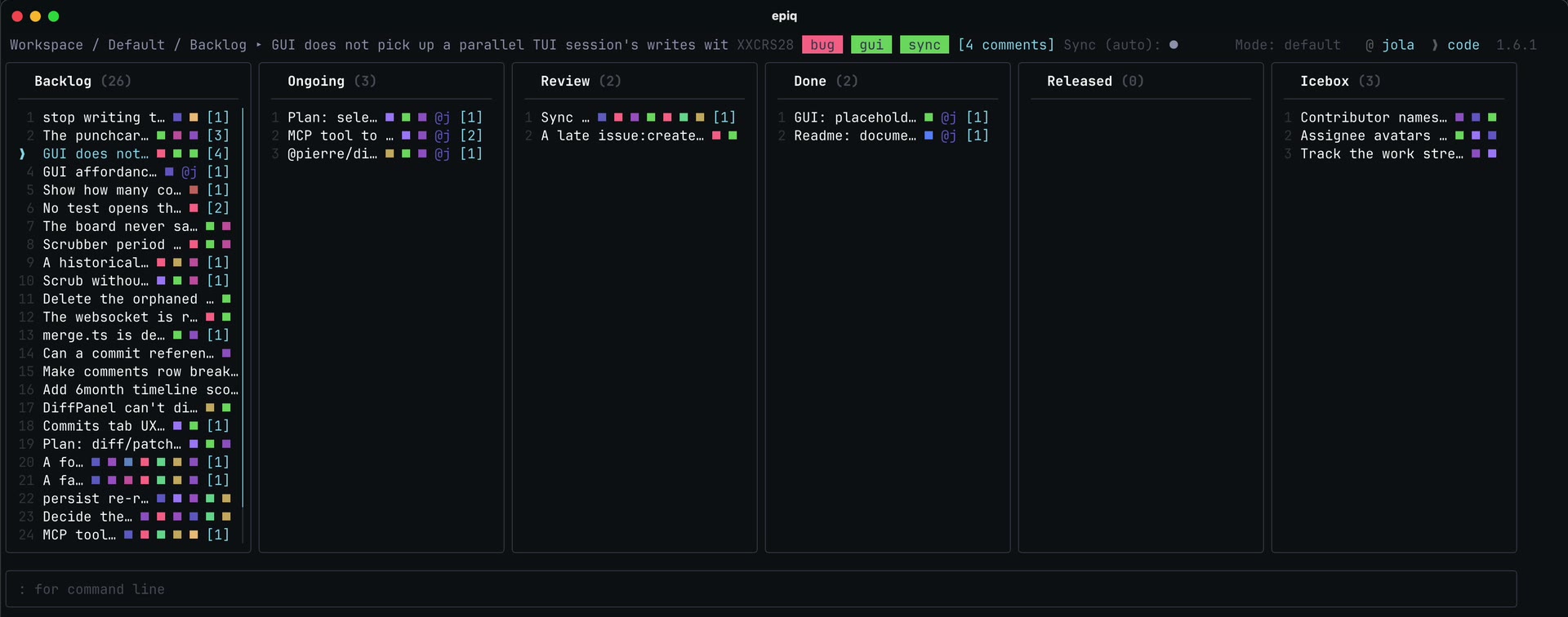
Epiq originated from the command line and offers a first-class terminal experience, but also features a browser interface powered by the same Git-backed event engine.
What is epiq?
Epiq is a self hosted issue tracker that allows you to review workflows in real time or after the fact via replay. It persists state as an immutable event log, versioned and synchronized via Git.
Most issue trackers live outside your workflow. Instead of a centralized, managed service, Epiq keeps project state alongside your repository, where it travels with your code.
These design choices result in a system that offers:
- Workflow replay, - inspect what happened while you were away, as if it happens now
- Simple setup — no accounts, SaaS, or external services required
- Repo-native — your issues can live where your code lives
- Offline-friendly — works anywhere, with eventual consistency
- Fast — local first, and eventual consistency makes Epiq edits instant
- Portable — runs on your local machine, on a remote Linux server or your grandma’s connected toaster
- Command driven — scriptable and automation-friendly, ready for the agentic era
Installation
Quick install
Binary:
curl -fsSL https://raw.githubusercontent.com/ljtn/epiq/main/install.sh | sh
Installs to ~/.local/bin by default. Override with EPIQ_INSTALL_DIR (or XDG_BIN_HOME); pin a version with EPIQ_VERSION=v1.0.0.
Via npm
npm install --global epiq
Verify
epiq --version
Getting Started in 2 steps
- Make sure you're inside a Git repository
# If needed:
git init
# For collaboration, use a repo with a remote (e.g. clone from GitHub)
- Run:
epiq
If it is your first run, this opens the interactive setup wizard that sets you up in about 30 seconds.
That’s it!
Once your project is set up, you can also launch the browser user interface with:
epiq gui
Setup wizard creates: User config persisted in
~/.epiq-global/config.json.
Initialization creates:
- Project definition in
./.epiq/project.json- Authoritative Git state at
~/.epiq-global/worktrees/- Updates your
.gitignoreto ignore local-only.epiq/log/Epiq manages a dedicated Git state branch and worktree automatically as the source of truth for synchronization.- A local debug log at
.epiq/log/epiq.log— check it first if sync, boot, or a Git operation is misbehaving.
MCP & Agent Compatibility
Epiq provides a MCP (Model Context Protocol) server for agents to interact with, making it easy to plug into modern agent frameworks. The server is exposed by the epiq-mcp binary that ships with the package.
Claude Code
The reliable way to register the server is with the claude mcp add command — it writes to the correct config file for you, so you don't have to hand-edit JSON:
# Available everywhere (recommended)
claude mcp add --scope user epiq -- npx -y --package=epiq epiq-mcp

# Or only in the current project
claude mcp add epiq -- npx -y --package=epiq epiq-mcp
Verify the connection with claude mcp list (it should report epiq … ✔ Connected). MCP servers are loaded at startup, so restart Claude Code after adding the server before its tools become available.
Skills
Find skill at .claude/skills/epiq/SKILL.md that documents a recommended workflow for working the Epiq board. epiq_skill_install writes the same file into any repository that lacks it, so a project set up from an agent gets the rules too — after epiq_project_init, since init refuses a repository with uncommitted files; it leaves an identical copy alone and refuses to overwrite a differing one unless told to with force.
Agent identity
Every process — your TUI, your GUI, each agent's MCP server - writes as your user, so by default the board cannot tell one agent from another. The MCP allows agents to assume an identity, so at the start of a session, tell your agent which name it should assume.
That agent then shows up in the contributor list, assigns itself rather than you, and authors its own events. This can be useful when tracing many agents at the same time. Consider reusing names instead of inventing one per session, or the registry fills with single-run identities.
Other MCP clients
For clients that are configured by hand, add the following to the client's MCP config file — note this is not the same as Claude Code's ~/.claude.json; Claude Desktop uses claude_desktop_config.json:
{
	"mcpServers": {
		"epiq": {
			"command": "npx",
			"args": ["-y", "-p", "epiq", "epiq-mcp"]
		}
	}
}
Once registered, agents can interact with your local Epiq instance through the MCP.
Sandboxed or network-restricted environments
npx -y -p epiq epiq-mcp resolves the package against the npm registry every time it starts, even if it's already cached locally. In agent sandboxes with restricted network access, this can make the MCP server appear to hang. If you're running Epiq's MCP server in such an environment, install it globally once and point your MCP config at the resolved executable directly, bypassing npx (and the registry lookup) entirely on every subsequent start:
npm install --global epiq
which epiq-mcp   # use this absolute path in your MCP config
{
	"mcpServers": {
		"epiq": {
			"command": "/absolute/path/to/epiq-mcp"
		}
	}
}
npx remains the simpler option for normal, network-connected setups.
How Epiq is synchronized
Epiq uses Git in the background - no manual Git commands are required. Running :sync synchronizes changes between your local state (persisted at ~/.epiq-global/worktrees//) and the remote state. By utilizing Git worktrees, synchronization stays isolated from your regular development workflow. Project tracking metadata is stored in .epiq/project.json.
Conflict Avoidance & Data Integrity
Epiq is designed to provide robustness in a distributed, Git-backed environment where multiple users may update state concurrently. Instead of mutating shared files, Epiq uses an event-sourced model to prevent merge conflicts and make concurrent changes predictable.
Event-sourced state
All changes are stored as append-only events in user-scoped files, rather than modifying a shared state file. This avoids in-place edits to the same lines and significantly reduces the likelihood of Git conflicts.
State is reconstructed in-memory by replaying a merge of all user logs.
Deterministic materialization
The current state is derived by replaying events in a deterministic order.
Events use a composite of time-sortable IDs (ULIDs) and a reference to the last known event ("edge"). On creation, events are appended relative to the last known event. If multiple events share the same reference point, their relative order is resolved using their time-based IDs.
This approach:
- Provides stable and reproducible ordering across machines
- Limits the impact of potential clock drift to small local ordering differences
- Ensures that concurrent updates converge to the same state
Conflict handling model
Epiq resolves concurrent changes at the event level:
- Events are designed to be idempotent where possible
- Later events take precedence when conflicts occur
- Each user writes to their own event log file
- Git merges become trivial combinations of changes in independent files
Local-first with eventual consistency
Epiq follows a local-first model:
- All operations apply instantly on the local machine
- Synchronization happens explicitly (
:sync) or automatically - When histories diverge, merging event logs and replaying them leads to a consistent state
Frequent synchronization reduces divergence and keeps the system predictable

🫡 Never leave your editor!