Easegress








- What is Easegress
- Features
- Getting Started
- Use Cases
- Documentation
- Easegress Portal
- Community
- Contributing
- License
What is Easegress
Easegress is a Cloud Native traffic orchestration system designed for:
- High Availability: Built-in Raft consensus & leader election provides 99.99% availability.
- Traffic Orchestration: Simple orchestration of various filters for each traffic pipeline.
- High Performance: Lightweight and essential features speed up the performance.
- Observability: There are many meaningful statistics periodically in a readable way.
- Extensibility: It's easy to develop your own filter or controller with high-level programming language.
- Integration: The simple interfaces make it easy to integrate with other systems, such as Kubernetes Ingress, EaseMesh sidecar, Workflow, etc.
The architecture of Easegress:
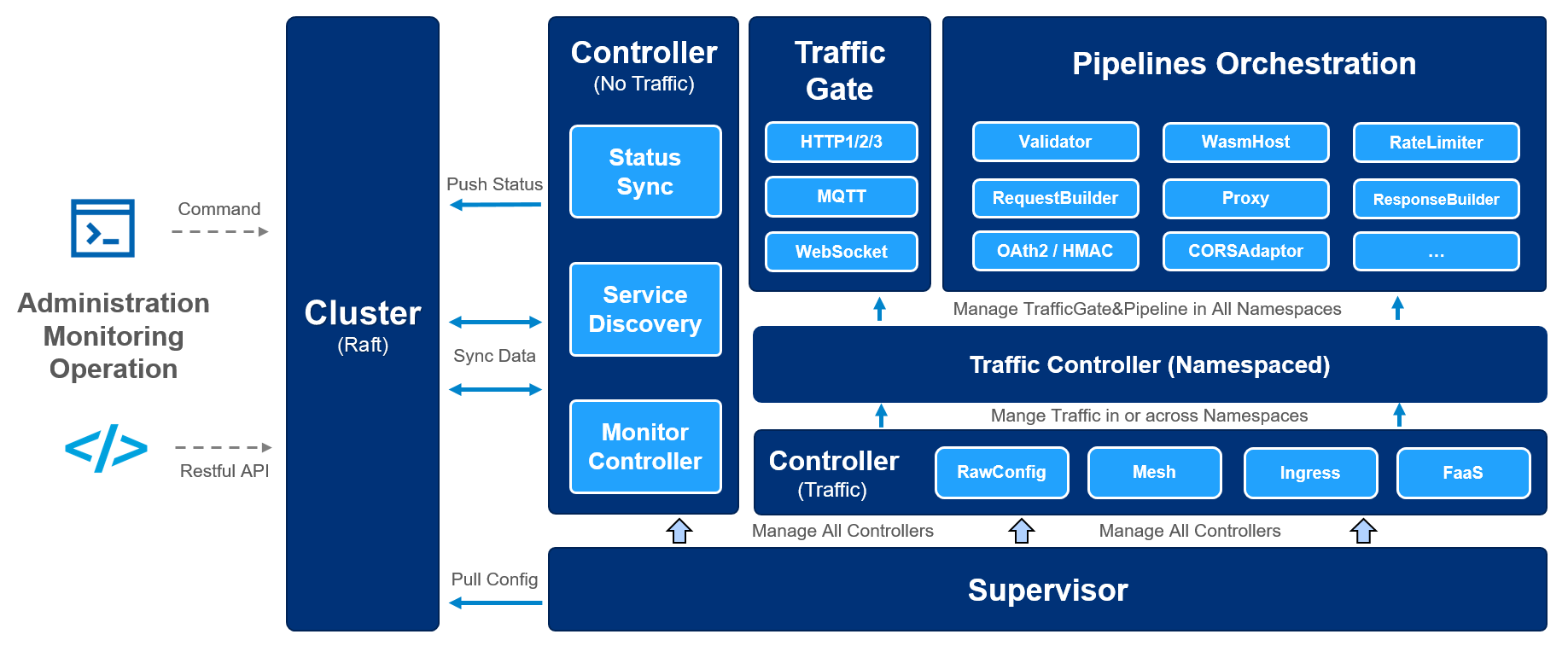
And you can check Easegress DeepWiki Page to dive into more details.
Features
- Service Management
- Multiple protocols:
- HTTP/1.1
- HTTP/2
- HTTP/3(QUIC)
- MQTT
- Rich Routing Rules: exact path, path prefix, regular expression of the path, method, headers, clientIPs.
- Resilience&Fault Tolerance
- CircuitBreaker: temporarily blocks possible failures.
- RateLimiter: limits the rate of incoming requests.
- Retry: repeats failed executions.
- TimeLimiter: limits the duration of execution.
- Deployment Management
- Blue-green Strategy: switches traffic at one time.
- Canary Strategy: schedules traffic slightly.
- API Management
- API Aggregation: aggregates results of multiple APIs.
- API Orchestration: orchestrates the flow of APIs.
- Security
- Pipeline-Filter Mechanism
- Filter Management: makes it easy to develop new filters.
- Service Mesh
- Mesh Master: is the control plane to manage the lifecycle of mesh services.
- Mesh Sidecar: is the data plane as the endpoint to do traffic interception and routing.
- Mesh Ingress Controller: is the mesh-specific ingress controller to route external traffic to mesh services.
Notes: This feature is leveraged by EaseMesh
- Third-Part Integration
- FaaS integrates with the serverless platform Knative.
- Service Discovery integrates with Eureka, Consul, Etcd, and Zookeeper.
- Ingress Controller integrates with Kubernetes as an ingress controller.
- Multiple protocols:
- Extensibility
- WebAssembly executes user developed WebAssembly code.
- High Performance and Availability
- Adaption: adapts request, response in the handling chain.
- Validation: headers validation, OAuth2, JWT, and HMAC verification.
- Load Balance: round-robin, random, weighted random, IP hash, header hash and support sticky sessions.
- Cache: for the backend servers.
- Compression: compresses body for the response.
- Hot-Update: updates both config and binary of Easegress in place without losing connections.
- Operation
- Easy to Integrate: command line(egctl), Easegress Portal, HTTP clients such as curl, postman, etc.
- Distributed Tracing
- Built-in OpenTelemetry, which provides a vendor-neutral API.
- Observability
- Node: role(primary, secondary), raft leader status, healthy or not, last heartbeat time, and so on
- Traffic: in multi-dimension: server and backend.
- Throughput: total and error statistics of request count, TPS/m1, m5, m15, and error percent, etc.
- Latency: p25, p50, p75, p95, p98, p99, p999.
- Data Size: request and response size.
- Status Codes: HTTP status codes.
- TopN: sorted by aggregated APIs(only in server dimension).
- AI Integration
- Proxy: proxy requests to LLM providers like OpenAI, DeepSeek, Anthropic, etc.
- Anthropic API Adaption: adapts requests and responses in Anthropic API to OpenAI format.
- Vector Database: integrates with vector databases for caching.
- Monitoring: provides insights into the performance and usage of AI models.
Getting Started
The basic usage of Easegress is to quickly set up a proxy for the backend servers.
Launch Easegress
Easegress can be installed from pre-built binaries or from source. For details, see Install.
Then we can execute the server:
$ easegress-server
2023-09-06T15:12:49.256+08:00   INFO    cluster/config.go:110   config: advertise-client-urls: ...
...
By default, Easegress opens ports 2379, 2380, and 2381; however, you can modify these settings along with other arguments either in the configuration file or via command-line arguments. For a complete list of arguments, please refer to the easegress-server --help command.
After launching successfully, we could check the status of the one-node cluster.
$ egctl get member
...

$ egctl describe member
...
Reverse Proxy
Assuming you have two backend HTTP services running at 127.0.0.1:9095 and 127.0.0.1:9096, you can initiate an HTTP proxy from port 10080 to these backends using the following command:
$ egctl create httpproxy demo --port 10080 \
  --rule="/pipeline=http://127.0.0.1:9095,http://127.0.0.1:9096"
Then try it:
curl -v 127.0.0.1:10080/pipeline
The request will be forwarded to either 127.0.0.1:9095/pipeline or 127.0.0.1:9096/pipeline, utilizing a round-robin load-balancing policy.
More about getting started with Easegress:
Use Cases
The following examples show how to use Easegress for different scenarios.
- API Aggregation - Aggregating many APIs into a single API.
- Cluster Deployment - How to deploy multiple Easegress cluster nodes.
- Canary Release - How to do canary release with Easegress.
- Distributed Tracing - How to do APM tracing - Zipkin.
- FaaS - Supporting Knative Fa