
dyrector.io is a self-hosted continuous delivery & deployment platform with version management.

)





dyrector.io helps engineers & DevOps teams and individual developers to shift their focus from maintaining and setting up their containerized applications to developing their software. The platform achieves this by offering continuous delivery and version management capabilities to your OCI containers.
Join our Discord and connect with other members to share and learn together. If you like the project, give us a Star.
dyrector.io is also available as a fully managed SaaS dyrector.io Platform ⛅ including a free tier.
Getting Started • Docs • Use Cases • Community • Contributing • Feedback
Getting Started
For detailed setup instructions, please refer to the Getting Started documentation.
Use Cases
🚢 Manage environments without SSH or kubectl
Replace multiple tools with a single platform that allows you to manage your entire infrastructure and the containerized applications that run on it. You're also able to initiate deployments to multiple environments simultaneously instead of repeated, manual processes.
⛴️ Instant test environments for QA
QA no longer needs help to test your services. Enable them to autonomously configure and deploy various versions of microservices to test environments. They have the flexibility to run arbitrary workloads on any accessible nodes, potentially transforming their local machines or any remote infrastructures into testing platforms.
⛵️ Container management across environments
Whether you're a developer or an indie hacker, bring your own infrastructure and manage all your containers and applications from one place while our software is running either as a SaaS or on your infrastructure.
🛳️ CD & Version Management
Bring transparency to your SDLC by configuring versions and deployments of your containerized stack from any registry using our platform. Automate your deployments by generating a CD token you can use with GitHub Actions and turn deployments painless and effortless while you can focus more on the development of your software.
🛠️ Manage container settings without access
Editing container settings no longer requires direct access or expertise in JSON formatting. Our platform provides a user-friendly JSON editor, enabling you to modify settings without accessing the containers. In case of deployment issues, you can easily make necessary adjustments using the platform's config editor screen. Additionally, you can create bundle configurations to avoid manual configuration for each container.
Intro video
https://user-images.githubusercontent.com/9247788/219671903-41da385e-4f8f-4fba-a7e4-c6ec4f727b7f.mp4
Key Features
- Kubernetes, Docker, and Podman support
- Multi-instance deployment
- Instant test environments from any branches
- Environment management
- Secret and configuration management
- Auto-generated changelogs and release notes
- Workflow support
- Scheduled releases
- Audit log
- Container Registry integrations
- Fine-grained RBAC
- ChatOps & notification solutions
Deployment Options
Besides the self-hosted instance, you can check out the platform's alpha at app.dyrectorio.com. The platform is still in the works, we might reset the database, so it's not recommended for production yet.
How it Works
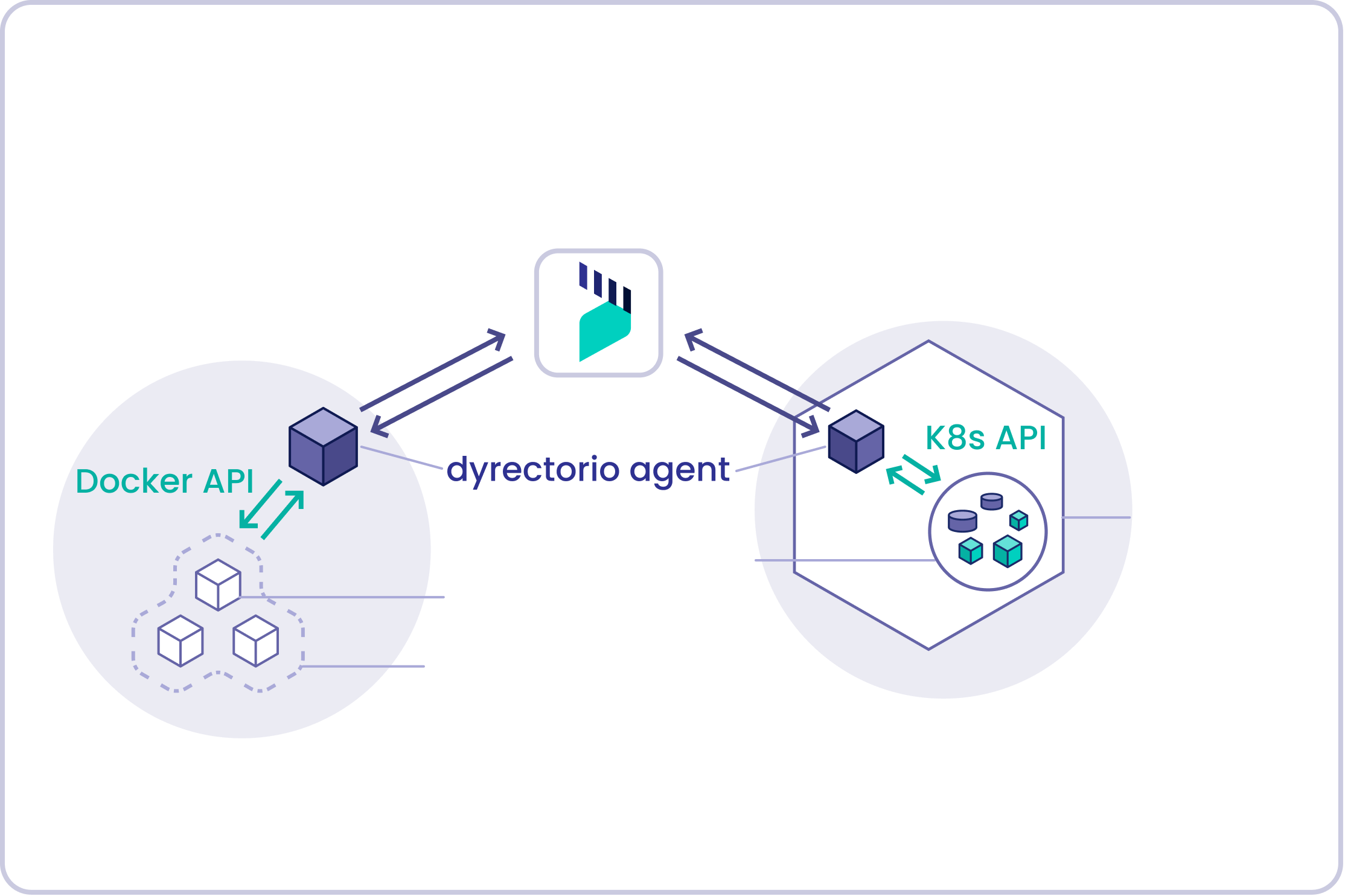
dyrector.io consists of an agent (GoLang) and a platform (UI developed in React.js, Next.js. Backend developed in Node.js, Nest.js). There are two types of agents communicating with the platform: one for Docker and another for Kubernetes. Communication takes place in gRPC with TLS encryption. The data is managed in a PostgreSQL database which we use with Prisma ORM.
FAQ
If you have any questions, check out FAQ or reach out to us on Discord.
Community
Also, follow us on GitHub Discussions, our Blog, and on Twitter. You can chat with the team and other members on Discord.
dyrector.io is Open Source - This repository, and most of our other open-source projects, are licensed under Apache 2.0.
Join our Discord and connect with other members to share and learn together. Send a pull request to any of our open-source repositories on Github. Check our contribution guide and our developer's guide for more details about how to contribute. We're looking forward to your contribution!

Contributing
The project can only accept contributions that are licensed under the Apache License 2.0. For further information please see our Contribution Guidelines.
Releases
We use semantic versioning, but shifted to the right, we don't bump major versions until we reach the beta phase.
The minor version is raised if:
- introduction of a breaking API change (proto or HTTP)
- new feature set is completed
- milestone is reached
- agent configuration changes
Patch version is raised if:
- important fixes in develop
- any other reason
Feedback
We’d love to hear your thoughts on this project. Feel free to drop us a note!
License
dyrector.io is open source software under the Apache License 2.0. Complete license and copyright information can be found in the source code.
Licensed under the Apache License, Version 2.0 (the "License"); you may not use this file except in compliance with the License. You may obtain a copy of the License at http://www.apache.org/licenses/LICENSE-2.0 Unless required by applicable law or agreed to in writing, software distributed under the License is distributed on an "AS IS" BASIS, WITHOUT WARRANTIES OR CONDITIONS OF ANY KIND, either express or implied. See the License for the specific language governing permissions and limitations under the License.