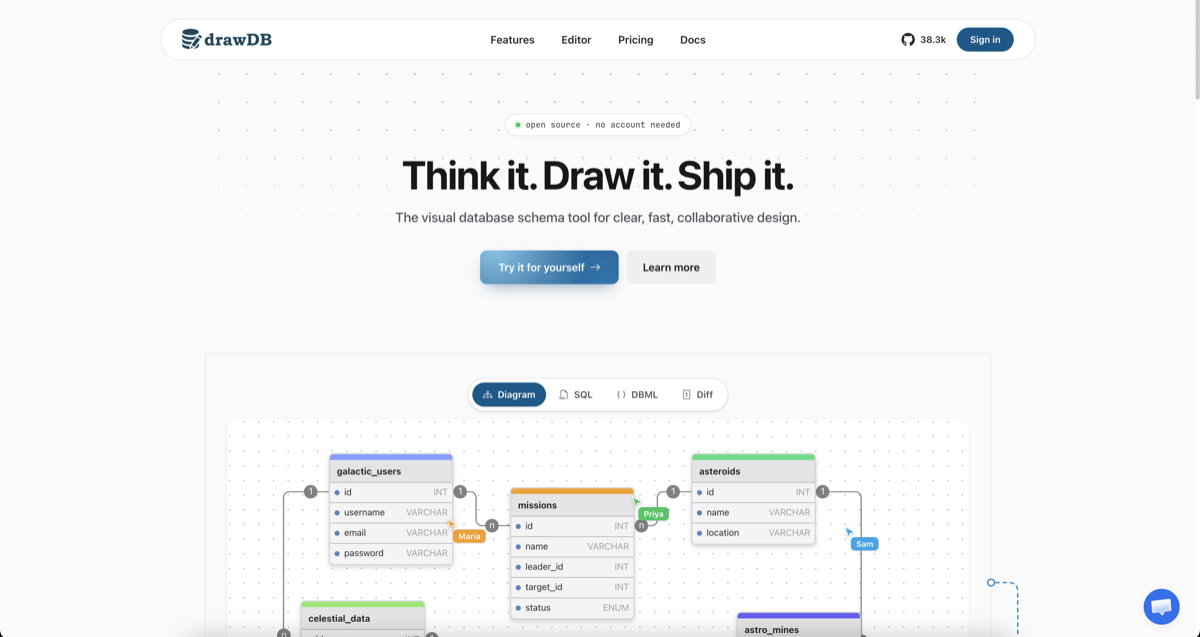
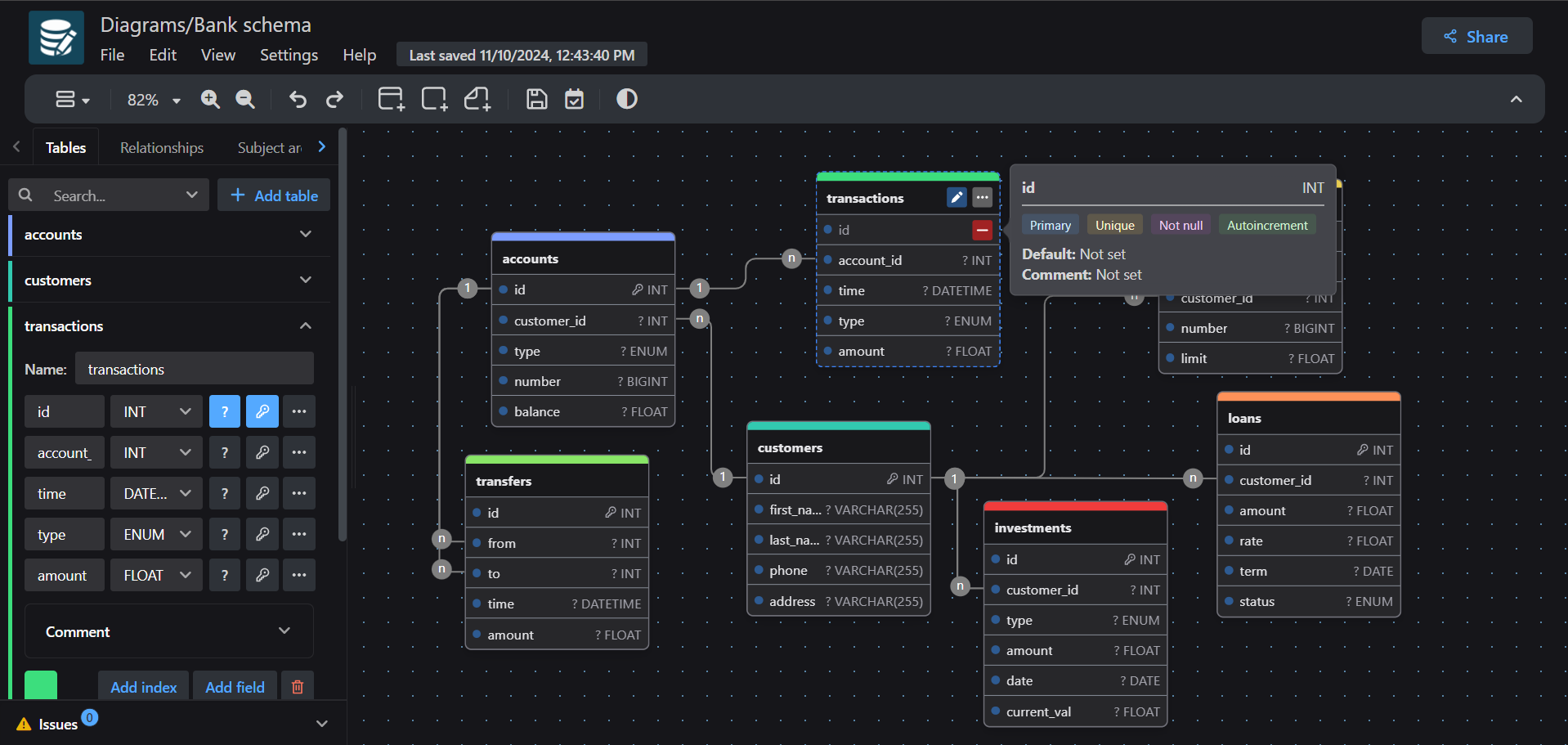
drawDB is a free, open-source, browser-based database entity relationship diagram (ERD) editor and SQL generator for developers, data modellers, and teams who need to design database schemas and turn them into SQL scripts without creating an account.
What it is
drawDB is a JavaScript application distributed under the AGPL-3.0 licence from the repository drawdb-io/drawdb, with the hosted editor at https://drawdb.app. It runs an entity relationship diagram editor directly in the browser: schemas are drawn as diagrams with a few clicks, and the tool exports and imports SQL scripts, generates migrations, and allows the editor itself to be customised. The GitHub description states the project plainly as a "Free, simple, and intuitive online database diagram editor and SQL generator." The topic list it carries — database-design, database-schema, er-diagram, erd, diagram-editor, dbml, indexeddb, mariadb — describes the space it occupies.
The concrete problem it solves is the gap between a database design and the SQL that realises it. Writing schema DDL and migration scripts by hand is repetitive and drifts from the diagram that motivated the design; drawDB keeps the diagram and the generated SQL in one loop, so a schema change is made visually and exported as a script rather than transcribed manually. It also removes the account requirement and the desktop install that usually come with schema design tooling: the editor opens in a browser, and the project can be self-hosted entirely, with the optional sharing server being the only piece that requires any backend.
Key capabilities
- Entity relationship diagram (ERD) editing in the browser, building schemas with a few clicks.
- Export and import of SQL scripts, so diagrams round-trip against existing schemas.
- Migration generation from the current diagram.
- Customisable editor interface.
- No account required to design schemas or export scripts.
- DBML appears among the project topics, indicating support for the DBML schema definition format.
- Browser-local persistence is reflected by the indexeddb topic, and MariaDB appears among the target databases.
Who uses it and how
- Individual developers sketch a schema in the browser and export the SQL script immediately, without signup or installation.
- Teams deploy the Docker image internally for a shared schema editor, running
docker build -t drawdb . and docker run -p 3000:80 drawdb.
- Groups that need document sharing set up the separate drawdb-io/drawdb-server and its environment variables per
.env.sample; the README marks this as optional unless file sharing is needed.
- Contributors work against the source with
npm run dev and follow CONTRIBUTING.md.
- Designers working in DBML or against MariaDB schemas use the diagram as the interchange point.
Getting started
Clone https://github.com/drawdb-io/drawdb, then run npm install and npm run dev for local development, or npm run build for a production build. A Docker route is documented as docker build -t drawdb . followed by docker run -p 3000:80 drawdb, and a hosted editor is available at https://drawdb.app.
How it compares
The provided facts name no competing or paid products, so drawDB stands alone in this registry. The nearest items in its topic list — dbml, mariadb, indexeddb — are a schema format, a database engine, and a browser storage API rather than alternatives to the editor itself, so no direct comparison can be drawn from the material available.
When to use it — and when not to
A self-hoster operates Node.js and npm for the source build, or a container runtime for the Docker image on port 3000, and must additionally run the separate drawdb-server with configured environment variables if file sharing is required. The AGPL-3.0 licence is copyleft, which matters to anyone intending to embed the editor in a proprietary product without releasing source. The repository also carries 241 open issues and a short README that points feature detail to drawdb.app rather than documenting it in-tree, so users who need exhaustive local documentation should look at the hosted site first; the last push is dated 2026-09-13.