DocETL: Declarative & Agentic Map-Reduce




What is DocETL · Install · Python API · YAML · DocWrangler UI · Docs
What is DocETL
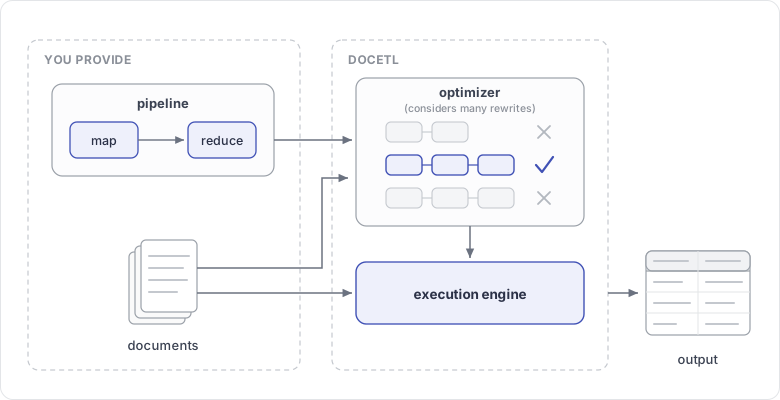
DocETL helps you process large collections of data (structured and unstructured) with LLMs. You write each operation in natural language, e.g., "pull out every complaint in this ticket," and DocETL
- provides the operators you need (map, reduce, filter, and more) and orchestrates them, parallelizing work across your data,
- optimizes your pipeline automatically, swapping models, rewriting prompts, decomposing operations, and replacing subtasks with code wherever possible, to raise accuracy and cut cost, and
- returns tables, easy to query in your favorite database.
Without DocETL, you write each LLM call yourself, wire them together, and tune the result for accuracy, cost, and latency by hand.
CLI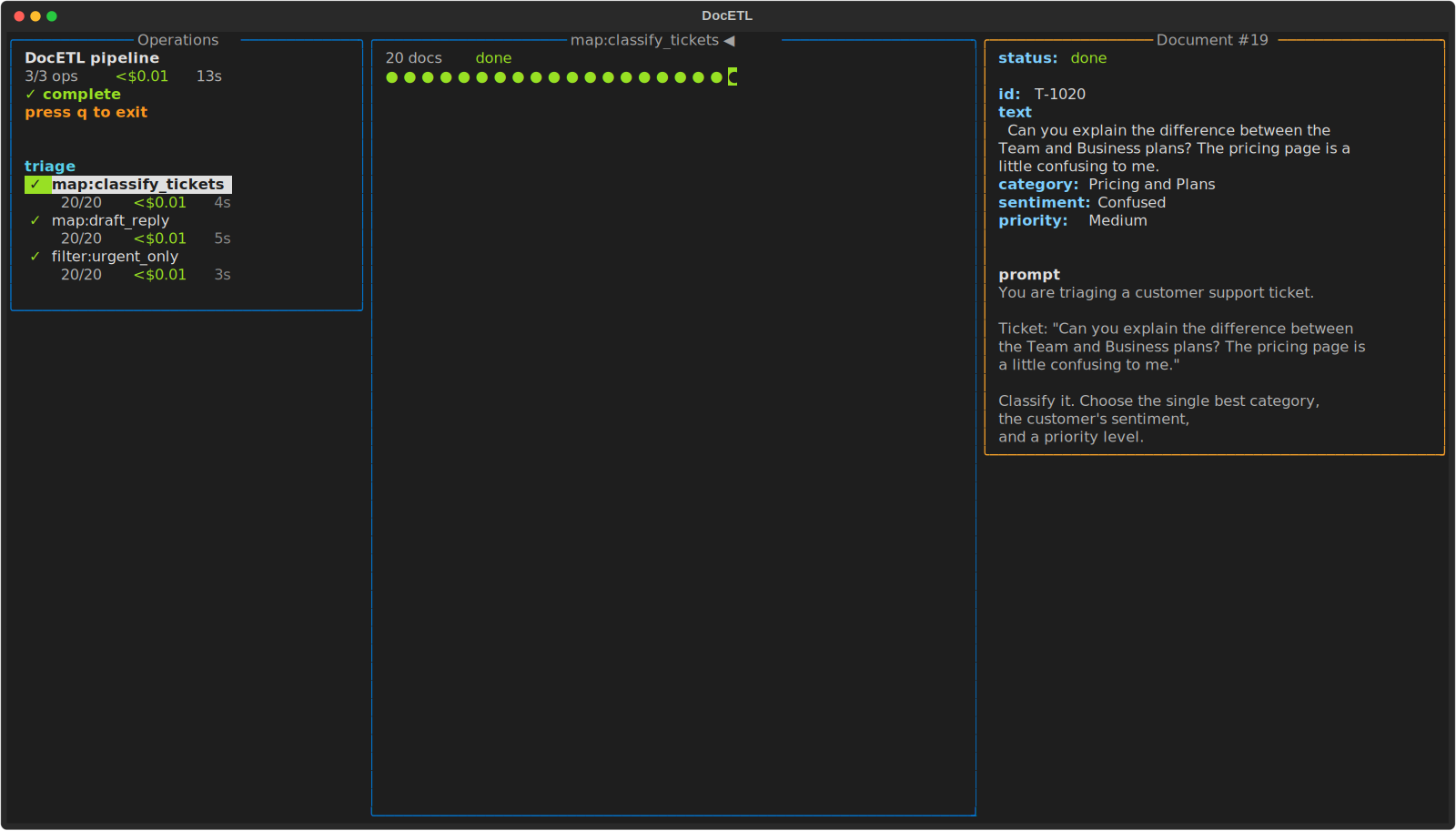
|
DocWrangler UI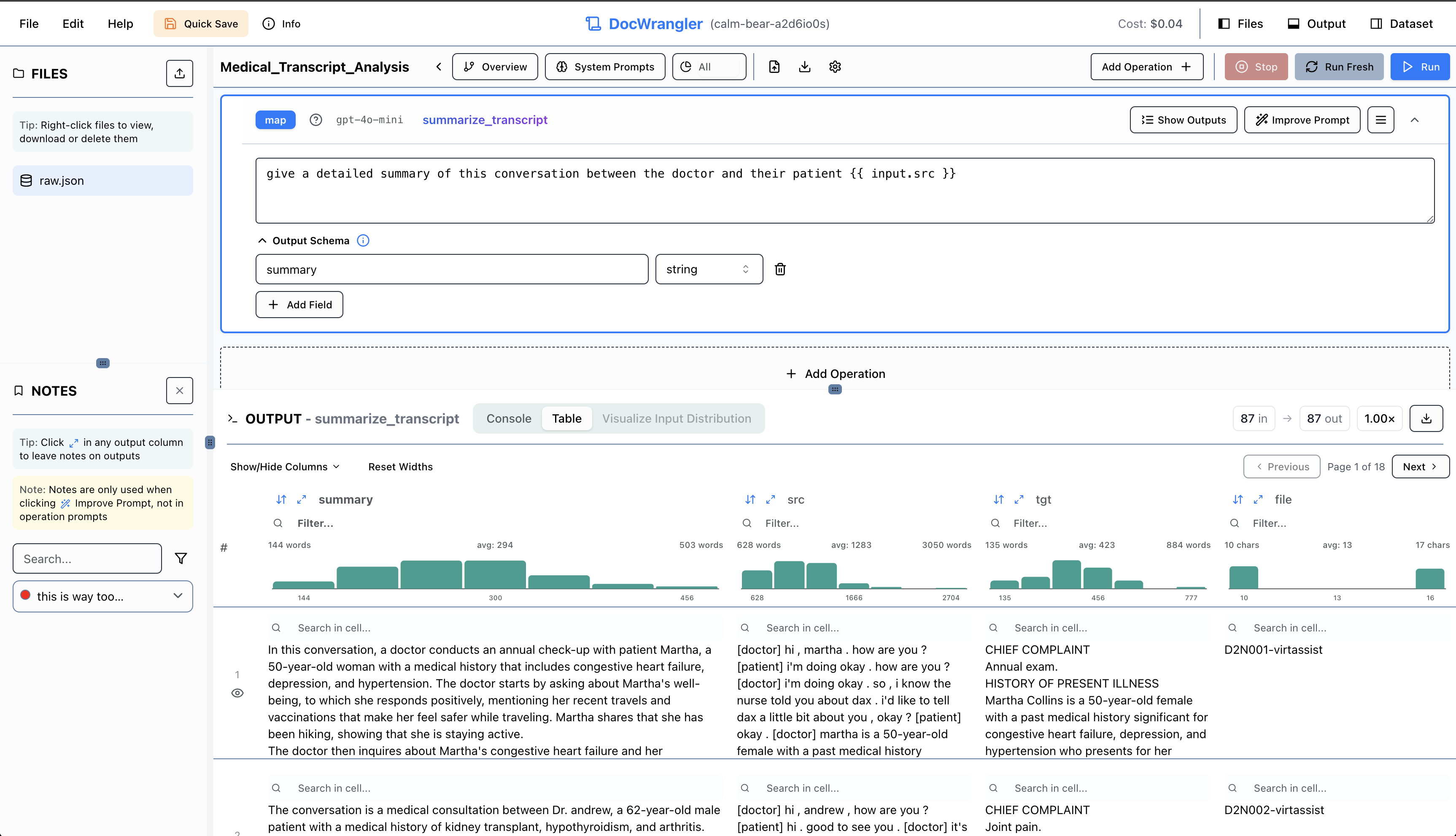
|
Install
pip install docetl
export OPENAI_API_KEY=your_key   # or any LLM provider key
Need Help Writing Your Pipeline?
Use Claude Code (recommended): run docetl install-skill and describe your task. See the quickstart.
If you'd rather use ChatGPT or the Claude app, copy the prompt at docetl.org/llms-full.txt into the chat before describing your task.
Python API (recommended)
Best for production code, notebooks, and scripting. Full guide
import docetl

docetl.default_model = "gpt-4o-mini"
docetl.rate_limits = {
    "llm_call": [{"count": 500, "per": 1, "unit": "minute"}],
    "llm_tokens": [{"count": 200_000, "per": 1, "unit": "minute"}],
}

# Classify support tickets, then summarize each category
pipeline = docetl.read_json("tickets.json")

pipeline = pipeline.map(
    prompt="Classify this support ticket: {{ input.text }}",
    output={"schema": {"category": "str", "priority": "str"}},
)

pipeline = pipeline.reduce(
    reduce_key="category",
    prompt="Summarize these tickets: {% for t in inputs %}{{ t.text }}{% endfor %}",
    output={"schema": {"summary": "str"}},
)

pipeline.schema()  # {'category': 'str', 'summary': 'str'}
pipeline.show()  # run on 5 docs and print results
rows = pipeline.collect()  # full run
print(f"Cost: ${pipeline.total_cost:.4f}")
YAML (low-code)
Declare your pipeline in a config file, no Python needed. Tutorial
datasets:
  tickets:
    type: file
    path: tickets.json

default_model: gpt-4o-mini

operations:
  - name: classify
    type: map
    prompt: "Classify this support ticket and assign a priority level."
    output:
      schema:
        category: str
        priority: str

pipeline:
  steps:
    - name: triage
      input: tickets
      operations: [classify]
  output:
    type: file
    path: output.json
docetl run pipeline.yaml
DocWrangler UI
Visual playground for interactive prompt development. Edit prompts, see results in real time. Try it at docetl.org/playground or run it locally.
Documentation
| Python API Guide | Frame API reference: operations, config, optimization |
| YAML Tutorial | Step-by-step walkthrough of declarative pipelines |
| Operators | Map, filter, reduce, resolve, split, gather, extract, and more |
| Optimization | Automatic cost-accuracy optimization with MOAR |
| DocWrangler Setup | Run the interactive UI locally or via Docker |
| Claude Code Quick Start | Describe your task and let Claude build the pipeline |
Community
Discord · Conversation Generator · Text-to-Speech · YouTube Transcript Topics
Development
git clone https://github.com/ucbepic/docetl.git && cd docetl
make install
make tests-basic  # < $0.01 with OpenAI
Papers
DocETL was created at the EPIC Data Lab and Data Systems and Foundations group at UC Berkeley.
DocETL, VLDB 2025 (paper)
@article{shankar2025docetl,
  title={DocETL: Agentic Query Rewriting and Evaluation for Complex Document Processing},
  author={Shankar, Shreya and Chambers, Tristan and Shah, Tarak and Parameswaran, Aditya G and Wu, Eugene},
  journal={Proceedings of the VLDB Endowment},
  volume={18}, number={9}, pages={3035--3048}, year={2025}
}
DocWrangler, UIST 2025, Best Paper Honorable Mention (paper)
@inproceedings{shankar2025docwrangler,
  title={Steering Semantic Data Processing With DocWrangler},
  author={Shankar*, Shreya and Chopra*, Bhavya and Hasan, Mawil and Lee, Stephen and Hartmann, Bj{\"o}rn and Hellerstein, Joseph M and Parameswaran, Aditya G and Wu, Eugene},
  booktitle={Proceedings of the ACM Symposium on User Interface Software and Technology (UIST)},
  year={2025}
}
MOAR, VLDB 2026 (paper)
@article{wei2026moar,
  title={Multi-Objective Agentic Rewrites for Unstructured Data Processing},
  author={Wei*, Lindsey Linxi and Shankar*, Shreya and Zeighami, Sepanta and Chung, Yeounoh and Ozcan, Fatma and Parameswaran, Aditya G},
  journal={Proceedings of the VLDB Endowment}, year={2026}
}
*Co-first authors