90+ databases in 25 MB. Desktop, Docker, CLI, built-in AI assistant, and MCP Server.
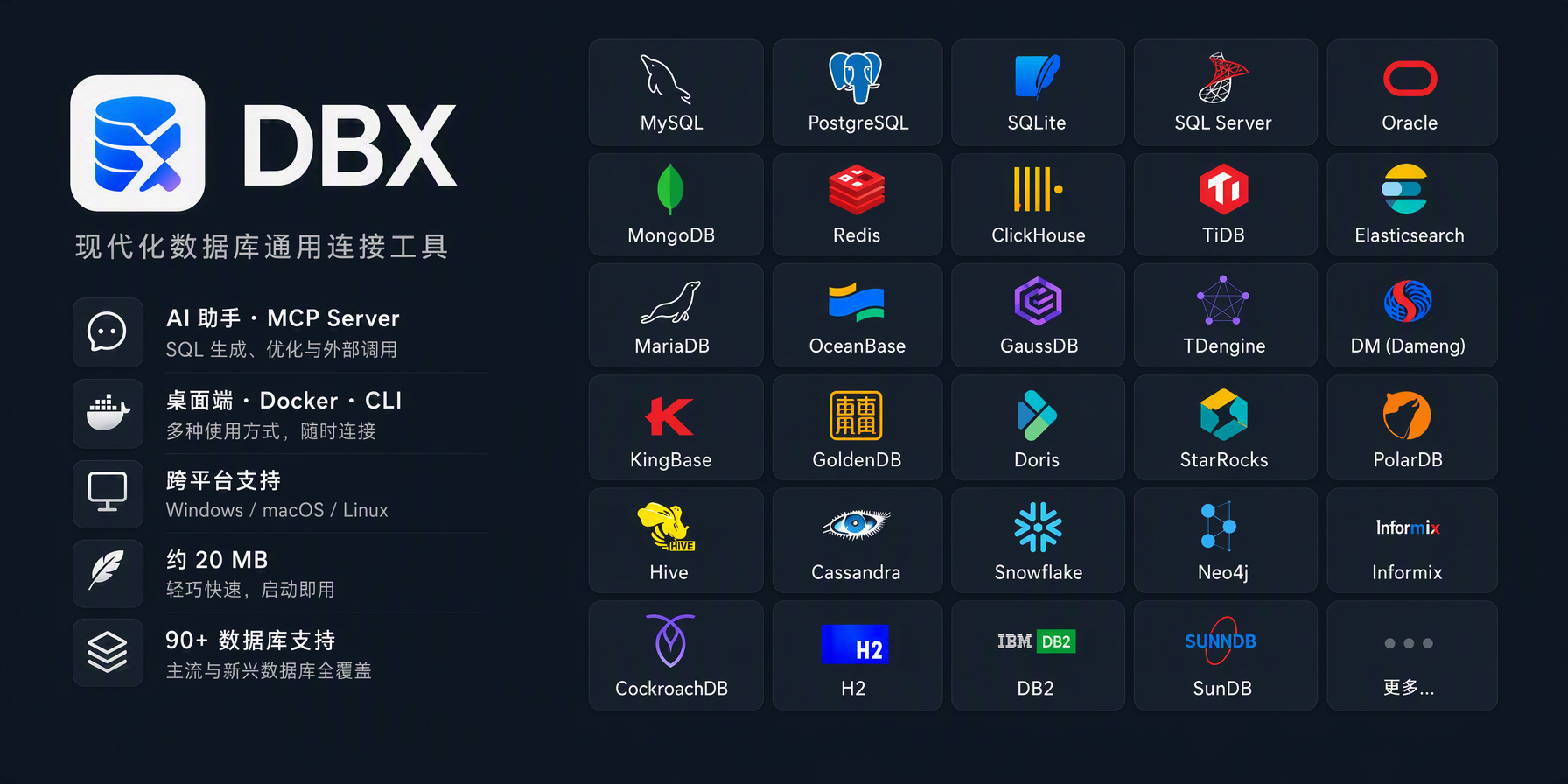





dbx is a free, open source databases project written in Rust and released under Apache-2.0. It has 19,957 GitHub stars, 1,937 forks and 1,406 open issues, and was last pushed 6 hours ago. On this registry it ranks #31 of 81 tracked projects in Databases, with 5 head-to-head comparisons available. It gained 337 stars over the last 3 tracked days.
dbx is a roughly 25 MB cross-platform database client written in Rust that connects to more than 90 databases and ships as a desktop application, a Docker container, a CLI, and a browser-based web version, aimed at developers and teams who want a single lightweight tool for MySQL, PostgreSQL, SQLite, Redis, MongoDB, DuckDB, SQL Server, Dameng, and many others.
dbx is an open-source database client and management tool distributed under the Apache-2.0 licence. It runs natively on macOS, Windows, and Linux, and it can also be self-hosted through Docker or accessed through a web interface, with the same connections and feature set across all three delivery forms. The project is written in Rust and covers a very wide driver surface: native support reaches MySQL, PostgreSQL, SQLite, Cloudflare D1, Redis, MongoDB, DuckDB, ClickHouse, SQL Server, Oracle, Elasticsearch, Easysearch, Meilisearch, Qdrant, Milvus, Weaviate, MariaDB, TiDB, OceanBase, openGauss, GaussDB, KWDB, KingbaseES, Vastbase, GoldenDB, Doris, SelectDB, StarRocks, Manticore Search, Redshift, DM, TDengine, XuguDB, CockroachDB, Access, HighGo, UXDB, and Dolt, with agent-based profiles extending that list to H2, Snowflake, Trino, PrestoSQL, Hive, DB2, Informix, Neo4j, Cassandra, BigQuery, Cloud Spanner, Kylin, SunDB, JDBCX, and custom JDBC connections.
The concrete problem it addresses is the weight and licensing model of existing database GUIs. The README states that DBeaver requires a Java runtime and that TablePlus is freemium, and it positions dbx as an alternative that carries no Java JRE, no Python virtual environment, and no bundled Chromium. dbx ships as a single small binary, so a user downloads it, installs it, and connects without provisioning a runtime first. That matters in environments where installing a JVM or a browser engine is inconvenient or prohibited.
Cmd+Enter execution, selected-SQL execution, diagnostics, SQL formatting, and 9 editor themes.dbx is obtained as a single small binary from the project homepage at https://dbxio.com, or self-hosted with Docker for team access. No runtime, JVM, or additional dependency is required.
The README contrasts dbx directly with DBeaver, which requires Java, and with TablePlus, which is freemium, presenting dbx as an Apache-2.0 alternative that runs with nothing extra installed. On data ownership and cost model, the distinction is that dbx is open source and self-hostable through Docker, so connections and credentials stay under the operator's control rather than inside a commercial licence tier. Those two named tools are the only comparable products the facts supply.
A self-hoster must operate the Docker container, which is the only server-side deployment path the README describes. Users who need vendor-specific deep tooling for one engine, or who want a commercial support contract, are better served elsewhere. The project also carries 1406 open issues against 19942 stars and 1935 forks, so the breadth of 90+ drivers comes with a large and busy issue tracker that a prospective user should review before standardising on it.
90+ databases in 25 MB. Desktop, Docker, CLI, built-in AI assistant, and MCP Server.
dbx is open source under the Apache-2.0 licence. There is no licence fee and no seat count — you can self-host it or, where the project offers one, pay a vendor for a managed version instead.
20 MB lightweight cross-platform database client for 90+ databases, including MySQL, PostgreSQL, SQLite, Redis, MongoDB, DuckDB, SQL Server, and Dameng. Built-i
dbx is primarily written in Rust. Its source is publicly available at https://github.com/t8y2/dbx, and it has 19,957 GitHub stars.






 readme truncated —