
crw is a free, open source data extraction & web scraping project written in Rust and released under AGPL-3.0. It has 1,045 GitHub stars, 80 forks and 10 open issues, and was last pushed 4 hours ago. On this registry it ranks #41 of 45 tracked projects in Data Extraction & Web Scraping, with 5 head-to-head comparisons available. It gained 13 stars over the last 3 tracked days.

What is crw?

crw (fastCRW) is a Rust-based web scraping, crawling, and search engine with an MCP server that turns URLs into clean markdown or structured JSON, aimed at AI agents and the developers who wire them into coding tools.

What it is

crw is a single-engine tool for search, scrape, map, crawl, and extract, distributed both as a small Rust binary that runs locally and as a managed cloud API. It lives in the AI-agent data-extraction ecosystem: the output formats are markdown, HTML, links, screenshots, and schema JSON, which is the shape language models and agent pipelines consume. The project ships under AGPL-3.0, with documentation at docs.fastcrw.com and a hosted service at fastcrw.com.

The concrete problem it solves is replacing a paid hosted scraping and search API with something that can run on the user's own machine or infrastructure. crw exposes a drop-in Firecrawl-compatible REST surface at /scrape, /crawl, and /search, so code written against Firecrawl's endpoints can be pointed at crw instead. The same server also registers itself as an MCP server, which removes the glue work of hand-wiring a scraper into an agent client. Self-hosters keep their own data and choose their own renderers, search backend, authentication, and proxies.

Key capabilities

  • Five documented operations: scrape one URL, run a bounded site crawl, map URLs without scraping each page, search the web and optionally scrape results, and extract structured fields from one or many URLs.
  • CLI entry points, including crw https://example.com for an immediate scrape and crw search "rust async runtime" for search once crw setup has run.
  • Firecrawl-compatible REST API at /scrape, /crawl, and /search, plus a capabilities endpoint at /v1/capabilities.
  • MCP server installation through npx -y crw-mcp@latest install, which installs the CRW skill and MCP server into detected AI tools; crw setup can perform the same step.
  • Client SDKs for pip install crw (the CrwClient class) and npm install crw-sdk, both supporting a formats option such as ["markdown"].
  • Output formats of markdown, HTML, links, screenshots, and schema JSON from a single scrape call.
  • Performance claims published against two benchmarks: 2.3x faster than Tavily and 1.5x faster than Firecrawl on a 1,000-URL benchmark, and 90.0% answer accuracy on the 600-question AA-Omniscience set.

Who uses it and how

  • Developers inside AI coding agents. Installation detects Claude Code, Cursor, Codex, Gemini CLI, OpenCode, and Windsurf when they are already configured, registers the MCP server, and leaves the API key in ~/.config/crw/config.toml rather than copying it into each tool.
  • Teams that need data control, private networks, or custom infrastructure, who run the binary locally and select their own renderers, search, auth, proxies, and capacity.
  • Python and Node.js application developers who consume scraping through the crw and crw-sdk packages instead of driving the CLI.
  • Teams with no infrastructure to operate, who use the managed API for proxy handling and JavaScript rendering, starting from 1,000 free credits with no credit card.
  • Evaluation and benchmarking users comparing search-answer accuracy across the 14-product field documented in the project's benchmark material.

Getting started

Install with the one-command script curl -fsSL https://fastcrw.com/install | sh, which runs locally and free with no account; add CRW_API_KEY=crw_live_... to the same command to connect a cloud key and register the MCP server. SDK users instead run pip install crw or npm install crw-sdk.

How it compares

The project positions itself as an alternative to Firecrawl and Tavily, and it is licence-transparent in a way that matters for self-hosting: the source is AGPL-3.0, so a team can deploy the whole engine itself rather than relying on a vendor endpoint. Compatibility is at the API level, since crw serves the same /scrape, /crawl, and /search paths, which makes migration a matter of changing the base URL rather than rewriting client code. crw also offers a managed cloud for teams that would rather not run anything, so the same project spans the free self-hosted case and the paid hosted case.

When to use it — and when not to

A self-hoster must operate the pieces the local deployment leaves to the user: renderers, search, authentication, proxies, and capacity, and the documentation warns that capabilities and response shapes can differ between the managed and local deployments. Anyone on Windows should check compatibility first, since the install is documented for macOS and Linux on Intel and ARM only. The reported memory footprint is inconsistent between the repository description, which cites 6 MB, and the README benchmark, which reports roughly 14 MB idle, so capacity planning should be based on measurement rather than either figure.

project readme (upstream, from github) — read inline

fastCRW

Turn URLs into clean markdown or structured JSON with one engine for search, scrape, map, crawl, and extract.

Run it locally as a small Rust binary or use the managed API.

Get 1000 free credits → · Install · Docs

No credit card. Continue with GitHub.

crates.io PyPI npm crw-mcp CI License GitHub Stars

One-command install

curl -fsSL https://fastcrw.com/install | sh

Runs local and free, no account needed. To use the Cloud, paste your key into the same command and it installs the binary, connects the key, and registers the MCP server with the AI coding tools you already have:

curl -fsSL https://fastcrw.com/install | CRW_API_KEY=crw_live_... sh
crw search "rust tutorials"

Claude Code, Cursor, Codex, Gemini CLI, OpenCode and Windsurf are picked up automatically when they are already set up; nothing else is touched, and your key stays in ~/.config/crw/config.toml rather than being copied into each tool. Add CRW_NO_AGENTS=1 to skip that step, or run crw setup on its own to choose interactively.

1000 free credits, no credit card. Managed proxies, JS rendering and search, with nothing to run or keep up to date. Get my free key →

macOS and Linux, Intel and ARM. More install options →

What it does

Operation Outcome
Scrape One URL to markdown, HTML, links, screenshots, or schema JSON
Crawl Follow a bounded site crawl and collect its pages
Map Discover URLs without scraping every page
Search Search the web and optionally scrape selected results
Extract Produce structured fields from one or many URLs

See the full API →

Why fastCRW

On Firecrawl's own public 1,000-URL dataset, fastCRW recovered more truth than Crawl4AI and Firecrawl, matched the fastest median latency, and idled at ~14 MB RAM.
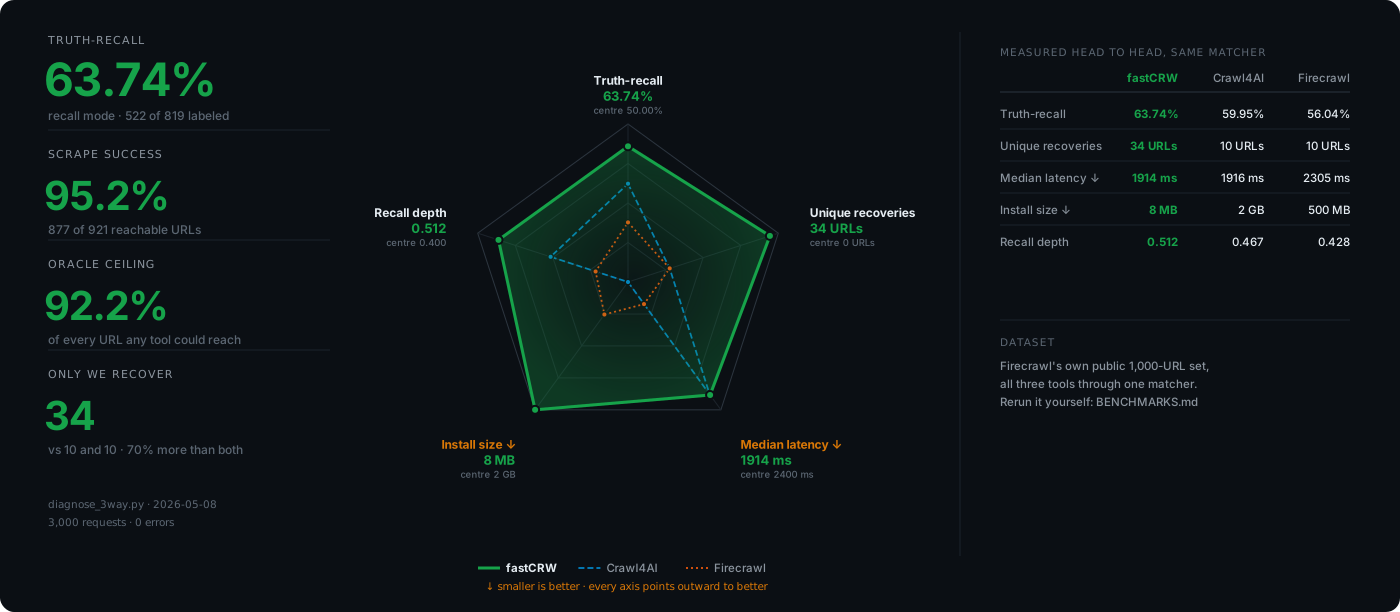
Methodology, full numbers, and how to reproduce it

On a different benchmark entirely, answer accuracy rather than scrape recall, fastCRW answers 90.0% of the 600 AA-Omniscience questions correctly. Every product listed on the Artificial Analysis Search Index sits below it.
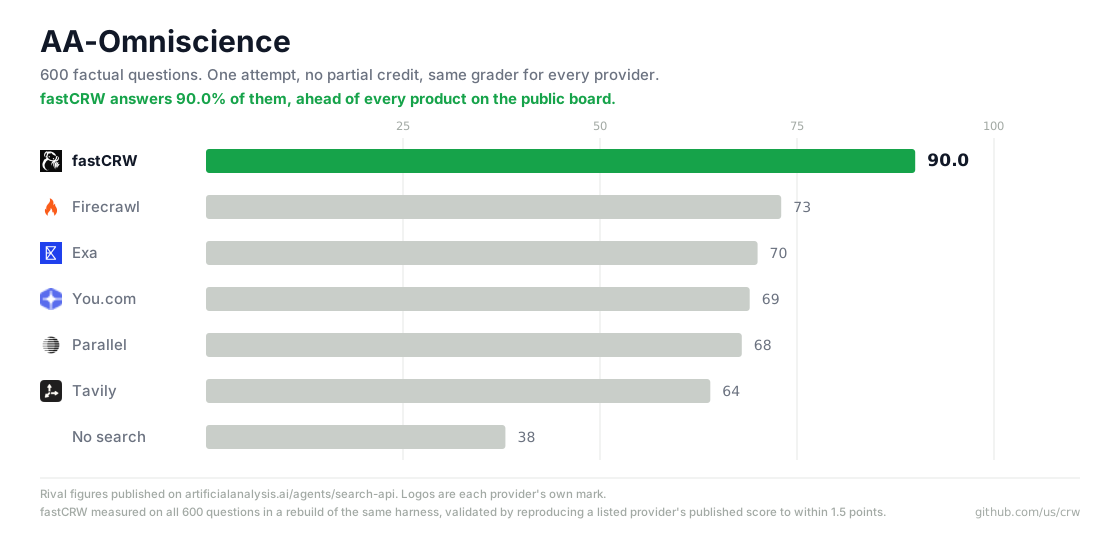
The full 14-product comparison, the control run, and how to reproduce it

Choose how you use it

CLI

crw https://example.com            # scrape, works right after install
crw search "rust async runtime"    # search, after `crw setup`

Python SDK

Using Cloud? Get an API key, then export it once:

export CRW_API_KEY="crw_live_..."
pip install crw
from crw import CrwClient

client = CrwClient()
page = client.scrape("https://example.com", formats=["markdown"])

print(page["markdown"])
Node.js
npm install crw-sdk
import { CrwClient } from "crw-sdk";

const client = new CrwClient();

const page = await client.scrape("https://example.com", {
  formats: ["markdown"],
});

console.log(page.markdown);

Local mode and more SDK examples → · REST API →

MCP for AI agents

npx -y crw-mcp@latest install

Installs the CRW skill and MCP server in your detected AI tools. crw setup can also do this step, so either path is enough. Manual setup →

Choose where it runs

Managed API Local / self-hosted
Best for Zero infrastructure and managed scaling Data control, private networks, or custom infrastructure
Start Create an API key, then crw setup Install and run crw
Operations Managed proxies, billing, and hosted capabilities You choose renderers, search, auth, proxies, and capacity

Capabilities and response shapes can differ by deployment: /v1/capabilities · response shapes

Self-hosting guide →

Learn more

Contributing

The workspace requires Rust 1.85 or newer:

git clone https://github.com/us/crw
cd crw
make check-fast

Read the contributor guide →

Contributors

crw is better because of these people. Thank you, all of you:

us paoloantinori rqi14 santhreal AsheTheWings adambenhassen atirna VIVAAN-DHAWAN mj520

Engine and MCP server: AGPL-3.0. Python and TypeScript SDKs: MIT. Embedding license: [email protected].

Star History

<source media="(prefers-color-scheme: light)" srcset="https://api.star-history.com/chart?repos=us/crw&type=date&legend=top-left&sealed_token=Pe6pRWL7lqTM-St9eo-Cmpk5kYNyuyun0krw9eVZQFIrm3g_R2h46IW6wfNalPXquMsWSNCgKqiar1YVo9MGy2IZmN5Lz6r

readme truncated — read the full docs on github

Frequently asked questions

Is crw free to use?

crw is open source under the AGPL-3.0 licence. There is no licence fee and no seat count — you can self-host it or, where the project offers one, pay a vendor for a managed version instead.

What does crw do?

Fast, lightweight Firecrawl/Tavily alternative in Rust. Web scraper, crawler & search API with MCP server for AI agents. Drop-in Firecrawl-compatible API (/scra

What is crw written in?

crw is primarily written in Rust. Its source is publicly available at https://github.com/us/crw, and it has 1,045 GitHub stars.

