Crit


Review and comment on plans, code diffs, frontend elements and send feedback directly to your agent.
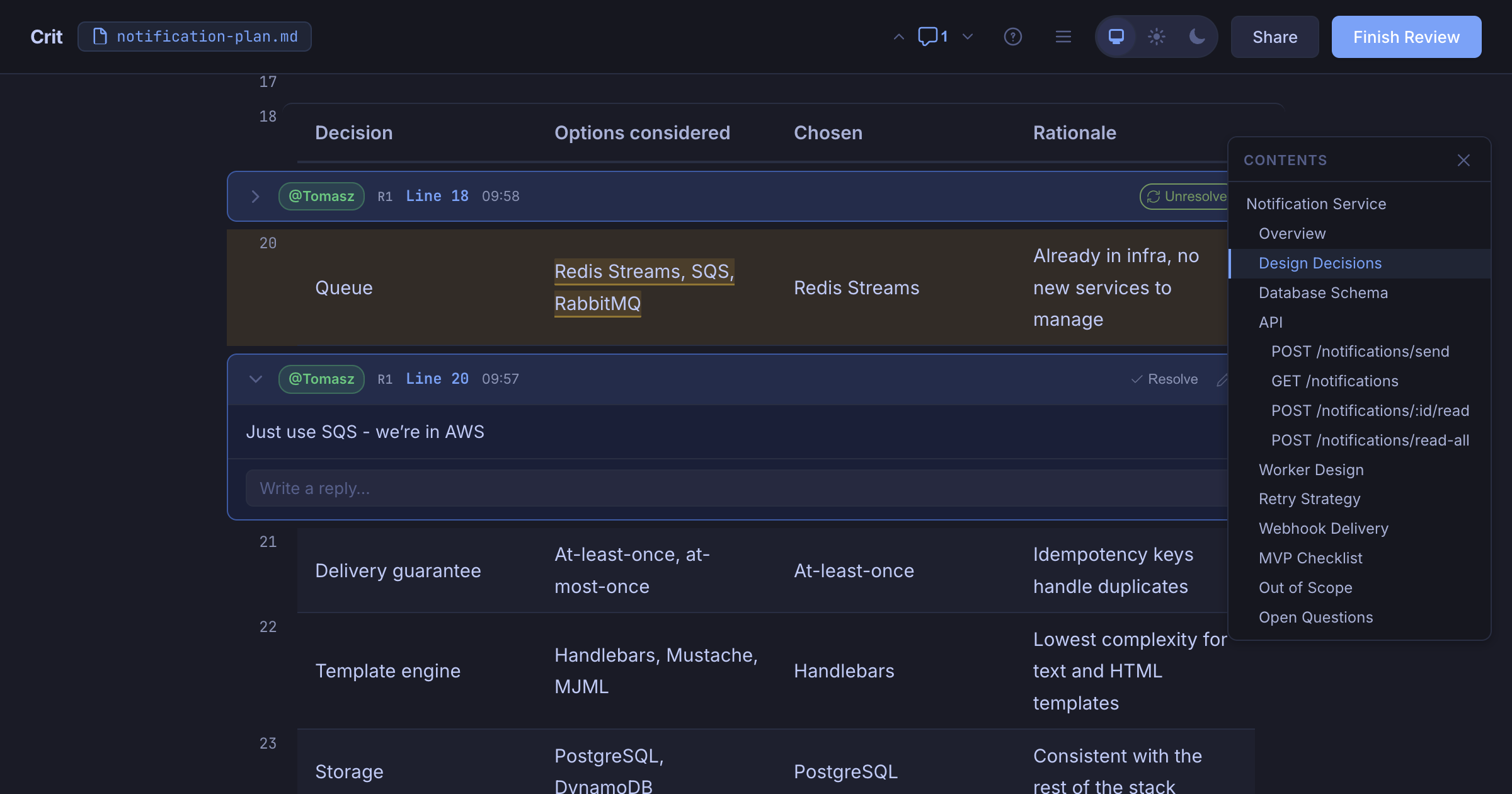
Adaptive UI for each type of output
For agents, plans and code are all the same - it's just text, but for us, humans, reviewing generated plans and reviewing web application are two very different activities.
Crit adds a proper interface for each type of output and lets you point at the exact thing that is wrong and leave a comment for the agent to fix:
crit plan.mdrenders a markdown file with proper formatting and review UIcritauto-detects git changes and shows syntax-highlighted diffs for local review.crit http://localhost:3000proxies your running app and adds a review interface to itcrit landing.htmlrenders a static HTML artifact to review
Everything runs locally via one single binary.
Quickstart
1. Install Crit binary
Brew:
brew install crit
Also available via Go, Nix, Windows
Go:
go install github.com/tomasz-tomczyk/crit/cmd/crit@latest
Nix:
nix profile install github:tomasz-tomczyk/crit
Windows:
iwr https://github.com/tomasz-tomczyk/crit/releases/latest/download/crit-windows-amd64.exe -OutFile crit.exe
Note: Then move crit.exe somewhere on your PATH. ARM64 users: swap amd64 for arm64. WSL users: use the Linux binary instead.
Or download the latest release from GitHub.
2. Integrate with your agent
Claude Code:
claude plugin marketplace add tomasz-tomczyk/crit
claude plugin install crit@crit
Crit also works with Cursor, GitHub Copilot, OpenCode, Codex, Gemini, Qwen, Hermes, Windsurf, Cline, Grok, Aider, and Pi — any agent that can read a file and run a command. See integrations/ for all install methods and details.
3. Tell your agent to use crit
Most integrations include a /crit slash command that automates the full review loop.
Agent launches Crit, waits for your review and acts on the feedback.
Repeat the process until you approve the changes.
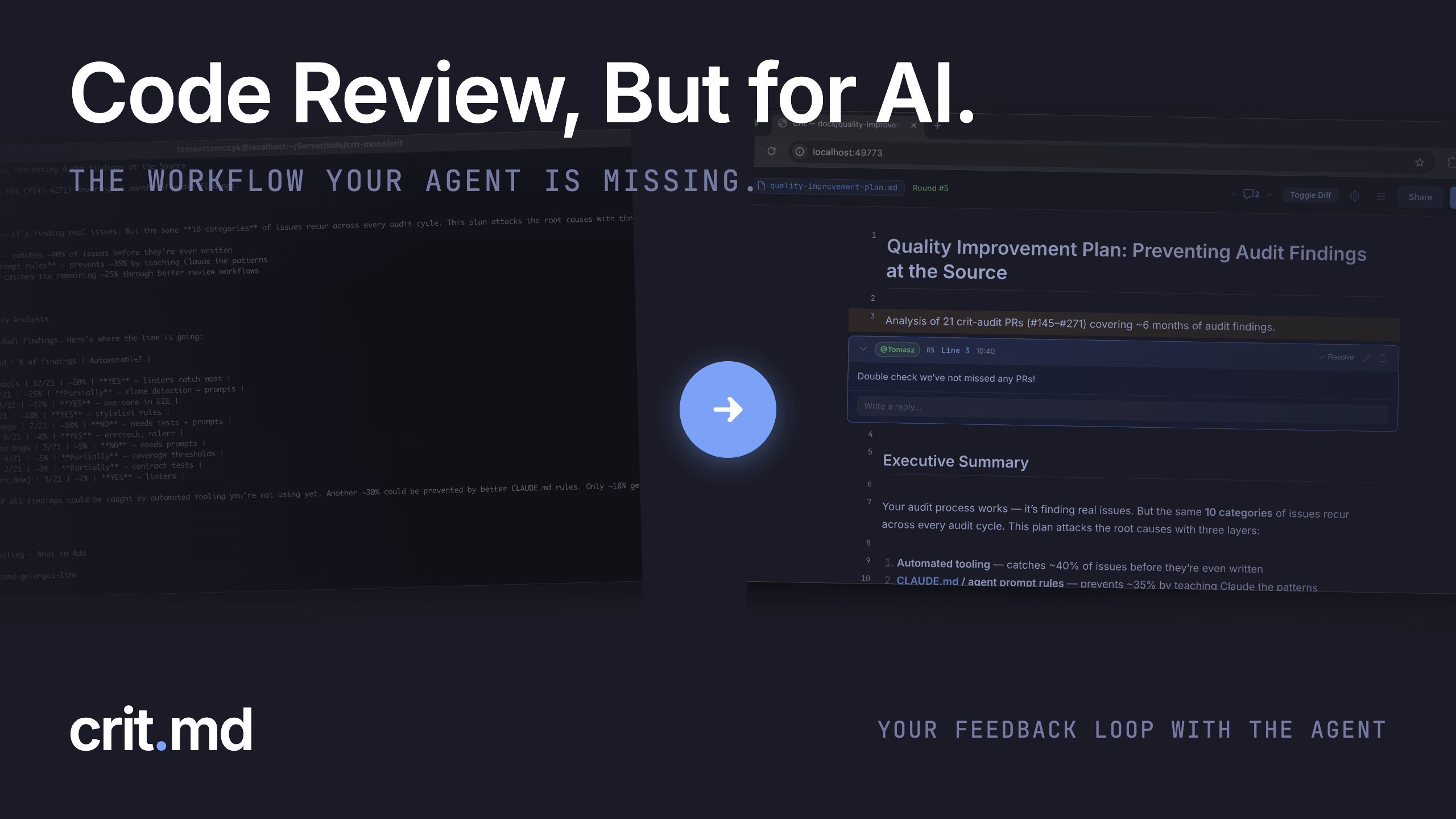
Here's a 2-minute demo walkthrough of plan review and branch review:
Usage
The recommended way is to use /crit command with your agent after any piece of work - whether it wrote a plan or made some code changes. You can however, launch it in your terminal by yourself and paste the prompt when you finish to your agent.
crit                              # auto-detect changed files in your repo
crit plan.md                      # review a specific file
crit plan.md api-spec.md          # review multiple files
crit http://localhost:3000        # review a running dev server
crit landing.html                 # review a static HTML file
If talking to an agent, you can invoke the /crit command and optionally provide arguments like the above examples or the agent will try to launch the right thing based on the context of the conversation.
Story mode
For larger branch, PR, MR, or range reviews, story mode adds a chaptered overview of the diff — thematic chapters, a prologue, and a support bucket for noise — so you can understand the shape of the change before line-by-line review. It is an explainer, not a reviewer.
Recommended: invoke /crit-story (or $crit-story, /skill:crit-story,
depending on your agent) after crit install . Your agent authors the
story in-session via crit story --prep / --story-file. Only run it when you
explicitly ask — agents will not infer it from a normal /crit review.
Alternative: crit story from the terminal uses your global agent_cmd
(separate LLM spend). Generation is LLM-driven exploration — cost depends on
change complexity more than raw file/diff size, and does not scale linearly.
In our experience, complex PRs (~20–50 files, ~2k–5k lines) land around
$1–$1.40 with Claude Opus 5. See the story mode guide
for commands, custom prompts, JSON shape, and token-cost notes.
Live mode
crit live (or crit ) proxies a running dev server through Crit's review UI. Crit's iframe loads the app on a different origin/port than your browser tab, so host-scoped session cookies are not shared automatically. If the direct URL works but Crit shows a login page or hydration mismatch, forward the upstream cookies:
# one-off
crit live http://localhost:4000/dashboard --cookie "_crit_key=..."

# repeatable (Netscape jar or raw Cookie header lines)
crit live http://localhost:4000/dashboard --cookie-file .crit/live-cookies.txt

# reuse cookies from a Chrome session with remote debugging enabled
crit live http://localhost:4000/dashboard --cdp-url http://127.0.0.1:9222
Getting cookies: log in to the app in your browser, then copy the session cookie from DevTools (Application → Cookies), export a cookie jar, or start Chrome with --remote-debugging-port=9222 and pass --cdp-url so Crit reads cookies for the target origin automatically.
Config (global or project .crit.config.json; project overrides global):
{
  "live_cookie_file": ".crit/live-cookies.txt",
  "live_cdp_url": "http://127.0.0.1:9222"
}
Relative paths resolve from the repo root. Prefer a gitignored file under .crit/ over committing live_cookie inline. Run crit live --help for all flags.
crit status                       # show review file path and daemon status
crit resume                       # pick a previous review to reopen
crit stats                        # show lifetime review statistics
crit cleanup                      # delete stale review files
crit resume lists every review in ~/.crit/reviews, newest first, with its branch or files, directory, age, and open comment count. Choosing one reconnects to its daemon, or restarts the daemon in the directory the review came from when it has stopped — so you can resume a review from anywhere. Pass --list to print the list instead, or a session ID to skip the picker.
Features
Round-to-round diff
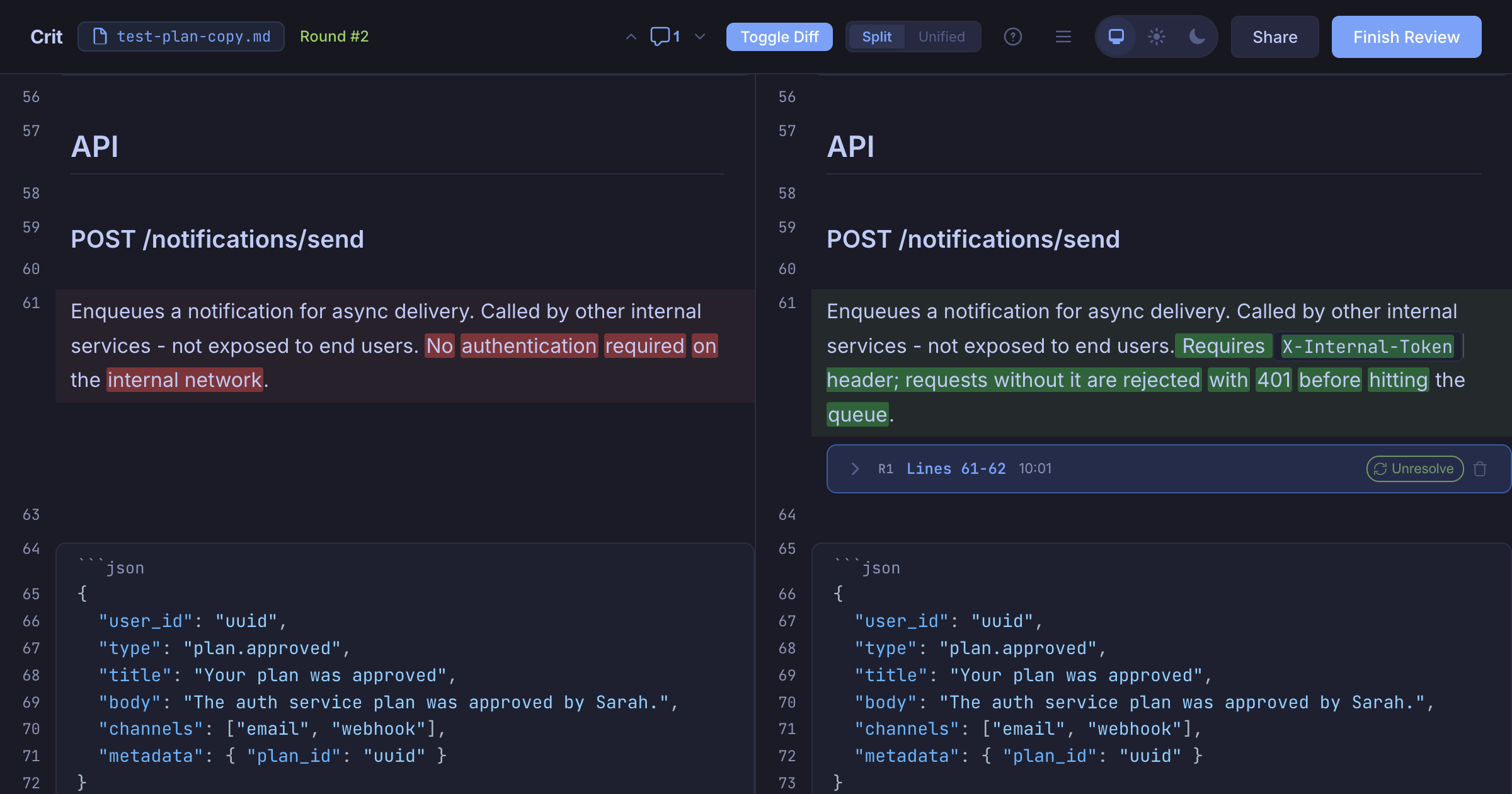
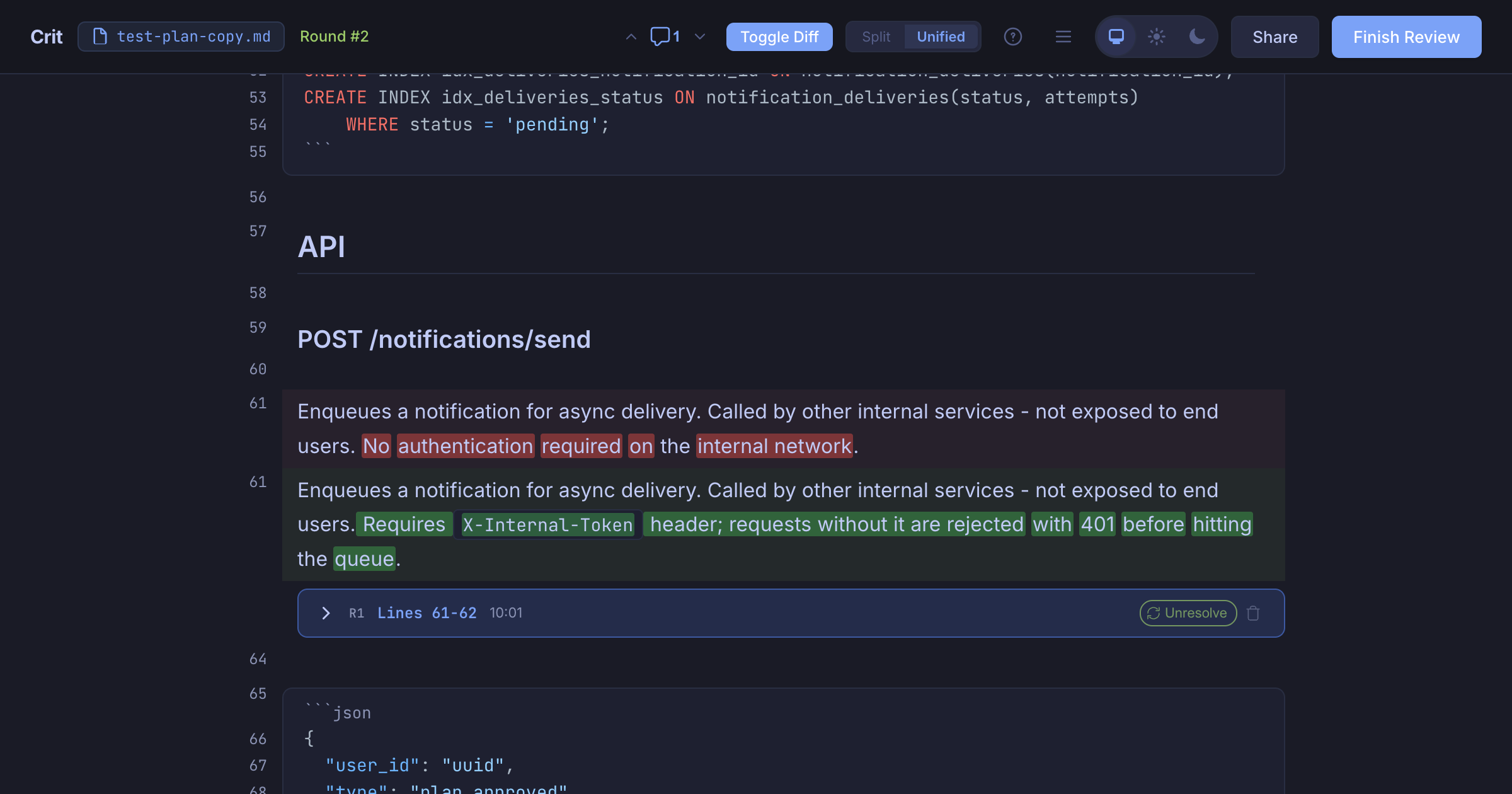
After your agent edits the file, Crit shows a split or unified diff of what changed - toggle it in the header.
Split view
Unified view
Inline comments: single lines and ranges
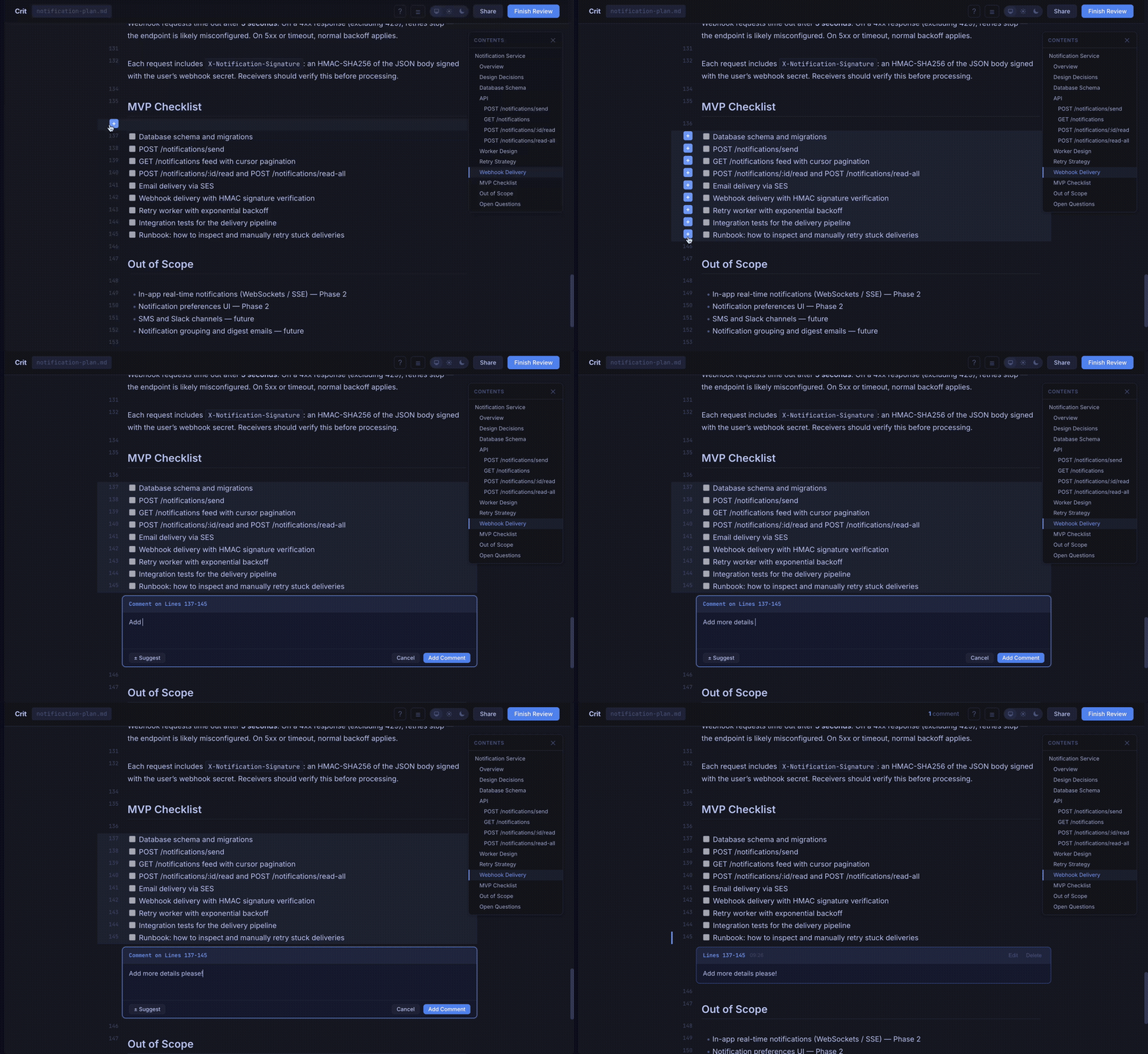
Click a line number to comment. Drag to select a range. Comments are rendered inline after their referenced lines, just like a GitHub PR review.
Programmatic comments
AI agents can use crit comment to add inline review comments without opening the browser UI or constructing JSON manually:
crit comment src/auth.go:42 'Missing null check'
crit comment src/handler.go:15-28 'Error handling issue'
crit comment --session 839f3b4cd5d6 src/auth.go:42 'Target this review'
echo '[{"body":"Overall feedback"}]' | crit comment --session 839f3b4cd5d6 --json
crit comment --output ~/.crit src/auth.go:42 'comment'  # same as default (~/.crit/reviews/<key>/)
crit comment --output .crit src/auth.go:42 'comment'    # in-repo: .crit/reviews/<key>/
crit comment --clear   # remove the review file
Comments are appended to the review file (stored in ~/.crit/reviews/) and created automatically if it doesn't exist. Run crit status to see active review session IDs and paths. If multiple sessions match the same directory and branch, select one with --session on crit comment, crit comments, crit share, crit push, or crit pull; an unqualified command fails instead of guessing.
Share for Async Review
Want a second opinion before handing off to the agent? Click the Share button to upload your review and get a public URL anyone can open in a browser, no install needed. Each reviewer's comments are color-coded by author. Unpublish anytime.
You can also share directly from the CLI without starting the browser UI:
crit share plan.md                    # share files and print the URL
crit share plan.md --qr               # also print a QR code in the terminal
crit share plan.md --org acme         # share under an organization
crit share plan