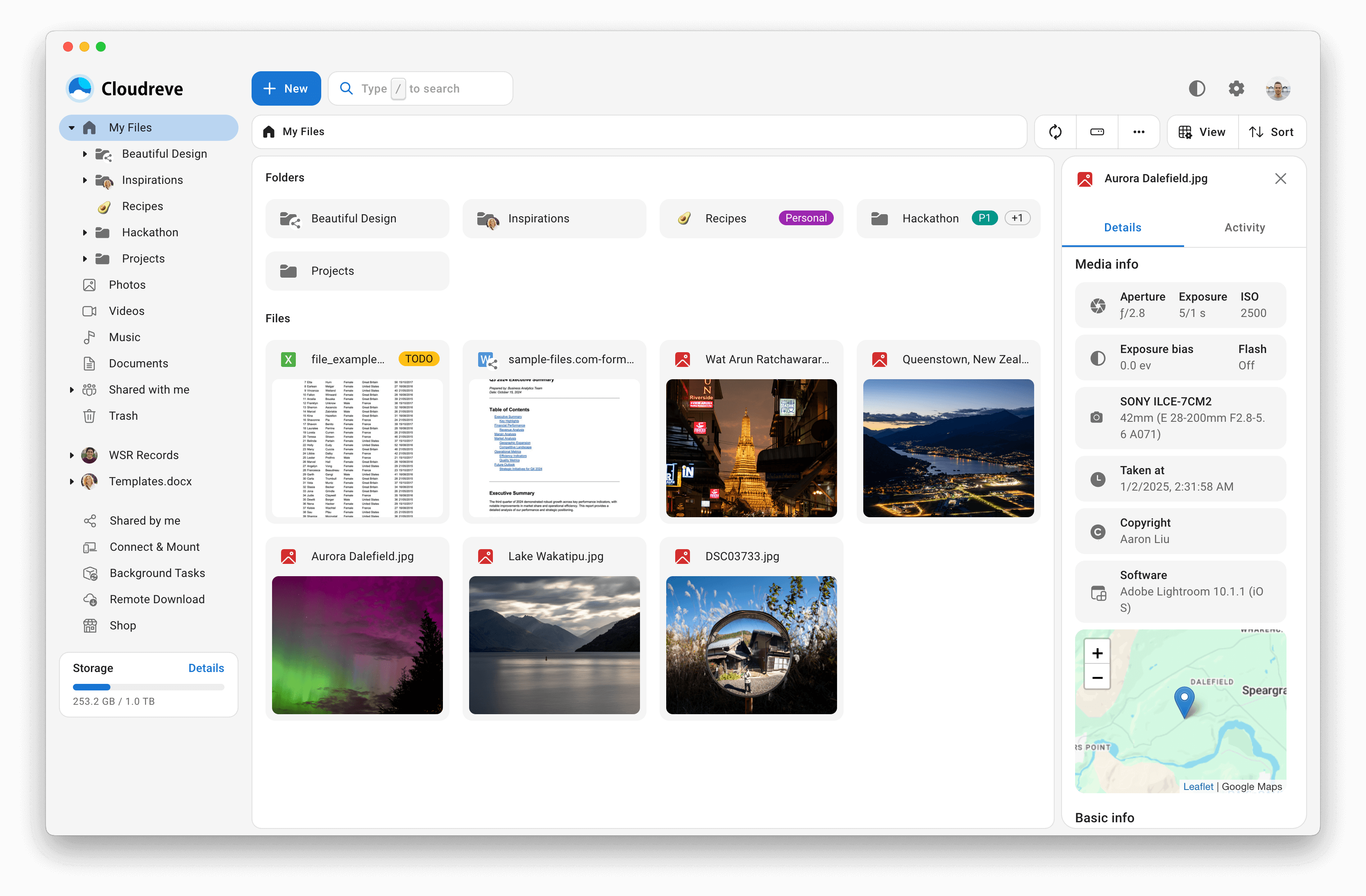
Cloudreve is a self-hosted file management and sharing system written in Go that gives an organisation its own web file manager, sharing layer, and multi-cloud storage gateway running on infrastructure it controls.
What it is
Cloudreve is an open-source file management system built as a Go backend on Gin and ent with a React, Redux, and Material-UI frontend, released under GPL-3.0. It sits between users and their storage: rather than tying an installation to one disk or one vendor, it presents a single file manager, sharing service, and WebDAV endpoint in front of many backends at once. Those backends include Local, Remote node, OneDrive, S3 compatible API, Qiniu Kodo, Aliyun OSS, Tencent COS, Huawei Cloud OBS, Kingsoft Cloud KS3, and Upyun. It is a first-class project in the Go self-hosting ecosystem, with 28,727 stars and 3,892 forks at the time of writing.
The concrete problem it solves is fragmentation of where files live. A user with data spread across a personal OneDrive account, an S3-compatible bucket, and a local disk normally juggles three interfaces, three sets of credentials, and no shared sharing model. Cloudreve replaces that with one account system, one permission model, and one interface over all of them, instead of replacing a commercial cloud drive subscription with another commercial cloud drive subscription. It also replaces the ad-hoc mix of an FTP server, a static file host, and a link-sharing script that small teams often assemble, by covering uploads, previews, archives, sharing, and desktop access in a single packaged application.
Key capabilities
- Storage abstraction across Local, Remote node, OneDrive, S3 compatible API, Qiniu Kodo, Aliyun OSS, Tencent COS, Huawei Cloud OBS, Kingsoft Cloud KS3, and Upyun.
- Direct transmission of uploads and downloads from the client to the storage provider.
- Background downloading through integration with Aria2 and qBittorrent, using multiple download nodes to share the load.
- WebDAV support that covers all storage providers, giving desktop and third-party clients access to the same file set.
- Drag-and-drop upload of files and folders with parallel resumable upload support.
- Archive handling for compress, extract, and preview, plus batch download of multiple files.
- Media metadata extraction, with search across files by metadata or tags.
- Share links for files and folders with expiration dates, plus multi-user operation with multi-groups.
- Online preview of videos, images, audio, and ePub files, and online editing of text, diagrams, Markdown, images, and Office documents.
- Custom theme colours, dark mode, PWA support, a single-page application frontend, and internationalisation.
Who uses it and how
- Teams running a shared file service, using the multi-user and multi-group model to give each group its own space and permissions on one installation.
- Self-hosters who keep files in OneDrive or an S3-compatible bucket but want a web interface and WebDAV access in front of that storage, rather than the provider's own client.
- Sites with heavy download traffic, using Aria2 or qBittorrent integration and multiple download nodes so the Cloudreve instance itself does not carry the file transfer load.
- Organisations that share files with people outside the team, issuing share links for files and folders with expiration dates instead of creating accounts for each recipient.
- Documentation and media workflows that need preview and editing in the browser, covering video, images, audio, ePub, Markdown, diagrams, and Office documents.
Getting started
The README describes all-in-one packaging with all features available out of the box, and points to the project's Getting started documentation at docs.cloudreve.org for a quick local deployment to test. Production deployments are directed to the Deploy documentation, and building from source is covered separately in the Build documentation.
How it compares
The facts provided name no paid products that Cloudreve replaces and no directly comparable file management tools, so it stands alone in this registry rather than sitting beside a documented set of alternatives. No head-to-head comparison on licence, self-hosting, data ownership, or cost model can be drawn from these materials.
When to use it — and when not to
The self-hoster must operate the all-in-one package and whatever storage backends are connected, and the registry entry does not state the database, storage, or SMTP requirements, so those must be confirmed in the external documentation before committing to a production deployment. Teams that want a fully managed service with no operational work should not pick it, and because the licence is GPL-3.0, embedding it in a closed-source product is constrained. The README is also thin on deployment specifics, naming no package, container image, or compose file, and the entry records no release or version information, so the documentation site rather than this page is the reliable starting point.