Bytebase is a free, open source databases project written in Go and released under a custom open-source licence. It has 14,491 GitHub stars, 983 forks and 167 open issues, and was last pushed 5 hours ago. On this registry it ranks #43 of 81 tracked projects in Databases, with 5 head-to-head comparisons available. It gained 11 stars over the last 6 tracked days.

Bytebase — Secure and streamline database changes with CI/CD automation

What is Bytebase?

What it is

Bytebase is an open-source database governance platform that acts as a single control plane between human users, AI agents, and databases. It governs change management, access control, and compliance so that every database change and query can be reviewed, controlled, and recorded. The project sits in the Infrastructure and Operations database ecosystem, with topics that include CI/CD, DevOps, DevSecOps, GitOps, data governance, data masking, data security, database access, Flyway, Liquibase, and MongoDB.

The concrete problem it addresses is the fragmentation of database operations across migration scripts, SQL clients, and ticketing systems. Bytebase unifies those workflows in one platform, supporting PostgreSQL, MySQL, SQL Server, Oracle, MongoDB, Redis, MariaDB, TiDB, Snowflake, ClickHouse, Spanner, and OceanBase. It also lists integrations spanning infrastructure as code, AI, identity providers, collaboration, ITSM, log streaming, and secret managers.

Key capabilities

  • Change management through a web console lets users request, review, deploy, and rollback database changes.
  • GitHub and GitLab integration supports database-as-code workflows through GitOps.
  • SQL Review applies 200+ lint rules to enforce SQL standards and best practices.
  • Fine-grained RBAC provides project and workspace-level roles and permissions.
  • Just-in-time access grants time-boxed database access with automatic revocation.
  • Dynamic data masking applies column-level masking based on user role at query time.
  • Audit logging records database activities, while Terraform Provider and API manage policies as code.

Who uses it and how

  • Development teams implement database schema version control, automate database deployments through CI/CD pipelines, and collaborate on changes with review workflows.
  • DBAs centralize database management across environments, enforce organization-wide SQL standards and policies, and monitor and audit database activities.
  • Security teams control data access with column-level permissions, implement data masking for sensitive information, and maintain compliance with audit trails.
  • AI agents and IDEs connect through the MCP Server, while the SQL Editor offers Text-to-SQL and Page Agent assistance for query generation and workflow execution.

Getting started

Typical self-hosted installation uses Docker with the bytebase/bytebase:latest image, publishing port 8080 and mounting ~/.bytebase/data, or Kubernetes with the bytebase/bytebase Helm chart; users then visit http://localhost:8080 and follow the setup wizard.

When to use it — and when not to

Choose Bytebase when teams need one platform for database change review, access governance, and audit trails instead of stitching together migration scripts, SQL clients, and ticketing systems. The README lists comparisons with Liquibase, Flyway, and Jira, so it is relevant where those workflows are fragmented. Self-hosting requires operating the Docker or Helm deployment, the contributor setup shows a PostgreSQL dependency through PG_URL, and the provided metadata lists zero contributors and 167 open issues.

project readme (upstream, from github) — read inline

⚙️ Install📚 Docs🙋‍♀️ Book Demo

banner

What is Bytebase?

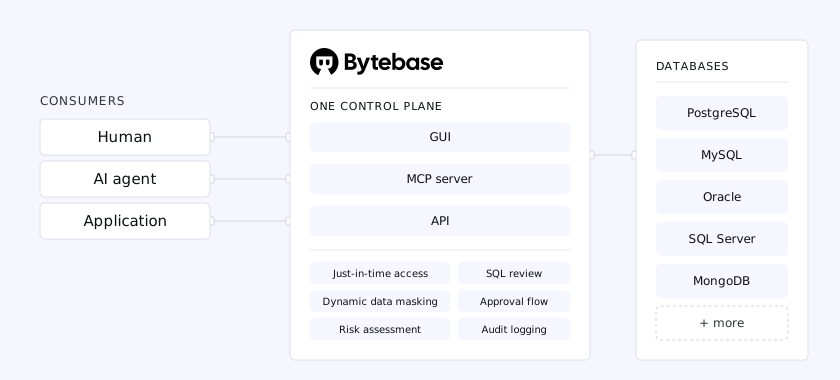
Bytebase is the open-source database governance platform. It acts as a single control plane between your users — humans and AI agents — and your databases, governing change management, access control, and compliance so every change and query is reviewed, controlled, and recorded.
middleware

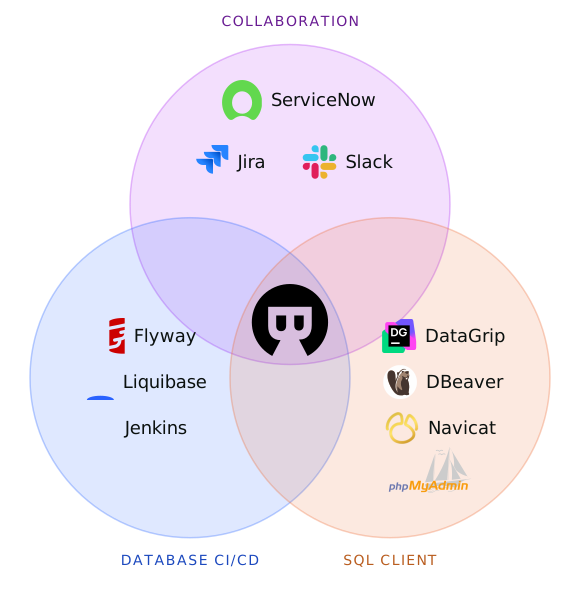
It replaces the disparate tools stitched across migration scripts, SQL clients, and ticketing systems, unifying database operations in a single platform.
venn

Supported Databases and Integrations

Bytebase supports PostgreSQL, MySQL, SQL Server, Oracle, MongoDB, Redis, MariaDB, TiDB, Snowflake, ClickHouse, Spanner, OceanBase, and more — plus integrations spanning IaC, AI, identity providers, collaboration, ITSM, log streaming, and secret managers.
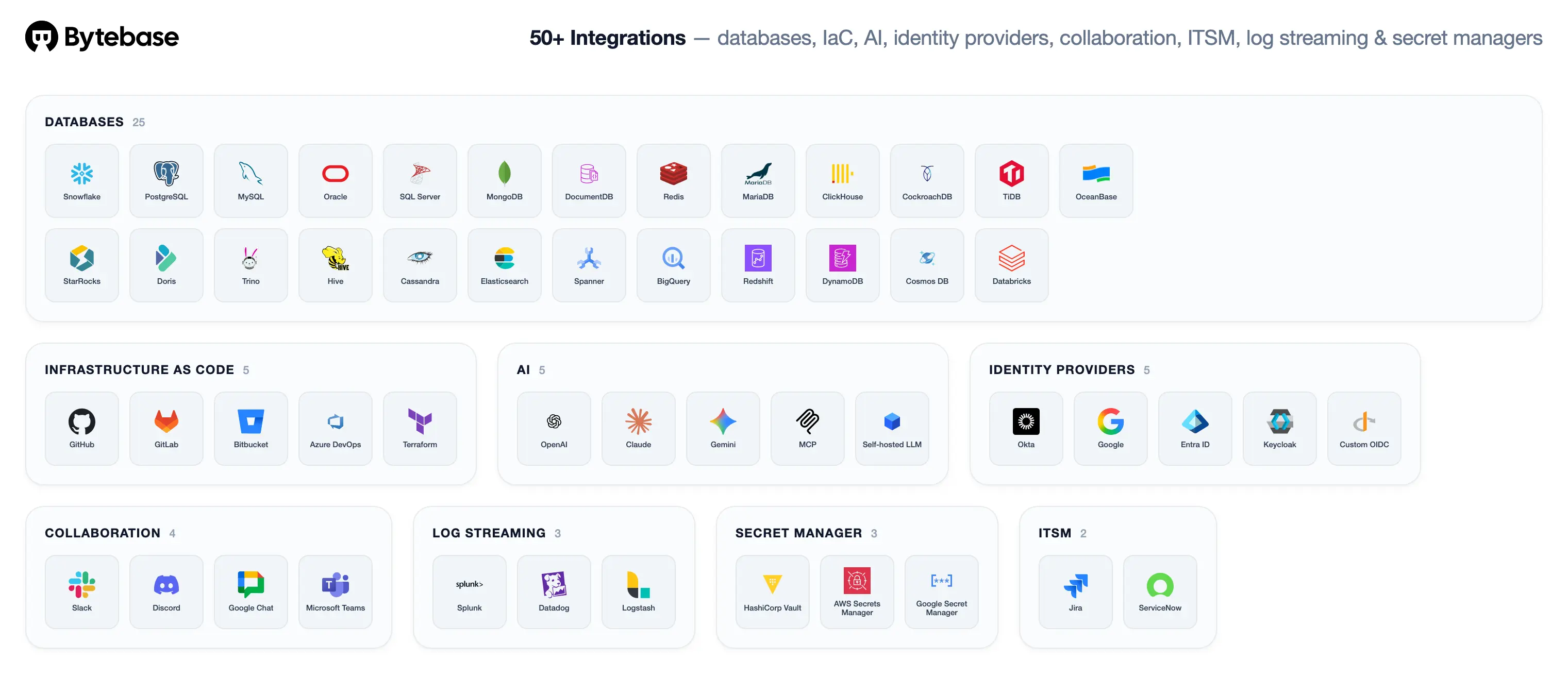
integrations

Key Features

Change Management

  • GUI-Based Workflow: Request, review, deploy, and rollback changes through a web console
  • GitOps Integration: Native GitHub/GitLab integration for database-as-code workflows
  • SQL Review: 200+ lint rules to enforce SQL standards and best practices

Access Control

  • Fine-Grained RBAC: Project and workspace-level roles and permissions
  • Just-in-Time Access: Time-boxed database access grants with automatic revocation
  • Dynamic Data Masking: Column-level masking applied based on user role at query time

Compliance

  • Audit Logging: Complete audit trail of all database activities
  • Codified Policy: Manage policies as code via Terraform Provider and API
  • Data Classification: Identify and tag sensitive data across your databases

AI

  • MCP Server: Connect AI agents and IDEs to Bytebase through the Model Context Protocol
  • Text-to-SQL: Generate and refine queries in the SQL Editor with AI assistance
  • Page Agent: Built-in AI assistant that guides or executes workflows from plain language requests

Quick Start

Docker

docker run --init \
  --name bytebase \
  --publish 8080:8080 \
  --volume ~/.bytebase/data:/var/opt/bytebase \
  bytebase/bytebase:latest

Kubernetes

helm install bytebase bytebase/bytebase

Visit http://localhost:8080 and follow the setup wizard.

Documentation

Use Cases

For Development Teams

  • Implement database schema version control
  • Automate database deployments through CI/CD pipelines
  • Collaborate on database changes with review workflows

For DBAs

  • Centralize database management across all environments
  • Enforce organization-wide SQL standards and policies
  • Monitor and audit all database activities

For Security Teams

  • Control data access with column-level permissions
  • Implement data masking for sensitive information
  • Maintain compliance with audit trails

Community & Support

Contributing

We welcome contributions!

# Setup a postgres database with user bbdev and database bbdev
export PG_URL=postgresql://bbdev@localhost/bbdev

# Start backend
alias r='go build -ldflags "-w -s" -p=16 -o ./bytebase-build/bytebase ./backend/bin/server/main.go && ./bytebase-build/bytebase --port 8080 --data . --debug'

# Start frontend
alias y="pnpm --dir frontend i && pnpm --dir frontend dev"

Comparisons

Star History Chart

Frequently asked questions

Is Bytebase free to use?

Bytebase is open source. There is no licence fee and no seat count — you can self-host it or, where the project offers one, pay a vendor for a managed version instead.

What does Bytebase do?

Secure and streamline database changes with CI/CD automation

What is Bytebase written in?

Bytebase is primarily written in Go. Its source is publicly available at https://github.com/bytebase/bytebase, and it has 14,491 GitHub stars.