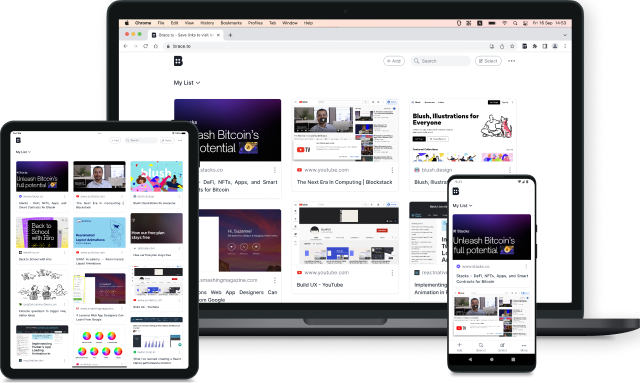
Brace.to is an MIT-licensed, end-to-end encrypted bookmark manager for people who want to save and revisit links across web, Android and iOS without handing the contents of their library to a hosted provider.
What it is
Brace.to is a bookmark manager built with privacy as its stated goal. It is a TypeScript project that lives in the Stacks ecosystem, the Web3 layer associated with Hiro's Stacks.js, and it uses that technology so that saved links are encrypted and only the account holder can decrypt them and read what is inside. The project ships as a client that runs on the web, on Android and on iOS, with a shared codebase split into a web package and a mobile package. Feature scope is deliberately close to a conventional read-later tool: nested lists that behave as folders, pinning entries to the top, tags, the ability to lock lists, and a dark mode.
The concrete problem it addresses is custody. A bookmark library is an unusually revealing dataset, because every saved link is a statement about what a person is reading, planning or worrying about. On a conventional cloud bookmark service, that library sits in readable form on someone else's infrastructure, and the account, not the user, is the unit of ownership. Brace.to replaces that arrangement by encrypting saved links before they are stored and by keeping the decryption key with the user, so the service and the underlying Stacks-based storage never see plaintext. The repository itself is stxapps/brace-client, and it is presented as a client rather than a monolithic hosted product.
Key capabilities
- End-to-end encryption of saved links, with the decryption key known only to the user.
- Client applications for the web, Android and iOS from one TypeScript codebase.
- Nested lists that function as folders, used to organise saved links hierarchically.
- Pin to the top, so frequently used lists or entries stay in reach.
- Tags for cross-cutting retrieval, alongside lockable lists and a dark mode.
- Web client built with React, Redux and TailwindCSS, wired to Stacks through Stacks.js.
- Mobile client built with React Native.
Who uses it and how
- Individuals who want one private bookmark library reachable from a laptop and a phone, and who object to that library being readable by a hosting company.
- Users already in the Stacks ecosystem, since the web client depends on Stacks.js and the project is published by
stxapps alongside a Medium blog on the same account.
- People who would rather build and run the client themselves: the documented path is a clone of
brace-client followed by npm install and npm run start inside packages/web or packages/mobile.
- Contributors and bug reporters, who are directed to GitHub issues at
stxapps/brace-client or to the support channels linked from the project homepage.
Getting started
The README documents a source install: clone the repository, change into packages/web or packages/mobile, run npm install, then run npm run start. A hosted version is available at brace.to, and documentation and FAQs live at docs.brace.to.
How it compares
The README names Pocket, Saved.io and Raindrop as inspirations rather than as products being displaced, so the relationship is one of category rather than replacement: Brace.to occupies the same read-later and link-saving niche as those tools. The differences the facts support are that Brace.to is MIT-licensed, that its client source is public and self-runnable, and that its encryption model is designed so that only the user holds the key to the saved content.
When to use it — and when not to
Brace.to suits someone who values custody of their reading history above convenience, and who is comfortable running npm commands or signing in to the hosted app. The repository is named brace-client, and the README documents only how to run the client, with no described backend, database or server deployment, so a self-hoster should expect to work out the account and storage side independently. Anyone who needs managed backups, administrator tooling or a formal support contract should look elsewhere, and anyone unwilling to safeguard a decryption key should take seriously that recovery depends on a key only they hold; with 106 stars, 4 forks and 19 open issues, the project is small and community-driven.