autobase is a free, open source databases project written in TypeScript and released under MIT. It has 4,385 GitHub stars, 603 forks and 29 open issues, and was last pushed 14 hours ago. On this registry it ranks #158 of 203 tracked projects in Databases, with 5 head-to-head comparisons available.

What is autobase?

Autobase is an open-source internal database platform for PostgreSQL that brings the managed DBaaS experience — deployment, failover, backups, restore, upgrades, and scaling — into infrastructure a team already owns, and it is aimed at teams running their own PostgreSQL that do not have dedicated database specialists.

What it is

Autobase is an automated database platform for PostgreSQL, written under an MIT licence and published as an open-source project. It describes itself as an internal database platform, meaning the software runs inside the operator's own environment rather than as a vendor-hosted service, and it delivers the managed database experience of a DBaaS on that infrastructure. The project is implemented as an automation layer over PostgreSQL: an Ansible Collection supplies the playbook-level automation, a Console provides a graphical interface for cluster creation, and a GitOps path allows cluster configuration to live in Git and to be applied through CI/CD pipelines. The repository lists TypeScript as its language, and its continuous integration runs Ansible-lint, Yamllint, Flake8, and Molecule checks.

The concrete problem it addresses is manual database administration. Creating and operating a production-ready, highly available PostgreSQL cluster by hand involves provisioning hosts, configuring replication and failover, scheduling backups, testing restores, performing upgrades, and scaling capacity as load changes, and each of those steps is a source of operational error. Autobase automates that whole set of tasks so that deployment, failover, backups, restore, upgrades, and scaling are handled by the platform rather than by an operator following a runbook. It replaces the manual management of self-hosted PostgreSQL clusters, and by extension reduces reliance on an external managed database provider for teams that would rather keep the data in their own infrastructure.

Key capabilities

  • Automated failover for PostgreSQL clusters, listed among the project topics as auto-failover and high availability.
  • Lifecycle automation covering deployment, failover, backups, restore, upgrades, and scaling.
  • Three deployment paths: the Console graphical interface, the Ansible Collection for playbooks, and GitOps through CI/CD pipelines.
  • Community Edition of the Console, offered under a free licence for individual developers and hobby projects, with lightweight cluster deployment.
  • Enterprise Edition of the Console, offered under a commercial licence for production environments, with extended cluster management features and support.
  • Tested against PostgreSQL 10 through 18, with all supported PostgreSQL versions declared compatible.
  • Reported support for Debian 11, 12, and 13; Ubuntu 22.04, 24.04, and 26.04; CentOS Stream 9 and 10; Oracle Linux 8, 9, and 10; Rocky Linux 8, 9, and 10; and AlmaLinux 8, 9, and 10, on x86_64 (amd64) and aarch64 (arm64).

Who uses it and how

  • Teams without specialized database expertise, since the project explicitly targets making database management accessible to them.
  • Individual developers and hobby projects running the Community Edition of the Console for lightweight cluster deployment.
  • Production environments running the Enterprise Edition, where extended cluster management features and vendor support are required.
  • Ansible-centric teams using the Ansible Collection instead of the database platform, keeping their existing playbook workflows.
  • GitOps teams that manage cluster configuration in Git and apply changes through CI/CD pipelines.
  • Organizations standardized on Red Hat-based or Debian-based fleets, given the distribution list above.

Getting started

Deploy through the Console user interface, which has a free Community Edition documented in ./console/README.md for individual developers and hobby projects and a commercial Enterprise Edition documented at autobase.tech/docs, or use the Ansible Collection in ./automation/README.md or the GitOps flow described in the management documentation.

How it compares

Patroni appears among the project topics, which places Autobase in the PostgreSQL high-availability space alongside that template-based failover tooling. Where Patroni is a component that operators wire into their own automation, Autobase packages the surrounding lifecycle work — the Console, the Ansible Collection, and the GitOps path — into a single platform. The Ansible Collection exists for teams that prefer playbooks over a database platform, and the Community and Enterprise editions split on licence and support rather than on the open-source core.

When to use it — and when not to

A self-hoster must supply the Linux hosts and keep them within the supported distribution matrix, because Autobase is an internal platform rather than a hosted service. Teams that need the extended cluster management features or vendor support will have to move to the commercial Enterprise Edition, and teams unwilling to run a mix of Ansible, a Console, and PostgreSQL hosts should look elsewhere. Note that the registry lists the repository language as TypeScript while the automation layer is Ansible-based, so tooling expectations are worth verifying against the documentation before committing.

project readme (upstream, from github) — read inline

Autobase for PostgreSQL® :elephant: :sparkling_heart:

Ansible-lint Yamllint Flake8 Molecule GitHub license

Autobase is an Internal Database Platform for PostgreSQL, bringing the managed database experience of DBaaS into your own infrastructure.

Create and manage production-ready, highly available PostgreSQL clusters. Autobase simplifies deployment, reduces operational costs, and makes database management accessible, even for teams without specialized expertise.
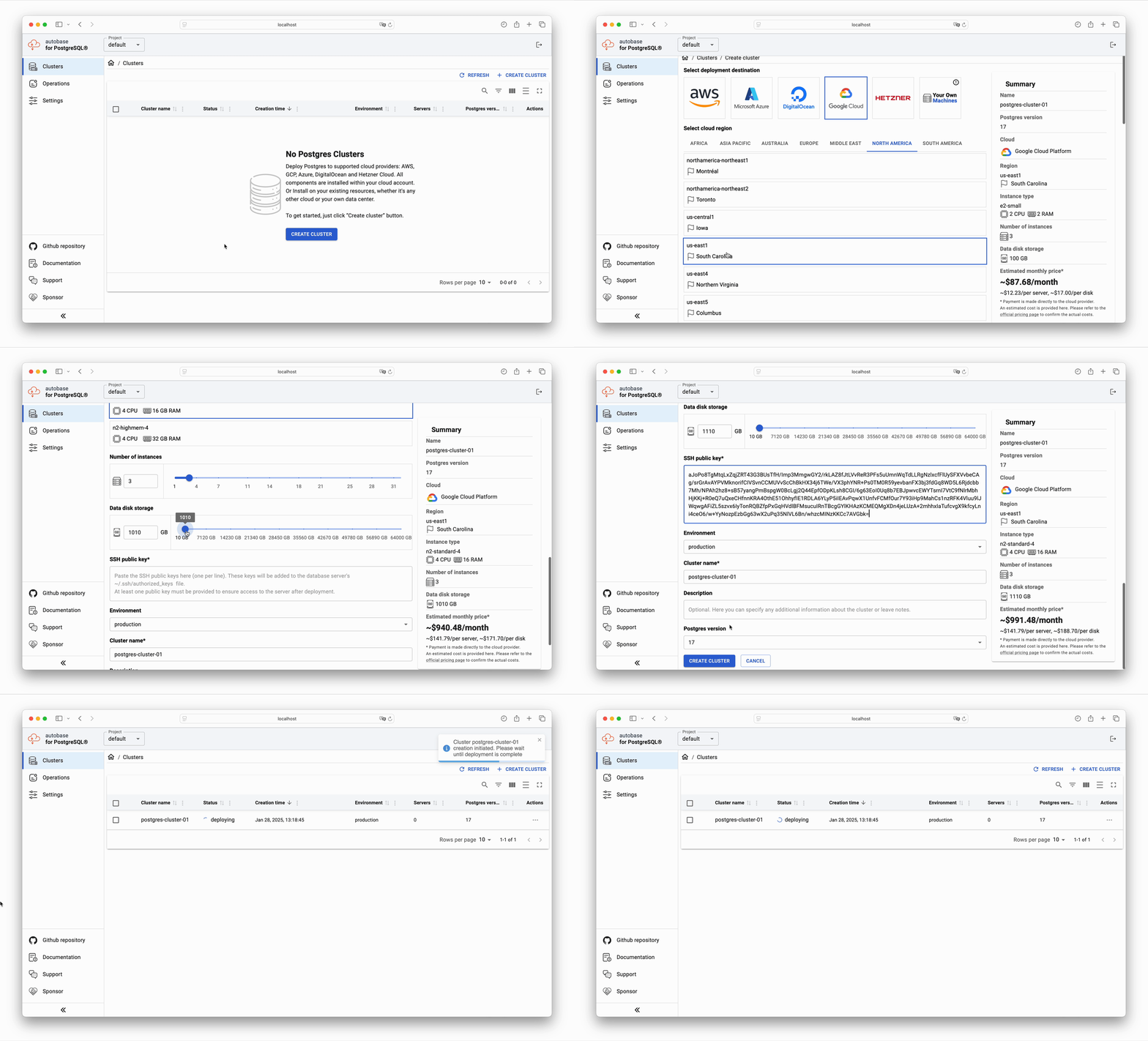
Cluster creation demo

Automate deployment, failover, backups, restore, upgrades, scaling, and more with ease.

Say goodbye to manual database management 👋

Documentation

Autobase documentation can be found here.

Architecture
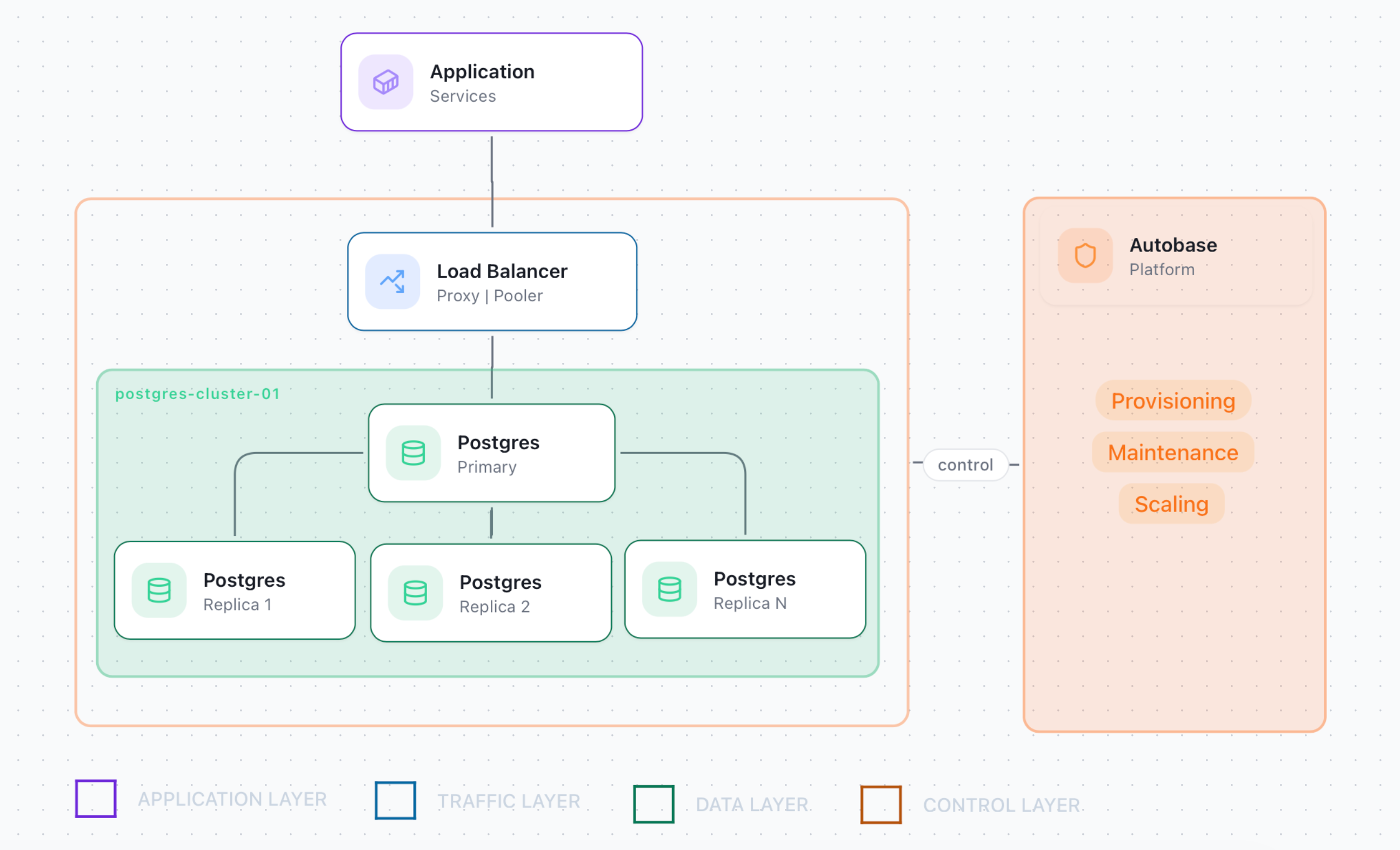
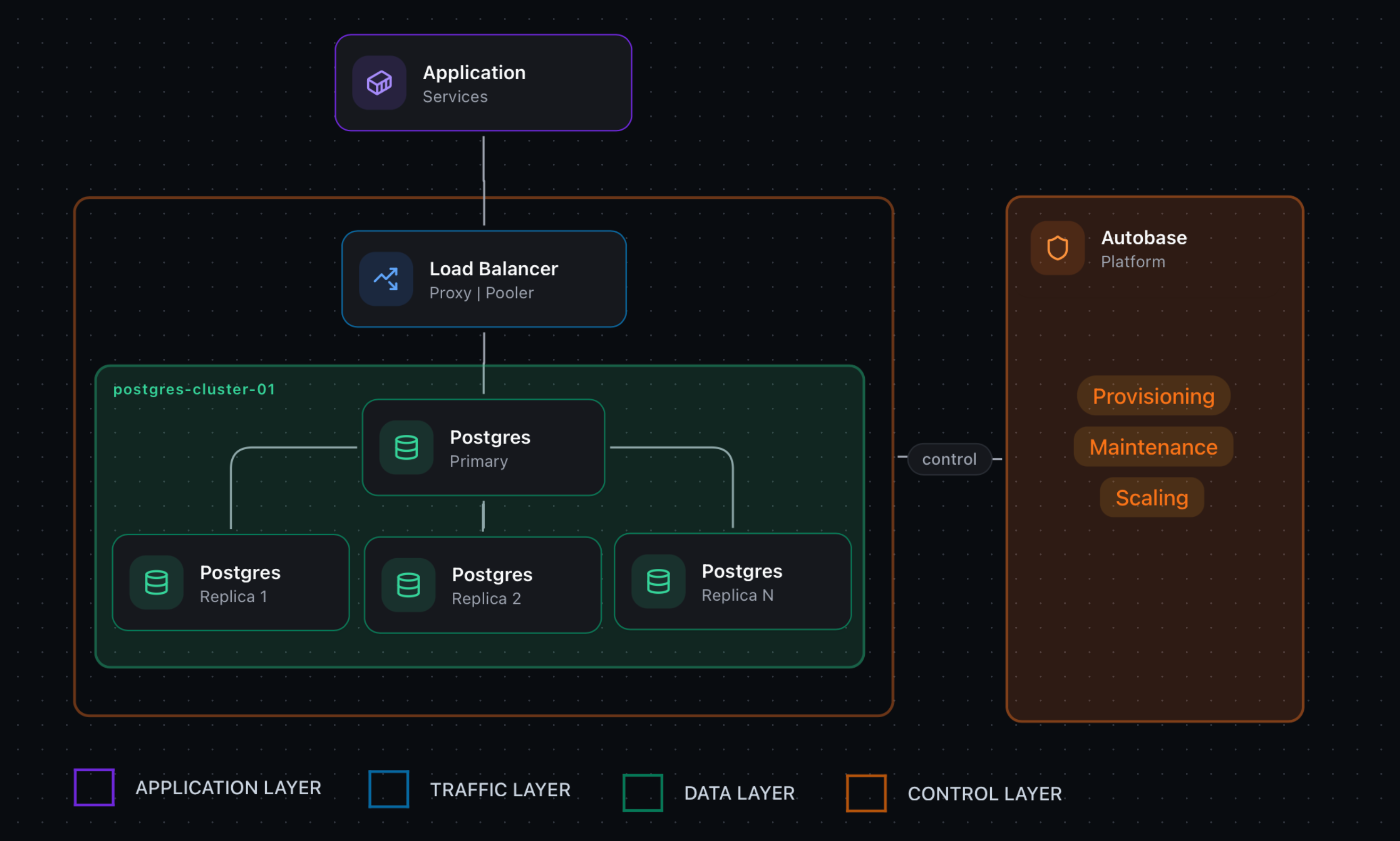
pg_cluster_scheme pg_cluster_scheme

For a detailed description of the cluster components, visit the Architecture page.

Getting Started

You can deploy PostgreSQL clusters using the Console (UI), command line (Ansible), or GitOps.

Console (UI)

  • Community Edition - Free license for individual developers and hobby projects; includes lightweight cluster deployment.
  • Enterprise Edition - Commercial license for production environments; includes extended cluster management features and support.

Ansible Collection

  • Ansible Collection - The automation layer for those who prefer Ansible playbooks instead of the database platform.

GitOps

  • GitOps (CI/CD) - Manage cluster configuration in Git and apply changes through CI/CD pipelines.

[!TIP] 📩 Contact us at [email protected], and our team will help you implement Autobase into your infrastructure.

Compatibility

Red Hat and Debian-based distributions.

Supported Linux Distributions:
  • Debian: 11, 12, 13
  • Ubuntu: 22.04, 24.04, 26.04
  • CentOS Stream: 9, 10
  • Oracle Linux: 8, 9, 10
  • Rocky Linux: 8, 9, 10
  • AlmaLinux: 8, 9, 10

Architecture: x86_64 (amd64), aarch64 (arm64).

PostgreSQL versions:

All supported PostgreSQL versions.

:white_check_mark: tested, works fine: PostgreSQL 10, 11, 12, 13, 14, 15, 16, 17, 18

Table of results of daily automated testing of cluster deployment:

Distribution Test result
Debian 12 GitHub Workflow Status
Debian 13 GitHub Workflow Status
Ubuntu 24.04 GitHub Workflow Status
Ubuntu 26.04 GitHub Workflow Status
CentOS Stream 9 GitHub Workflow Status
CentOS Stream 10 GitHub Workflow Status
Oracle Linux 9 GitHub Workflow Status
Oracle Linux 10 GitHub Workflow Status
Rocky Linux 9 GitHub Workflow Status
Rocky Linux 10 GitHub Workflow Status
AlmaLinux 9 GitHub Workflow Status
AlmaLinux 10 GitHub Workflow Status

Project Status

Autobase has been actively developed for over 7 years (since 2019) and is trusted by companies worldwide, including in production environments with high loads and demanding reliability requirements. Our mission is to provide an open-source DBaaS that delivers reliability, flexibility, and cost-efficiency.

The project will remain open-source forever, but to ensure its continuous growth and development, we rely on sponsorship and support packages. Support packages provide access to personalized support from the project authors and PostgreSQL experts.

Star us

If you find our project helpful, consider giving it a star on GitHub! Your support helps us grow and motivates us to keep improving. Starring the project is a simple yet effective way to show your appreciation and help others discover it.

Star History Chart

License

Licensed under the MIT License. See the LICENSE file for details.

Author

Vitaliy Kukharik (PostgreSQL Expert, Founder Autobase.tech)
[email protected]

Frequently asked questions

Is autobase free to use?

autobase is open source under the MIT licence. There is no licence fee and no seat count — you can self-host it or, where the project offers one, pay a vendor for a managed version instead.

What does autobase do?

Automated database platform for PostgreSQL® - Your own DBaaS.

What is autobase written in?

autobase is primarily written in TypeScript. Its source is publicly available at https://github.com/autobase-tech/autobase, and it has 4,385 GitHub stars.