@extractus/article-extractor
Extract main article, main image and meta data from URL.


Install
Deno
deno add jsr:@extractus/article-extractor
Node.js / Bun
pnpm add jsr:@extractus/article-extractor
# or
npx jsr add @extractus/article-extractor
# or
bunx jsr add @extractus/article-extractor
Alternatively, install from npm:
npm install @extractus/article-extractor
# or
bun add @extractus/article-extractor
Usage
import { extract } from "jsr:@extractus/article-extractor";

const data = await extract("https://example.com/article");
console.log(data);
APIs
extract()
Load and extract article data from a URL or HTML string.
Syntax
extract(input: string): Promise<ArticleData | null>
extract(input: string, parserOptions?: ParserOptions): Promise<ArticleData | null>
extract(input: string, parserOptions?: ParserOptions, fetcher?: Fetcher): Promise<ArticleData | null>
Example:
import { extract } from "jsr:@extractus/article-extractor";

try {
  const article = await extract("https://example.com/some-article");
  console.log(article);
} catch (err) {
  console.error(err);
}
The result can be null (when no article found) or an ArticleData object:
interface ArticleData {
  url?: string;           // best resolved URL
  links?: string[];       // alternative URLs (canonical, shortlink, amphtml)
  title?: string;         // article title
  description?: string;   // short description / excerpt
  image?: string;         // main image URL
  favicon?: string;       // site favicon URL
  author?: string;        // author name
  content?: string;       // extracted article HTML
  source?: string;        // original publisher domain
  published?: string;     // publication date string
  ttr?: number;           // estimated time to read (seconds), 0 = unknown
  type?: string;          // page type (e.g. "article")
}
Parameters
input required
URL string or raw HTML content.
parserOptions optional
| Property | Type | Default | Description |
|---|---|---|---|
wordsPerMinute |
number |
300 |
Words per minute for time-to-read estimation |
descriptionTruncateLen |
number |
210 |
Max characters for generated description |
descriptionLengthThreshold |
number |
180 |
Min characters to keep meta description |
contentLengthThreshold |
number |
200 |
Min characters for article content |
allowedTags |
string[] |
(semantic/content tags) | HTML tags to keep in output |
allowedAttributes |
Record |
(src, href, alt, etc.) | Per-tag attributes to keep |
allowedIframeDomains |
string[] |
(youtube, vimeo, etc.) | Allowed domains for iframe src |
const article = await extract(url, {
  descriptionLengthThreshold: 120,
  contentLengthThreshold: 500,
});
fetcher optional
A custom fetch function with the signature (url: string) => Promise.
Use this to customize HTTP behavior: proxy, headers, TLS, authentication, timeouts, etc.
Defaults to globalThis.fetch.
Deno (with proxy):
import { extract } from "@extractus/article-extractor";

const client = Deno.createHttpClient({
  proxy: { url: "http://proxy.example.com:8080" },
});
const myFetcher = (url: string) => fetch(url, { client });

const result = await extract("https://example.com/some-article", {}, myFetcher);
Node.js (with proxy via undici):
import { extract } from "@extractus/article-extractor";
import { fetch, ProxyAgent } from "undici";

const dispatcher = new ProxyAgent("http://proxy.example.com:8080");
const myFetcher = (url: string) => fetch(url, { dispatcher });

const result = await extract("https://example.com/some-article", {}, myFetcher);
Bun (with proxy):
import { extract } from "@extractus/article-extractor";

const myFetcher = (url: string) =>
  fetch(url, {
    proxy: "http://proxy.example.com:8080",
  });

const result = await extract("https://example.com/some-article", {}, myFetcher);
Custom headers:
const myFetcher = (url: string) =>
  fetch(url, {
    headers: {
      "user-agent": "MyBot/1.0",
      authorization: "Bearer token123",
    },
  });

const result = await extract("https://example.com/some-article", {}, myFetcher);
Request timeout:
const myFetcher = (url: string) =>
  fetch(url, {
    signal: AbortSignal.timeout(5000),
  });

const result = await extract("https://example.com/some-article", {}, myFetcher);
extractFromHtml()
Extract article data from an HTML string directly.
Syntax
extractFromHtml(html: string): Promise<ArticleData | null>
extractFromHtml(html: string, url?: string): Promise<ArticleData | null>
extractFromHtml(html: string, url?: string, parserOptions?: ParserOptions): Promise<ArticleData | null>
Example:
import { extractFromHtml } from "jsr:@extractus/article-extractor";

const res = await fetch(url);
const html = await res.text();

const article = await extractFromHtml(html, url);
Parameters
html required
HTML string containing the article.
url optional
Source URL for resolving relative links.
parserOptions optional
See parserOptions above.
Transformations
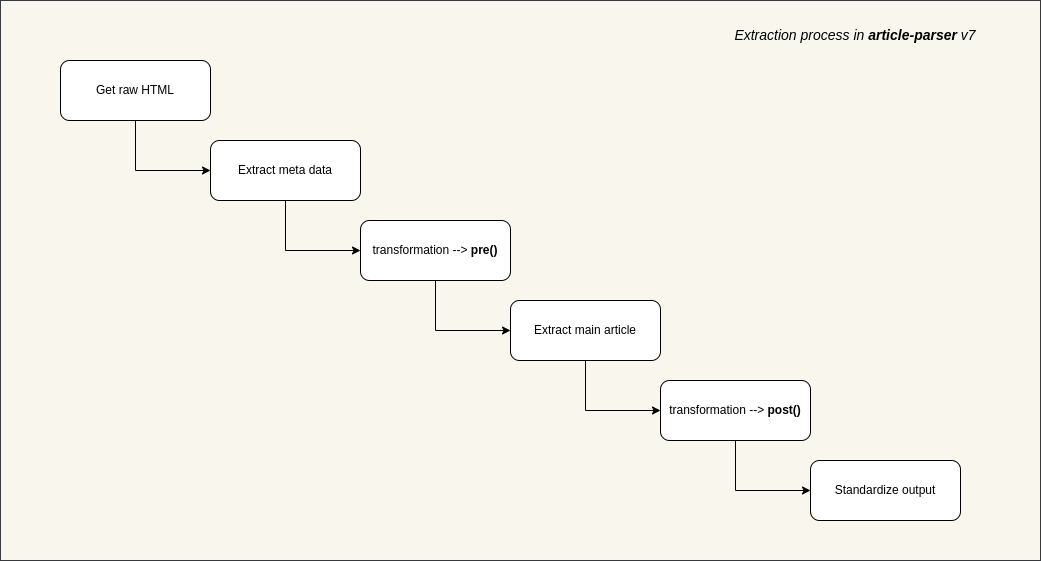
Sometimes the default extraction algorithm may not work well. Transformations let you add pre/post processing per-site.
addTransformations(transformation: Transformation | Transformation[]): numberremoveTransformations(patterns?: RegExp[]): number
Transformation object
interface Transformation {
  patterns: RegExp[];                        // URL patterns to match
  pre?: (document: Document) => Document;    // pre-process raw HTML
  post?: (document: Document) => Document;   // post-process extracted article
}
For URLs matching
patterns, runpreon raw HTML, extract article, then runposton the result.
Example:
import { addTransformations } from "jsr:@extractus/article-extractor";

addTransformations({
  patterns: [/([\w]+.)?domain\.tld\/*/],
  pre: (document) => {
    document.querySelectorAll(".advertise-area").forEach((el) => {
      el.parentNode?.removeChild(el);
    });
    return document;
  },
  post: (document) => {
    document.querySelectorAll("h4").forEach((el) => {
      const h2 = document.createElement("h2");
      h2.innerHTML = el.innerHTML;
      el.parentNode?.replaceChild(h2, el);
    });
    return document;
  },
});
To write better transformations, refer to linkedom and the Document API.
addTransformations(transformation | Transformation[])
Add a single or multiple transformations. Transformations without patterns are ignored.
import { addTransformations } from "jsr:@extractus/article-extractor";

addTransformations([
  {
    patterns: [/([\w]+.)?abc\.tld\/*/],
    pre: (doc) => { /* ... */ return doc; },
    post: (doc) => { /* ... */ return doc; },
  },
  {
    patterns: [/([\w]+.)?xyz\.tld\/*/],
    post: (doc) => { /* ... */ return doc; },
  },
]);
removeTransformations(patterns?: RegExp[])
Remove transformations matching the given patterns. Call without arguments to remove all.
import { removeTransformations } from "jsr:@extractus/article-extractor";

removeTransformations([
  /([\w]+.)?abc\.tld\/*/,
  /([\w]+.)?xyz\.tld\/*/,
]);
Priority order
When multiple transformations match, they all execute in order.
Given two transformations matching goo.gl:
pre_one -> pre_three -> extraction -> post_two -> post_four
Content sanitization options
Extracted HTML is sanitized using a built-in DOM tree walker. Disallowed tags are removed (not escaped), and disallowed attributes are stripped. Configure via parserOptions:
import { extract } from "jsr:@extractus/article-extractor";

// allow class attributes on <code> and
const article = await ext