English · 简体中文
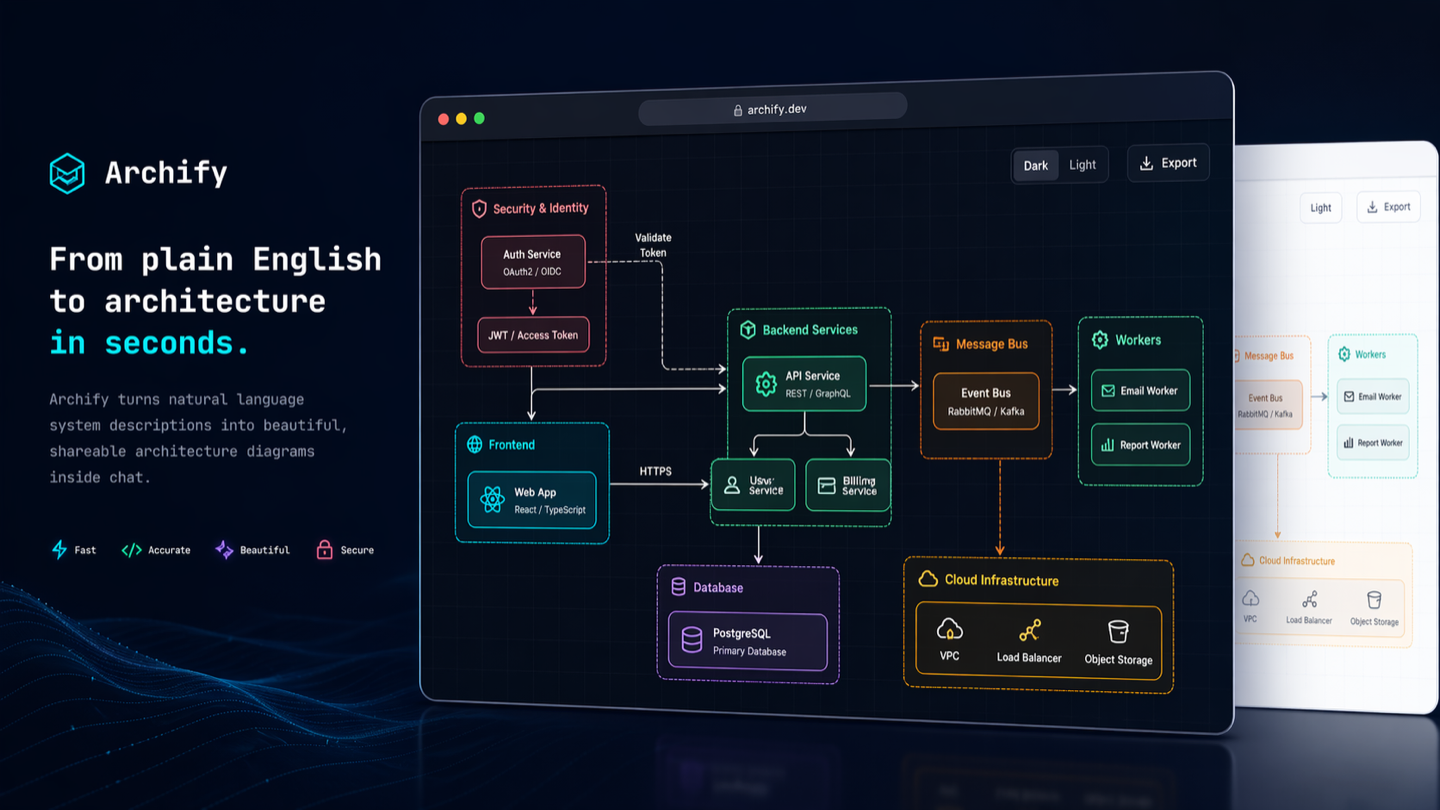
Archify
Turn a codebase or system description into a polished, interactive system map — directly in chat.
Archify is a Node.js rendering and validation system for Cursor, Claude Code, Codex CLI, and OpenCode. Agents produce typed JSON IR; Archify deterministically compiles it into HTML/SVG.
- Open it and present — five diagram types, four presets, dark/light themes, built-in brand marks, and finite motion
- Review architecture changes before merge — compare two validated snapshots as Before / Delta / After, with exact added, removed, changed, moved, and rerouted facts
- Every interaction stays grounded — search nodes, optionally open revision-verified source, trace upstream/downstream authored reach and exact routes, compare roles, and play guided stories without inventing topology
- One file, ready to trust and share — typed JSON IR and deterministic checks produce self-contained HTML plus PNG, SVG, WebM, and 1200×630 share cards



Current development version: v2.17.0-dev.1. See Changelog.
Project page · Scenario guide · Proof Lab
npx skills add tt-a1i/archify -g
Using Cursor? Open the agent-aware quick start for exact global and project commands.
No repository is required: describe the system in any agent chat.
❤️ Sponsors
 supercode.sh |
Supercode sponsors Archify and enhances Codex and Cursor with token optimization, curated Skills, and spec-driven development. Archify is featured as a Supercode Editor’s Choice skill. |
 EverMind · Raven | EverMind sponsors Archify and builds memory infrastructure for agents. Its Raven harness supports Archify as a Skill for verified, interactive system maps. |
Want to sponsor Archify? Contact us by email.
See Archify in action
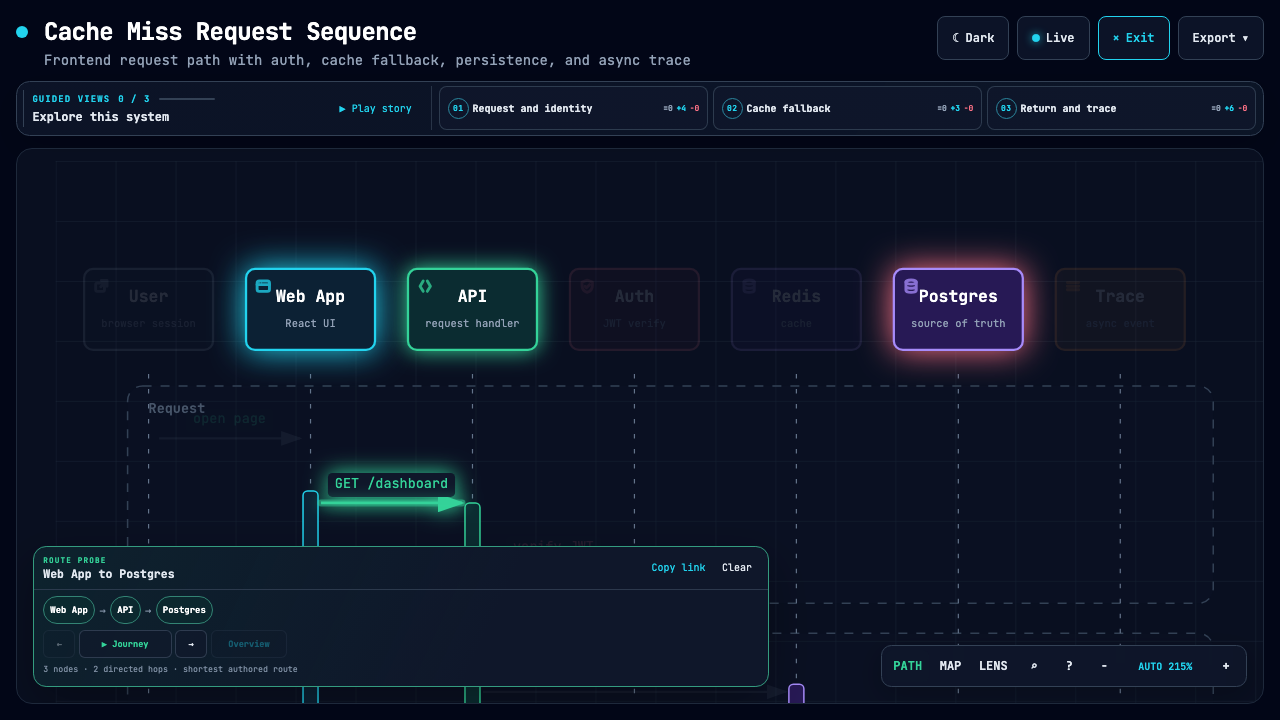
These are generated Archify artifacts, not product mockups. Click a frame to open its live, shareable state.
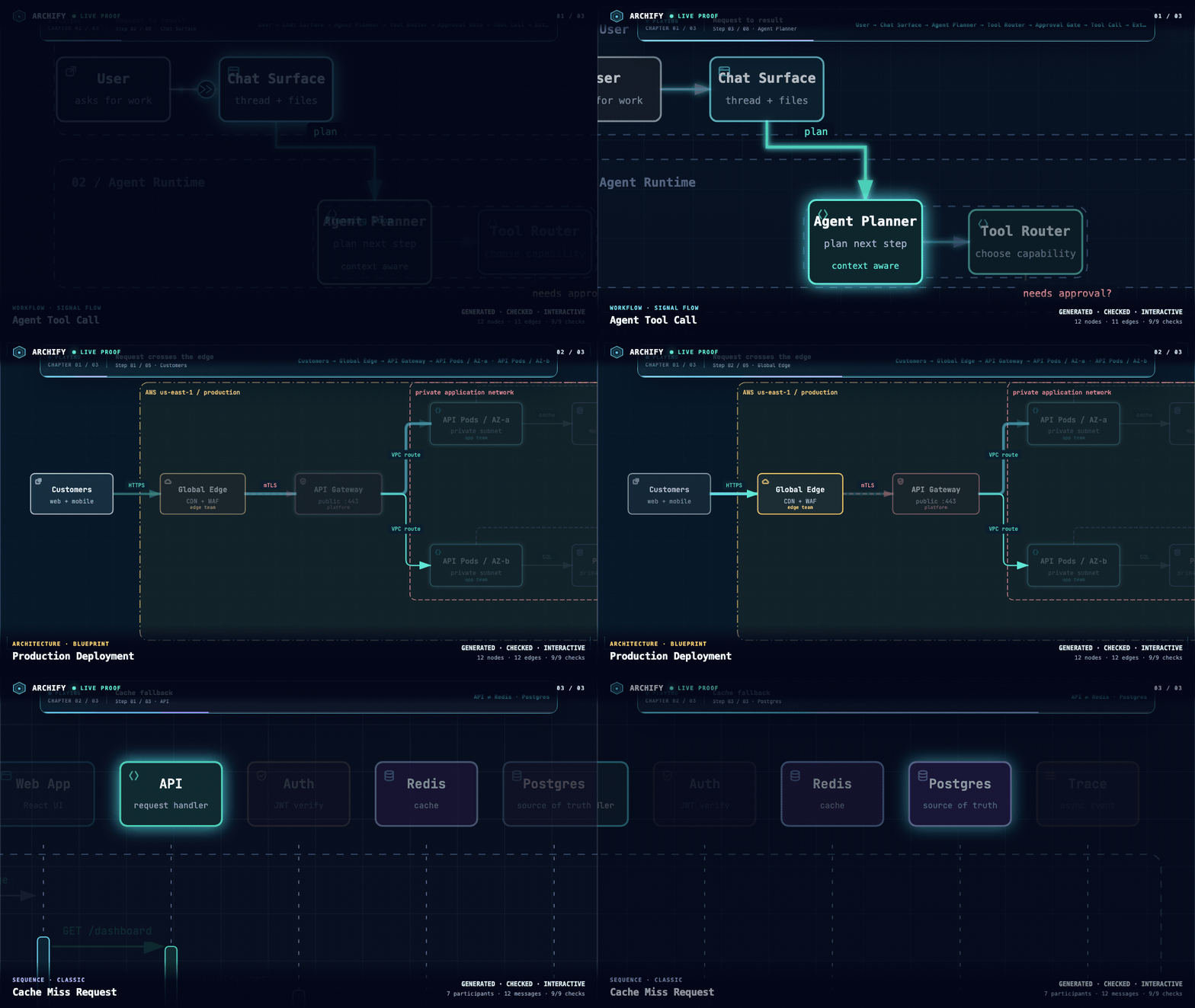
Three real generated artifacts. Signal Flow · Blueprint · Classic · open the interactive Proof Lab ↗
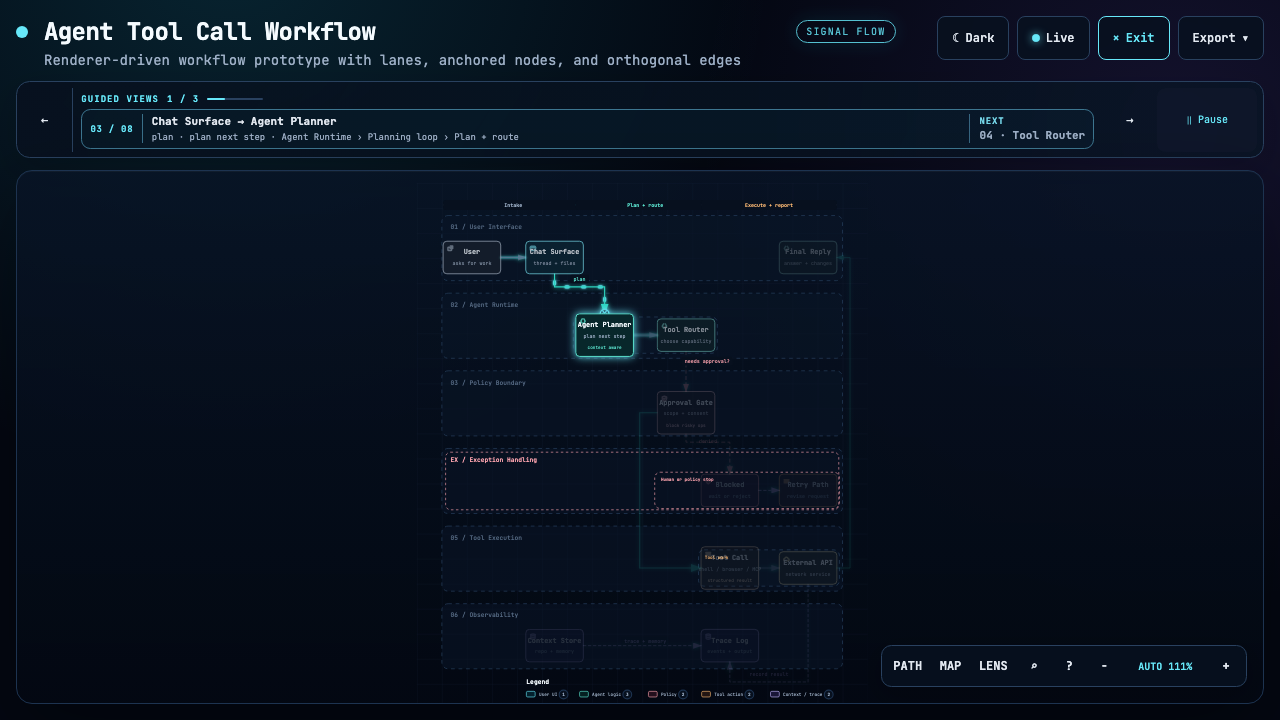
| Guided story | Route probe | Semantic lens |
|---|---|---|
 |
 |
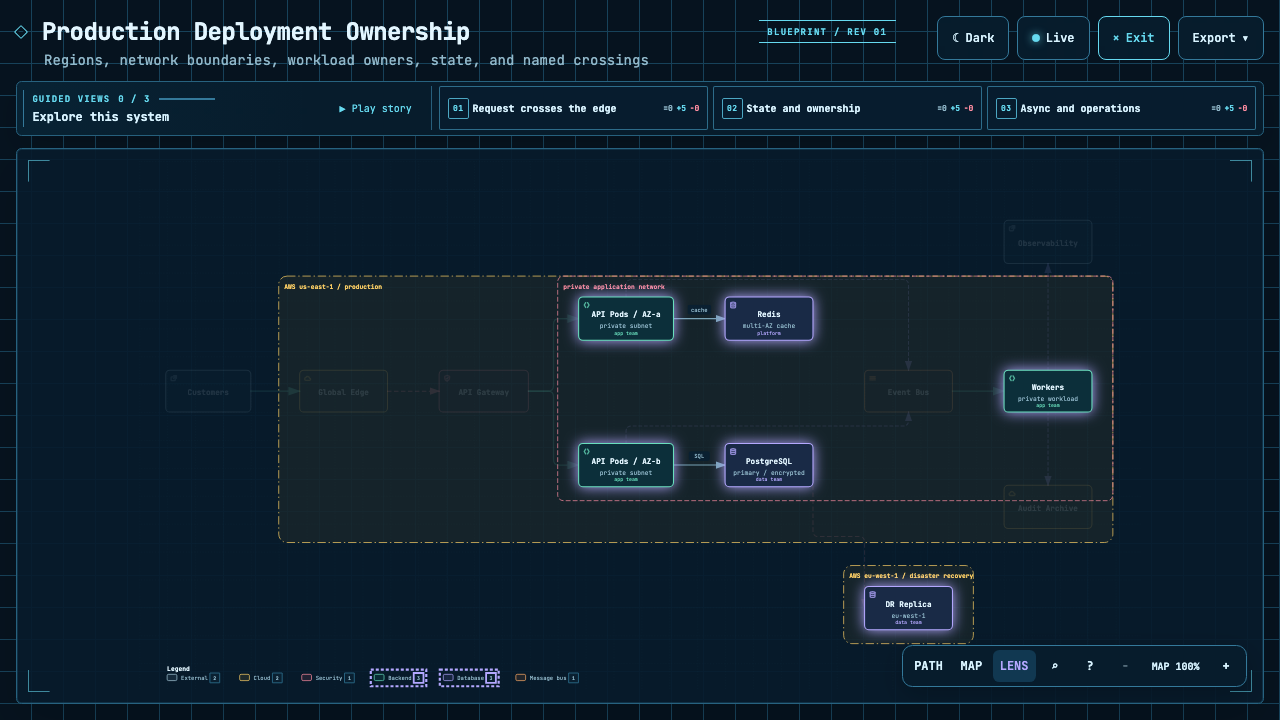 |
| Play one finite named chapter. | Inspect the shortest authored directed path. | Compare real traffic between semantic roles. |
The Proof Lab contains all 11 checked-in scenarios, their JSON sources, named views, and validation receipts.
A real repository, mapped from source
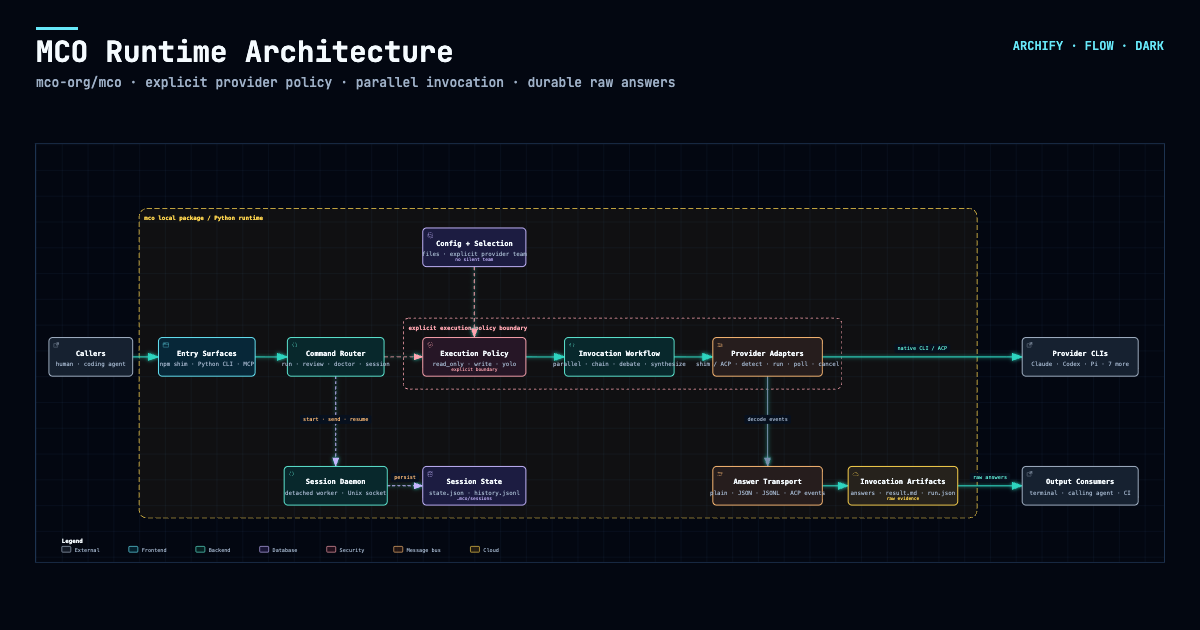
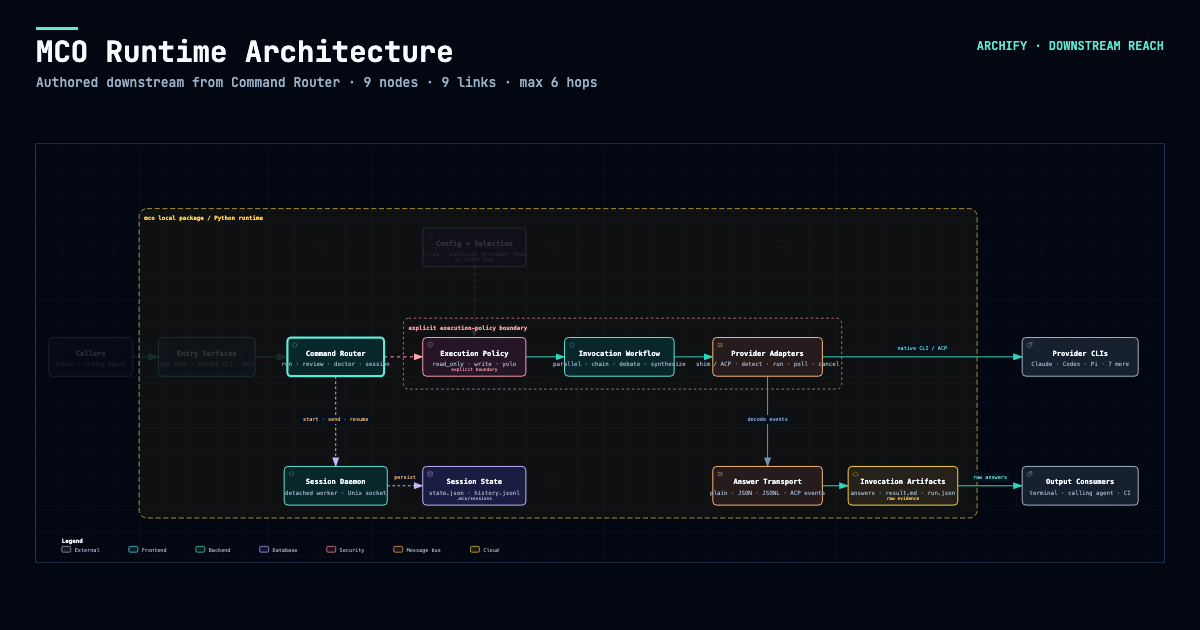
Archify traced mco-org/mco at 9f1a1cf and produced this checked map. Open it ↗ · trace reach ↗ · typed source
Preview
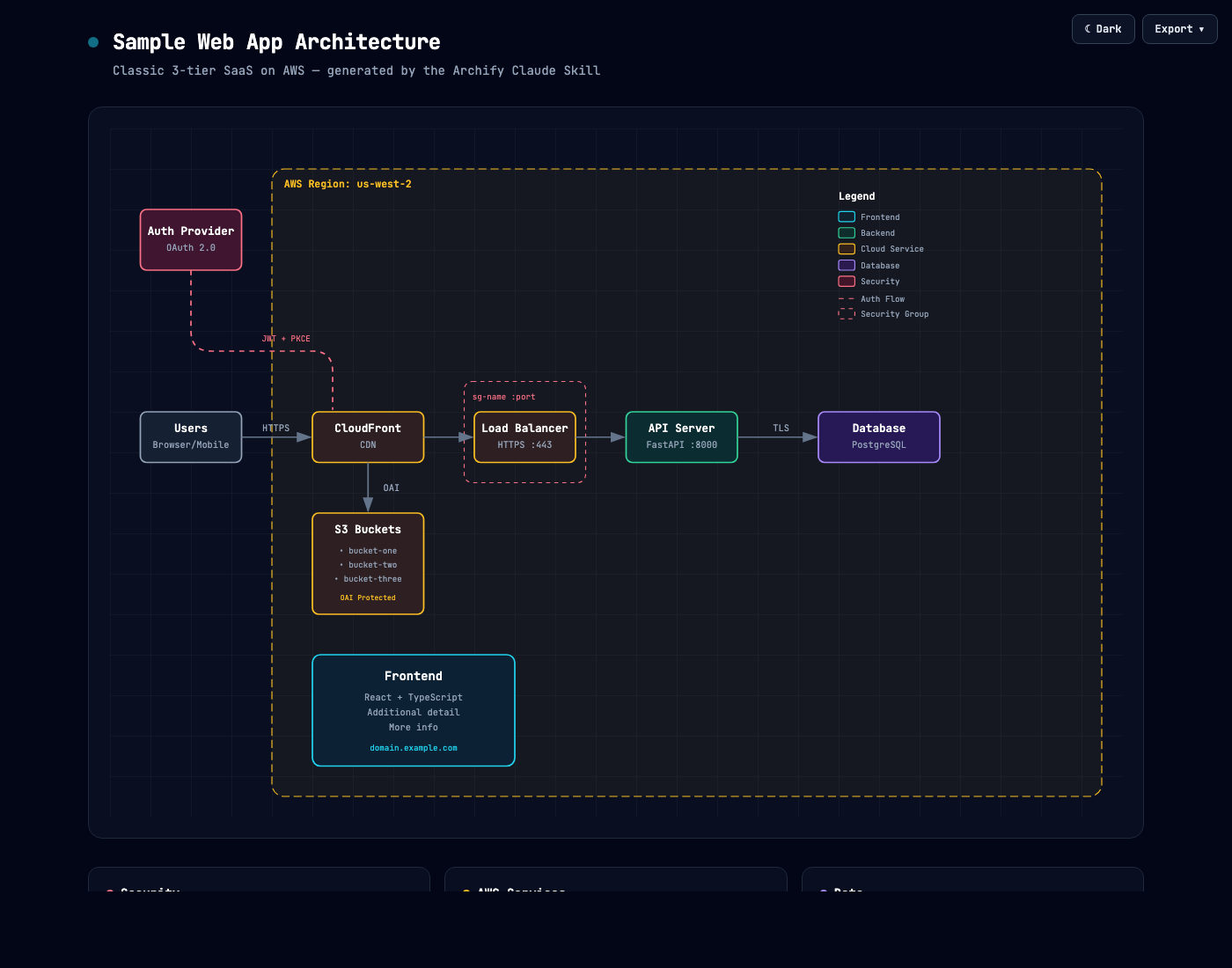
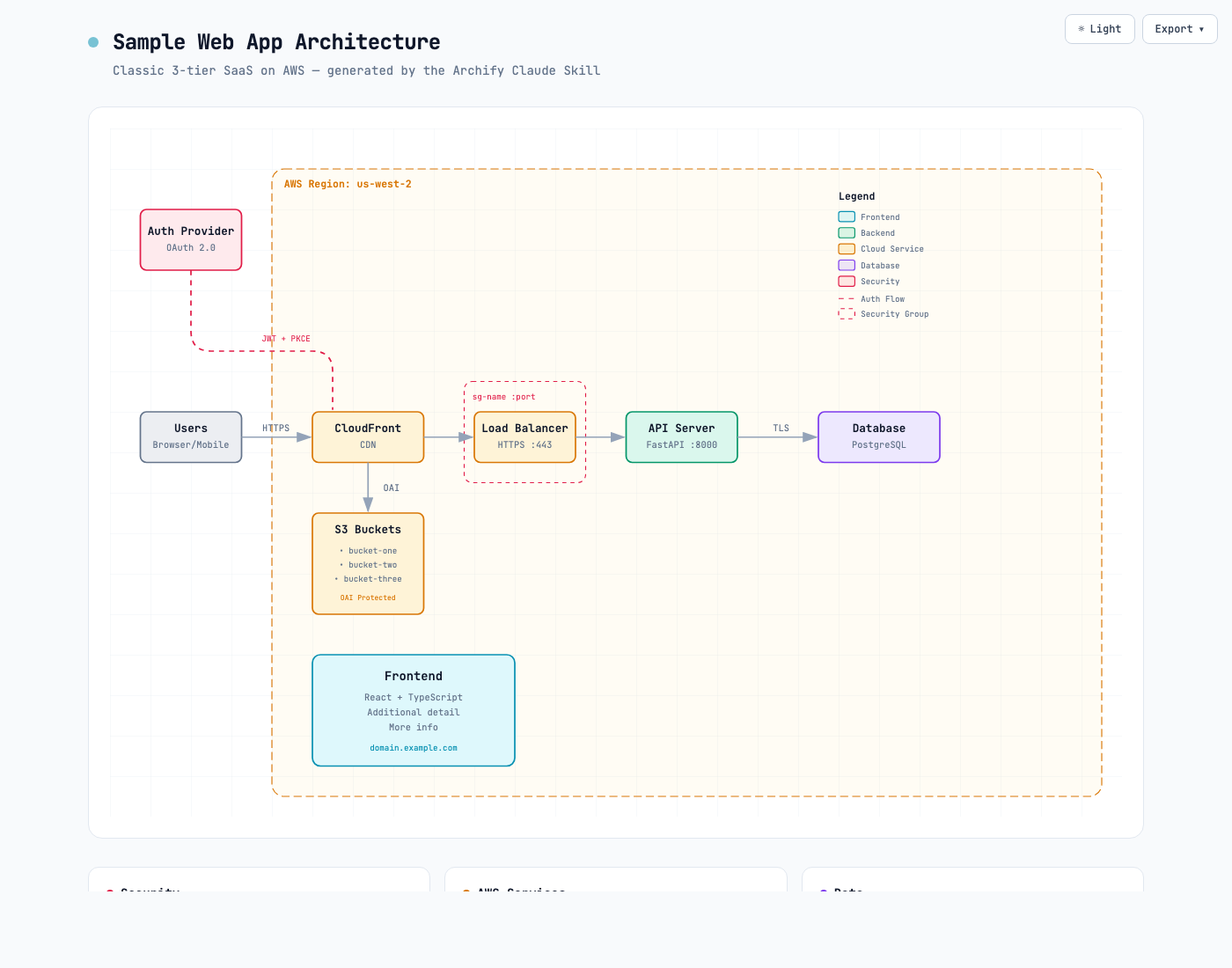
Same diagram, two themes, one click to switch:
| Dark | Light |
|---|---|
 |
 |
The Export menu copies PNG to the clipboard and downloads static or motion formats:
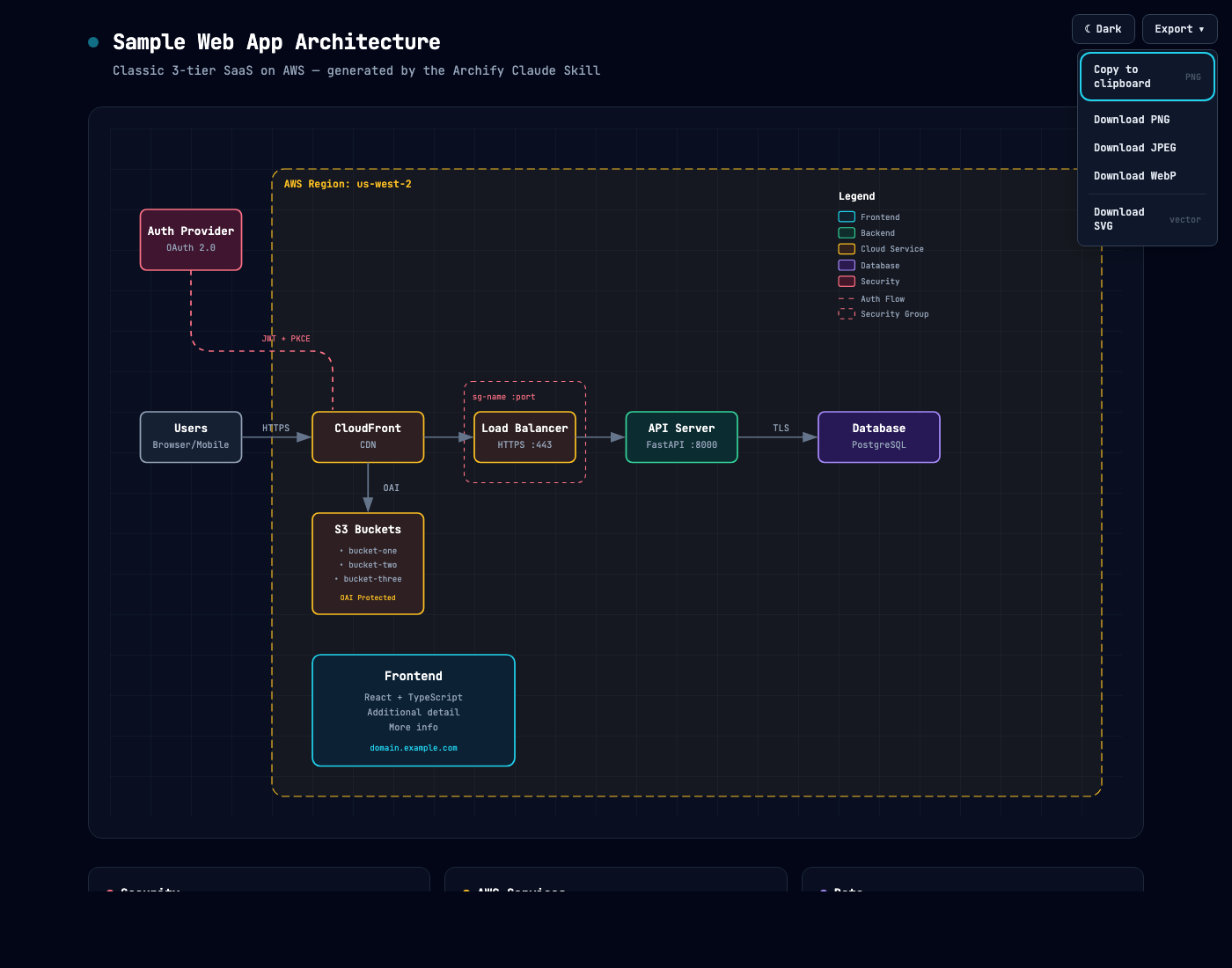
Use Copy Share Card when you want a canonical 1200×630 image for a README, release, or social post.
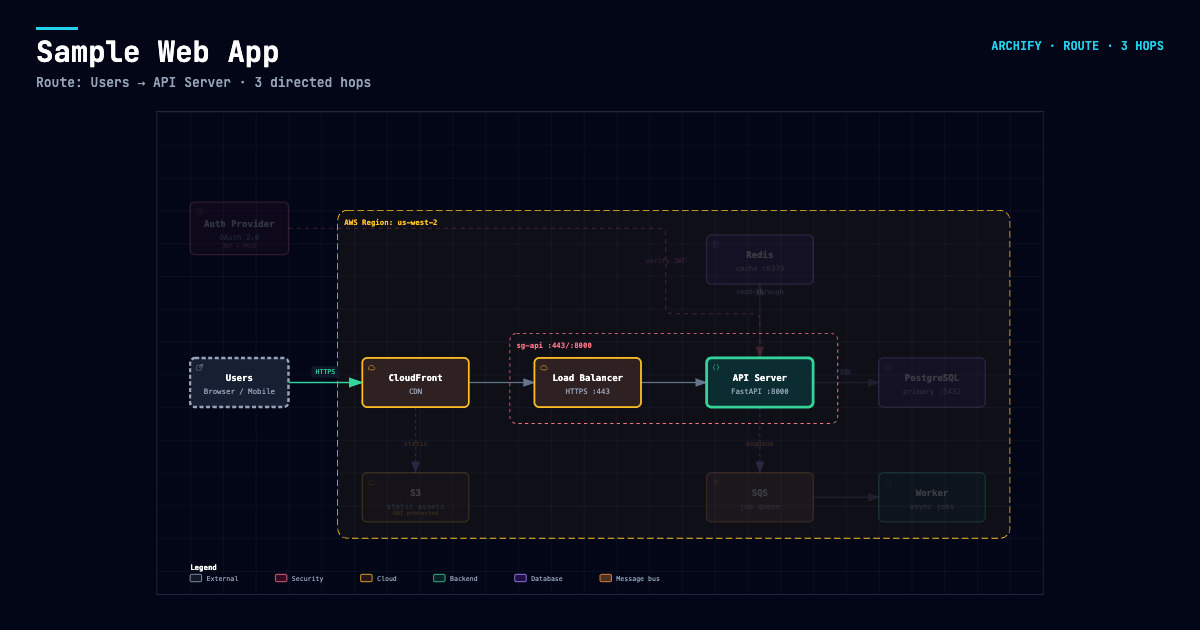
After tracing a route, Export → Route Share Card downloads that authored path as a 1200×630 PNG with the full diagram retained for context.
After tracing authored Upstream or Downstream reach, Export → Reach Share Card captures that exact reading without claiming runtime impact.
Open examples/web-app.html locally to try the complete viewer.
Quick start
1. Install
npx skills add tt-a1i/archify -g
For an explicit, non-interactive Cursor install:
npx -y skills add tt-a1i/archify --skill archify --agent cursor --global --copy --yes
To try without installing:
npx skills use tt-a1i/archify@archify --agent codex
DSH community opt-in: dsh plugin --profile web add @tt-a1i/[email protected]
The agent switcher covers cursor, codex, claude-code, and opencode. For Raven's manual ZIP install, extract archify.zip into ~/.raven/workspace/skills; it yields ~/.raven/workspace/skills/archify. Raven is not a switcher target.
Archify may GET the fixed stable manifest solely to show an optional reminder; it never downloads or installs updates. Successful checks wait about 72 hours (±20%); active use retries failures after 6, then 24 hours. The server sees normal HTTP metadata (IP and time), but receives no version, Agent, project data, prompts, account/device ID, or ETag. You decide whether and when to update. Set ARCHIFY_UPDATE_CHECK_DISABLED=1 to disable networking and reminder-state writes.
2. Start from a description — no repository required
Use Archify to draw: Browser -> API -> Redis cache -> PostgreSQL fallback.
For source evidence, open a repository and ask:
Analyze this repository, then use archify to create a high-level runtime architecture diagram.
Show 8–12 core components, one primary path, external dependencies, and trust boundaries.
Put supporting detail in cards instead of adding more edges.
3. Refine in chat
Continue with focused requests such as add Redis, move auth to the left, or highlight the rollback path. Archify keeps the