Airgorah is a WiFi security auditing application written in Rust with a GTK4 graphical interface, built for Linux users such as penetration testers, wireless auditors and security engineers who assess networks they own or are authorised to test.
What it is
Airgorah is a WiFi security auditing tool published as the crate airgorah on crates.io and packaged for Arch Linux in the AUR. It is written in Rust, uses GTK4 for its graphical layer, and is listed in this registry under Security & Privacy / Threat Detection & Response. The project is released under the MIT licence and carries the topics aircrack-ng, gui, kali, linux-app, security, security-audit, wifi, wifi-security and wireless. It holds 3520 stars and 594 forks, with 7 open issues and a last push on 18 September 2026.
The concrete job it does is stated plainly in the README: capture nearby WiFi traffic, discover clients connected to access points, perform deauthentication attacks, capture handshakes, and crack the password of access points. The ecosystem it lives in is the Linux wireless auditing stack, and the topic list names aircrack-ng as the adjacent tool of that class. Airgorah's answer to the usual command-line workflow is a desktop application: the graphical interface runs as a normal user under both X11 and Wayland, and a small privileged agent, airgorah-agent, is launched through polkit only when a privileged operation is required, prompting for authentication once. That keeps the audit session in a window instead of a root shell.
Key capabilities
- Captures nearby WiFi traffic from a wireless card running in monitor mode.
- Discovers clients connected to access points.
- Performs deauthentication attacks.
- Captures handshakes.
- Cracks the password of access points.
- Runs the GTK4 interface as a normal user, under both X11 and Wayland.
- Escalates through the
airgorah-agent binary launched via polkit, which prompts for authentication once per session.
Who uses it and how
- Wireless security auditors and penetration testers assessing networks they own; the README states that attacking networks you do not own is illegal in almost all countries.
- Kali Linux users, indicated by the
kali and linux-app topics, running the tool from an audit workstation.
- Arch Linux users installing from the AUR package tracked by the project's badge.
- Rust and crates.io users consuming
airgorah as a published crate.
- Operators on a single desktop machine with a wireless adapter that supports monitor mode and packet injection.
Getting started
Installation instructions live in the project wiki, and the software is distributed through crates.io as the crate airgorah and through the Arch User Repository package. Expect a Linux desktop with a monitor-mode, packet-injection capable wireless card before anything runs.
How it compares
No list of paid products this project replaces appears in the facts. The only comparable tool named is aircrack-ng, which registers as a topic tag rather than as a documented replacement target, so the contrast that can be made honestly is narrow: Airgorah covers the same class of wireless auditing tasks from a Rust and GTK4 desktop application, where the work is otherwise associated with the command-line aircrack-ng suite and its supporting utilities.
When to use it — and when not to
It is Linux-only, it needs a wireless card supporting monitor mode and packet injection, and privileged actions depend on polkit and the airgorah-agent helper, so anyone without that hardware or without authorisation over the target network should not pick it up. The README itself is short and defers both installation and usage detail to external wiki pages, so a self-hoster should expect to leave the repository to get running. The MIT licence is clear and the project is active, but the documentation split is a real friction point.
project readme (upstream, from github) — read inline

Airgorah
A WiFi security auditing software
Installation
|
Usage
|
Credits
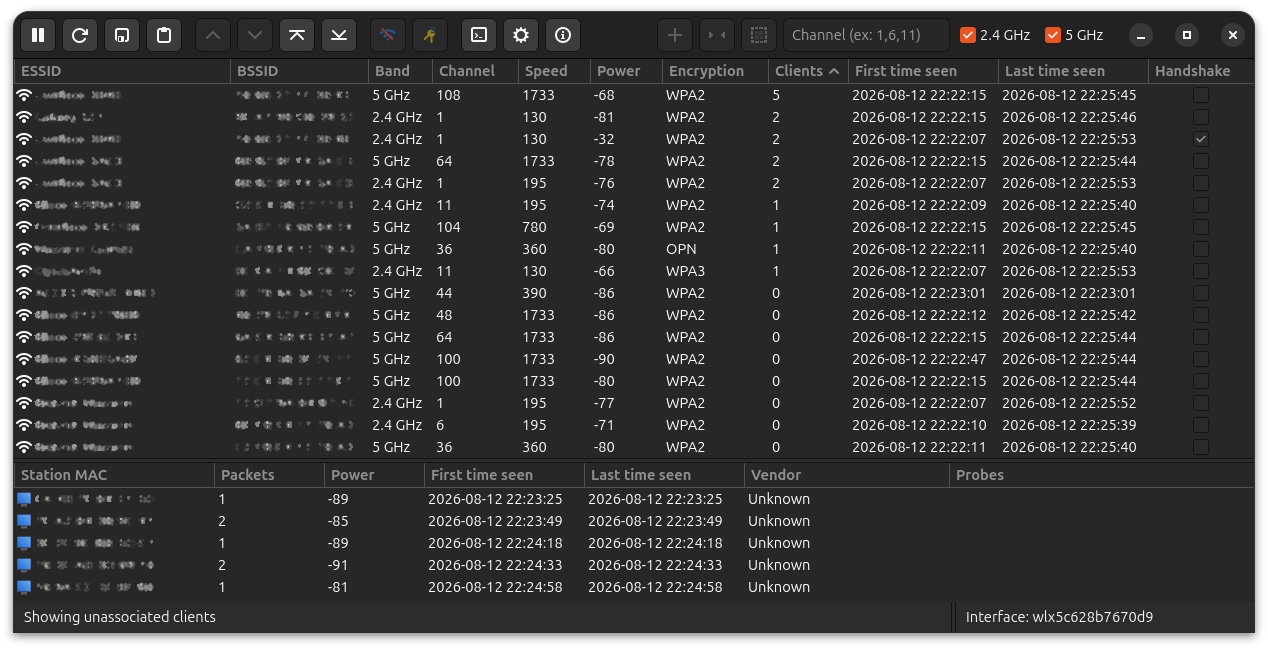



Airgorah is a WiFi security auditing software that can capture nearby WiFi traffic, discover clients connected to access points, perform deauthentication attacks, capture handshakes, and crack the password of access points.
It is written in Rust and uses GTK4 for the graphical part.
⭐ Don't forget to put a star if you like the project!
Legal
⚠️ Airgorah is designed to be used in testing and discovering flaws in networks you are owner of. Performing attacks on WiFi networks you are not owner of is illegal in almost all countries. I am not responsible for whatever damage you may cause by using this software.
Requirements
This software only works on linux. The graphical interface runs as a normal
user (so it works under both X11 and Wayland). When a privileged operation is
needed, it launches a small privileged agent (airgorah-agent) via polkit,
which will prompt for authentication once.
You will also need a wireless network card that supports monitor mode and packet injection.
Installation
The installation instructions are available here.
Usage
The documentation about the usage of the application is available here.
License
This project is released under MIT license.
Contributing
If you have any question about the usage of the application, do not hesitate to open a discussion
If you want to report a bug or provide a feature, do not hesitate to open an issue or submit a pull request