Agent Router is an open source control plane for AI and agent traffic, built on Envoy and Envoy Gateway, that gives application teams one consistent OpenAI-compatible API across hosted providers, self-hosted inference, and MCP servers, and it is aimed at platform teams and application teams running generative AI workloads, especially on Kubernetes.
What it is
Agent Router is a Go project licensed under Apache-2.0 and published as an Agentic AI Foundation project. The registry entry records 2,116 stars, 379 forks, and 300 open issues. The README describes it as the open source control plane for AI and agent traffic, powered by Envoy, and summarises the split of responsibility as "Agent Router controls. Envoy carries." The project was formerly named Envoy AI Gateway and retains the same code, maintainers, release cadence, and licence.
The problem it solves is fragmentation. Without a gateway, every application team integrates each model provider separately, while credential handling, quota enforcement, and failover logic sit in scattered places. Agent Router replaces those per-provider integrations with a single OpenAI-compatible API, and platform teams keep credentials, routing, quotas, failover, and usage attribution in one place, enforced by Envoy and Envoy Gateway rather than by application code.
Key capabilities
- Serves an OpenAI-compatible API on
http://localhost:1975/v1, so existing OpenAI-compatible clients work without provider-specific changes.
- Supports OpenAI, Azure OpenAI, Google Gemini, Vertex AI, AWS Bedrock, Mistral, Cohere, Groq, Together AI, DeepInfra, DeepSeek, Hunyuan, SambaNova, Grok, Tetrate Agent Router Service, and Anthropic.
- Declares routing and credentials through the
AIGatewayRoute, AIServiceBackend, and BackendSecurityPolicy custom resources in the aigateway.envoyproxy.io API group.
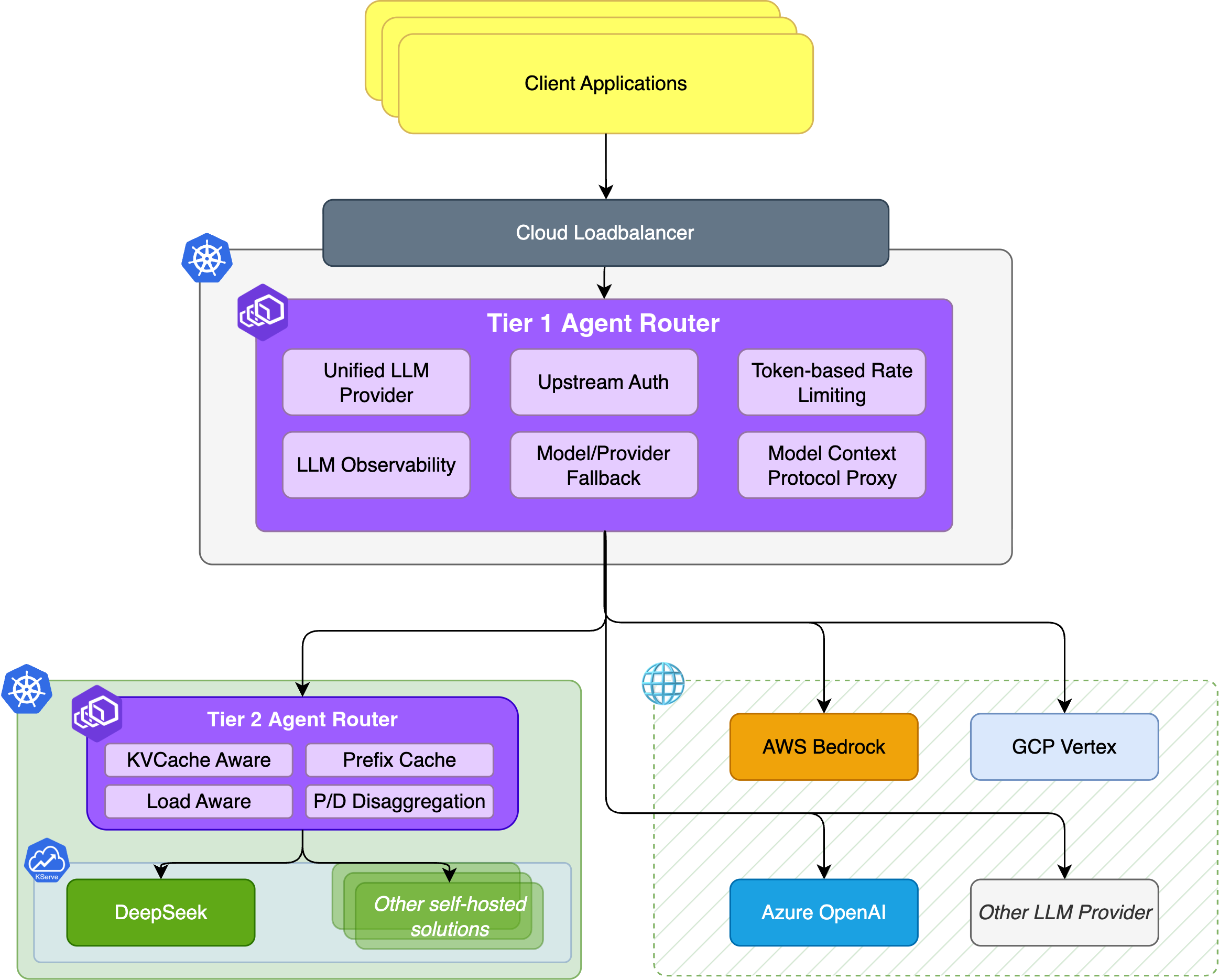
- Implements a two-tier gateway pattern in which the Tier One Gateway handles authentication, top-level routing, and global rate limiting.
- Adds a Tier Two Gateway for ingress to a self-hosted model serving cluster, with endpoint picker support for LLM inference optimization.
- Ships the
aigw CLI, which runs Agent Router standalone and handles provider auto-configuration.
- Leaves the
envoy-ai-gateway-system namespace, the docker.io/envoyproxy/ai-gateway-* images, the Helm charts, and the Go module path github.com/envoyproxy/ai-gateway unchanged after the rename.
Who uses it and how
- Platform teams centralize credentials, routing, quotas, failover, and usage attribution for every model and tool the organization consumes.
- Application teams point existing OpenAI-compatible code at the gateway endpoint, so changing a model does not require client rewrites.
- Kubernetes operators deploy it next to Envoy Gateway as the control plane, following the documented Getting Started path.
- Teams running self-hosted inference use the Tier Two Gateway for fine-grained control over model access and endpoint picking.
- Developers run the standalone router locally with
aigw run before applying the same configuration to a cluster.
Getting started
The quickest route is the standalone CLI: install aigw, run OPENAI_API_KEY=sk-your-key aigw run, then point an OpenAI-compatible client at http://localhost:1975/v1. For cluster deployment, the Getting Started guide covers installing Agent Router on Kubernetes with Envoy Gateway.
How it compares
The facts provided name no paid products that this project replaces, and they name no comparable gateway. Within this registry, Agent Router stands alone in pairing an Envoy Gateway control plane with an OpenAI-compatible interface spanning hosted providers and self-hosted inference. Its only named lineage is its own former identity as Envoy AI Gateway.
When to use it — and when not to
Choose it when a platform team needs one enforcement point for credentials, quotas, failover, and usage attribution across many providers and self-hosted models. A self-hoster must operate Envoy Gateway and the Kubernetes control plane and remains responsible for its configuration. It is a poor fit for a single-provider application that needs no routing, quota, or attribution layer, and for teams unwilling to run Envoy Gateway at all. The project also carries 300 open issues and a recent rename, so documentation written before the change may still refer to Envoy AI Gateway.
project readme (upstream, from github) — read inline
The open source control plane for AI and agent traffic, powered by Envoy.
An Agentic AI Foundation project. Formerly Envoy AI Gateway.
Documentation ·
Quickstart ·
Blog ·
Release Notes ·
Talks
Agent Router
Agent Router gives application teams one consistent, OpenAI-compatible API for every model and tool, from hosted providers to self-hosted inference and MCP servers. Platform teams keep credentials, routing, quotas, failover, and usage attribution in one place, enforced by Envoy and Envoy Gateway.
Agent Router controls. Envoy carries.
Formerly Envoy AI Gateway
Envoy AI Gateway is now Agent Router, an Agentic AI Foundation project. Same code, same maintainers, same release cadence and Apache 2.0 license. Nothing you deploy is renamed:
- CRDs and API group are unchanged:
AIGatewayRoute, AIServiceBackend, BackendSecurityPolicy, and the aigateway.envoyproxy.io API group stay as they are.
- The CLI is still
aigw, and the envoy-ai-gateway-system namespace is unchanged.
- Container images, Helm charts, and the Go module path are unchanged (
docker.io/envoyproxy/ai-gateway-*, github.com/envoyproxy/ai-gateway).
- The repository moved to
theagentrouter/agent-router; old envoyproxy/ai-gateway links redirect.
- The website moved to theagentrouter.ai; every
aigateway.envoyproxy.io link redirects to the same page.
Your manifests from yesterday apply tomorrow.
Quick start
Run Agent Router as a standalone, OpenAI-compatible router on your laptop with one command:
OPENAI_API_KEY=sk-your-key aigw run
Then point any OpenAI-compatible client at http://localhost:1975/v1. See the CLI guide for installation and provider auto-configuration, or the Getting Started guide to deploy on Kubernetes with Envoy Gateway.
Usage
When using Agent Router, we refer to a two-tier gateway pattern. The Tier One Gateway functions as a centralized entry point, and the Tier Two Gateway handles ingress traffic to a self-hosted model serving cluster.
- The Tier One Gateway handles authentication, top-level routing, and global rate limiting
- The Tier Two Gateway provides fine-grained control over self-hosted model access, with endpoint picker support for LLM inference optimization.
Supported AI Providers
Agent Router supports a wide range of AI providers, making it easy to integrate with your preferred LLM services:
Documentation
Contact
- Chat: join the Agent Router Discord to ask questions and collaborate with the community.
- Weekly meeting: the maintainers and community meet every Monday. Register, add agenda points, and get involved via the public meeting document.
Get Involved
We follow the LF Projects Code of Conduct, as an Agentic AI Foundation project.
To contribute to the project via pull requests, please read the CONTRIBUTING.md file which includes information on how to build and test the project.
Background
The proposal of using Envoy Gateway as a Cloud Native LLM Gateway inspired the initiation of this project.
Agent Router is an Agentic AI Foundation project, powered by Envoy. Copyright © Agent Router a Series of LF Projects, LLC. For web site terms of use, trademark policy and other project policies please see .