






Zeroshot
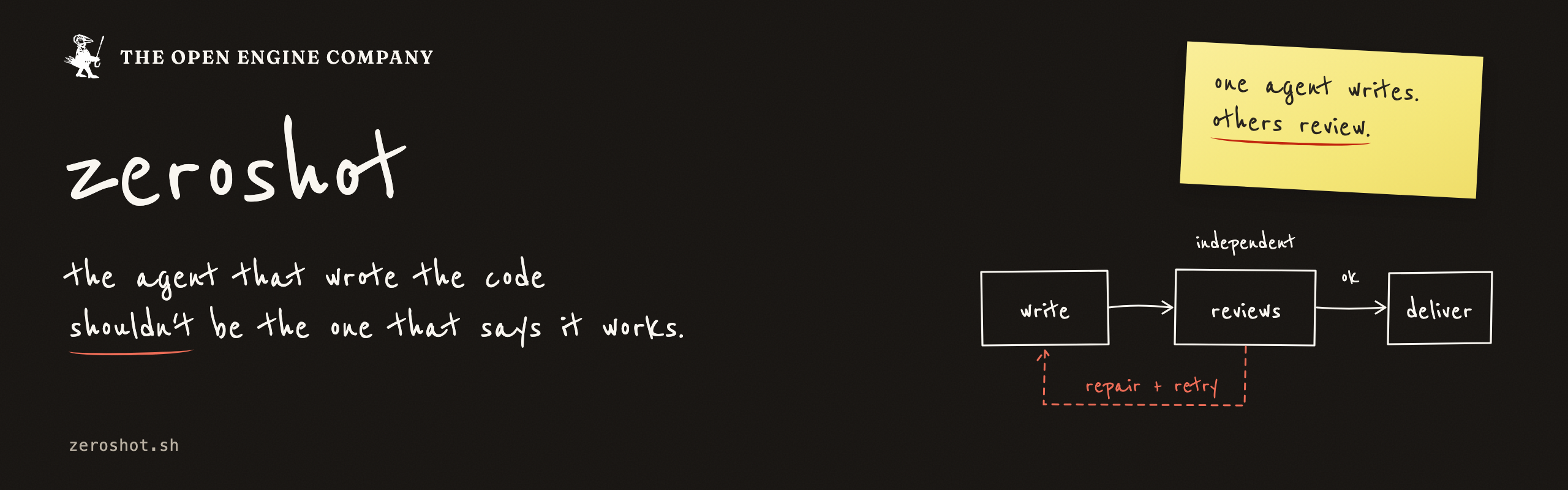
The agent that writes the code should not be the one that decides it works.
Zeroshot turns a software goal into an explicit multi-agent graph: one agent implements, independent agents review, failures go back to a bounded repair loop, and nothing is delivered until the graph's checks pass. The implementing agent never approves its own work.
Use the built-in graph or bring your own topology. Add reviewers, tests, and repair loops, then save the setup as a profile for the next task.
Opcore works alongside it: Opcore checks each edit while an agent writes code, and Zeroshot has independent agents review the whole change before it lands.
Questions, ideas, or a run worth showing? Join the Zeroshot community on Discord.
When to use it
Zeroshot fits when:
- a change should be checked by agents other than the one that wrote it, against the task's acceptance criteria and for code quality;
- you want the result delivered as a branch, a pull request with review feedback handled, or a merge after CI;
- you want the same review and repair setup reused across tasks, locally, on your own Docker target, or in Zeroshot Cloud.
It is not the right tool when:
- you'll review a small edit yourself in the editor; a single agent session is quicker;
- you need it to replace your tests. A passing run means the configured checks accepted the work, so coverage depends on the requirements, reviewers, and tests you provide.
Zeroshot v8 is a hard interface cutover. v8 replaces the Node.js runtime with a native
zeroshotbinary.
Install
npm install -g @the-open-engine-company/zeroshot
The installer requires Node.js 18 or newer and installs a verified native binary for Linux
x64/arm64, macOS x64/arm64, or Windows x64. It also installs one Zeroshot skill for Codex, GitHub
Copilot, and Claude Code at user scope. Native archives and checksums are attached to each
canonical vX.Y.Z GitHub Release.
For local execution, install and sign in to Codex, Claude Code, or GitHub Copilot. Local runs can reuse the harness's existing login, including subscription-backed sessions. See the installation guide for harness prerequisites.
Run your first task
This example uses Codex and keeps delivery local. The worker edits the current Git worktree, so start in a clean worktree intended for the task.
Create input.json, replacing the example task with a change appropriate for your repository:
{
  "task": "Add JSON output to the status command and cover it with focused tests."
}
Create runtime.json. Replace YOUR_MODEL_ID with a model identifier supported by your installed
Codex CLI:
{
  "harness": "codex",
  "provider": "openai",
  "model": "YOUR_MODEL_ID",
  "effort": "high"
}
Check the graph, runtime configuration, and input without starting a run:
zeroshot run \
  --title "Add JSON status output" \
  --template software-change \
  --input input.json \
  --uniform-runtime-config runtime.json \
  --validate-only
Then start it:
zeroshot run \
  --title "Add JSON status output" \
  --template software-change \
  --input input.json \
  --uniform-runtime-config runtime.json
Open another terminal to inspect the run:
zeroshot ui
Visit http://127.0.0.1:4173/ui/ and open Runs. Stopping the UI server leaves active runs
running. The CLI also provides zeroshot list, zeroshot status RUN_ID, and zeroshot logs RUN_ID.
For other harnesses and providers, see Runtimes and connections.
What the built-in workflow does
- A worker implements the task.
- Acceptance and code reviewers check the result independently, in parallel.
- Rejected work goes to a repair worker, then through both reviews again.
- With delivery enabled, accepted work proceeds through the configured Git and CI steps.
- Delivery conflicts return through repair and review.
The graph defines the sequence, parallel steps, retry paths, and exit conditions before execution starts. Runs are bounded, and events are recorded in a durable SQLite ledger. A passing run means its configured checks accepted the work; coverage depends on the requirements, reviewers, tests, and environment you provide.
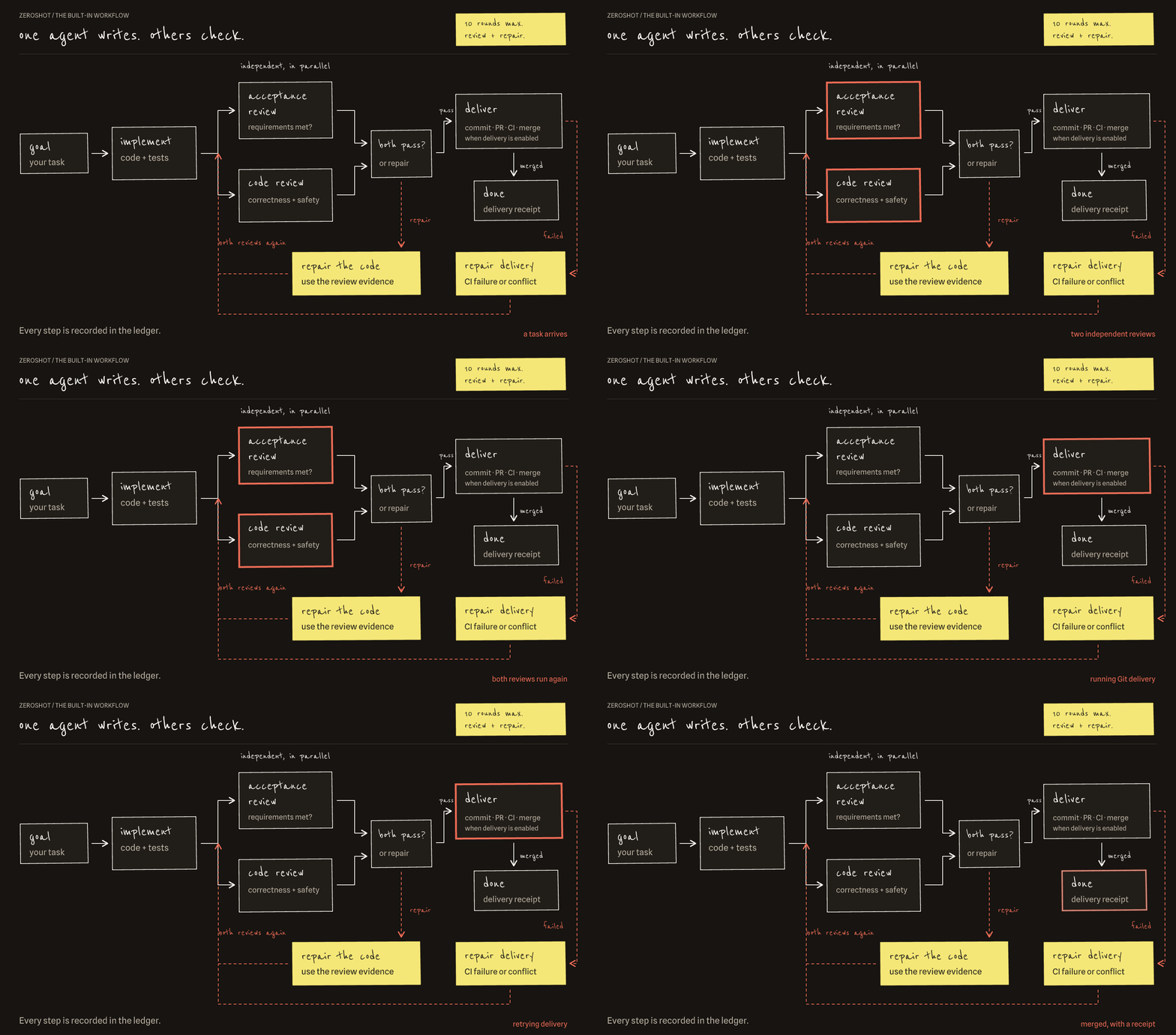
Both reviews run again after a repair. Git delivery is optional.
Static diagram

Bring your own graph topology
Choose each agent's model and instructions, which steps run in parallel, and when to retry. For example, add a bugfinder and E2E tests after the code and acceptance review loop:
Implementation
      ↓
Code review + acceptance review
      ↓
Bugfinder: adversarial tests
      ↓
E2E tests
      ↓
Delivery
The bugfinder and E2E stages are custom additions. Provide their test tools, services, and credentials, and configure where failures route back for repair.
Inspect the built-in graph as a starting point:
zeroshot template show software-change
See the graph contract for custom graph authoring and Prepare a runtime environment for dependency and service setup.
Save and reuse a profile
A profile stores a graph and its runtime settings. Use Profiles in the browser UI to edit and save your configuration. Keep different profiles for different kinds of work, or reuse one for the next task.
Once you've saved a local profile named my-profile, run another task with it:
zeroshot run \
  --title "My next task" \
  --profile local:my-profile \
  --input input.json
The CLI and UI share the same local profiles. Pass --target NAME to zeroshot ui to inspect a
configured direct or hosted target's run history while keeping profiles local. See
UI setup.
Experimental: expose a local graph as an ACP agent. First create the separate acp-worker profile
from the ACP guide. ACP requires a response output and node-scoped sessions;
the software-change profile above is not compatible. Each prompt runs the graph while the ACP session
keeps the workspace and node sessions alive:
zeroshot acp --profile local:acp-worker
Choose delivery and execution
Keep the first result local, then enable the delivery mode that fits your process:
| Delivery | Behavior |
|---|---|
| No delivery flag | Keep the work local |
--push |
Push the managed branch |
--pr |
Prepare a mergeable pull request without merging |
--ship |
Proceed through PR, CI, and merge |
PR and ship runs address visible pull request review feedback by default; pass --no-pr-feedback to
ignore it.
Graphs can execute locally, on a self-hosted target, or in Zeroshot Cloud. Each environment needs its own tools and authentication setup. Hosted merge plans, which coordinate several dependent jobs, are a Zeroshot Cloud feature.
Self-hosted: run the Docker target
Keep execution and durable state on infrastructure you control. The target image includes the native engine plus pinned Codex, Claude, and GitHub Copilot harness CLIs.
docker run --detach --restart unless-stopped --name zeroshot-target \
  -p 127.0.0.1:8080:8080 \
  -v zeroshot-data:/var/lib/zeroshot \
  ghcr.io/the-open-engine/zeroshot-target:latest

zeroshot target add local --url http://127.0.0.1:8080 --direct
The target also serves its profile editor and run viewer at http://127.0.0.1:8080/ui/.
See the target image guide for persistent storage, network isolation, builds, and HTTPS.
Zeroshot Cloud: close the laptop
Use the built-in cloud target at https://api.cloud.zeroshot.sh for a shared team queue and
durable run history:
zeroshot target login cloud
Open the printed link to sign in with the device code already filled in. Use --target cloud when
submitting runs.
When a failed run has a recoverable workspace, restart its graph on the latest saved files or choose an earlier node boundary:
zeroshot resume RUN_ID
zeroshot checkpoints RUN_ID
zeroshot resume RUN_ID --from-checkpoint CHECKPOINT_ID
Add --target NAME for Docker or Cloud. See
Restart or resume a failed run
for restore rules and retention.
Research graph
Zeroshot also includes an auto-research graph for ten bounded iterations of experiments with
independent review of evidence, method, and progress. It keeps adopted, record-only, and aborted
results under .zeroshot/research; add --push when each finalized iteration should be published.
zeroshot template list
zeroshot template show auto-research
See Execution for the research workflow's decision and evidence rules.
Community
- Discord: ask questions, share runs and graphs, and talk to the team.
- GitHub Discussions: longer-form questions and show-and-tell.
- GitHub Issues: reproducible bugs and feature requests.
Reference
- Versioned documentation
- Get started
- ACP agent preview
- CLI reference
- Standalone HTML CLI reference
- Distribution contract
- Target image guide
- Python SDK
- Cluster API reference
- Graph contract
Development
npm ci
npm run check
cargo test --workspace # Unix; Windows: powershell -NoProfile -File scripts/test-windows.ps1
Node.js builds the static UI and supports repository tooling and npm delivery; Rust serves the UI. See UI development, CONTRIBUTING.md, PUBLISHING.md, and SECURITY.md.
License
MIT. See LICENSE.