
Your Next Store
Open-source AI-native Next.js e-commerce template.
Powered by Stripe. Built for AI coding tools.
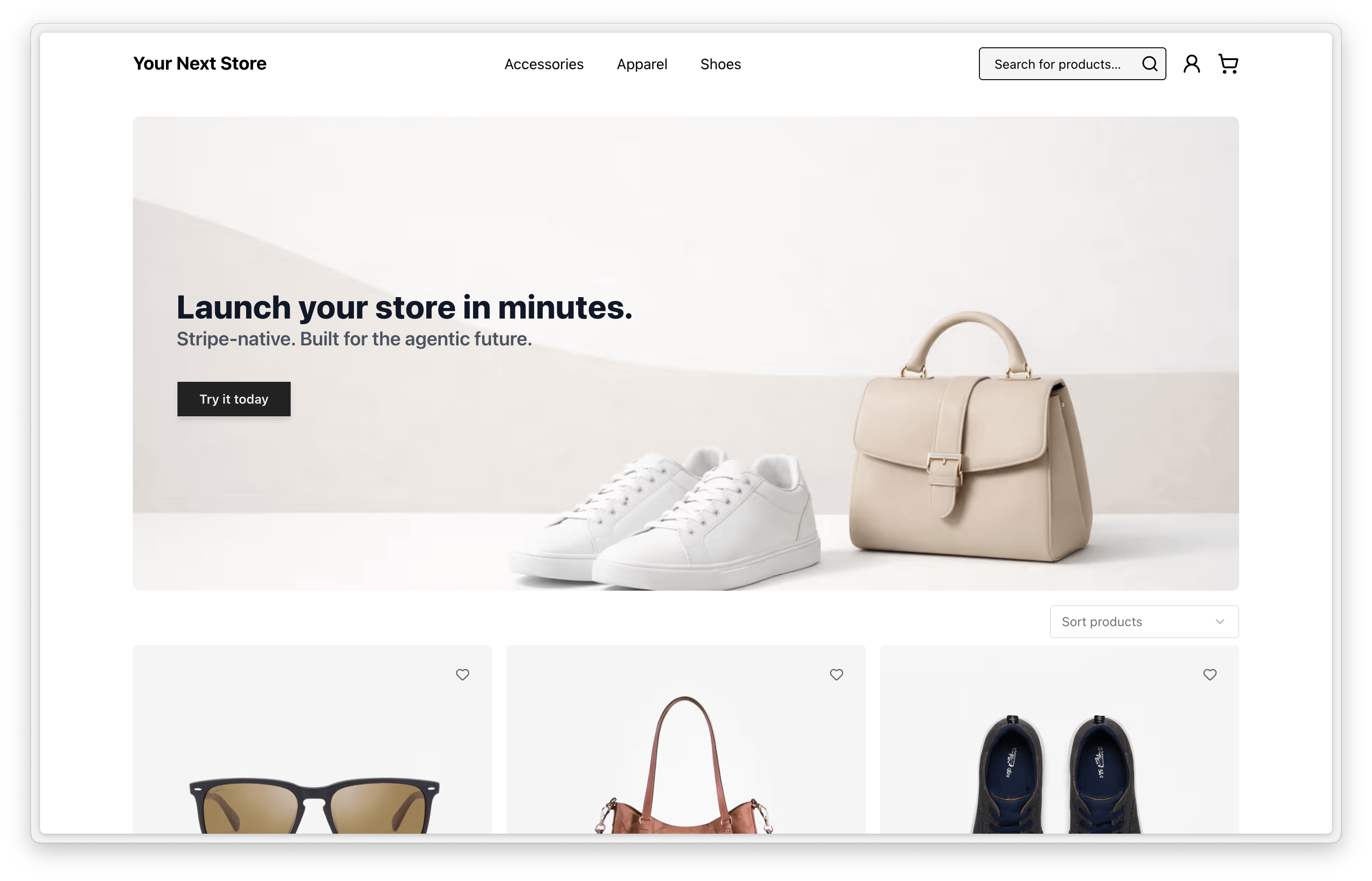
Live Demo: demo.yournextstore.com


| AI-Friendly Codebase | Ships with AGENTS.md — idiomatic patterns, Commerce Kit SDK with typed methods. Claude Code, Cursor, and Codex work out of the box |
| Stripe-Native | Direct Stripe API integration — checkout, billing, subscriptions |
| Next.js 16 | App Router, React Server Components, React Compiler |
| Open Source | Self-host anywhere, deploy to Vercel in one click |
Quick Start
git clone https://github.com/yournextstore/yournextstore.git
cd yournextstore && bun install
cp .env.example .env.local   # Add your YNS_API_KEY from https://yns.store/manage/settings/api
bun dev
Open localhost:3000 — your store is running.
Why AI Tools Work Better Here
| Familiar patterns | Idiomatic Next.js App Router (Server Components, Server Actions, "use cache") — matches what LLMs have seen thousands of times |
| Commerce Kit SDK | Methods like productBrowse() and cartUpsert() have defined input/output shapes. LLMs write correct code when they know the contracts |
| Well-defined domain | Products, variants, carts, checkout — the data models already exist with clear types. No need for the LLM to invent them |
| AGENTS.md | Full project context, SDK examples, Biome rules, and validation checklist — AI agents understand the codebase before writing a single line |
Tech Stack
- Next.js 16 — App Router, React Server Components, React Compiler
- Bun — Fast JavaScript runtime and package manager
- Commerce Kit SDK — Headless commerce API integration
- Tailwind CSS v4 — Utility-first styling
- Shadcn UI — 50+ accessible components built on Radix UI
- TypeScript — Strict type-safe development
- Biome — Lightning-fast linter and formatter
Performance and accessibility defaults — prerendered chrome on every route, optimizer-served icons,
WCAG-AA colour tokens, tappable controls — are spelled out in AGENTS.md
and checked by bun run build and bun test.
Prerequisites
- Node.js 24+
- Bun 1.0+
- YNS API key from https://yns.store/manage/settings/api
Environment Variables
Copy .env.example to .env.local and set:
YNS_API_KEY— Your API token from the admin panel
Publishing & Store API from the CLI
Two small scripts in scripts/ talk to the YNS platform using only the store's YNS_API_KEY (read from .env.local / .env):
bun run publish:store            # Trigger a production publish (same as the admin "Publish" button) and wait for the build
bun run publish:store --no-wait  # Fire and forget

bun run api GET  /products?limit=5                      # Call any Store API endpoint
bun run api POST /products '{"name":"Tee","price":29.99}'
scripts/publish.sh deploys the tenant repo's remote main — push your commits first. scripts/api.sh is a thin wrapper around curl that handles auth, base-URL resolution, and pretty JSON output for every /api/v1/* endpoint (see the API documentation).
Syncing a store with the template
Stores are seeded from a snapshot of this repo and share no commits with it, so a plain merge has no base. See docs/sync.md for the graft-and-merge procedure and why merge beats rebase here.
Contributing
See CONTRIBUTING.md for coding conventions and PR checklist.
Next Steps
Refer to the API documentation for details on fetching products, managing carts, and building on top of YNS.
Themes
Your Next Store ships with 149 ready-made themes across different store categories. Each theme includes a fully redesigned homepage, hero, color palette, and section layout — all built on the same core codebase.
Themes live on branches named theme-001 … theme-149. Switch themes with a single command:
git checkout theme-016
Browsing themes
Each theme branch is a single commit on top of main whose message describes the theme's vibe. List them all (id + description) with:
git for-each-ref --sort=refname --format='%(refname:short) %(subject)' 'refs/remotes/origin/theme-*'
All theme branches use a zero-padded three-digit id (
theme-001…theme-149). Themes modify only visual components and static assets — your products, cart, and checkout remain unchanged.