xyd is an MIT-licensed, TypeScript documentation framework for developer-facing teams that publish prose docs and generated OpenAPI, GraphQL and REST API references from one toolchain, distributed as the xyd-js package with documentation at xyd.dev.
What it is
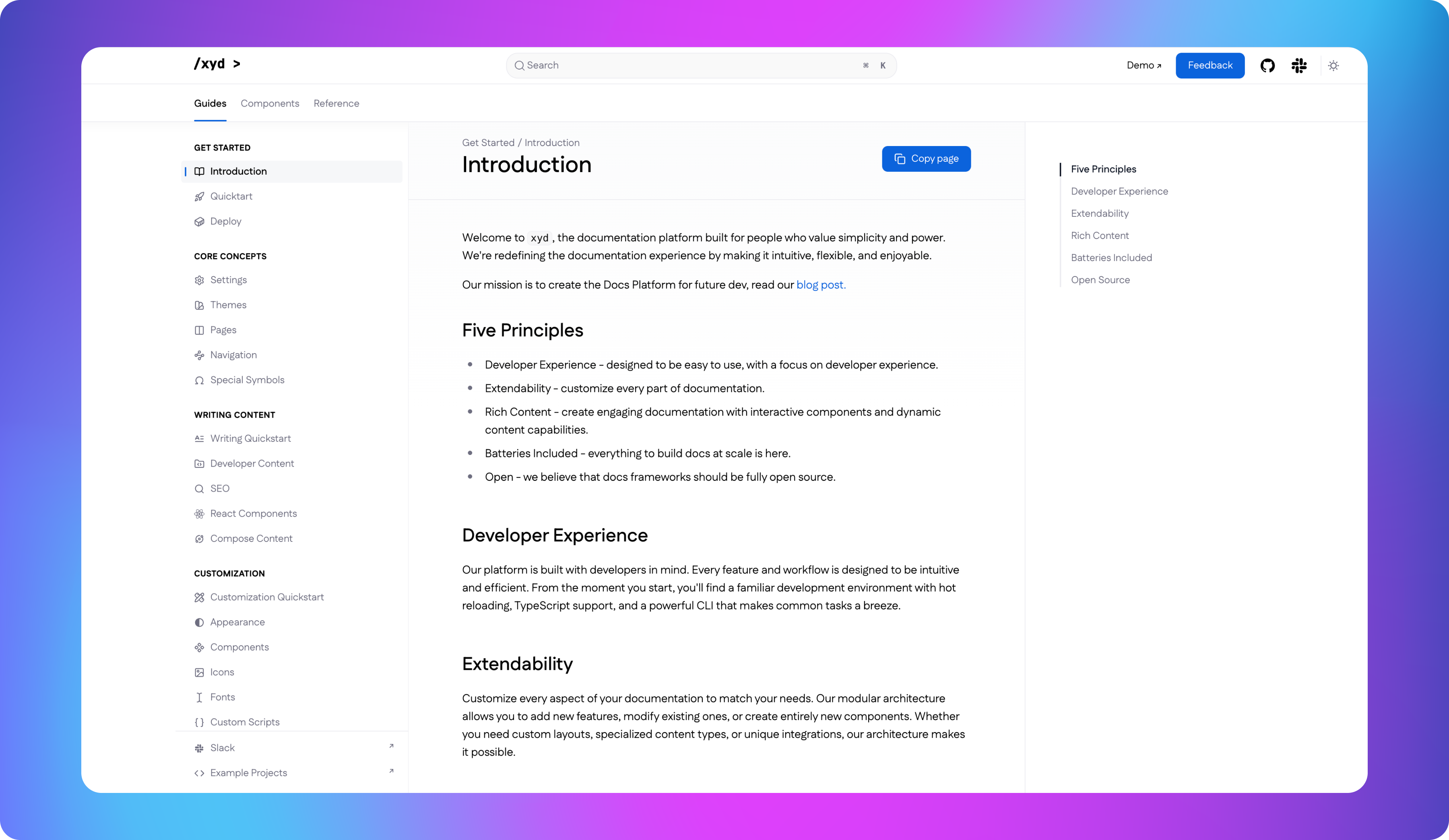
xyd is a docs framework written in TypeScript and published under the MIT licence by the team behind LiveSession. Its GitHub description calls it an "ambitious docs framework for everyone", and the README states its aim as a "Docs Framework for future dev". Content is authored in markdown and MDX and rendered through React components; the topic list places it alongside docs-generator, api-explorer, openapi, graphql, rest-api and mdx. It ships as a CLI with two primary commands, xyd for a development server and xyd build for static output, installed globally from the xyd-js package.
The concrete problem it addresses is the split toolchain most documentation sites require. Teams typically assemble one framework for prose, a separate generator for API reference pages, and further services for search, analytics and chat. xyd bundles those concerns: OpenAPI and GraphQL specifications feed both automatic API docs generation and SDK generation from the same source, while full-text search, analytics, A/B testing and live chat are built-in integrations. The README frames this as "batteries included" and points to a migration tool for moving off "a bunch of docs frameworks". Its stated philosophy covers developer experience, extendability, rich content, batteries-included scope and full open source.
Key capabilities
- Plug-and-play development server with hot reload and zero configuration, started with the
xyd command, while xyd build emits docs static files.
- Automatic API documentation generation from OpenAPI and GraphQL specifications, plus SDK generation capabilities from those same specifications.
- Six built-in themes published in the
xyd-js/themes repository: Solar, Gusto, Poetry, Picasso, Opener and Cosmo.
- Full-text search with typo tolerance and relevance scoring, alongside a plugin ecosystem covering search, analytics and chat.
- Analytics integration with custom events and session replay through LiveSession, and A/B testing through LaunchDarkly and GrowthBook.
- Live chat integrations for Intercom, LiveChat and Chatwoot, plus developer content features including advanced syntax highlighting and interactive code examples, with standalone in-house packages at xwrite.dev and apitoolchain.dev.
Who uses it and how
- Product and platform teams that want prose docs and API reference pages generated from one repository instead of two separate pipelines.
- API-first teams holding OpenAPI or GraphQL specifications, using xyd to derive both human-readable reference pages and generated SDKs.
- Teams migrating from an existing docs framework, using the migration tool documented at xyd.dev/docs/resources/migration-tool.
- Organisations with internal design systems, reusing xyd components catalogued in Storybook at components.xyd.dev, with ready-to-run examples in the
xyd-js/examples and xyd-js/deploy-samples repositories and a starter at xyd-js/starter.
Getting started
Install the CLI globally with bun add -g xyd-js, which requires Node 22.12 or newer. Run xyd to start the development server and xyd build to produce static docs files.
How it compares
The facts provided do not name any competing frameworks or paid products that xyd replaces, and no equivalent project appears beside it here, so it stands alone in this registry. The README states only that it is 100% open source and distinguishes itself from "other Docs Framework" on native API spec support, SDK generation and an included design system, without identifying those frameworks by name.
When to use it — and when not to
Self-hosting requires a Node 22.12+ toolchain and a build step that produces static files; the facts describe no database, object storage or SMTP service to operate, so the running burden is a CI build and a static host. Teams not already working in React or MDX, or those wanting a framework with a long independent track record, should weigh that dependency before committing. The project is also young relative to its surface area — 113 stars, 8 forks and 36 open issues at the time of writing — and the README points most operational detail outward to xyd.dev and its linked sites rather than documenting it in-repo.
project readme (upstream, from github) — read inline

Docs Framework for future dev.






Quickstart
[!IMPORTANT]
Node 22.12+ is required
# install
bun add -g xyd-js

# run a dev server
xyd

# build a docs static files
xyd build
Our Philosophy
Developer Experience - designed to be easy to use, with a focus on developer experience
Extendability - customize every part of documentation
Rich Content - create engaging documentation with interactive components and dynamic content capabilities
Batteries Included - everything to build docs at scale is here
Open - we believe that docs frameworks should be fully open source
Major Features
- 🎨 Themes - Built-in themes: Solar, Gusto, Poetry, Picasso, Opener, and Cosmo
- 🚀 Plug & Play Dev Server - Instant development server with hot reload and zero configuration
- ⚙️ Easy customization - Extend and modify every component, layout, and functionality
- 🔗 OpenAPI / GraphQL API docs generation - Automatic documentation generation from API specifications
- 🔌 Plugins - Rich ecosystem of plugins for search, analytics, chat, and more
- 📊 Analytics - Built-in analytics integration with support for custom events and session replay with LiveSession
- 🧪 A/B testing - Built-in integration for A/B testing experiments with LaunchDarkly and GrowthBook
- 🔍 Full-text search - Lightning-fast search with typo tolerance and relevance scoring
- 💬 Live chat - Seamless integration with Intercom, LiveChat, and Chatwoot
- 💻 Developer content - Advanced syntax highlighting with interactive code examples and tooling for developers
- 🔧 SDK generation capabilities - Automatic SDK generation from API specifications
Documentation
For more info head over to our docs.
Resources
🚀 The starter for xyd docs
📚 Ready-to-run xyd examples
📦 Ready-to-run xyd deploy samples
🔗 Live demo showcasing xyd's API documentation capabilities.
👩🎤 Collection of built-in components.
FAQ
How is this different than other Docs Framework?
- 100% open source
- Batteries included - native support for API specs (GraphQL/OpenAPI), SDK generation, Code Languages API docs and more++
- Design System - we built components with design system philosophy
- Not only docs - xyd is using a couple of in-house packages you can use standalone, e.g a docs writing engine or a set of tools for modern API docs
Why another yet docs framework?
At LiveSession we're on our way to creating a next-generation analytics platform.
We need a powerful tool that will meet our needs.
You can read the story behind it here.
How to migrate from my current docs framework to xyd?
First of all, great to hear that! We have a migration tool for a bunch of docs frameworks.
Contributing
We welcome community contributions. For guidelines, refer to our CONTRIBUTING.md and DEVELOPMENT.md

[!TIP]
You can understand or ask questions to codebase powered by Devin:

Join our community