WorkFlow-Engine is a Java, GPL-3.0 licensed workflow engine built on Spring Boot and Vue that gives Chinese agencies and enterprises visual form design, graphical process design and item management, and is aimed at teams that must digitise internal approval flows and drive third-party business interfaces on their own infrastructure.
What it is
WorkFlow-Engine is a domestic (信创) workflow engine with a separated Spring Boot and Vue front end, built on Flowable 6.8.0. It combines three cooperating parts: a form designer for visual form creation, a process designer for graphical BPMN modelling and instance monitoring, and an item management module (事项管理) that configures how each process node behaves. The back end runs on Spring Boot 2.7.10 with SpringDataJPA, SpringDataRedis, SpringKafka and Nacos 2.2.1, and the front end on Vue 3.3.2, Vite 2 and Element Plus.
The problem it solves is assembly work. Flowable 6.8.0 is a raw BPMN engine; WorkFlow-Engine supplies the layer above it that most teams would otherwise build by hand. The form designer maps form structures onto database table designs through drag-and-drop, the process designer handles node permissions, transition conditions, suspend, activate and delete on running instances, and item management supplies node-level approval rules, opinion boxes, attachment settings and numbering rules. Teams that would otherwise wire a bare Flowable engine to a hand-written administrative interface get a configured front end instead.
Key capabilities
- Form designer with drag-and-drop layout, data source binding, field validation rules, custom styles, and support for arrays and tables as complex data structures, plus standardised template import.
- Process designer covering start events, approval nodes and end events, node permissions, transition conditions, process simulation, and seamless migration of low-version process instances to higher versions.
- Item management (事项管理) configures per-node form style, approval rules, opinion box, attachment settings and numbering rules, and collects all to-dos into one screen filterable by 岗位 (post).
- Interface configuration attaches third-party interfaces to process nodes and process paths; link configuration binds third-party application entries to posts.
- Body templates, red-header templates (正文模板, 套红模板) and print templates can be imported and managed, though body and red-header templates require third-party plugins.
- Source modules: y9-module-processadmin, y9-module-itemadmin, y9-module-flowableui and y9-module-jodconverter for preview; front ends y9vue-itemAdmin and y9vue-flowableUI.
- Deployment supports microservice, distributed and containerised topologies; three granted patents cover全域状态更新的工作流同步更新, 工作流数据恢复, and 多起点多分支流程引擎实现.
Who uses it and how
- Government units and agencies digitising internal process management rules and internal business flows, with configuration handled by operations staff in 事项配置 and daily work in the workbench.
- Organisations running on 信创 stacks: compatible with 统信, 麒麟 and 中科方德 operating systems, 人大金仓, 达梦 and 高斯 databases, 东方通, 金蝶 and 宝兰德 middleware, and 奇安信, 火狐, 谷歌 and 360 browsers.
- Small single-node deployments: the monolith handles 500 users on a 4-core, 8GB virtual machine in a 信创 environment, with historical data carried over by year.
- Larger or distributed installations scaling outward through microservices and containers, driving external business, algorithm, interface and proxy integrations.
- Any deployment must connect to a digital base (数字底座) for post and role configuration plus its single sign-on service, without which the engine will not run.
Getting started
No published artifact or installation command appears in the README; it points to the source tree, where the back end is built from the y9-module-* Maven modules and the front end from y9vue-itemAdmin and y9vue-flowableUI. An online demo (在线体验) is linked from the project homepage at risesoft.net.
How it compares
Flowable 6.8.0 is the engine underneath rather than a competitor: WorkFlow-Engine wraps that BPMN core with form, process and item administration tooling. Teams already comfortable with a plain Flowable deployment and their own front end gain little from the additional modules.
When to use it — and when not to
A self-hoster must operate MySQL 5.7/8.0+, Redis 6.2+, Elasticsearch 7.9+, Kafka 2.6+, Nacos 2.2.1 and filezilla server 1.7+, plus a separate file preview server, the digital base and its single sign-on service, and third-party plugins for body and red-header templates. Teams that cannot supply that digital base should not pick it, and projects needing permissive licensing should weigh GPL-3.0 carefully. The README is Chinese-only and gives no installation command, so expect to read the source tree rather than a deployment guide.
project readme (upstream, from github) — read inline

基于SpringBoot+Vue前后端分离的Java国产信创工作流引擎






简介
工作流引擎为业务流程自动化提供底层支撑,通过表单设计器、流程设计器与事项管理模块的协同,实现流程从设计、运行到监控的全生命周期管理。支持表单可视化配置、流程图形化设计、待办事项集中处理及跨系统集成,结合模板管理与智能提醒功能,提升流程流转效率与规范化水平,满足复杂业务场景的自动化需求。系统在线体验----->>>>>
(一)表单设计器
表单设计器提供可视化的表单创建与配置工具,支持通过拖拽操作快速设计表单结构,灵活设置数据源关联、字段绑定规则及校验逻辑。可自定义表单样式与布局,适配不同终端展示需求,支持数组、表格等复杂数据结构的录入与展示。通过配置表单动作触发规则,实现与后端数据的联动交互,同时支持导入标准化模板,简化常用表单的重复设计工作,提升表单制作效率与标准化程度,为流程流转提供结构化数据载体。
(二)流程设计器
流程设计器支持图形化流程建模与全生命周期管理,核心功能包括流程可视化设计、实例运行监控及版本迭代支持。通过图形界面拖拽节点元素(如开始事件、审批节点、结束事件),配置节点权限、流转条件及处理规则,构建可视化流程模型;可实时监控流程实例状态,对异常流程执行删除、挂起、激活等操作,查看审批历程与变量信息;支持低版本流程实例向高版本无缝迁移,保障流程迭代过程中业务连续性,同时支持流程模拟,提前发现设计缺陷,优化流程路径。
(三)事项管理
事项管理模块实现流程运行的精细化管控,核心功能涵盖事项配置、待办集中处理、流程协同及模板管理。支持统一配置流程节点的表单样式、审批规则、意见框管理、附件配置及编号规则,通过接口配置与链接配置实现第三方系统集成;汇总所有待办事项于统一界面,支持按岗位筛选不同状态的流程实例,通过消息提醒功能推送审批通知与办理结果。提供正文模板、套红模板、打印模板的导入与管理功能,支持流程实例关联、日历规则配置,结合动态视图自定义展示方式,全面提升流程处理效率与用户体验。
开源地址
源码地址:
源码目录
y9-module-flowableui -- 工作流程模块
 ├── risenet-y9boot-webapp-flowableui -- 工作流程webapp
y9-module-itemadmin -- 事项管理模块
 ├── risenet-y9boot-api-feignclient-itemadmin -- 事项管理接口客户端封装
 ├── risenet-y9boot-api-interface-itemadmin -- 事项管理接口
 ├── risenet-y9boot-support-itemadmin-jpa-repository -- 事项管理持久层
 ├── risenet-y9boot-support-itemadmin -- 事项管理控制层、业务层
 ├── risenet-y9boot-webapp-itemadmin -- 事项管理webapp
y9-module-jodconverter -- 预览模块
 ├── risenet-y9boot-webapp-jodconverter -- 预览webapp
y9-module-processadmin -- 流程管理模块
 ├── risenet-y9boot-api-feignclient-processadmin -- 流程管理接口客户端封装
 ├── risenet-y9boot-api-interface-processadmin -- 流程管理接口
 ├── risenet-y9boot-support-processadmin -- 流程管理业务层
 ├── risenet-y9boot-webapp-processadmin -- 流程管理webapp
vue -- 前端工程
 ├── y9vue-itemAdmin  -- 事项管理前端工程
 ├── y9vue-flowableUI -- 工作流程前端工程
逻辑架构图
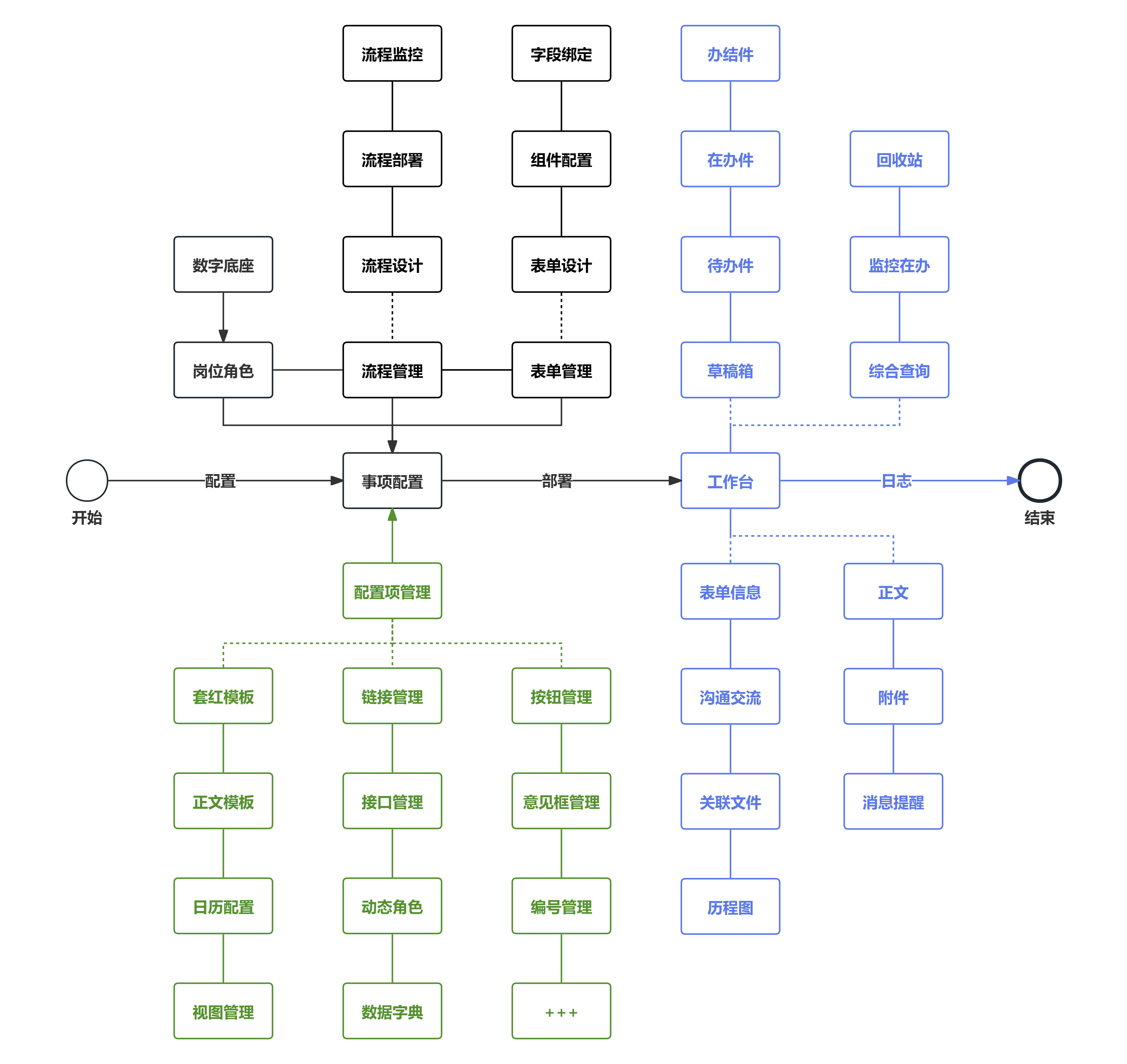
工作流引擎主要分为事项配置和工作台,事项配置面向运维人员对工作流进行配置,工作台面向用户操作使用
工作流引擎需要数字底座中对于岗位角色的配置,否则无法运转
工作流引擎不仅仅支持传统OA,更面向外部业务、算法、接口、代理的接入和控制
功能架构图
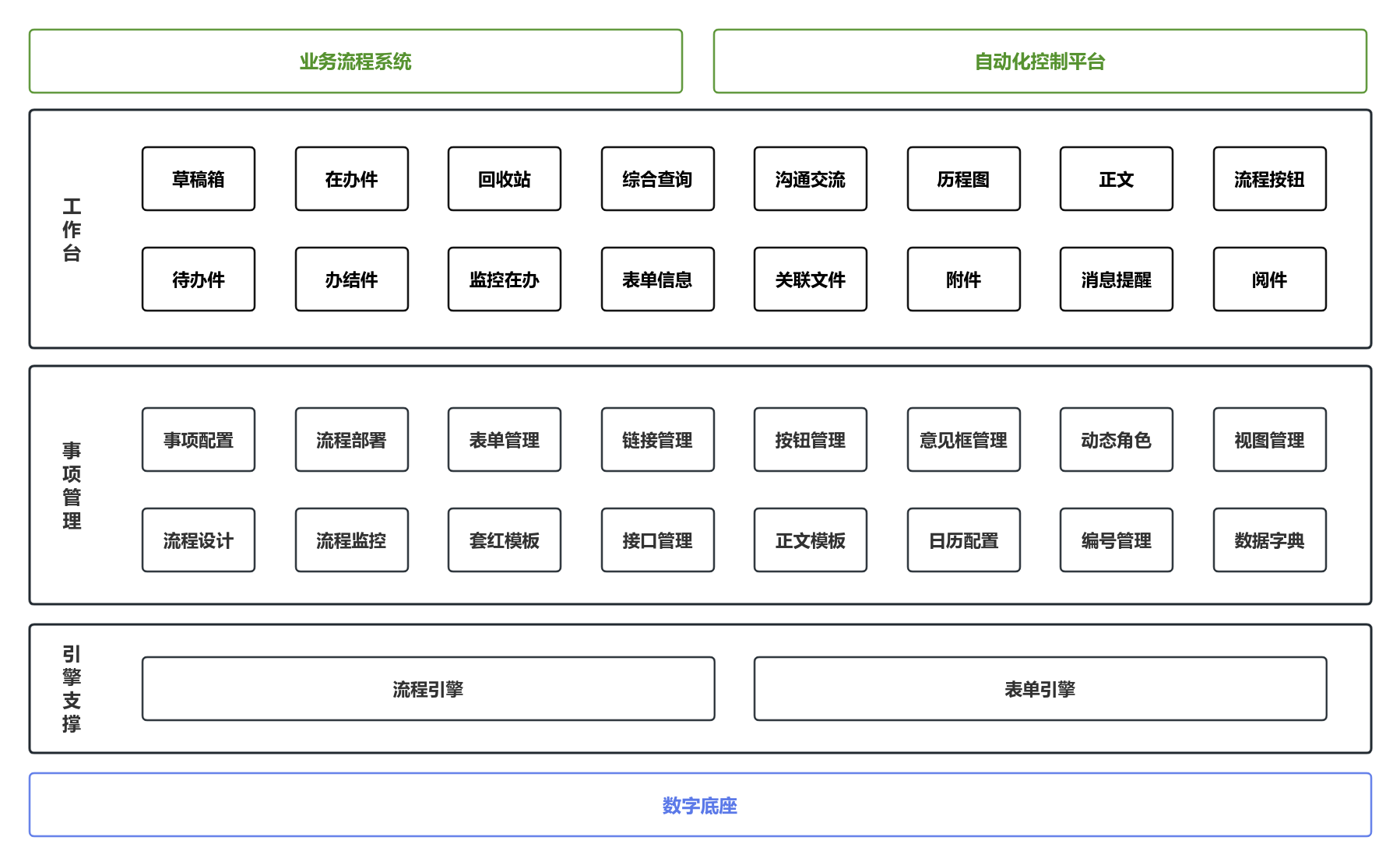
1.工作台的功能和界面都由事项管理进行配置后形成
2.事项管理的功能分为流程类、表单类和配置项类
3.表单管理负责映射数据库的表结构设计,由拖拉拽的表单引擎支撑
4.流程管理包含流程的设计、部署和监控,由拖拉拽的流程引擎支撑
5.接口管理支持在流程节点和流程路径中接入第三方的接口
6.链接管理支持通过岗位绑定第三方应用的入口
7.正文模板和套红模板均需要接入第三方插件才可以使用
部署架构图
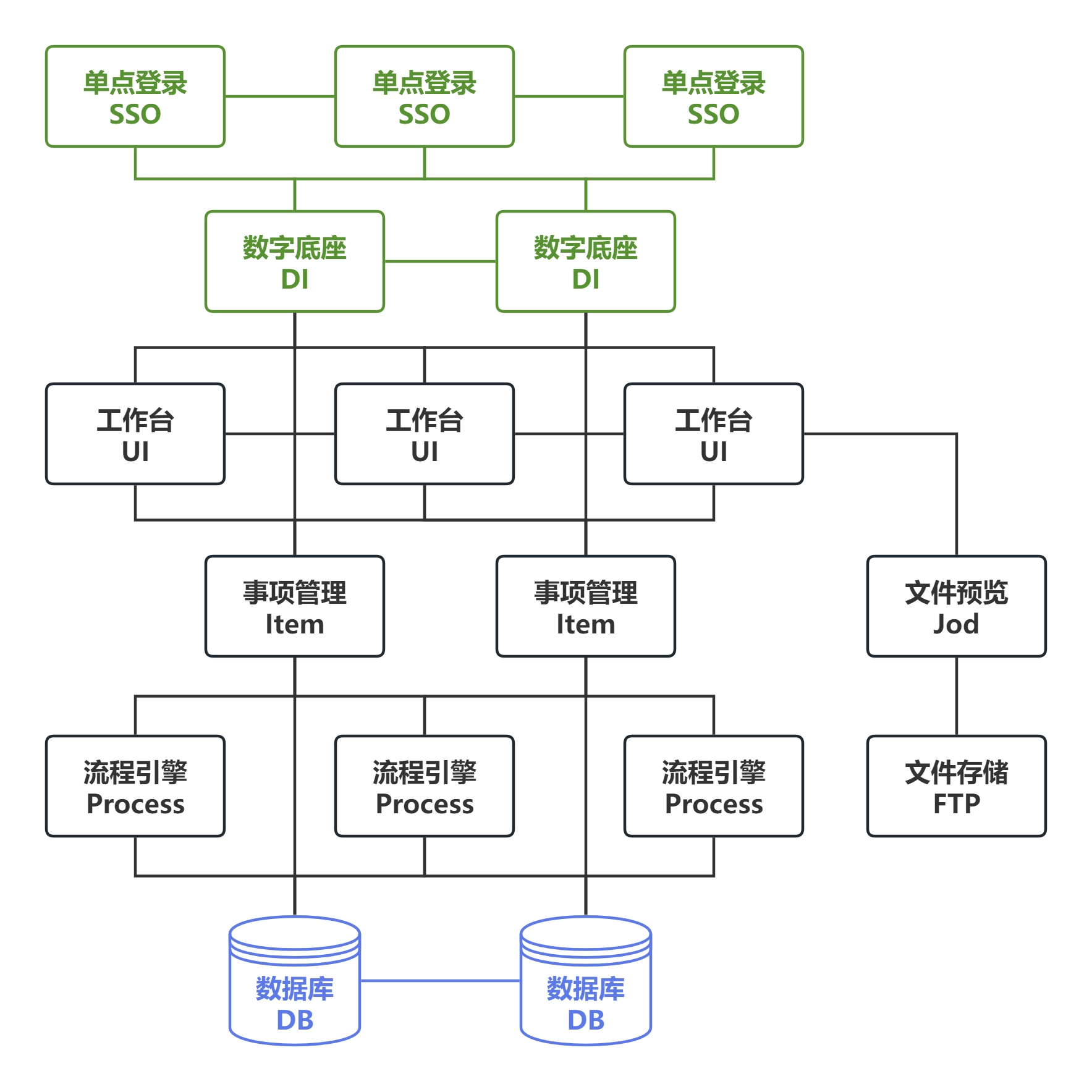 1.工作流引擎支持以微服务、分布式、容器化的方式进行部署和扩展
2.工作流引擎需要额外部署文件预览相关的服务器
3.工作流引擎依赖数字底座和其单点登录服务
4.工作流引擎单体在信创环境中,4核8GB内存的虚拟机可以轻松应对500用户(历史数据需按年度结转)
后端技术选型
前端技术选型
中间件选型
数据库选型
工作流引擎专利
信创兼容适配
引擎国产