





Documentation | Website | Blog


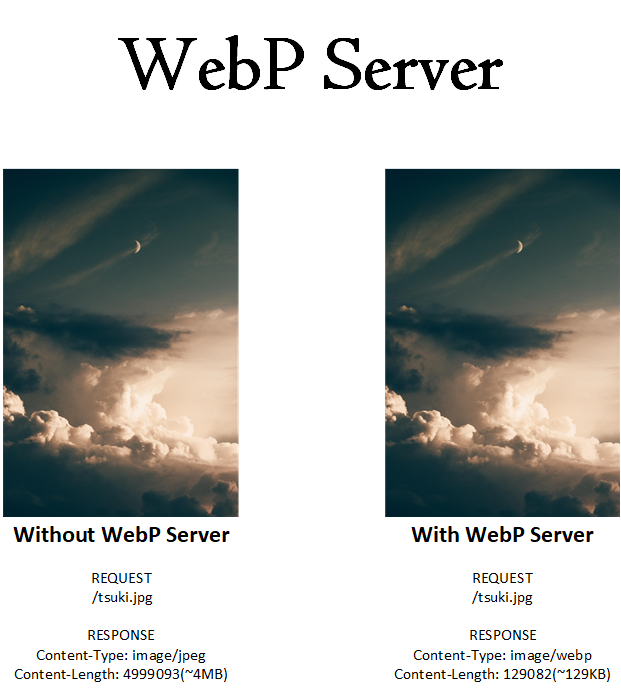
This is a Server based on Golang, which allows you to serve WebP images on the fly.
Currently supported image format: JPEG, PNG, BMP, GIF, SVG, HEIC, NEF, WEBP
e.g When you visit
https://your.website/pics/tsuki.jpg,it will serve asimage/webp/image/avifformat without changing the URL.GIF image will not be converted to AVIF format because the converted AVIF image is not animated.
Usage with Docker(recommended)
We strongly recommend using Docker to run WebP Server Go because running it directly with the binary may encounter issues with glibc and some dependency libraries, which can be quite tricky to resolve.
flowchart LR
client["Client\nGET /some-images/tsuki.jpg"] --> server["WebP Server Go\n:3333"]

subgraph host["Host machine"]
hostPics["/path/to/pics"]
hostExhaust["./exhaust"]
hostMeta["./metadata"]
end

subgraph container["Docker container"]
cPics["/opt/pics (source images)"]
cExhaust["/opt/exhaust (optimized cache)"]
cMeta["/opt/metadata (source metadata)"]
end

hostPics <-- "volume mount" --> cPics
hostExhaust <-- "volume mount" --> cExhaust
hostMeta <-- "volume mount" --> cMeta

server --> cPics
server --> cExhaust
server --> cMeta
server --> response["Return optimized image\n(webp/avif/jxl)"]
This helps separate responsibilities clearly:
picsstores original files,exhauststores converted outputs, andmetadatastores source metadata used for cache validation.
Make sure you've got Docker and docker-compose installed, create a directory and create docker-compose.yml file inside it like this:
version: '3'

services:
  webp:
    image: webpsh/webp-server-go
    # image: ghcr.io/webp-sh/webp_server_go
    restart: always
    volumes:
      - ./path/to/pics:/opt/pics
      - ./exhaust:/opt/exhaust
      - ./metadata:/opt/metadata
    ports:
      - 127.0.0.1:3333:3333
Suppose your website and image has the following pattern.
| Image Path | Website Path |
|---|---|
/var/www/img.webp.sh/path/tsuki.jpg |
https://img.webp.sh/path/tsuki.jpg |
Then
./path/to/picsshould be changed to/var/www/img.webp.sh./exhaustis cache folder for output images, by default it will be inexhaustdirectory alongside withdocker-compose.ymlfile, if you'd like to keep cached images in another folder, you can change./exhaustto/some/other/path/to/exhaust./metadatais cache folder for images' metadata, by default it will be inmetadatadirectory alongside withdocker-compose.ymlfile
Start the container using:
docker-compose up -d
Now the server should be running on 127.0.0.1:3333, visiting http://127.0.0.1:3333/path/tsuki.jpg will see the optimized version of /var/www/img.webp.sh/path/tsuki.jpg, you can now add reverse proxy to make it public, for example, let Nginx to proxy_pass http://127.0.0.1:3333/;, and your WebP Server is on-the-fly!
Custom config
If you'd like to use a customized config.json, you can follow the steps in Configuration | WebP Server Documentation to genereate one, and mount it into the container's /etc/config.json, example docker-compose.yml as follows:

version: '3'

services:
  webp:
    image: webpsh/webp-server-go
    # image: ghcr.io/webp-sh/webp_server_go
    restart: always
    volumes:
      - ./path/to/pics:/opt/pics
      - ./path/to/exhaust:/opt/exhaust
      - ./path/to/metadata:/opt/metadata
      - ./config.json:/etc/config.json
    ports:
      - 127.0.0.1:3333:3333
You can refer to Configuration | WebP Server Documentation for more info, such as custom config, AVIF support etc.
Or, if you need some examples, you can refer to Configuration Examples | WebP Server Documentation.

Advanced Usage
If you'd like to use with binary, please consult to Use with Binary(Advanced) | WebP Server Documentation

spoiler alert: you may encounter issues with
glibcand some dependency libraries.
For supervisor or detailed Nginx configuration, please read our documentation at https://docs.webp.sh/
WebP Cloud Services
We are currently building a new service called WebP Cloud Services, it now has three parts:
- Public Service
- GitHub Avatar/Gravater reverse proxy with WebP optimization, for example, change
https://www.gravatar.com/avatar/09eba3a443a7ea91cf818f6b27607d66tohttps://gravatar.webp.se/avatar/09eba3a443a7ea91cf818f6b27607d66for rendering will get a smaller version of gravater, making your website faster - Totally free service and currently has a large number of users, this includes, but is not limited to CNX Software, Indienova
- GitHub Avatar/Gravater reverse proxy with WebP optimization, for example, change
- WebP Cloud
- No need to install WebP Server Go yourself, especially suitable for static websites.
- Image Conversion: WebP Cloud converts images to WebP/AVIF format, reducing size while maintaining quality for faster website loading.
- Example 1: Original image URL (https://yyets.dmesg.app/api/user/avatar/BennyThink) becomes compressed URL (https://vz4w427.webp.ee/api/user/avatar/Benny).
- Example 2: Original image URL (https://yyets.dmesg.app/api/user/avatar/BennyThink) becomes a thumbnail image using URL (https://vz4w427.webp.ee/api/user/avatar/BennyThink?width=200).
- Caching: WebP Cloud automatically caches served images, reducing traffic and bandwidth load on the origin server.
- Fly
- We call this service Fly, with the aim of providing a public and free service that users can experience without registering on WebP Cloud.
As this is a public service, some limitations compared to WebP Cloud are imposed:
- Fly supports a maximum original image size of 8MB, while WebP Cloud supports up to 80MB.
- Fly cache time is 1 day, while WebP Cloud has unlimited time (can be manually cleared at any time).
- It does not support parameters like
blur,sharpenfor image processing. - And that’s it.
- We call this service Fly, with the aim of providing a public and free service that users can experience without registering on WebP Cloud.
As this is a public service, some limitations compared to WebP Cloud are imposed:


For detailed information, please visit WebP Cloud Services Website or WebP Cloud Services Docs. |

License
WebP Server is under the GPLv3. See the LICENSE file for details.
Security
Please refer to SECURITY.md for more information.