warpdrive
An open-source, self-hosted Pipedrive alternative for business-development teams.
Pipeline management, a deal workspace, contacts, and two-way Gmail, running entirely on your own infrastructure.




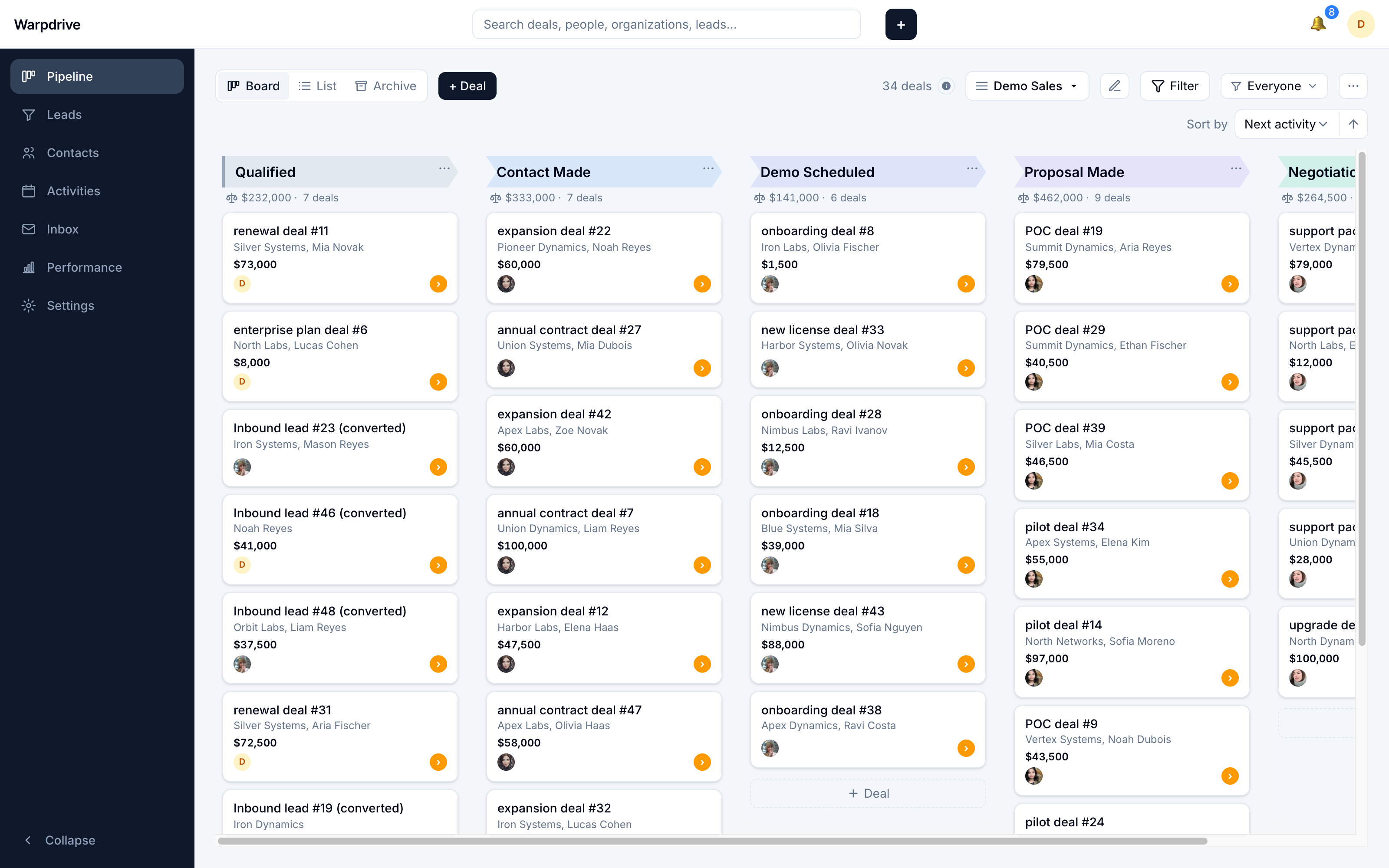
warpdrive reimplements the core business-development workflow of Pipedrive as software you run yourself. It is single-tenant and self-hosted: your own box, your own Postgres and object storage, authenticated with your own Google Workspace. Your customer data never leaves your infrastructure, and there is no per-seat bill.
The information architecture and workflows follow the tools BD teams already know, but all code, styling, and assets are original, and the interface ships its own visual layer built on shadcn/ui. warpdrive is not affiliated with or endorsed by Pipedrive.
Contents
- Features
- Screenshots
- warpdrive vs Pipedrive
- Tech stack
- Quickstart (local development)
- Self-hosting
- Tests
- Project status
- Contributing
- License
Features
Pipeline
- Kanban board with drag-and-drop stages, multiple pipelines, and custom stages
- Per-stage weighted totals, rotting-deal indicators, and saved filters
- Board / list / archive views
Deals
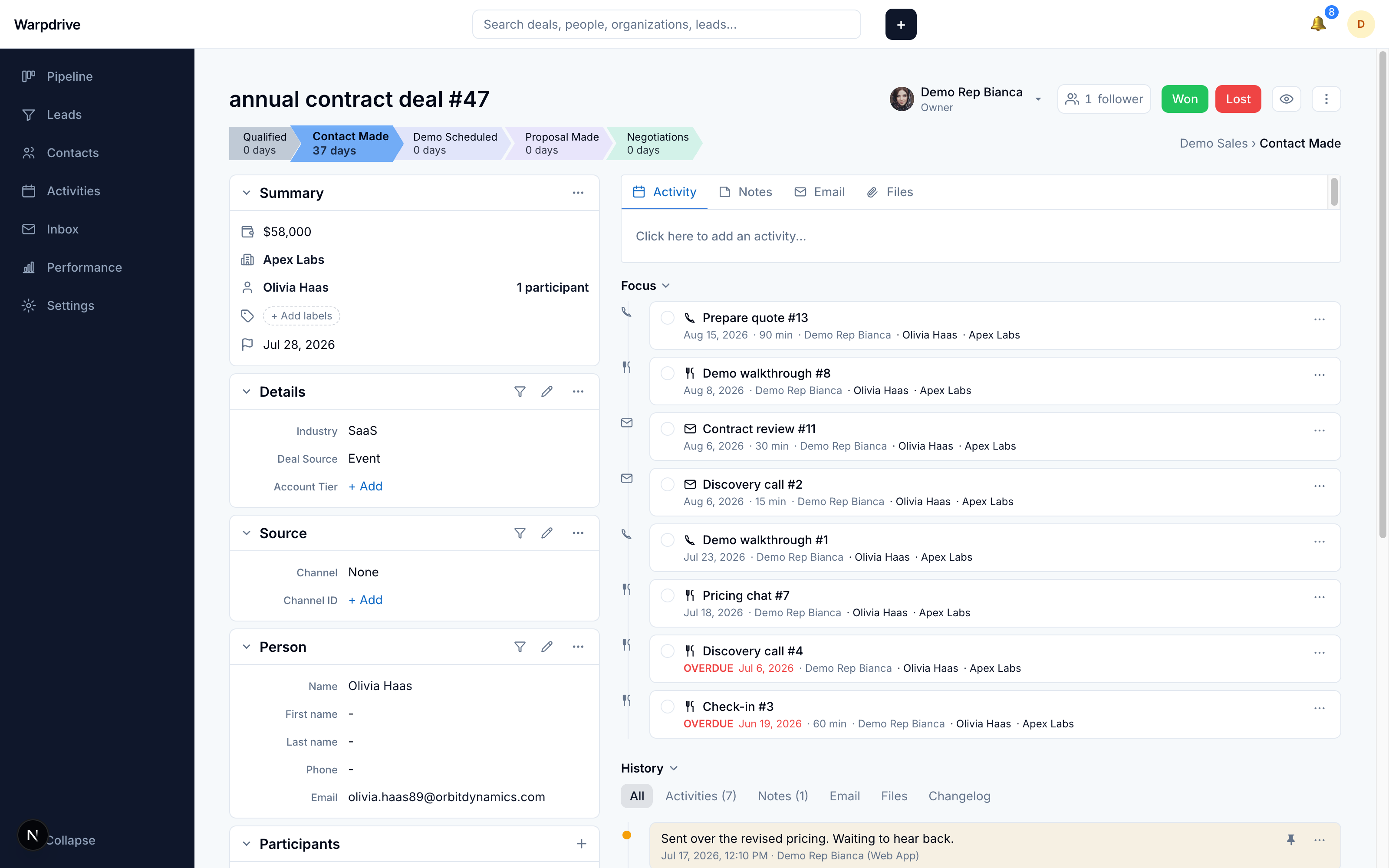
- Deal workspace with a unified timeline: activities, notes, files, email, and full change history
- Participants, followers, labels, lost reasons, and close dates
- Won / lost handling with a stage-progress bar
Contacts
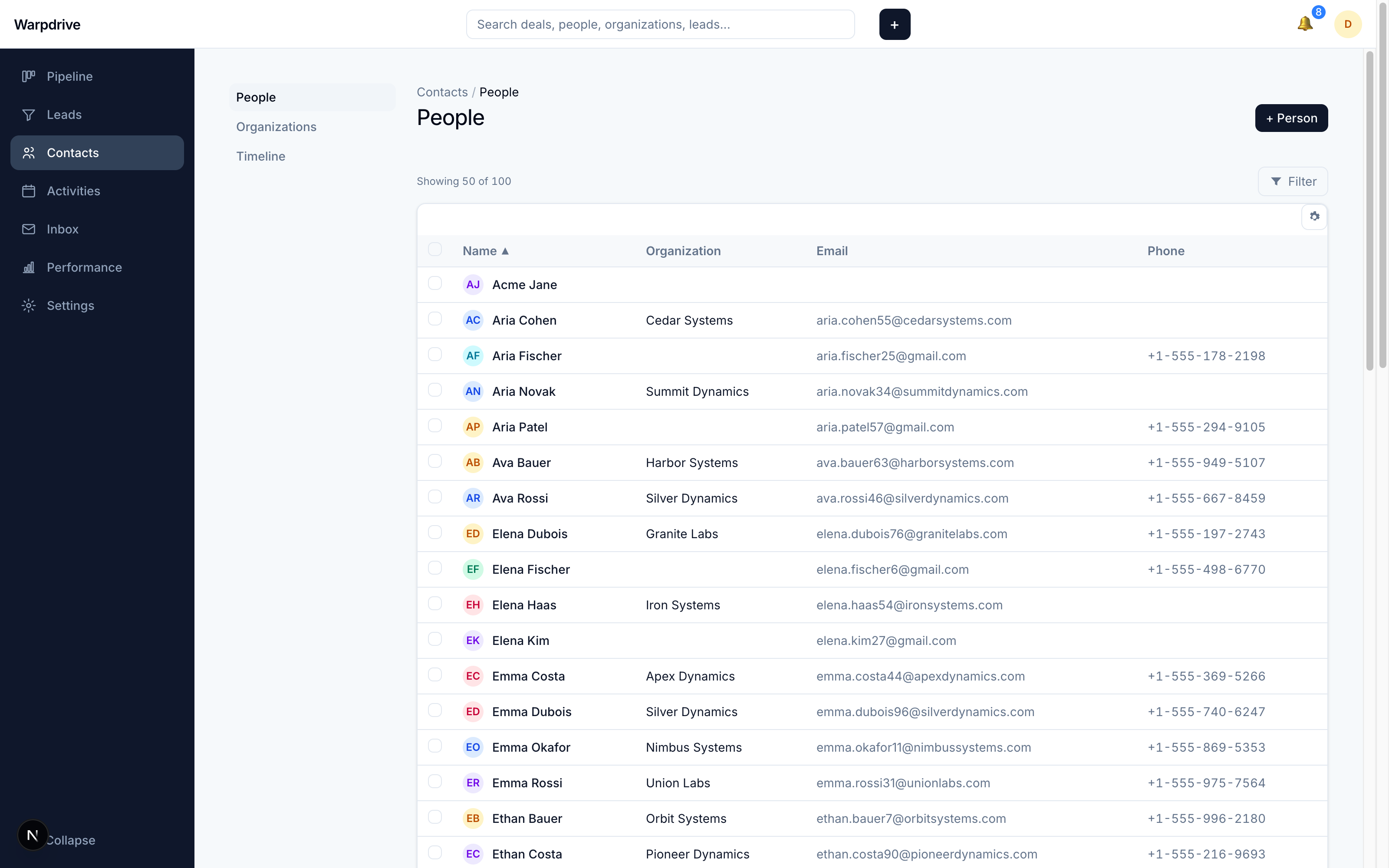
- People and organizations with custom fields (JSONB)
- Organization firmographics and org-to-org relationships
- Leads inbox and CSV import with an undo step
Email (two-way Gmail)
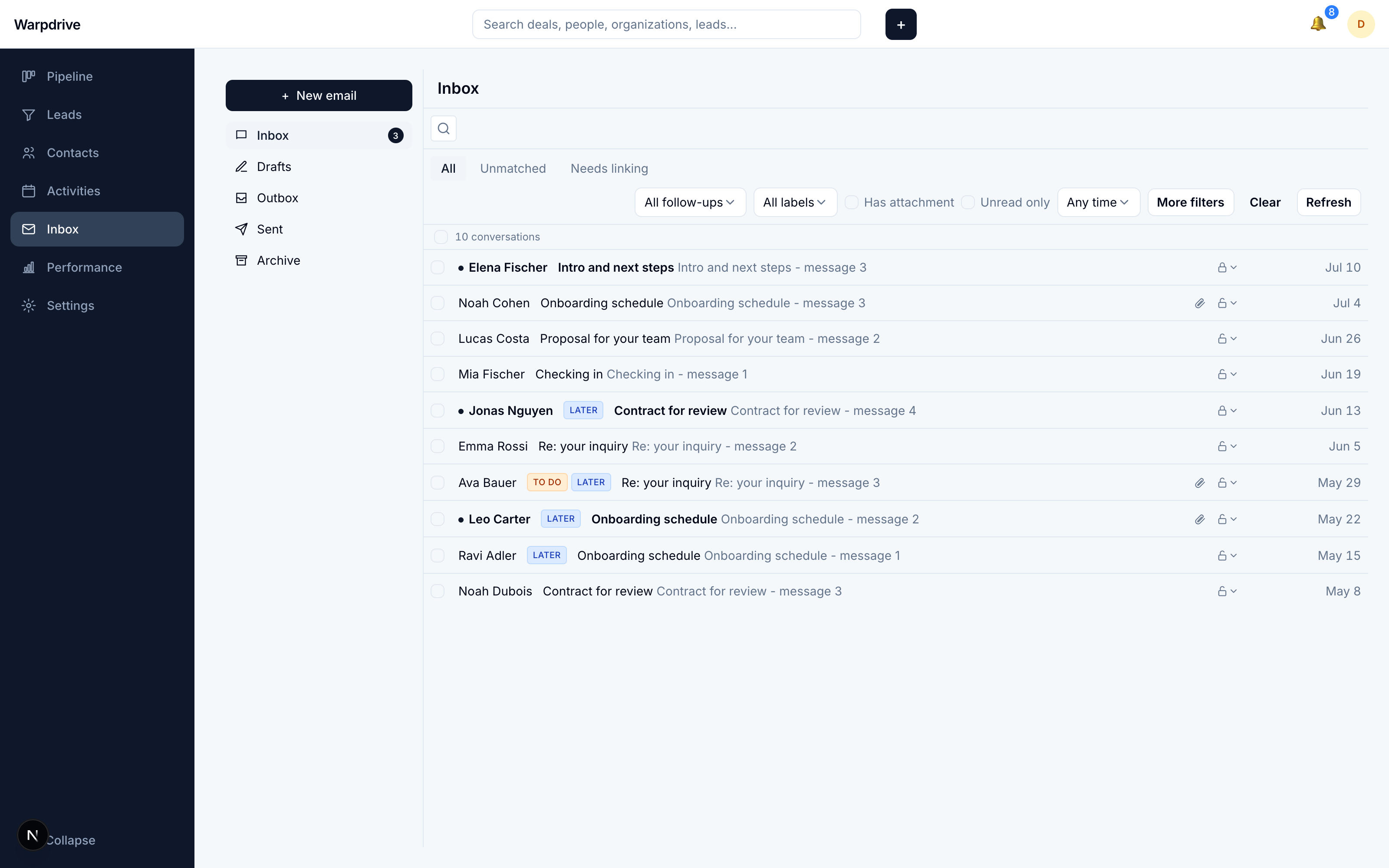
- Send and receive over the Gmail API, with thread linking to deals and people
- Open and click tracking, templates, signatures, merge fields, and scheduled send
- Personal inbox plus shared, deal- and contact-linked threads
Team and platform
- Role-based permissions, teams, and user management
- Notifications and basic pipeline stats (funnel, deal and activity performance)
- Realtime updates across the board, inbox, notifications, and presence over WebSocket
Screenshots
Deal workspace: activities, notes, files, and the full history timeline in one view.
Inbox: two-way Gmail with thread linking, follow-up labels, and unread state.
Contacts: people and organizations with custom fields.
warpdrive vs Pipedrive
warpdrive covers Pipedrive's core BD loop and deliberately leaves the rest out of scope. The goal is a focused, self-hosted CRM, not a feature-for-feature clone.
| warpdrive | Pipedrive | |
|---|---|---|
| License | MIT, open source | Proprietary |
| Hosting | Self-hosted, single-tenant | Vendor cloud |
| Pricing | Free (your infrastructure only) | Paid, per seat |
| Your data | Stays on your infrastructure | Vendor servers |
| Kanban pipeline + custom stages | ✅ | ✅ |
| Multiple pipelines | ✅ | ✅ |
| Deal workspace (activities, notes, files, history) | ✅ | ✅ |
| Contacts and organizations + custom fields | ✅ | ✅ |
| Leads inbox + CSV import (with undo) | ✅ | ✅ |
| Two-way Gmail (send/receive, threads, open/click tracking) | ✅ | ✅ |
| Email templates, signatures, scheduled send | ✅ | ✅ |
| Permissions, teams, user management | ✅ | ✅ |
| Saved filters | ✅ | ✅ |
| Realtime board / inbox / presence | ✅ | ✅ |
| Notifications | ✅ | ✅ |
| Pipeline stats (funnel, performance) | ✅ Basic | ✅ Advanced |
| Products, Projects, Invoicing, Forecast | ➖ Out of scope | ✅ |
| Multi-currency | ➖ Out of scope | ✅ |
| Workflow automation | ➖ Email scheduling only | ✅ |
| Web forms / chatbot / marketplace | ➖ Out of scope | ✅ |
| Native mobile apps | ➖ Web app | ✅ |
✅ supported · ➖ intentionally out of scope
Tech stack
Next.js (App Router) and React with TypeScript, Drizzle ORM on Postgres, tRPC with TanStack Query, Next server actions, shadcn/ui with Tailwind, dnd-kit for the board, Zustand for board-local state, a self-hosted WebSocket server backed by Postgres LISTEN/NOTIFY, MinIO (or any S3-compatible store) for files, and the Gmail API via Google OAuth. Package manager: pnpm.
Quickstart (local development)
Requires Node, pnpm, and Docker.
pnpm install
cp .env.example .env
# bring up Postgres and MinIO with host ports and no TLS:
docker compose -f docker-compose.yml -f docker-compose.dev.yml up -d postgres minio
pnpm db:migrate
pnpm dev
The app runs at http://localhost:3000. Google sign-in and Gmail need an OAuth client (see
docs/deploy.md); for local exploration you can sign in without Google
using the dev-login route.
Self-hosting
The repo ships a single-box Docker topology (app, WebSocket server, background worker, Postgres, MinIO, and Caddy for automatic HTTPS):
cp .env.example .env    # fill in domain, Google OAuth, storage, and secrets
docker compose up -d --build
Caddy provisions TLS for your domain automatically; Postgres and MinIO stay on the internal
network. See docs/deploy.md for the full guide, including Google OAuth
setup, the s3. subdomain for file uploads, and every required environment variable.
Tests
pnpm test:unit          # fast unit tests
pnpm test:integration   # spins up a disposable Postgres via Testcontainers
Integration tests run against a real Postgres (never a mock) so migrations and queries are exercised as they run in production.
Project status
warpdrive is used in production for a single team's BD workflow and is actively developed. The features listed above are built and working. The out-of-scope rows in the comparison table are deliberate and not on the near-term roadmap; the focus is depth and polish on the core pipeline, deal, contact, and email surfaces.
Contributing
Issues and pull requests are welcome. PRs are reviewed and merged upstream, then land back here on the next release. Please keep changes focused and include tests for new behavior.
License
MIT. See LICENSE.