Wallabag is a free, open source bookmark & content management project written in PHP and released under MIT. It has 12,969 GitHub stars, 896 forks and 764 open issues, and was last pushed 4 days ago. On this registry it ranks #3 of 14 tracked projects in Bookmark & Content Management, with 5 head-to-head comparisons available. It gained 9 stars over the last 6 tracked days.

Wallabag — Save articles for later reading with complete privacy

What is Wallabag?

What it is

wallabag is a self-hosted web application for saving web pages and reading them later. It lives in the PHP and Symfony ecosystem, is released under the MIT license, and presents itself as a read-it-later tool for users who want to keep their saved articles on their own server. The project also points to wallabag.it as a hosted account option for people who do not want to run the application themselves.

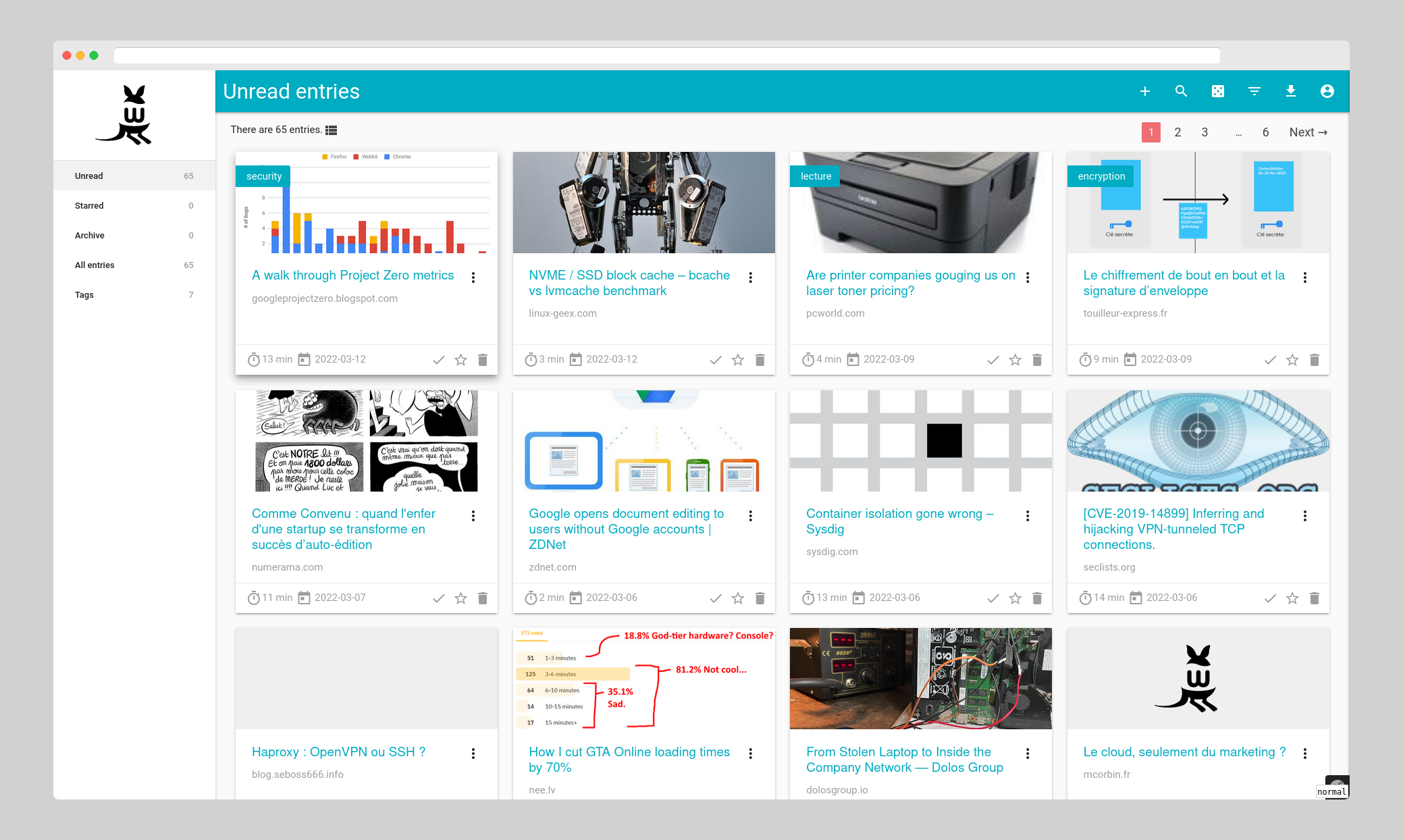
The problem it solves is the gap between finding an article to read later and actually reading it in a clean, manageable form. wallabag saves a page, extracts the content, and lets the user classify articles so the saved material can be revisited without the original page's pop-ups and other distractions. The repository describes the basic workflow as click, save, and read later, with companion clients and browser tools listed around the main application.

Key capabilities

  • wallabag saves web pages for later reading by extracting article content from the saved page.
  • The application runs as a self-hosted PHP program built with the Symfony framework.
  • It supports saving and classifying articles, as stated in the repository description.
  • The project provides companion clients for Android and iOS, plus a browser extension named wallabagger.
  • wallabag offers a hosted option through wallabag.it for users who prefer not to operate their own server.
  • Content extraction relies on Graby, php-readability, and ftr-site-config.
  • Translation work is handled through Weblate.

Who uses it and how

  • Readers save pages from a browser and return to them later in an extracted reading view.
  • Self-hosters install wallabag on their own server and configure a virtual host for access.
  • Mobile users can access saved pages through the Android or iOS apps listed in the README.
  • Browser users can save pages with the wallabagger extension.
  • Linux desktop users can connect through the GNOME read-it-later application, which the README notes is not maintained by the project.

Getting started

Install from source by cloning the repository, running make install, and configuring a virtual host; use gmake install when the default make is not GNU make. The documentation lists other installation methods, and users may instead create an account on wallabag.it.

When to use it — and when not to

wallabag fits users who want a self-hosted, MIT-licensed read-it-later application in the PHP and Symfony ecosystem and who are willing to operate the server, virtual host, and installation requirements. It is less suitable for users who want a service with no administrative responsibility, because the self-hosted path requires server setup and maintenance. The repository shows 764 open issues, so a new user should review the issue tracker and documentation before relying on it for saved reading.

project readme (upstream, from github) — read inline

wallabag

[!IMPORTANT] The name of this project is wallabag — all lowercase, always. Not "Wallabag", not "WallaBag", not any other variation. Just plain, humble, all-lowercase wallabag 😉

CI Matrix Donation Status Translation status License

wallabag is a web application allowing you to save web pages for later reading. Click, save and read it when you want. It extracts content so that you won't be distracted by pop-ups and cie.

You can install it on your own server, or you can create an account on wallabag.it.
wallabag

Documentation

The documentation is available at https://doc.wallabag.org.

The source files live in the doc/ directory of this repository.

Installation

Please read the documentation to see the wallabag requirements.

Then you can install wallabag by executing the following commands:

git clone https://github.com/wallabag/wallabag.git
cd wallabag && make install

If your system's default make is not GNU make, use gmake install instead.

Now, configure a virtual host to use your wallabag.

Other methods

Refer to the installation documentation for other installation methods.

Translation

This project uses Weblate for translation.

Feel free to help us translating wallabag.

Contributing

To learn more about developing wallabag, please refer to the contribution guide.

Content extraction relies on Graby, php-readability and ftr-site-config.

Sponsors

Blackfire

License

Copyright © 2013-current Nicolas Lœuillet

This work is free. You can redistribute it and/or modify it under the terms of the MIT License. See the COPYING.md file for more details.

Frequently asked questions

Is Wallabag free to use?

Wallabag is open source under the MIT licence. There is no licence fee and no seat count — you can self-host it or, where the project offers one, pay a vendor for a managed version instead.

What does Wallabag do?

Save articles for later reading with complete privacy

What is Wallabag written in?

Wallabag is primarily written in PHP. Its source is publicly available at https://github.com/wallabag/wallabag, and it has 12,969 GitHub stars.

