


wagtail is a free, open source content management systems (cms) project written in Python and released under BSD-3-Clause. It has 20,503 GitHub stars, 4,608 forks and 1,007 open issues, and was last pushed 5 hours ago. On this registry it ranks #6 of 47 tracked projects in Content Management Systems (CMS), with 5 head-to-head comparisons available. It gained 3 stars over the last 3 tracked days.

What is wagtail?

Wagtail is an open source content management system built on Django, for developers, designers and editors who need a fast authoring interface alongside precise control over front-end design and content structure.

What it is

Wagtail is a content management system written in Python and built on the Django web framework. It runs with Python 3 on any platform, supports Django 5.2.x, 6.0.x and 6.1.x alongside Python 3.11 through 3.14, and accepts PostgreSQL, MySQL, MariaDB or SQLite (with JSON1) as database backends. It is released under the BSD-3-Clause licence, carries roughly 20,500 stars and 4,604 forks on GitHub, and lives at wagtail.org with full reference documentation at docs.wagtail.org. The project describes itself as embracing and extending Django rather than standing apart from it, and it ships an integration path for teams that already run an existing Django project.

The concrete problem it solves is the gap between Django's built-in administration and the needs of real editorial sites. Django core provides no page hierarchy, no draft and publishing workflow, no rich editor-facing content model, and no image or embedded-media library. Wagtail supplies those as first-class parts of the application, so a team does not have to assemble a bespoke CMS on top of the Django admin. It scales to millions of pages and thousands of editors, and the same codebase runs on a Raspberry Pi or across a multi-datacenter cloud platform.

Key capabilities

  • StreamField gives editors flexible, block-based content without compromising structural integrity.
  • A Content API supports headless sites with a decoupled front end.
  • Integrated search backed by Elasticsearch or PostgreSQL.
  • Multi-site and multi-language support in the core product.
  • Strong handling of images and embedded content.
  • Complete control over front-end design and structure, aimed at designers and developers.
  • Cache-friendly performance out of the box, with a fast authoring interface.

Who uses it and how

  • Large institutions run public sites on it, including NASA, Google, Oxfam, the NHS, Mozilla, MIT, the Red Cross, Salesforce, NBC, BMW, and the US and UK governments.
  • Teams with an existing Django project integrate Wagtail using the integration documentation rather than starting from a blank project.
  • Editorial organisations with thousands of editors and millions of pages use it for its authoring interface and page hierarchy.
  • Headless deployments pair the Content API with a separate front-end framework.
  • Projects built on it can be listed at madewithwagtail.org, and community support runs through Stack Overflow under the "wagtail" tag and a Slack workspace.

Getting started

Install with pip install wagtail inside a virtual environment, then scaffold and run a project with wagtail start mysite, followed by pip install -r requirements.txt, python manage.py migrate, python manage.py createsuperuser and python manage.py runserver. The getting started tutorial at docs.wagtail.org covers detailed installation and setup.

How it compares

No comparable content management system is named in the facts supplied for this page, so Wagtail stands alone in this registry entry rather than being contrasted against peers. The only adjacent name present is Django itself, which is the framework Wagtail extends rather than a competing CMS.

When to use it — and when not to

A self-hoster must operate a Python and Django application plus one of PostgreSQL, MySQL, MariaDB or SQLite, optionally Elasticsearch for search, and must track the supported Django and Python version matrix as it moves. It is a poor fit for teams that want a hosted, no-operations product, expect a non-Python stack, or need a CMS with no application server to maintain. The 1,007 open issues are also worth noting as a large backlog to weigh against the project's active development.

project readme (upstream, from github) — read inline


Build Status License Version Monthly downloads Follow @wagtail@fosstodon.org

Wagtail is an open source content management system built on Django, with a strong community and commercial support. It's focused on user experience, and offers precise control for designers and developers.
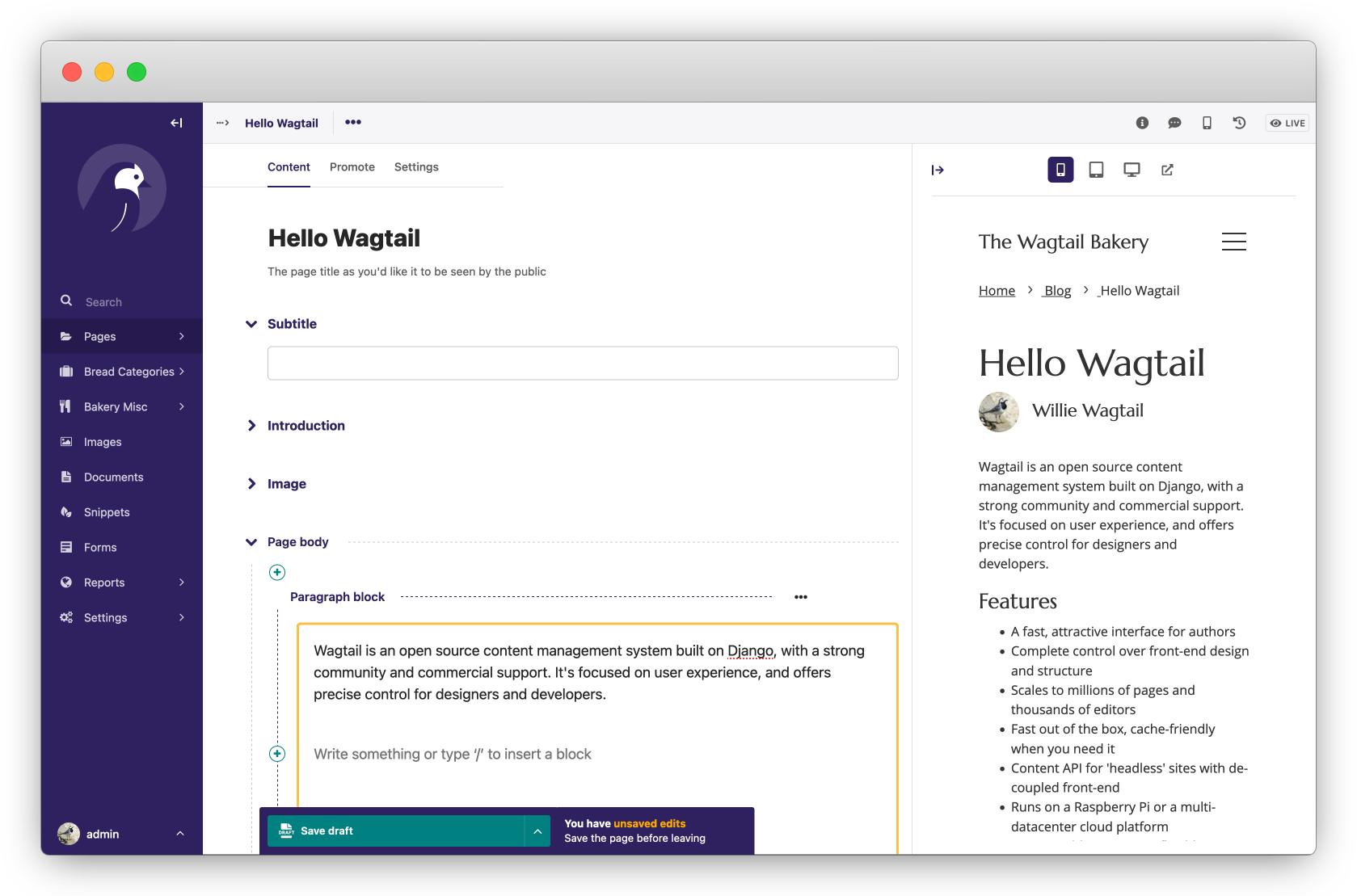
Wagtail screenshot

🔥 Features

  • A fast, attractive interface for authors
  • Complete control over front-end design and structure
  • Scales to millions of pages and thousands of editors
  • Fast out of the box, cache-friendly when you need it
  • Content API for 'headless' sites with decoupled front-end
  • Runs on a Raspberry Pi or a multi-datacenter cloud platform
  • StreamField encourages flexible content without compromising structure
  • Powerful, integrated search, using Elasticsearch or PostgreSQL
  • Excellent support for images and embedded content
  • Multi-site and multi-language ready
  • Embraces and extends Django

Find out more at wagtail.org.

👉 Getting started

Wagtail works with Python 3, on any platform.

To get started with using Wagtail, run the following in a virtual environment:
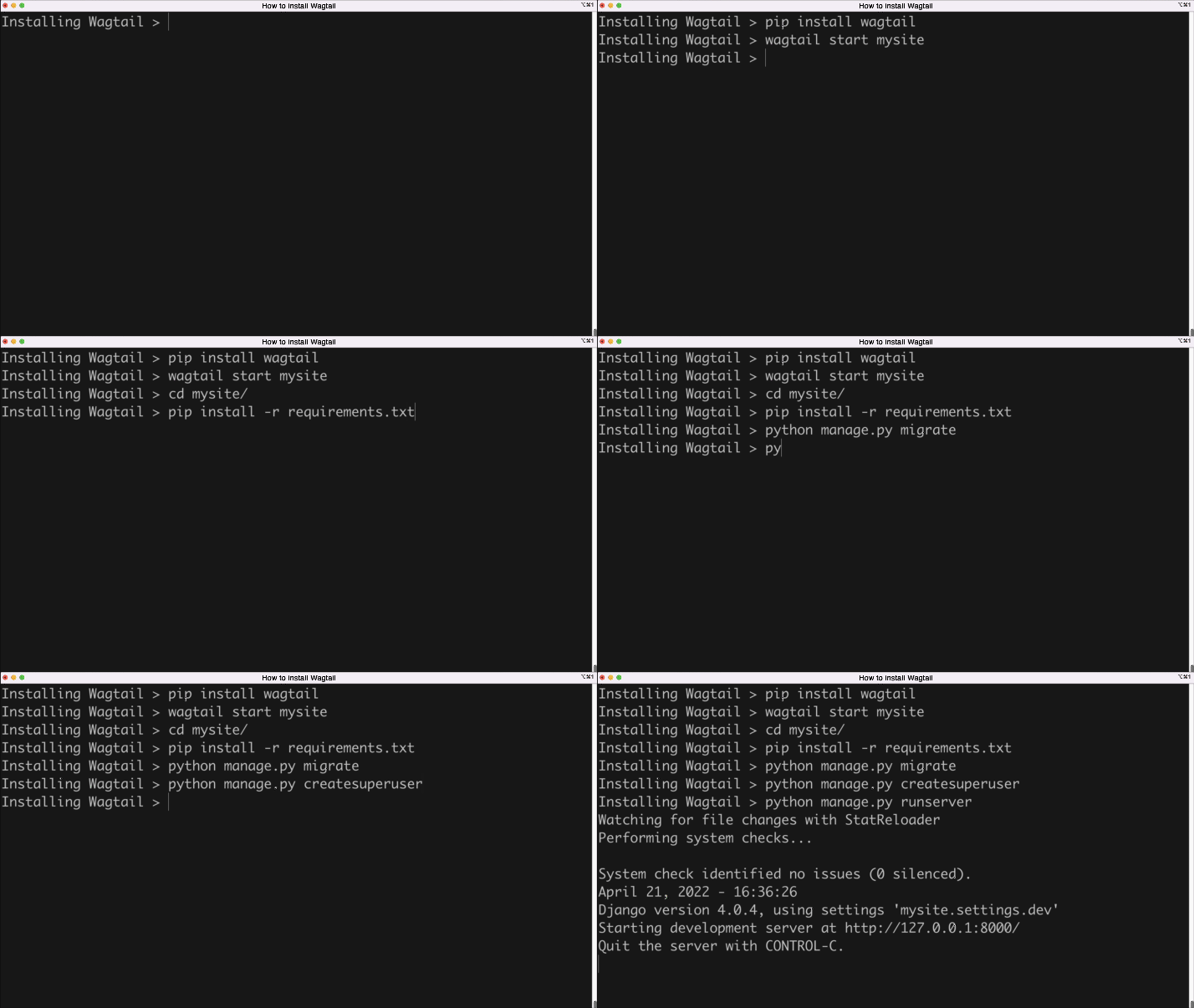
Installing Wagtail

pip install wagtail
wagtail start mysite
cd mysite
pip install -r requirements.txt
python manage.py migrate
python manage.py createsuperuser
python manage.py runserver

For detailed installation and setup docs, see the getting started tutorial.

👨‍👩‍👧‍👦 Who’s using it?

Wagtail is used by NASA, Google, Oxfam, the NHS, Mozilla, MIT, the Red Cross, Salesforce, NBC, BMW, and the US and UK governments. Add your own Wagtail site to madewithwagtail.org.

📖 Documentation

docs.wagtail.org is the full reference for Wagtail, and includes guides for developers, designers and editors, alongside release notes and our roadmap.

For those who are new to Wagtail, the Zen of Wagtail will help you understand what Wagtail is, and what Wagtail is not.

For developers who are ready to jump in to their first Wagtail website the Getting Started Tutorial will guide you through creating and editing your first page.

Do you have an existing Django project? The Wagtail Integration documentation is the best place to start.

📌 Compatibility

(If you are reading this on GitHub, the details here may not be indicative of the current released version - please see Compatible Django / Python versions in the Wagtail documentation.)

Wagtail supports:

  • Django 5.2.x, 6.0.x and 6.1.x
  • Python 3.11, 3.12, 3.13, and 3.14
  • PostgreSQL, MySQL, MariaDB and SQLite (with JSON1) as database backends

Previous versions of Wagtail additionally supported Python 2.7, 3.8 and earlier Django versions.


📢 Community Support

There is an active community of Wagtail users and developers responding to questions on Stack Overflow. When posting questions, please read Stack Overflow's advice on how to ask questions and remember to tag your question "wagtail".

For topics and discussions that do not fit Stack Overflow's question and answer format we have a Slack workspace. Please respect the time and effort of volunteers by not asking the same question in multiple places.

Join slack community

Our GitHub discussion boards are open for sharing ideas and plans for the Wagtail project.

We maintain a curated list of third party packages, articles and other resources at Awesome Wagtail.

🧑‍💼 Commercial Support

Wagtail is sponsored by Torchbox. If you need help implementing or hosting Wagtail, please contact us: [email protected]. See also madewithwagtail.org/developers/ for expert Wagtail developers around the world.

🔐 Security

We take the security of Wagtail, and related packages we maintain, seriously. If you have found a security issue with any of our projects please email us at [email protected] so we can work together to find and patch the issue. We appreciate responsible disclosure with any security related issues, so please contact us first before creating a GitHub issue.

🕒 Release schedule

Feature releases of Wagtail are released every three months. Selected releases are designated as Long Term Support (LTS) releases, and will receive maintenance updates for an extended period to address any security and data-loss related issues. For dates of past and upcoming releases and support periods, see Release Schedule.

🕛 Nightly releases

To try out the latest features before a release, we also create builds from main every night. You can find instructions on how to install the latest nightly release at https://releases.wagtail.org/nightly/index.html

🙋🏽 Contributing

If you're a Python or Django developer, fork the repo and get stuck in! We have several developer focused channels on the Slack workspace.

You might like to start by reviewing the contributing guidelines and checking issues with the good first issue label.

We also welcome translations for Wagtail's interface. Translation work should be submitted through Transifex.

🔓 License

BSD - Free to use and modify for any purpose, including both open and closed-source code.

👏 Thanks

We thank the following organisations for their services used in Wagtail's development:

Browserstack
BrowserStack provides the project with free access to their live web-based browser testing tool, and automated Selenium cloud testing.

Assistiv Labs
Assistiv Labs provides the project with unlimited access to their remote testing with assistive technologies.

Frequently asked questions

Is wagtail free to use?

wagtail is open source under the BSD-3-Clause licence. There is no licence fee and no seat count — you can self-host it or, where the project offers one, pay a vendor for a managed version instead.

What does wagtail do?

A Django content management system focused on flexibility and user experience

What is wagtail written in?

wagtail is primarily written in Python. Its source is publicly available at https://github.com/wagtail/wagtail, and it has 20,503 GitHub stars.