
Voiden : The offline, Git-native API workspace.
Build, test, document, and collaborate on APIs with plain-text .void files.
No accounts. No required cloud sync. Just local files, reusable blocks, and Git.









Contributors
Why Voiden
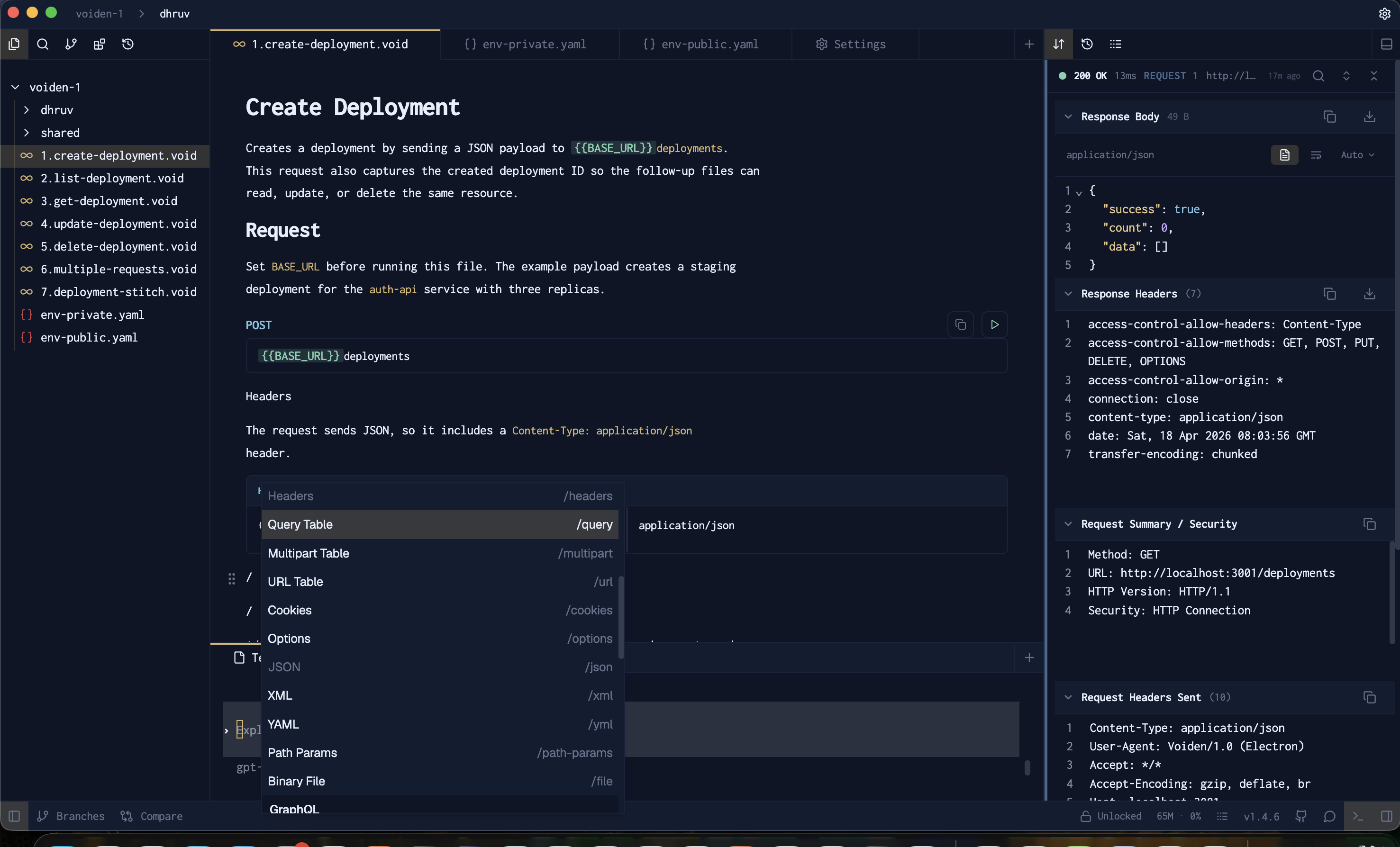
Voiden is an offline API client that helps developers, QA and technical writers build, test, collaborate and document APIs in one place. With a programmable interface (/slash commands) and an agent-friendly CLI, Voiden adapts to how engineers already work. Voiden is built with Electron, Typescript and Javascript, and it doesnt require an account to use it.
No telemetry, no VC funding, and no cloud lock-in.
✨ Features:
Voiden supports all major API protocols:
- Supports REST, GraphQL, Grpc, Web-Sockets. All these are plugins that you can install or uninstall according to your needs. Community plugins available: https://voiden.md/plugins
- Import collections from Postman, Insomnia and Swagger/ OpenAPI.
Single Source of truth for all API work in the same file:
- Keep API requests, tests, notes and docs together in the same executable
.voidfiles. Keep everything in one format and one workflow. - Requests can be composed by API building blocks (endpoint, auth, params, body). Decompose requests into blocks. Reuse the same blocks across files, like functions.
- Work in Markdown and structured blocks instead of opaque collections locked inside an app.
- Test and document APIs without leaving the editor.
Workflows:
- Scripting: Execute JavaScript, Python, or Shell scripts before sending requests and after receiving responses.
- Stitch runner: Batch-execute multiple .void files sequentially. Supports glob patterns, stop-on-failure, variable isolation, configurable delays, and environment selection.
Collaboration:
- Collaborate with Git branches and pull requests instead of proprietary team workspaces.
- Stay local-first with no signup and no required cloud sync.
AI Friendly:
- No proprietary workspace. No binary exports. Pure text all the way down, diffable like code, greppable, AI-editable, and merge-friendly.
- Supports Voiden skills for Claude and Codex agents.
Voiden Runner: A headless CLI for running those .void files outside the desktop app, directly in the terminal.
- runs on Node.js 18+
- works in terminal, CI/CD, Docker, and cron jobs
- supports REST, WebSocket, gRPC, and GraphQL
- supports request chaining through runtime variables
- works with core Voiden plugins like scripting, assertions, faker, advanced auth, + more.
Install
Current version: 2.1.0
Download installers for macOS, Windows, and Linux from voiden.md/download.
Direct downloads are available for Apple Silicon and Intel macOS, Windows .exe, and Linux .deb, .rpm, and .AppImage builds.
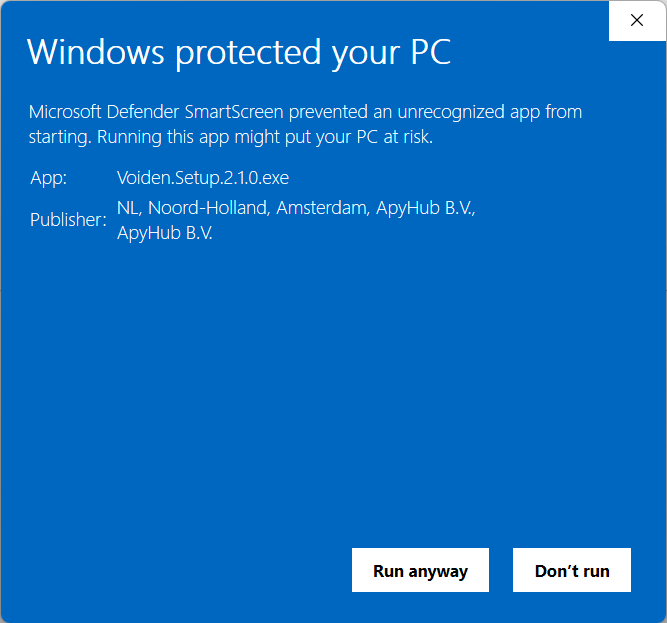
Windows note (starting v2.1.1): the Windows installer is now signed via Azure Trusted Signing instead of our previous certificate provider. Because of this change, you may see a "Windows protected your PC" SmartScreen dialog during install — the installer is signed and verified, this is expected while the app builds up download reputation with Microsoft. Click "More info" → "Run anyway" to proceed.
Package managers
| Platform | Stable | Early access |
|---|---|---|
| macOS | brew install voiden |
brew install voiden@beta |
| Windows | winget and Chocolatey coming soon |
winget and Chocolatey coming soon |
| Linux | apt and snap support |
Beta apt and snap channels |
| Linux/macOS | nix run github:VoidenHQ/voiden (Flake) |
Development shell with nix develop |
Homebrew
brew install voiden
# beta
brew install voiden@beta
APT (Ubuntu / Debian)
curl -fsSL https://voiden.md/apt/stable/voiden.gpg | sudo gpg --dearmor -o /etc/apt/keyrings/voiden.gpg
echo "deb [arch=amd64 signed-by=/etc/apt/keyrings/voiden.gpg] https://voiden.md/apt/stable stable main" | sudo tee /etc/apt/sources.list.d/voiden.list
sudo apt update && sudo apt install voiden
# beta
curl -fsSL https://voiden.md/apt/beta/voiden.gpg | sudo gpg --dearmor -o /etc/apt/keyrings/voiden-beta.gpg
echo "deb [arch=amd64 signed-by=/etc/apt/keyrings/voiden-beta.gpg] https://voiden.md/apt/beta beta main" | sudo tee /etc/apt/sources.list.d/voiden-beta.list
sudo apt update && sudo apt install voiden
Snap
sudo snap install voiden
# beta
sudo snap install voiden --channel=beta
Nix (Linux / macOS)
Run Voiden directly using Nix Flakes:
nix run github:VoidenHQ/voiden
Looking for newer builds? Check the early access section on voiden.md/download.
Get started with Voiden
- Install Voiden and open it. No signup or login is required.
- Create a
.voidfile in any folder and add your request, docs, and reusable blocks. - Run the request with
Cmd+EnterorCtrl+Enter, then commit the file to Git.
For a guided first run, see the Voiden quick start.
Coming from Postman and other tools?
If you already use Postman, you can bring your existing collections with you:
- In Postman, export your collection as JSON (v2.1 is recommended).
- Drag the exported JSON file into the Voiden file list on the left panel.
- Open the imported file and click Generate Voiden Files to create a folder of native
.voidfiles — one per request, with headers, auth, query params, path variables, bodies, and response examples preserved.
Full walkthrough: Postman Imports.
Using Swagger or Insomnia?
OpenAPI Imports. Insomnia Imports
What you can do
- Build REST and HTTP requests with headers, query params, JSON/XML/YAML/form bodies, file uploads, and cURL import/export.
- Work with GraphQL using schema import, a visual query builder, variables, and subscriptions.
- Use WebSocket and gRPC workflows in the same workspace.
- Add pre-request and post-response scripts in JavaScript, Python, or shell.
- Run assertions and stitch multiple
.voidfiles into batch runs with aggregated results. - Import OpenAPI specs and Post