⚖️ Veritas Kanban
Veritas in actis — Truth in action.
Local-first task management board with optional AI agent orchestration.
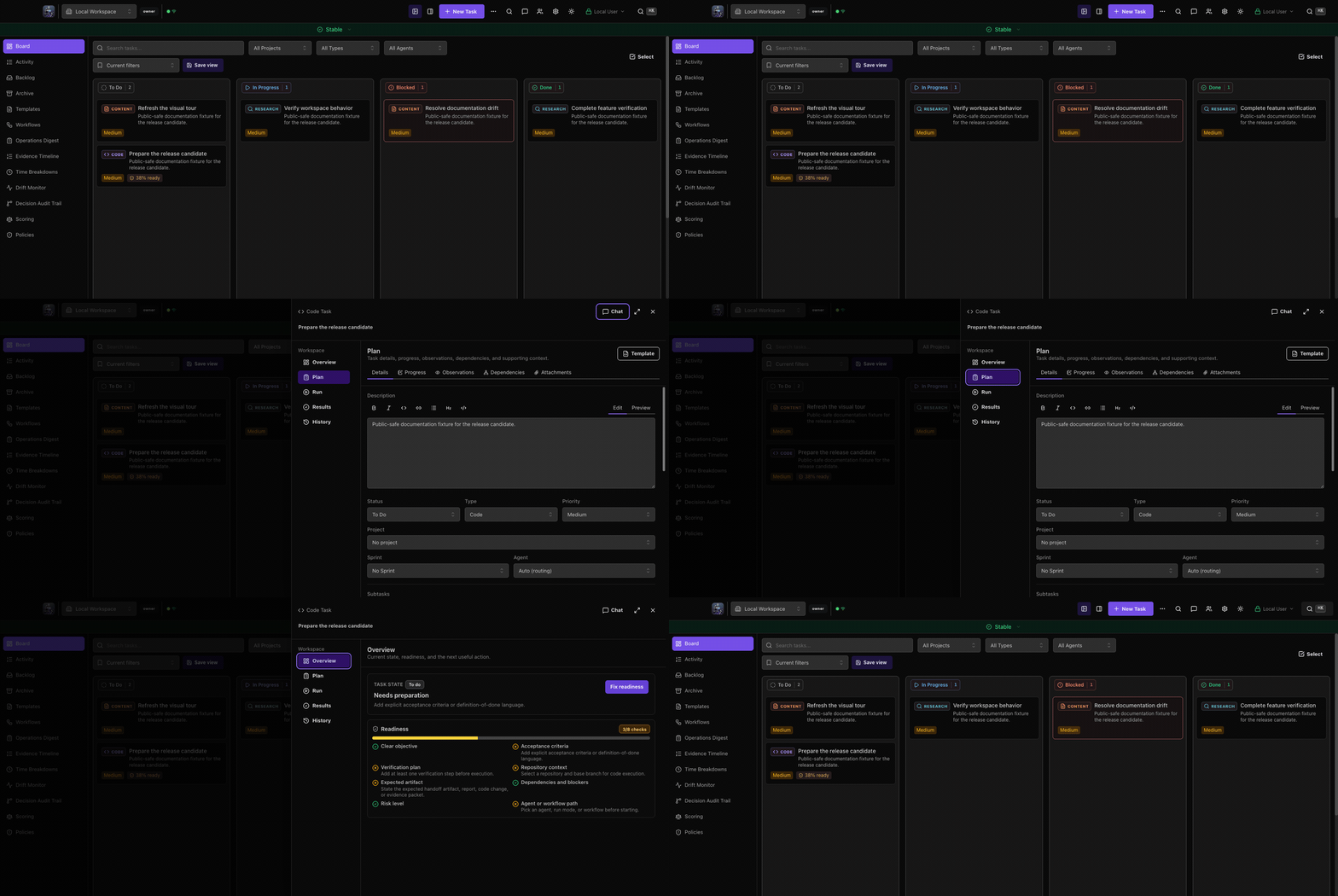
Start with a visual Kanban board. Add CLI, MCP, OpenClaw, Squad Chat webhooks, workflows, or governance only when you need that layer.


⭐ If you find this useful, star the repo — it helps others discover it!
Quickstart · Features · Why VK · All Features · Docs · Troubleshooting · API · Agent Setup · MCP Server · Contributing · Changelog
Created by Brad Groux — CEO of Digital Meld, and host of the Start Small, Think Big podcast · LinkedIn · Twitter · YouTube
⚡ Quickstart
Start with the local board. OpenClaw, MCP, Squad Chat webhooks, notifications, workflows, and governance gates are optional layers you can turn on later. See Setup Paths for the board-only, CLI, MCP, OpenClaw, and self-hosted paths.
Want to take the easy way out? Ask your agent:
Clone and set up veritas-kanban locally using the board-only setup path first. Install dependencies with pnpm, copy server/.env.example to server/.env, and start the dev server. Verify the UI at localhost:3000 and the API health endpoint at localhost:3001/api/health. Do not configure OpenClaw, MCP, Squad Chat webhooks, workflows, or notifications unless I explicitly ask for that layer.
Want to do it yourself? Choose the packaged Mac app or a local source checkout:
For the packaged Mac desktop app:
brew tap BradGroux/tap
brew install --cask veritas-kanban
Existing desktop users should follow the routine Mac upgrade path so backup, heartbeat pause, app replacement, launch, and exact-version server readiness happen in the right order.
For local source development:
git clone https://github.com/BradGroux/veritas-kanban.git
cd veritas-kanban
pnpm install
cp server/.env.example server/.env   # Edit to change VERITAS_ADMIN_KEY
pnpm dev
Open http://localhost:3000 for source runs, or install
the signed/notarized Mac app with
brew tap BradGroux/tap && brew install --cask veritas-kanban. The board
auto-seeds with example tasks on first run so you can explore right away.
A working board means the UI loads and http://localhost:3001/api/health returns healthy. Agent-ready and external wake/delivery-ready are separate setup levels; use Setup Paths before adding those layers.
Do not configure these on day one unless you already know you need them:
- OpenClaw gateway or browser relay
- MCP write access
- Squad Chat webhook or external wake behavior
- Notification delivery channels
- Workflow gates or governance policies
When the board is working, use Setup Paths to choose the next layer and run the read/write smoke checks before handing the board to an assistant.
Want a clean slate? Delete the example tasks:
rm tasks/active/task_example_*.mdand refresh. Want to re-seed? Runpnpm seedto restore the example tasks (only works when the board is empty).
Note: Never commit
.envfiles. Use.env.exampleas a template — it contains safe placeholder values and documentation for every variable.
📚 Documentation Map
- Setup Paths — start here for board-only, CLI, MCP, OpenClaw, and self-hosted paths without mixing optional layers into first-run setup.
- Getting Started Guide — zero ➝ agent-ready in 5 minutes, plus sanity checks and prompt registry tips.
- MCP Server Guide — optional MCP setup, 42 tools, architecture, tool catalog, security model, and read/write smoke checks.
- Agent Guide and
AGENTS.mdTemplate — shared managed-run protocol, external self-reporting template, and unmanaged MCP setup. - Agent Providers — evidence-backed Buzz, Grok Build, Codex, Claude Code, Copilot CLI, Hermes, OpenClaw, and optional model profiles.
- v6 Agent Runtime Control Plane — authority, adapter, lifecycle, approval, tool, credential, Buzz, and certification boundaries.
- Phase Capability Profiles — versioned execution-phase authority contracts, deterministic intersections, exact-path plan artifacts, and current delivery boundaries.
- Phase Transition Journal — durable compare-and-set transitions, approval and override controls, restart recovery, REST, and CLI operations.
- Run Access Summary v1 — one redacted, digest-bound view of a run's filesystem, network, tools, integrations, budgets, support, and historical authority.
- Knowledge Collections v1 — immutable sources, cited pages, stable identity, bidirectional links, and reversible reviewed ingestion with file/SQLite parity.
- OpenAI Codex Integration — local execution, SDK and app-server sessions, cloud delegation, MCP setup, workflows, and telemetry.
- Codex Integration SOP & Codex Workflow Examples — operational playbooks for using Codex as a first-class Veritas agent.
- API Reference — Auth, endpoints, request/response examples, WebSocket, common workflows.
- Identity and RBAC Model — users, workspaces, memberships, roles, agent tokens, permission matrix, migration, and UX flows.
- v6 GA Checklist — release gates for harness certification, migration, runtime, desktop, and distribution evidence.
- v6 Visual Tour — release-safe views of provider support, Buzz setup, approvals, and run evidence.
- v6 Upgrade, Install, Remote, And Admin Guide — fresh install, v5-to-v6 upgrade, harness setup, desktop, backup, and diagnostics paths.
- v6 Compatibility And Release Policy — provider support tiers, tested builds, platform combinations, update channels, and rollback limits.
- v6 Release Notes — user-facing highlights, stabilization fixes, install/upgrade steps, behavior changes, and known limits.
- Desktop Architecture ADR — shell decision, native/server boundaries, connection modes, lifecycle, packaging, and security model.
- Post-GA Native Mobile Offline ADR — native mobile authority model, offline queue semantics, conflict handling, and security review.
- Post-GA Cloud Sync And Hosted SaaS ADR — optional hosted model, tenant isolation, lifecycle, support, cost, and migration boundaries.
- Self-Hosting Guide — production deployment, reverse proxy, auth hardening, Docker, and backups.
- Agent Task Workflow SOP — lifecycle, API/CLI snippets, prompts.
- Squad Chat Protocol — agent messaging, system events (spawned/completed/failed), model attribution, and helper scripts.
- Buzz Integration — signed Squad Chat bridging,
explicit persona/team import, and a separate disabled-by-default
buzz-agentprofile under the generic ACP provider. - Agent Providers — exact-version Grok Build, GitHub Copilot CLI, Buzz Agent, Claude Code, and Codex runtime setup, safet