TryPost is a free, open source marketing & customer engagement project written in PHP and released under AGPL-3.0. It has 621 GitHub stars, 164 forks and 39 open issues, and was last pushed 3 days ago. On this registry it ranks #45 of 50 tracked projects in Marketing & Customer Engagement, with 5 head-to-head comparisons available. It gained 15 stars over the last 6 tracked days.

What is TryPost?

TryPost is a self-hostable, open-source social media scheduler written in PHP and released under the AGPL-3.0 licence, built for creators, freelancers, and agencies that want to plan, draft, and publish to twelve social networks from one calendar while keeping their posts, drafts, and metrics on infrastructure they control.

What it is

TryPost is an open-source social media scheduling application written in PHP, listed in the registry under Business Software / Marketing & Customer Engagement and tagged with laravel, content-scheduling, self-hosted, and open-source alongside the networks it targets. It centres on a visual calendar with month, week, and day views, from which posts are composed once and then tailored and previewed per network. Publishing is native through each platform's official API to Instagram, Facebook, LinkedIn, X (Twitter), TikTok, YouTube, Pinterest, Threads, Bluesky, Mastodon, Telegram, and Discord, with no redirect to a mobile app to finish the job. Alongside the calendar, it ships an AI copilot for captions, hooks, drafts, and multi-slide carousels, a REST API, and a first-class MCP server so AI assistants such as Claude, Cursor, or ChatGPT can draft, schedule, and publish on the user's behalf.

The problem it addresses is the split workflow that teams running several brands usually live with. The README frames the alternative as spreadsheets: workspaces, roles, and approval flows exist so an agency or freelancer can run a roster of brands without them. The second problem is tooling that stops short of publishing, handing the final step to a vendor's mobile app; TryPost publishes natively instead. The third is ownership. As the README puts it, self-hosting keeps posts, drafts, and metrics on the operator's own infrastructure, with no seat tax, no feature gates, and no vendor deciding when to lock users out.

Key capabilities

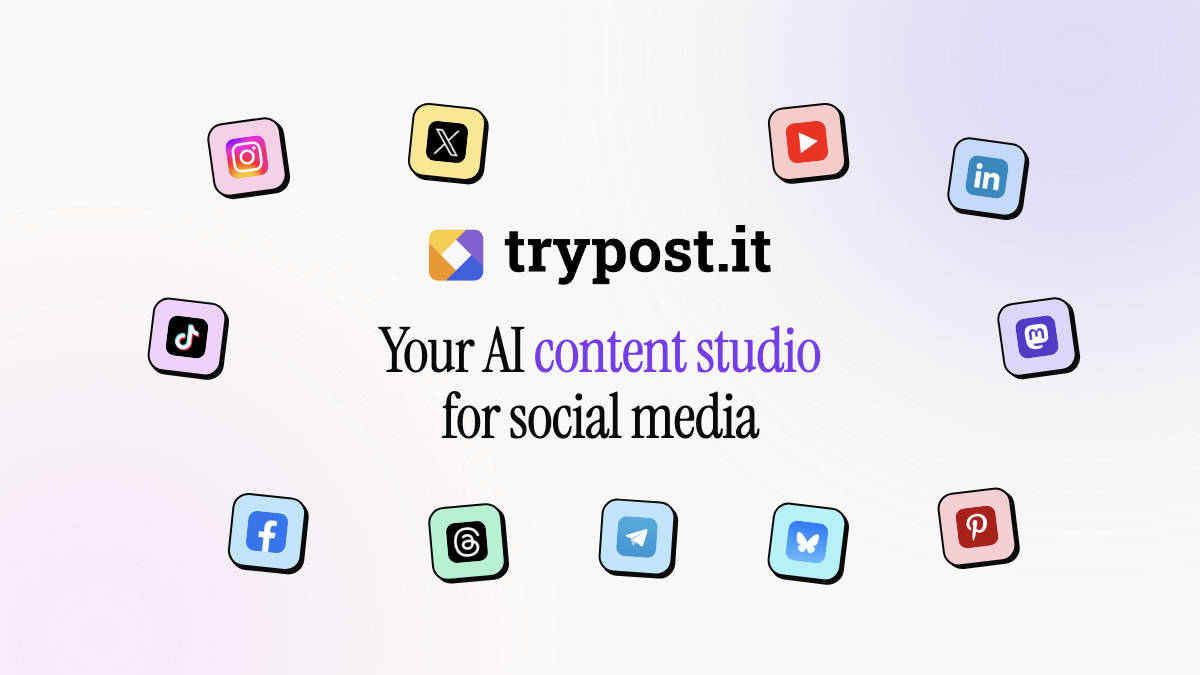
  • Native publishing to 12 networks through each platform's official API: Instagram, Facebook, LinkedIn, X (Twitter), TikTok, YouTube, Pinterest, Threads, Bluesky, Mastodon, Telegram, and Discord.
  • Visual calendar with month, week, and day views and drag-and-drop rescheduling across networks.
  • AI copilot that generates captions, hooks, full drafts, and multi-slide carousels, reading a stored brand profile for tone, voice, language, and colours on every call.
  • MCP server plus REST API for full programmatic control, letting Claude, Cursor, ChatGPT, or custom scripts draft, schedule, and publish.
  • Workspaces, Owner / Admin / Member roles, approval flows, and comments with @mentions on drafts for multi-client operation.
  • Asset library of reusable workspace media with built-in Unsplash and Giphy search, plus reusable signatures and colour-coded post labels.
  • Native analytics showing per-account reach and engagement across every connected platform, and interface translations for 16 languages.

Who uses it and how

  • Agencies and freelancers running a roster of client brands, using one workspace per brand to isolate content, roles, and approvals instead of spreadsheets.
  • Content teams that need Owner, Admin, and Member roles with @mention comments on drafts so review happens before anything is published.
  • Operators who want their posts, drafts, and metrics to stay on their own infrastructure, self-hosting the PHP application rather than using the hosted cloud.
  • AI-driven workflows where Claude, Cursor, or ChatGPT connects over MCP and drafts, schedules, and publishes directly, with scripts using the REST API for the same purpose.
  • Distributed or multilingual teams, given interface translations covering English, Ukrainian, Spanish, Portuguese, French, German, Italian, Dutch, Polish, Greek, Japanese, Korean, Chinese, Russian, Turkish, and Arabic.

Getting started

The README offers three routes: start on cloud at trypost.it, self-host by following the installation guide at docs.trypost.it/self-hosting/overview, or connect an AI assistant over MCP using the setup guide at docs.trypost.it/ai/introduction; self-hosting is free forever.

How it compares

No competing products are named anywhere in the facts provided, so TryPost stands alone in this registry entry and no feature-by-feature comparison can be made here. What the facts do support is the contrast between TryPost's two delivery models rather than against other tools: the same product is either self-hosted under AGPL-3.0 with the operator's own servers and data, or consumed as a hosted cloud service with updates and scaling handled by the maintainers.

When to use it — and when not to

Self-hosting means operating a PHP application on your own servers and staying current with the separate installation guide, since the provided facts do not name the required database, object storage, or mail configuration, so a prospective self-hoster should read that guide before committing. The AGPL-3.0 carries an obligation that teams should weigh deliberately: anyone running a modified version as a network service must make those changes available to its users. Teams that do not want to run or maintain servers, or that cannot accept copyleft terms, should use the cloud option or look elsewhere; and anyone evaluating maturity should note 616 stars, 163 forks, and 39 open issues against a last push of 14 September 2026.

project readme (upstream, from github) — read inline

Run your whole social presence from one calendar

An open-source social media scheduler with an AI copilot, native publishing to 12 networks,
and an MCP server so your AI assistant can post for you. Self-host it, or skip the setup on cloud.


Stars License Release Discussions

Try on Cloud  •  Documentation  •  Community

What you get

📅  One calendar, every network Plan a month at a glance, drag any post to a new slot, and publish natively to 12 platforms. No redirects, no "finish in the mobile app."
✨  An AI copilot that knows your brand Captions, hooks, full drafts, and multi-slide carousels in your tone, voice, and colors. It reads your brand profile on every generation.
🤖  Built for AI agents A first-class MCP server and REST API. Claude, Cursor, ChatGPT, or your own scripts can draft, schedule, and publish for you.
🗂️  Made for many clients Workspaces, roles, and approval flows so an agency or freelancer can run a roster of brands without the spreadsheets.

Features

Visual calendar Month, week, and day views. Drag and drop to reschedule across networks.
Multi-platform composer Write once, then tailor the preview per network in parallel.
AI generate & review Draft from a prompt, get inline feedback before you publish.
AI carousel builder Prompt to a multi-slide carousel with images, on-brand.
Brand profile Tone, voice, language, and colors applied to every AI call.
Repurpose Auto-replicate the videos you post outside TryPost to your other networks.
Asset library Reusable workspace media, plus Unsplash and Giphy search built in.
Signatures & labels Reusable hashtag and CTA blocks, color-coded post tags.
Team collaboration Owner / Admin / Member roles, comments with @mentions on drafts.
Workspaces Isolate each brand, client, or project in its own space.
REST API + MCP Full programmatic control; AI assistants integrate natively.
Native analytics Per-account reach and engagement across every connected platform.
Multi-language English, Ukrainian, Spanish, Portuguese, French, German, Italian, Dutch, Polish, Greek, Japanese, Korean, Chinese, Russian, Turkish, and Arabic.

Supported platforms

Posts publish natively through each platform's official API.


Instagram

Facebook

LinkedIn

X (Twitter)

TikTok

YouTube

Pinterest

Threads

Bluesky

Mastodon

Telegram

Discord

Get started

☁️  Cloud The fastest way in. We host, update, and scale it for you. Start at trypost.it →
🛠️  Self-host Free forever, your servers, your data. Installation guide →
🤖  Drive it with AI Connect Claude, Cursor, or ChatGPT over MCP. MCP setup →

Own your stack

TryPost is open source on purpose. Self-host it and your posts, drafts, and metrics stay on your infrastructure, under a license that is yours to keep. No seat tax, no feature gates, no vendor deciding when to lock you out. Read every line, fork it, and ship it. When you would rather not run servers, the same product is one click away on cloud.

Contributing

Contributions of any size are welcome. Pick an issue, say hi in Discussions, or open a PR with what you would like to see.

Short on time? A star is the most valuable thing you can give. It helps more people find the project.

License

GNU Affero General Public License v3.0. Use, modify, fork, self-host, and redistribute, including commercially. If you run a modified version as a network service, make your changes available to its users (AGPL §13).


Built in the open. Star TryPost on GitHub and tell a friend.

Frequently asked questions

Is TryPost free to use?

TryPost is open source under the AGPL-3.0 licence. There is no licence fee and no seat count — you can self-host it or, where the project offers one, pay a vendor for a managed version instead.

What does TryPost do?

Schedule posts to every major social network, self-hosted

What is TryPost written in?

TryPost is primarily written in PHP. Its source is publicly available at https://github.com/trypostit/trypost, and it has 621 GitHub stars.