





Quickstart · Benchmarks · Docs · Kernels · Blog post · runanywhere.ai
TrnRT is an open inference engine for large language models on AWS Trainium. It serves an OpenAI-compatible API
from one trn2.48xlarge, runs decode as NKI megakernels (about one kernel per layer half), and keeps a prefix cache
across device and host memory. GLM-5.3-Flash is the first supported model; more open models are on the way.
How we built it, with the AgentX results: Serving GLM-5.3-Flash on one Trainium2 box with NKI layer megakernels.

Highlights
| Feature | What it does |
|---|---|
| NKI megakernels | One fused kernel per layer half for decode: KDA attention, the fused DSA layer, mHC and the MoE FFN. |
| 1M-token context | Sparse attention (top 2,048) and linear attention, with fixed-size state. |
| Prefix cache | A radix tree over FP8 KV pages, plus a host-memory tier for evicted pages and state checkpoints. |
| Two engines per box | Each engine is tensor-parallel over 32 logical NeuronCores, behind a session-affine router. |
| OpenAI API | Chat and completions, streaming, tool calls and reasoning output. |
| Offline compile | Every graph is built on a CPU host; the serving box loads them and compiles nothing by default. |
Quickstart
You need Docker, a trn2.48xlarge to serve on, and any x86_64 host to compile on. New to Trainium? Start with
docs/AWS.md.
1. Build the image (Neuron SDK 2.32 (neuronx-cc 2.27), Python 3.13)
git clone https://github.com/RunanywhereAI/trnrt.git && cd trnrt
docker build -f docker/Dockerfile \
  --build-arg TRNRT_VERSION=$(python3 -c 'import trnrt; print(trnrt.__version__)') \
  --build-arg TRNRT_REVISION=$(git rev-parse HEAD) -t trnrt .
2. Build the compile cache (any x86_64 host, no NeuronCore needed; takes hours)
OUT=/data/trnrt REV=eb9eb208eb0d988989d07a6a12d0fdeb5f52574a
mkdir -p $OUT/nki $OUT/work
trnrt() { docker run --rm -e HF_TOKEN -v $OUT:$OUT \
  -v $OUT/nki:/var/tmp/nki-intermediate-cache trnrt "$@"; }
trnrt compile shapes zai-org/GLM-5.3-Flash --revision $REV --out $OUT
trnrt compile decisions --model zai-org/GLM-5.3-Flash --revision $REV --out $OUT
trnrt compile capture --out $OUT -- --model $OUT/shapes
trnrt compile compile --out $OUT --work-root $OUT/work
trnrt compile strip --out $OUT
3. Serve (on the trn2.48xlarge, with $OUT/cache and $OUT/nki copied over)
hf download zai-org/GLM-5.3-Flash --revision eb9eb208eb0d988989d07a6a12d0fdeb5f52574a \
  --local-dir /models/GLM-5.3-Flash
docker run --rm --privileged --network host --ipc=host \
  -v /data/trnrt/cache:/cache \
  -v /data/trnrt/nki:/var/tmp/nki-intermediate-cache \
  -v /models/GLM-5.3-Flash:/model \
  -e NEURON_LIBTORCH_CACHE_ROOT=/cache \
  trnrt serve --model /model --port 8000
4. Call it with any OpenAI client
from openai import OpenAI

client = OpenAI(base_url="http://localhost:8000/v1", api_key="unused")
reply = client.chat.completions.create(
    model="glm",
    messages=[{"role": "user", "content": "Write a haiku about Trainium."}],
    extra_body={"session_id": "my-session"},  # keeps a conversation on one engine's prefix cache
)
print(reply.choices[0].message.content)
The full guide covers what each step needs, start-up checks, the batch 4, 8 and 12 configurations and every flag: deploy · API · configuration.
Supported hardware and models
| Target | Status |
|---|---|
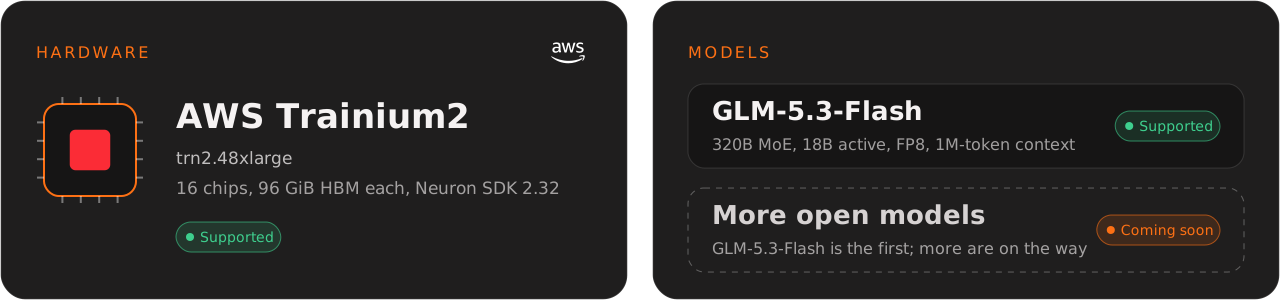
AWS Trainium2, trn2.48xlarge (16 chips, 2 engines × TP 32, LNC 2) |
✅ Supported |
| GLM-5.3-Flash (320B MoE, 18B active, FP8, 1M-token context) | ✅ Supported |
| More open models | 🔜 Coming soon. Request a model |
GLM-5.3-Flash is where TrnRT starts. The engine, router, caches and compile pipeline are built to carry more model families, and docs/ARCHITECTURE.md describes what a new one needs.
Benchmarks
SemiAnalysis AgentX replays real coding-agent sessions. One
trn2.48xlarge ran it at a 1M-token context with 32 concurrent agents, for one hour per point:
| Decode batch | Requests / min | Tokens / min | Decode tok/s per user (p50) | First token, cached (p50) | $ / M tokens (spot) |
|---|---|---|---|---|---|
| 4 | 19.3 | 2.36M | 46.6 | 76.73 s | $0.061 |
| 8 | 25.2 | 3.02M | 29.4 | 28.82 s | $0.047 |
| 12 (default) | 28.9 | 3.57M | 22.3 | 6.53 s | $0.040 |
Tokens count input (cached input included) and output. Spot price: $8.60/h, us-east-2, 3 Nov 2026. On a capacity block at $35.76/h, the batch 12 cost is $0.167 per million tokens. Full tables, cold-prompt latencies, long prompts and methodology are in docs/RESULTS.md.
These numbers were measured with an earlier build of TrnRT. This repository passes these checks against that build (docs/KNOWN_ISSUES.md):
- Graph equivalence: EQUAL on all 32 ranks, for all 157 graphs that build compiles in the default batch-12 configuration.
- Outputs: byte-identical to that build's on 384 of 384 requests.
- Serving: the two-engine serve in the Quickstart passes end to end.
How it works
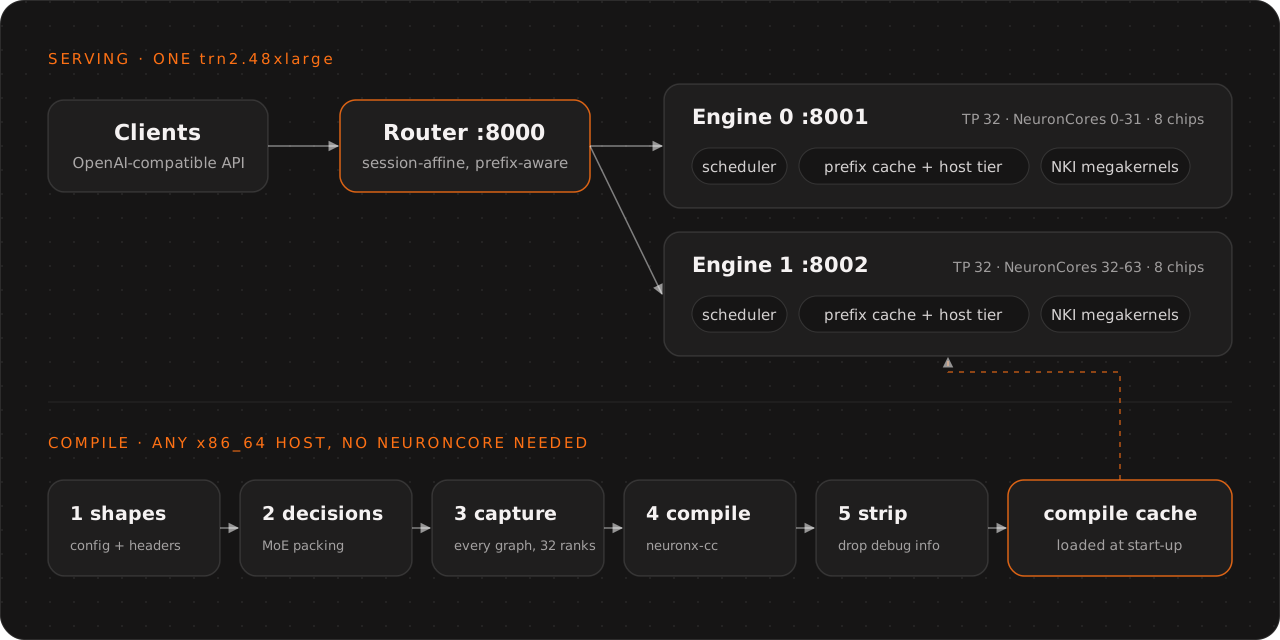
Decode is not limited by memory bandwidth here; small instructions, kernel boundaries and exposed collectives dominate it. So each decode megakernel follows three rules: keep the working set in SBUF, use both physical cores symmetrically, and move the collectives into the kernel. docs/MEGAKERNELS.md walks through every kernel.
Repository layout
trnrt/
├── __main__.py   CLI: serve, engine, compile
├── serve/        OpenAI API, session-affine router, output parsers
├── engine/       scheduler, prefix caches, tensor parallelism
├── models/       GLM-5.3-Flash: KDA, DSA, mHC, MoE, FP8 loading
├── kernels/      NKI decode megakernels and prefill kernels
└── compile/      offline compile: shapes, capture, neuronx-cc, strip
docker/           the serving and compile image
tools/            graph-equivalence gate, device checks, doc checks
tests/            CPU test suite (no NeuronCore needed)
docs/             guides, results, kernel notes
More in docs/ARCHITECTURE.md.
Development
make dev     # editable install with test and lint tools (Python 3.13)
make check   # lint, type-check, then the CPU test suite
See docs/DEVELOPMENT.md for the test tiers and CI, CONTRIBUTING.md to send a
change (pull requests target development), SUPPORT.md to get help, and SECURITY.md to
report a vulnerability.
AWS resources
| Resource | Link |
|---|---|
Trainium2 and trn2 instances |
aws.amazon.com/ec2/instance-types/trn2 |
| AWS Neuron SDK documentation | awsdocs-neuron.readthedocs-hosted.com |
| NKI (Neuron Kernel Interface) | NKI documentation |
| Neuron deep learning containers | github.com/aws-neuron/deep-learning-containers |
| EC2 Capacity Blocks for ML | aws.amazon.com/ec2/capacityblocks |
Acknowledgments
Thanks to the AWS Neuron team for NKI and its documentation, to Z.ai for releasing GLM-5.3-Flash, and to SemiAnalysis for AgentX and its public traces. TrnRT includes code derived from other Apache-2.0 projects: see NOTICE and THIRD_PARTY_NOTICES.md.
License

Built by RunAnywhere.
AWS, Amazon Web Services, Trainium, Inferentia and Neuron are trademarks of Amazon.com, Inc. or its affiliates. The AWS logo appears here as published in AWS's Architecture Icons. TrnRT is an independent open-source project, not affiliated with or endorsed by Amazon Web Services.