




trivy is a free, open source cloud infrastructure management project written in Go and released under Apache-2.0. It has 37,961 GitHub stars, 691 forks and 269 open issues, and was last pushed 10 hours ago. On this registry it ranks #2 of 43 tracked projects in Cloud Infrastructure Management, with 5 head-to-head comparisons available. It gained 35 stars over the last 3 tracked days.

What is trivy?

What it is

Trivy is an open-source security scanner written in Go and released under the Apache-2.0 license. It is an Aqua Security open source project, hosted at trivy.dev, and it lives in the cloud-native and DevSecOps ecosystem alongside container runtimes, Kubernetes clusters, and infrastructure-as-code tooling. The design separates two ideas: scanners, which describe the classes of security issue Trivy looks for, and targets, which describe where it looks. The README presents the project as a comprehensive and versatile scanner, and the topic list — containers, devsecops, docker, iac, infrastructure-as-code, kubernetes, vulnerability-detection, security-tools — reflects that positioning. The repository is roughly seven years old, carries about 37,915 stars and 685 forks, and has 269 open issues at the time of writing.

The concrete problem it solves is the fragmentation of security checks across the software supply chain. A team shipping a container image usually needs one tool for OS package vulnerabilities, another for application dependencies, another for infrastructure-as-code misconfigurations, another for leaked secrets, and another for license compliance. Trivy collapses those checks into a single binary with a single invocation, and it runs that invocation against several kinds of target: a container image, a filesystem, a remote Git repository, a virtual machine image, or a Kubernetes cluster. The same scanners then report OS packages and software dependencies as an SBOM, known CVEs, IaC issues and misconfigurations, sensitive information and secrets, and software licenses.

Key capabilities

  • Scans container images, filesystems, remote Git repositories, virtual machine images, and Kubernetes clusters as targets.
  • Detects known vulnerabilities (CVEs) in OS packages and software dependencies, and can emit an SBOM of what is in use.
  • Detects IaC issues and misconfigurations.
  • Detects sensitive information and secrets.
  • Reports software licenses.
  • Selects scanners per run through the --scanners flag, for example trivy fs --scanners vuln,secret,misconfig myproject/.
  • Supports most popular programming languages, operating systems, and platforms, per the Scanning Coverage page.
  • Ships canary builds from every push to the main branch as Docker Hub, GitHub, and ECR images and as binaries.

Who uses it and how

  • Developers scan a container image before pushing, as in trivy image python:3.4-alpine.
  • Projects scan a working tree or filesystem for vulnerabilities, secrets, and misconfigurations in one pass with `trivy fs --scanners vuln
project readme (upstream, from github) — read inline

GitHub Release Test Go Report Card License: Apache-2.0 GitHub Downloads Docker Pulls

📖 Documentation

Trivy (pronunciation) is a comprehensive and versatile security scanner. Trivy has scanners that look for security issues, and targets where it can find those issues.

Targets (what Trivy can scan):

  • Container Image
  • Filesystem
  • Git Repository (remote)
  • Virtual Machine Image
  • Kubernetes

Scanners (what Trivy can find there):

  • OS packages and software dependencies in use (SBOM)
  • Known vulnerabilities (CVEs)
  • IaC issues and misconfigurations
  • Sensitive information and secrets
  • Software licenses

Trivy supports most popular programming languages, operating systems, and platforms. For a complete list, see the Scanning Coverage page.

To learn more, go to the Trivy homepage for feature highlights, or to the Documentation site for detailed information.

Quick Start

Get Trivy

Trivy is available in most common distribution channels. The full list of installation options is available in the Installation page. Here are a few popular examples:

  • brew install trivy
  • docker run aquasec/trivy
  • Download binary from
  • See Installation for more

Trivy is integrated with many popular platforms and applications. The complete list of integrations is available in the Ecosystem page. Here are a few popular examples:

Canary builds

There are canary builds (Docker Hub, GitHub, ECR images and binaries) generated with every push to the main branch.

Please be aware: canary builds might have critical bugs, so they are not recommended for use in production.

General usage

trivy <target> [--scanners <scanner1,scanner2>] <subject>

Examples:

trivy image python:3.4-alpine
Result

https://github.com/user-attachments/assets/af1c11e7-d9c5-48af-8e05-cb34dfd6352a

trivy fs --scanners vuln,secret,misconfig myproject/
Result

https://github.com/user-attachments/assets/6b3894b7-77c5-4ffc-ac94-ffe6648a30dc

trivy k8s --report summary cluster
Result
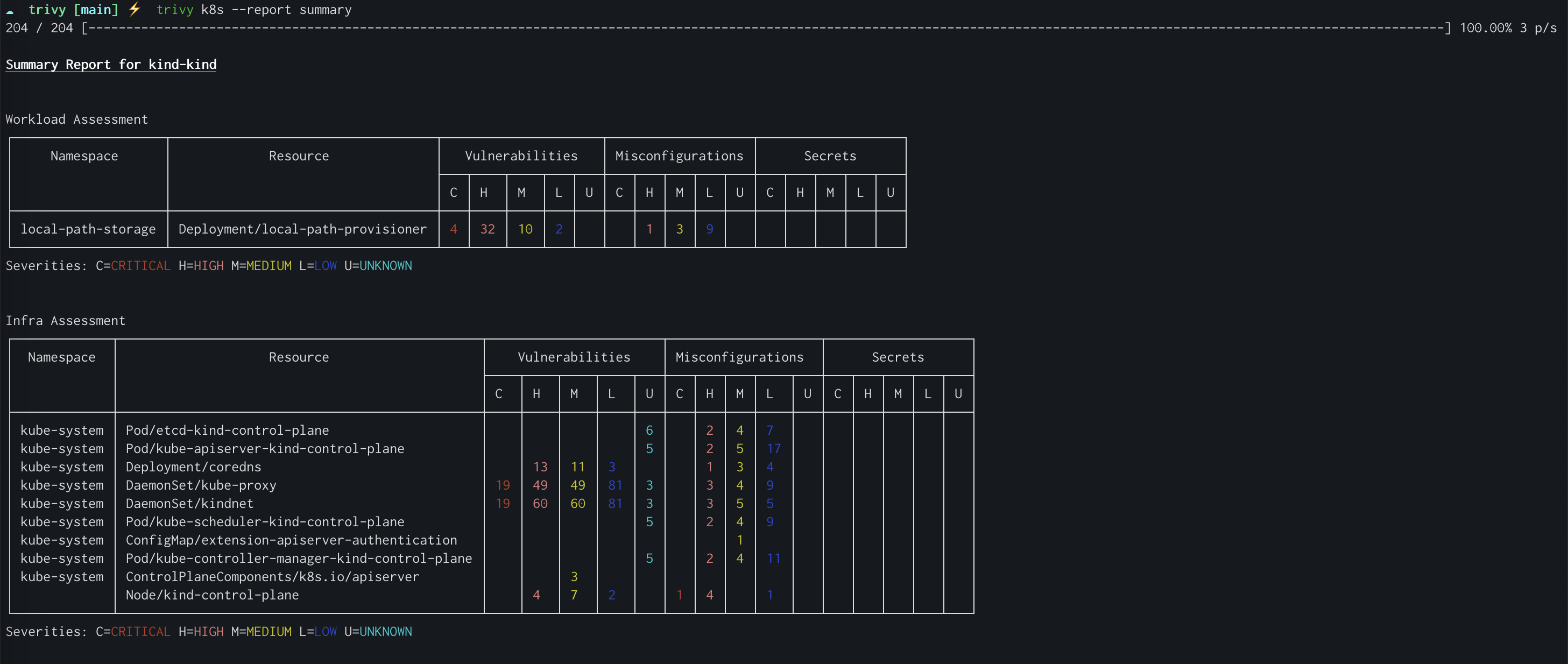
k8s summary

FAQ

How to pronounce the name "Trivy"?

tri is pronounced like trigger, vy is pronounced like envy.

Want more? Check out Aqua

If you liked Trivy, you will love Aqua which builds on top of Trivy to provide even more enhanced capabilities for a complete security management offering.
You can find a high level comparison table specific to Trivy users here. In addition check out the website for more information about our products and services. If you'd like to contact Aqua or request a demo, please use this form:

Community

Trivy is an Aqua Security open source project.
Learn about our open source work and portfolio here.
Contact us about any matter by opening a GitHub Discussion here

Please ensure to abide by our Code of Conduct during all interactions.

Frequently asked questions

Is trivy free to use?

trivy is open source under the Apache-2.0 licence. There is no licence fee and no seat count — you can self-host it or, where the project offers one, pay a vendor for a managed version instead.

What does trivy do?

Find vulnerabilities, misconfigurations, secrets, SBOM in containers, Kubernetes, code repositories, clouds and more

What is trivy written in?

trivy is primarily written in Go. Its source is publicly available at https://github.com/aquasecurity/trivy, and it has 37,961 GitHub stars.