


traefik is a free, open source networking & connectivity project written in Go and released under MIT. It has 64,895 GitHub stars, 6,201 forks and 939 open issues, and was last pushed 14 hours ago. On this registry it ranks #3 of 14 tracked projects in Networking & Connectivity, with 5 head-to-head comparisons available.

What is traefik?

Traefik — pronounced traffic — is "The Cloud Native Application Proxy": an MIT-licensed, Go-based HTTP reverse proxy and load balancer that watches your orchestrator or service registry and generates its own routes, aimed at teams running microservices on Docker, Swarm, Kubernetes, Consul, Etcd, Rancher v2, or Amazon ECS.

What it is

Traefik is an HTTP reverse proxy and load balancer written in Go and published under the MIT licence. It integrates with the infrastructure components already present in a deployment — Docker, Swarm mode, Kubernetes, Consul, Etcd, Rancher v2, and Amazon ECS — and configures itself automatically and dynamically from those sources. The project's own framing is that pointing Traefik at your orchestrator should be the only configuration step required. It ships as a single binary and as an official Docker image at hub.docker.com/r/_/traefik/, and exposes a REST API and a web UI.

The concrete problem it solves is route maintenance. Traditional reverse proxies require that you configure each route connecting paths and subdomains to each microservice by hand. In an environment where services are added, removed, killed, upgraded, or scaled many times a day, keeping those routes current becomes tedious. Traefik replaces that manual route table: it listens to the service registry or orchestrator API and instantly generates routes so microservices are reachable from outside, without further intervention. Manual route configuration remains supported through the File provider for cases that need it.

Key capabilities

  • Continuously updates its configuration with no restarts.
  • Supports multiple load balancing algorithms.
  • Provides HTTPS to microservices by leveraging Let's Encrypt, including wildcard certificate support.
  • Implements circuit breakers and retry.
  • Is WebSocket, HTTP/2, and gRPC ready.
  • Exposes metrics to REST, Prometheus, Datadog, Statsd, and InfluxDB 2.X, and keeps access logs in JSON and CLF formats.
  • Reads backends from Docker and Swarm mode, the Kubernetes CRD provider, ECS, and the File provider.
  • Presents a clean web UI for inspecting the generated configuration, and exposes a REST API.

Who uses it and how

  • Kubernetes teams use the Kubernetes CRD provider to let Traefik derive ingress routing from cluster resources rather than a hand-maintained config file.
  • Docker and Swarm mode users rely on the Docker provider, so services register and deregister routes as containers start and stop.
  • Teams on AWS use the ECS provider for the same automatic route generation on Amazon's orchestrator.
  • Operators needing observability wire the metrics integrations and JSON or CLF access logs into existing monitoring and log pipelines.
  • Teams that need bespoke routing combine providers with the File provider to keep manual routes alongside discovered ones.

The project has a large community: 64,895 stars, 6,201 forks, and 939 open issues at the time of writing, with a support forum hosted at community.traefik.io.

Getting started

The documented entry point is the 5-Minute Quickstart in the official documentation, which requires Docker. Alternatively, deploy the single Go binary or the official Docker image.

How it compares

The facts provided name no comparable or paid products, so Traefik stands alone in this registry. The only contrast its README draws is with traditional reverse proxies generally: those require per-route manual configuration, while Traefik generates routes from the orchestrator or registry automatically and updates them continuously without restarts. Where a manually configured proxy would need a route added for every path or subdomain, Traefik treats that work as the thing it exists to remove.

When to use it — and when not to

Traefik fits teams already on a supported source — Docker, Swarm mode, Kubernetes, ECS, Consul, Etcd, or Rancher v2 — where services churn frequently enough that manual route upkeep is real work. A self-hoster runs the binary or container, handles certificate issuance and renewal through the Let's Encrypt integration, and provisions whatever metrics and log backends they intend to feed. It is a weaker fit for small deployments with a handful of routes that change rarely, or for teams outside the supported provider list who would end up configuring everything through the File provider anyway. Two caveats are visible in the facts: the issue count sits near 939, and the project maintains a migration guide from v2 to v3, which signals breaking changes across major versions that operators must plan for.

project readme (upstream, from github) — read inline

Docs License Join the community support forum at https://community.traefik.io/ Twitter

Traefik (pronounced traffic) is a modern HTTP reverse proxy and load balancer that makes deploying microservices easy. Traefik integrates with your existing infrastructure components (Docker, Swarm mode, Kubernetes, Consul, Etcd, Rancher v2, Amazon ECS, ...) and configures itself automatically and dynamically. Pointing Traefik at your orchestrator should be the only configuration step you need.


. Overview . Features . Supported backends . Quickstart . Web UI . Documentation .

. Support . Release cycle . Contributing . Maintainers . Credits .


:warning: When migrating to a new major version of Traefik, please refer to the migration guide to ensure a smooth transition and to be aware of any breaking changes.

Overview

Imagine that you have deployed a bunch of microservices with the help of an orchestrator (like Swarm or Kubernetes) or a service registry (like etcd or consul). Now you want users to access these microservices, and you need a reverse proxy.

Traditional reverse-proxies require that you configure each route that will connect paths and subdomains to each microservice. In an environment where you add, remove, kill, upgrade, or scale your services many times a day, the task of keeping the routes up to date becomes tedious.

This is when Traefik can help you!

Traefik listens to your service registry/orchestrator API and instantly generates the routes so your microservices are connected to the outside world -- without further intervention from your part.

Run Traefik and let it do the work for you! (But if you'd rather configure some of your routes manually, Traefik supports that too!)
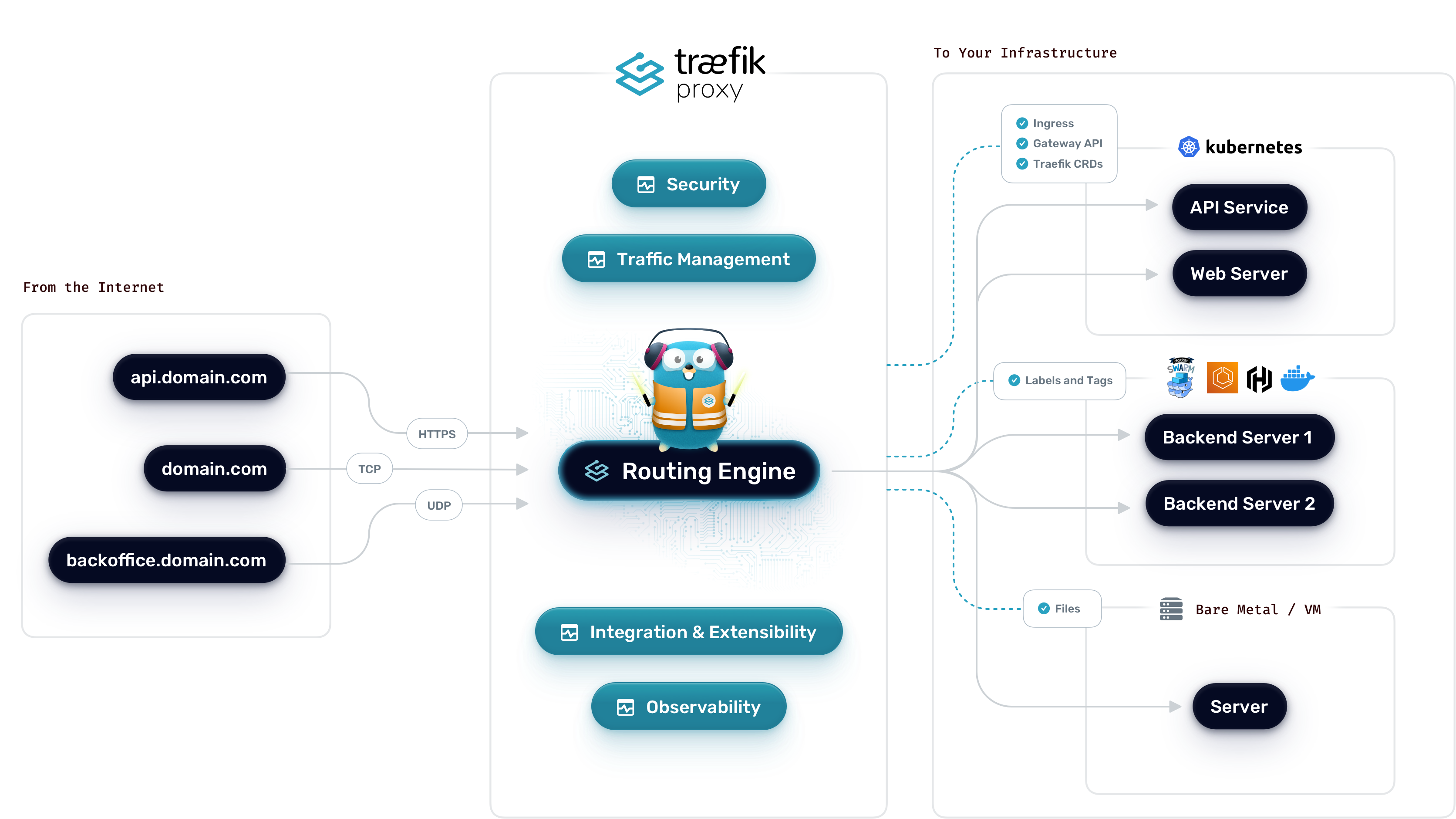
Architecture

Features

  • Continuously updates its configuration (No restarts!)
  • Supports multiple load balancing algorithms
  • Provides HTTPS to your microservices by leveraging Let's Encrypt (wildcard certificates support)
  • Circuit breakers, retry
  • See the magic through its clean web UI
  • WebSocket, HTTP/2, gRPC ready
  • Provides metrics (Rest, Prometheus, Datadog, Statsd, InfluxDB 2.X)
  • Keeps access logs (JSON, CLF)
  • Fast
  • Exposes a Rest API
  • Packaged as a single binary file (made with :heart: with go) and available as an official docker image

Supported Backends

Quickstart

To get your hands on Traefik, you can use the 5-Minute Quickstart in our documentation (you will need Docker).

Web UI

You can access the simple HTML frontend of Traefik.
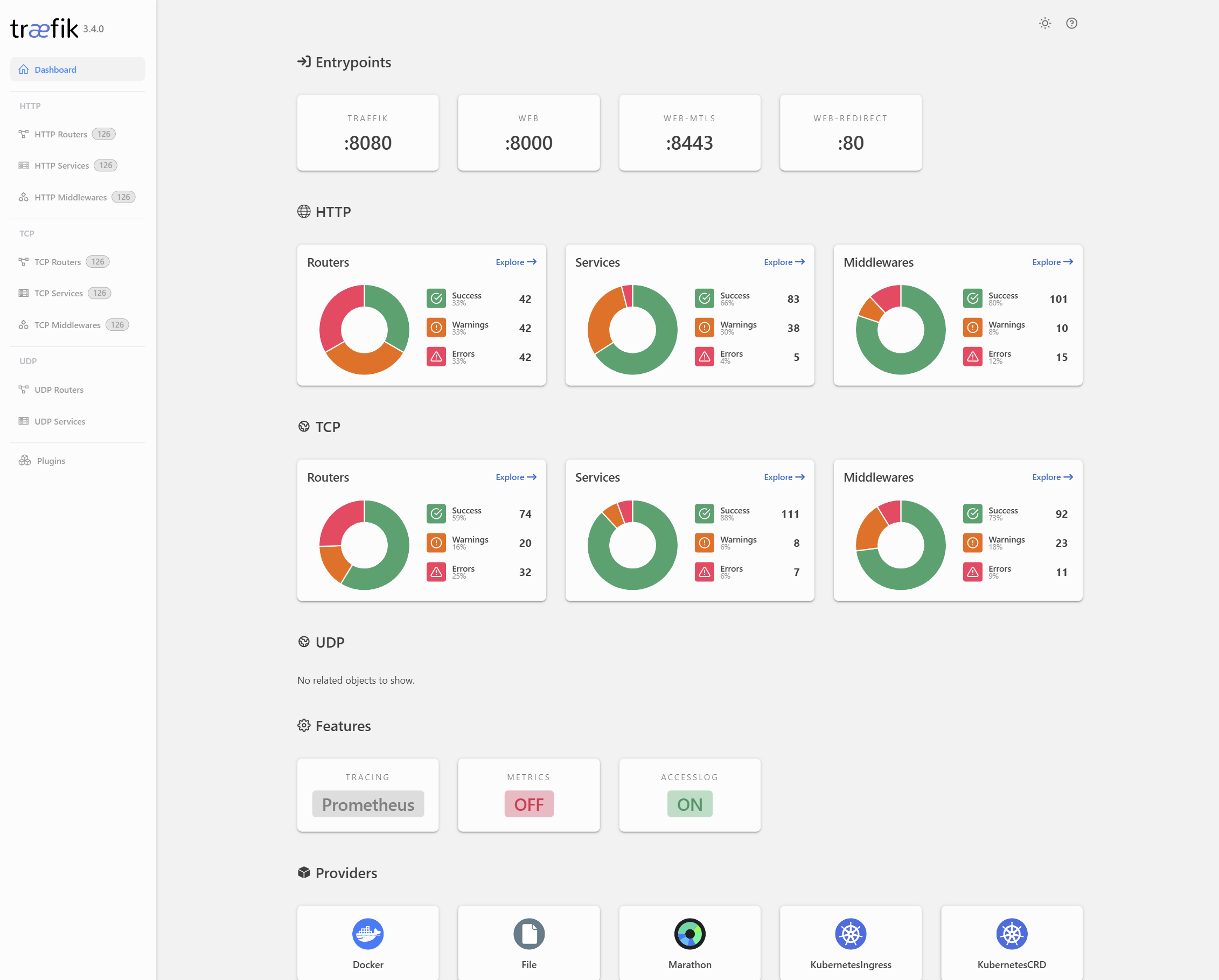
Web UI Providers

Documentation

You can find the complete documentation of Traefik v3 at https://doc.traefik.io/traefik/.

Support

To get community support, you can:

  • join the Traefik community forum: Join the chat at https://community.traefik.io/

If you need commercial support, please contact Traefik.io by mail: .

Download

./traefik --configFile=traefik.toml
docker run -d -p 8080:8080 -p 80:80 -v $PWD/traefik.toml:/etc/traefik/traefik.toml traefik
  • Or get the sources:
git clone https://github.com/traefik/traefik

Introductory Videos

You can find high level and deep dive videos on videos.traefik.io.

Maintainers

We are strongly promoting a philosophy of openness and sharing, and firmly standing against the elitist closed approach. Being part of the core team should be accessible to anyone who is motivated and want to be part of that journey! This document describes how to be part of the maintainers' team as well as various responsibilities and guidelines for Traefik maintainers. You can also find more information on our process to review pull requests and manage issues in this document.

Contributing

If you'd like to contribute to the project, refer to the contributing documentation.

Please note that this project is released with a Contributor Code of Conduct. By participating in this project, you agree to abide by its terms.

Release Cycle

  • We usually release 3/4 new versions (e.g. 1.1.0, 1.2.0, 1.3.0) per year.
  • Release Candidates are available before the release (e.g. 1.1.0-rc1, 1.1.0-rc2, 1.1.0-rc3, 1.1.0-rc4, before 1.1.0).
  • Bug-fixes (e.g. 1.1.1, 1.1.2, 1.2.1, 1.2.3) are released as needed (no additional features are delivered in those versions, bug-fixes only).

Each version is supported until the next one is released (e.g. 1.1.x will be supported until 1.2.0 is out).

We use Semantic Versioning.

Mailing Lists

Credits

Kudos to Peka for his awesome work on the gopher's logo!.

The gopher's logo of Traefik is licensed under the Creative Commons 3.0 Attributions license.

The gopher's logo of Traefik was inspired by the gopher stickers made by Takuya Ueda. The original Go gopher was designed by Renee French.

Frequently asked questions

Is traefik free to use?

traefik is open source under the MIT licence. There is no licence fee and no seat count — you can self-host it or, where the project offers one, pay a vendor for a managed version instead.

What does traefik do?

The Cloud Native Application Proxy

What is traefik written in?

traefik is primarily written in Go. Its source is publicly available at https://github.com/traefik/traefik, and it has 64,895 GitHub stars.