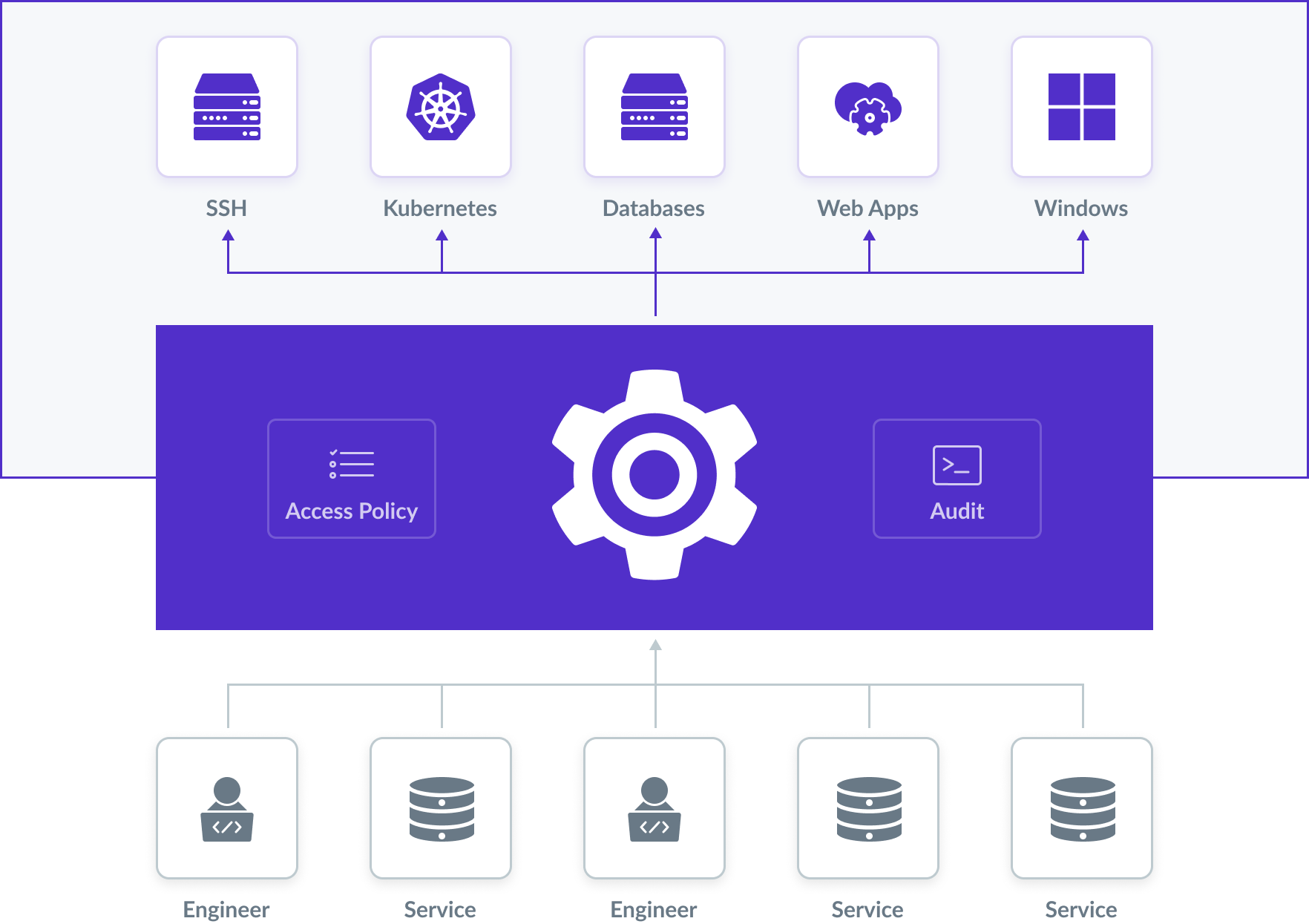
Teleport provides connectivity, authentication, access controls and audit for infrastructure.
You might use Teleport to:
- Set up single sign-on (SSO) for all of your cloud and on-prem infrastructure.
- Protect access to servers, Kubernetes clusters, databases, Windows desktops, web applications, and cloud APIs without long-lived keys or passwords.
- Establish secure tunnels to reach resources behind NATs and firewalls without VPNs or bastion hosts.
- Record and audit activity across SSH, Kubernetes, database, RDP, and web sessions.
- Apply consistent Role-Based and Attribute-Based Access Control (RBAC/ABAC) across users, machines, workloads, and resource types.
- Enforce least privilege and Just-in-Time (JIT) access requests for elevated roles or sensitive systems.
- Maintain a single identity and access layer for both human users and workloads.
Teleport works with SSH, Kubernetes, databases, RDP, cloud consoles, internal web services, Git repositories, and Model Context Protocol (MCP) servers.



More Information
Teleport Getting Started
Teleport Architecture
Reference Guides
FAQ
Table of Contents
- Introduction
- Why We Built Teleport
- Supporting and Contributing
- Installing and Running
- Docker
- Building Teleport
- License
- FAQ
Introduction
Teleport includes an identity-aware access proxy, a CA that issues short-lived certificates, a unified access control system, and a tunneling system to access resources behind the firewall.
Teleport is a single Go binary that integrates with multiple protocols and cloud services, including
- SSH nodes
- Kubernetes clusters
- PostgreSQL, MongoDB, CockroachDB and MySQL databases
- Model Context Protocol
- Internal Web apps
- Windows Hosts
- Networked servers
You can set up Teleport as a Linux daemon or a Kubernetes deployment.
Teleport focuses on best practices for infrastructure security, including:
- No shared secrets such as SSH keys or Kubernetes tokens; Teleport uses certificate-based auth with automatic expiration for all protocols.
- Multi-factor authentication (MFA) for everything.
- Single sign-on (SSO) for everything via GitHub Auth, OpenID Connect, or SAML with endpoints like Okta or Microsoft Entra ID.
- Session sharing for collaborative troubleshooting for issues.
- Infrastructure introspection to view the status of every SSH node, database instance, Kubernetes cluster, or internal web app through the Teleport CLI or Web UI.
Teleport uses Go crypto. It is
fully compatible with OpenSSH, sshd servers, and ssh clients,
Kubernetes clusters and more.
| Project Links | Description |
|---|---|
| Teleport Website | The official website of the project. |
| Documentation | Admin guide, user manual and more. |
| Features | Explore the complete list of Teleport capabilities. |
| Blog | Our blog where we publish Teleport news and helpful articles. |
| Forum | Ask us a setup question or post tutorials, feedback, or ideas. |
| Developer Tools | Dozens of free browser-based tools for code processing, cryptography, data transformation, and more. |
| Teleport Academy | How-to guides, best practices, and deep dives into topics like SSH, Kubernetes, MCP, and more. |
| Slack | Need help with your setup? Ping us in our Slack channel. |
| Cloud & Self-Hosted | Teleport Enterprise is a cloud-hosted option for teams that require easy and secure access to their computing environments. |
Why We Built Teleport
While working together at Rackspace, the creators of Teleport noticed that most cloud users struggle with setting up and configuring infrastructure security. Many popular tools designed for this are complex to understand and expensive to maintain across modern, distributed computing infrastructure.
We decided to build a solution that's easy to use, understand, and scale. A real-time representation of all your servers in the same room as you, as if they were magically teleported. And thus, Teleport was born!
Today, Teleport is trusted by everyone from hobbyists to hyperscalers to simplify security across cloud CLIs and consoles, Kubernetes clusters, SSH servers, databases, internal web apps, and Model Context Protocol (MCP) used by AI agents.
Learn more about Teleport and our history
Supporting and Contributing
We aim to make Teleport easy to adopt and contribute to, starting with clear and comprehensive documentation.
If you have questions, are exploring ideas, or want to sanity-check something, please start with a GitHub Discussion. Discussions help us answer questions, explore use cases, and decide together whether something should become a bug report or feature request.
Start a conversation in Teleport Discussions
This is the best place to ask questions, share ideas, and get help. Our engineers actively participate there, and discussions can be promoted to issues when there is a clear, actionable next step.Issues are for confirmed bugs and well-defined feature requests
If something has already been validated as a bug or an enhancement, feel free to open an issue. When in doubt, start a discussion and we will help guide it.Enterprise and POC support
If you are evaluating Teleport Enterprise or need more responsive support during a POC, we can set up a dedicated Slack channel. You can reach out to us through our website to get started.
Installing and Running
To set up a single-instance Teleport cluster, follow our getting started guide. You can then register your servers, Kubernetes clusters, and other infras