Turn your data into AI workflows and custom apps that 100% fit your business
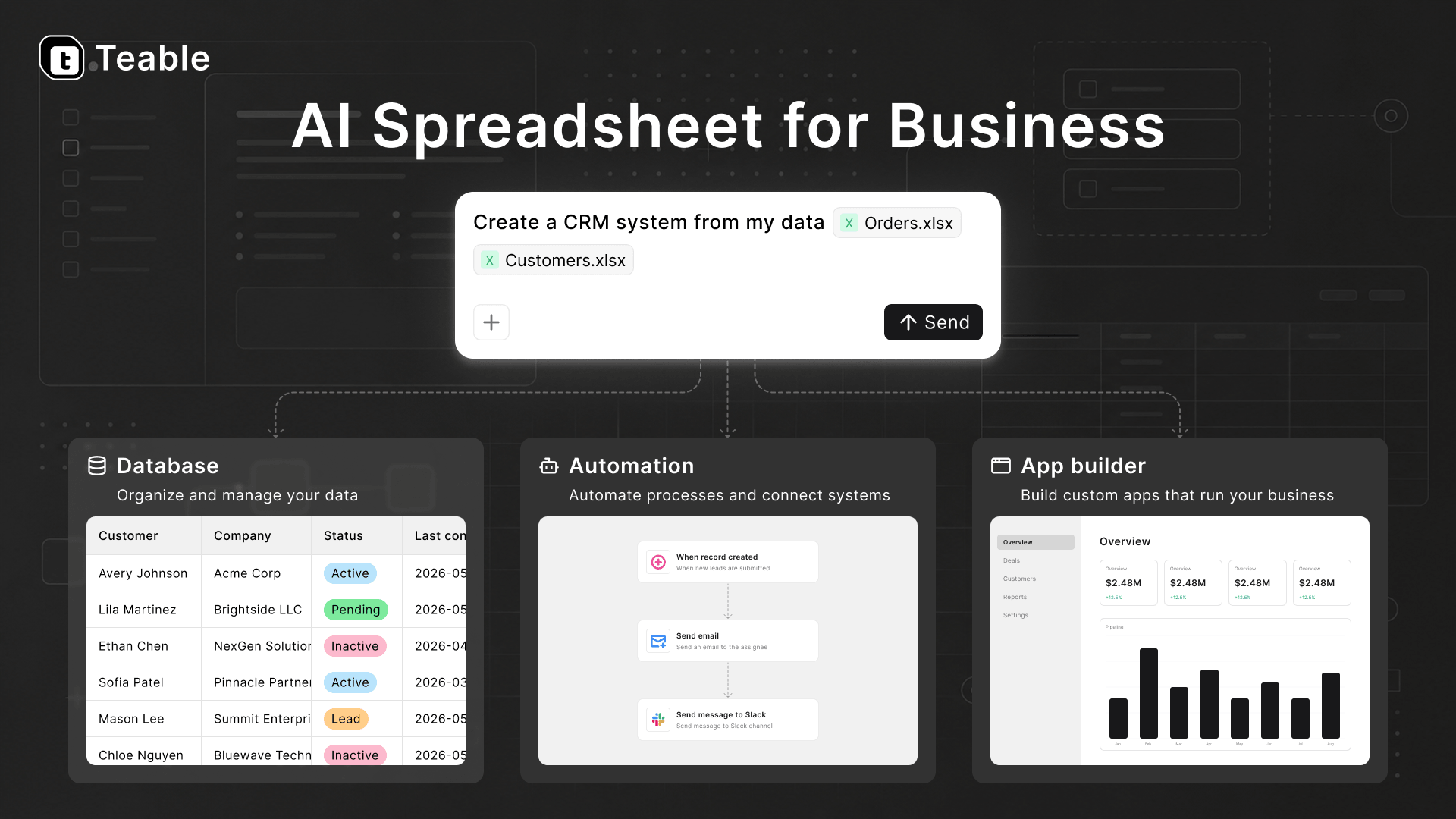
One platform where data management, AI workflows, and app building come together — spreadsheet-simple on the surface, real PostgreSQL underneath. Agents work inside your live data and real processes, so what they build lands seamlessly and fits your business exactly. In the cloud or fully self-hosted.
Try out Teable using our hosted version at teable.ai
Home | Help | Blog | Template | API | Community | X



Quick Guide
- Want to see it in action? Try Teable on our hosted cloud at teable.ai.
- Deploying it yourself? Start from the Deployment guide — standalone in minutes, or the full AI platform on your own machines.
Four platforms in one
AI chat, App Builder, and app deployments are part of Teable, not bolt-ons. Self-hosting Teable deploys four platforms in one:
- A secure, scalable agent sandbox — every AI session runs in its own isolated container, started on demand and gone when the session ends.
- A resource-efficient app deployment platform — every app your team builds and publishes runs as its own lightweight, long-lived container.
- An AI workflow engine — automations triggered by record changes, schedules, and webhooks, with AI steps, running right where your data lives.
- A full-featured database collaboration platform on PostgreSQL — tables, views, permissions, and API.
Self-hosting wraps your own compute into an agent-ready, fully controlled productivity environment — putting AI in the hands of everyone on your team. See Architecture for how the pieces fit together.
✨Features
🤖 AI-native
- AI Chat — ask, analyze, and operate on your data in natural language.
- App Builder — describe the app you need; an agent builds it in an isolated sandbox and deploys it to its own URL in one click.
- AI automations — react to record changes, schedules, and webhooks, with AI steps doing the reasoning.
- AI field filling — generate and enrich field values in bulk.
🍺 Everything you need, out of the box
Grid, Form, Kanban, Gallery, and Calendar views; formulas, field conversion, filtering, grouping, sorting, and aggregation; comments, record history, undo/redo, and real-time collaboration; attachments preview, batch editing, import/export, search, validation, charts, plugins, SQL query — and millions of rows without breaking a sweat.
More features land all the time — see the Changelog.
Deploy
Three ways to run Teable — pick by what you need (full comparison in the Deployment guide):
| Teable Cloud | Full-featured self-host | Standalone self-host | |
|---|---|---|---|
| Tables, collaboration, API, automation | ✅ | ✅ | ✅ |
| AI features (chat, agents) | ✅ | ✅ | ❌ |
| App Builder (build & deploy apps) | ✅ | ✅ | ❌ |
| Start here | teable.ai | teableio/teable-deployment | Docker guide |
Prefer not to deploy by hand? Hand teableio/teable-deployment to your AI agent (Claude Code, Codex, …) together with a domain, a DNS token, and access to the target machine or cluster — it can take the deployment end to end.
Already running standalone Teable? The runtime plane installs next to it and your data stays in place: migration guide.
Development
1. Initialize
# Enabling the Help Management Package Manager
corepack enable

# Install project dependencies
pnpm install
2. Initialize Postgres
make switch-db-mode
3. Custom Environment Variables(Optional)
cd apps/nextjs-app
cp .env.development .env.development.local
4. Run Dev Server
you just need to start backend, it will start next server for frontend automatically, file change will be auto reload
cd apps/nestjs-backend
pnpm dev
Why Teable?
Software should fit the work — not the other way around. Every team knows the compromise: you have a concrete business need, you search for an app, and it covers 70% of it. So you bend your process around the tool, or you file a ticket and wait quarters for custom development. The work adapts to the software, when it should be the software adapting to the work.
AI only changes this if it reaches the real workflow. A wave of AI tools can now generate an app on demand — but each one is built in a vacuum: an empty database, no knowledge of how your team actually operates, one more island to integrate and maintain. The demo impresses; the workflow stays the same.
Teable puts the agent where the work already happens. Your data, apps, automations, permissions, and collaborators live here, on a real PostgreSQL — and the AI operates all of it. Chat acts on live data. Automations reason over records as they change. App Builder ships working systems wired to the same database your team already uses — so what gets built is never another silo, but a precise extension of the workflow it came from. AI lands in the work seamlessly, and what it builds fits the business exactly.
And it's an architecture an IT team can say yes to. Self-hosting Teable packages your own compute into an agent-ready platform for the whole team: every AI session confined to an isolated sandbox, every app shipped as a standard container, everything resting on PostgreSQL and HTTP APIs, with your own models and keys, on your own infrastructure. Full AI capability, full control — neither traded for the other.
The result is a different way of building: business systems shaped precisely to your business, delivered in days instead of quarters, evolving as fast as the work itself — by everyone on the team, not just the people who code.