talivia is a free, open source web & product analytics project written in TypeScript and released under MIT. It has 2,416 GitHub stars, 140 forks and 0 open issues, and was last pushed 39 hours ago. On this registry it ranks #13 of 25 tracked projects in Web & Product Analytics, with 5 head-to-head comparisons available.

What is talivia?

What it is

Talivia is an open-source, self-hosted analytics platform written in TypeScript and released under the MIT license. It is positioned as revenue-first analytics for founders, and it combines web analytics, Session Replay, revenue attribution, and customer revenue integrations in one product. The project lives in the web and product analytics ecosystem, and it is described as a datafast alternative.

The concrete problem it solves is the separation between traffic analytics and revenue data. Many teams can see visits, events, and user behavior, but they still need another system to connect those sessions to payments, subscriptions, refunds, disputes, and attribution. Talivia addresses this by letting a self-hosted deployment collect website visits, replay sessions, and link them to revenue from supported payment providers or a manual payment API.

Key capabilities

  • Core web analytics tracks visits and provides a dashboard for website activity.
  • Session Replay can be enabled per website to review recorded sessions alongside analytics data.
  • Revenue attribution connects visits to customer revenue from Stripe, LemonSqueezy, Polar, Dodo, Yolfi, or the Manual Payment API.
  • Subscription lifecycle, refunds, disputes, and first-touch or last-touch attribution are retained in the revenue model.
  • Website collaborators, shared analytics, and import/export support team workflows and data portability.
  • Configuration supports PostgreSQL, a required application secret, optional CoinGecko exchange-rate conversion, and reverse-proxy header handling.
  • An open-source Agent Kit is available for MCP-compatible clients to help install tracking, verify events, and connect visits to payment attribution.

Who uses it and how

  • Founders and small product teams use it to host their own analytics stack instead of relying only on a third-party service.
  • Teams with Stripe, LemonSqueezy, Polar, Dodo, Yolfi, or manual revenue data use it to connect payment events to website sessions.
  • Operators running behind a reverse proxy configure forwarded headers so generated webhook URLs use the correct origin.
  • Administrators create websites, add tracking snippets, confirm visits, enable Session Replay, and connect payments during initial setup.
  • Developers use local Docker Compose or Node.js and pnpm workflows to run, test, build, and migrate the application.

Getting started

Typical deployment methods are local development with Node.js 22 or 24, pnpm, Prisma migrations, and an empty PostgreSQL database, or Docker Compose using the documented Docker setup. The hosted option is Talivia Cloud, while the open-source edition requires environment configuration through .env.example, a generated APP_SECRET, and DATABASE_URL.

When to use it — and when not to

Use Talivia when you want a self-hosted, MIT-licensed analytics base that can combine web analytics, Session Replay, and revenue attribution with your own payment data. Do not use it if you need the additional Talivia Cloud integrations such as Google Search Console, Bing Webmaster Tools, GitHub activity, or social mentions, or if you need to migrate from a hosted Talivia database. Self-hosters must operate PostgreSQL, backups, migrations, secrets, and reverse-proxy settings, and the repository is new, so early adoption requires more operational care.

project readme (upstream, from github) — read inline

Talivia

Languages: English | 简体中文

This repository contains the focused open-source edition of Talivia, the revenue-first analytics platform available at talivia.com. The self-hosted edition combines core web analytics, Session Replay, website collaborators, shared analytics, import/export, and customer revenue from Stripe, LemonSqueezy, Polar, Dodo, Yolfi, or the Manual Payment API.
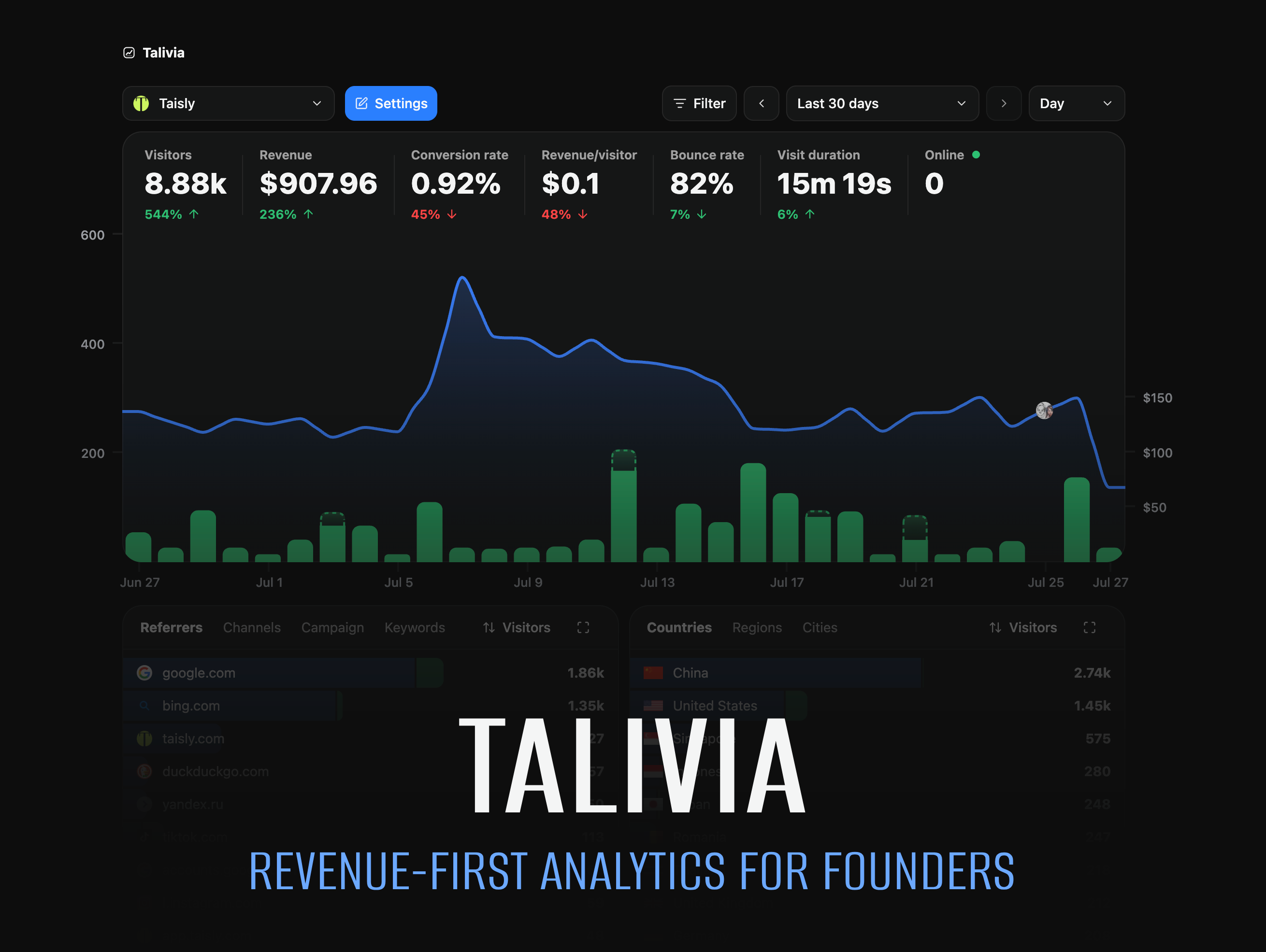
Talivia dashboard

Open source and Talivia Cloud

The open-source edition is a self-hosted subset of the complete Talivia product. For managed hosting and additional integrations - including Google Search Console, Bing Webmaster Tools, GitHub activity, and social mentions from X, Reddit, TikTok and others use Talivia Cloud.

Documentation

Product and integration guides are available in the official Talivia documentation.

Local development

Requirements: Node.js 22 LTS or 24 LTS, pnpm 10+, and an empty PostgreSQL database.

cp .env.example .env
openssl rand -hex 32

Put the generated value in APP_SECRET, then install, migrate, and start Talivia:

pnpm install --frozen-lockfile
pnpm exec prisma migrate deploy
pnpm dev

Open http://localhost:3000 and sign in with:

  • Username: admin
  • Password: admin

Change this bootstrap password immediately under Settings → Account. Administrators can create additional username/password accounts and change their roles on the same Account page. Password hashes are never shown; every user changes their own password.

Useful checks:

pnpm lint
pnpm test
pnpm build

The baseline migration is for an empty database only. There is no migration path from a hosted Talivia database.

Configuration

Talivia has two required settings and one optional integration:

Variable Required Purpose
DATABASE_URL Yes Connection string for the PostgreSQL database.
APP_SECRET Yes Random value of at least 32 bytes; signs sessions and encrypts saved provider credentials.
COINGECKO_API_KEY No Enables crypto exchange-rate conversion.

The application remains usable when CoinGecko is not configured or temporarily unavailable.

First setup

  1. Create a website in Talivia.
  2. Copy its tracking snippet into your site.
  3. Confirm that a visit appears on the dashboard.
  4. Optionally enable Session Replay in website settings.
  5. Connect customer revenue under Website settings → Payments.

Supported revenue inputs include Stripe, LemonSqueezy, Polar, Dodo, Yolfi, and the Manual Payment API. Subscription lifecycle, refunds, disputes, and first-/last-touch attribution are retained.

Payment-provider webhook URLs are generated from the incoming request origin. When Talivia runs behind a reverse proxy, forward the original Host and X-Forwarded-Proto headers.

Docker

Requirements: Docker Engine with Docker Compose.

cp .env.example .env
openssl rand -hex 32

Put the generated value in APP_SECRET, then start Talivia:

docker compose up --build -d
docker compose ps

Open http://localhost:3000 and change the bootstrap admin password immediately. The container applies the OSS database migration automatically before starting the application.

Backups and upgrades

Back up the PostgreSQL database and any deployment-specific storage before upgrading. For a Compose installation, create a logical database backup with:

docker compose exec -T postgres pg_dump -U talivia -d talivia_oss > talivia-backup.sql

Future releases add ordered migrations under prisma/migrations. Apply them with pnpm exec prisma migrate deploy; the official container does this during startup. Never edit a migration that has already been applied to a persistent database.

AI agents and MCP

Talivia also provides an open-source Agent Kit for Codex, Claude Code, ChatGPT, and other MCP-compatible clients. It helps agents install website tracking, generate framework-specific setup plans, verify live analytics events, and connect visits to payment attribution.

Connect to the hosted MCP server with OAuth:

https://talivia.com/mcp

Or run the Agent Kit locally over stdio:

npx -y @talivia/agent mcp

See the AI Agent Kit guide for setup instructions and supported clients. The hosted MCP endpoint connects to Talivia Cloud; this self-hosted edition does not expose the Talivia Cloud OAuth endpoint.

Security and contributions

See SECURITY.md for vulnerability reporting and deployment guidance, and CONTRIBUTING.md for the development workflow.

Talivia is licensed under the MIT License.

Frequently asked questions

Is talivia free to use?

talivia is open source under the MIT licence. There is no licence fee and no seat count — you can self-host it or, where the project offers one, pay a vendor for a managed version instead.

What does talivia do?

Open-source, self-hosted revenue-first analytics for founders: web analytics, Session Replay, revenue attribution, and customer revenue integrations. datafast a

What is talivia written in?

talivia is primarily written in TypeScript. Its source is publicly available at https://github.com/talivia-group/talivia, and it has 2,416 GitHub stars.