TagStudio: A User-Focused Photo & File Management System




TagStudio is a photo & file organization application with an underlying tag-based system that focuses on giving freedom and flexibility to the user. No proprietary programs or formats, no sea of sidecar files, and no complete upheaval of your filesystem structure. Read the documentation and more at docs.tagstud.io!
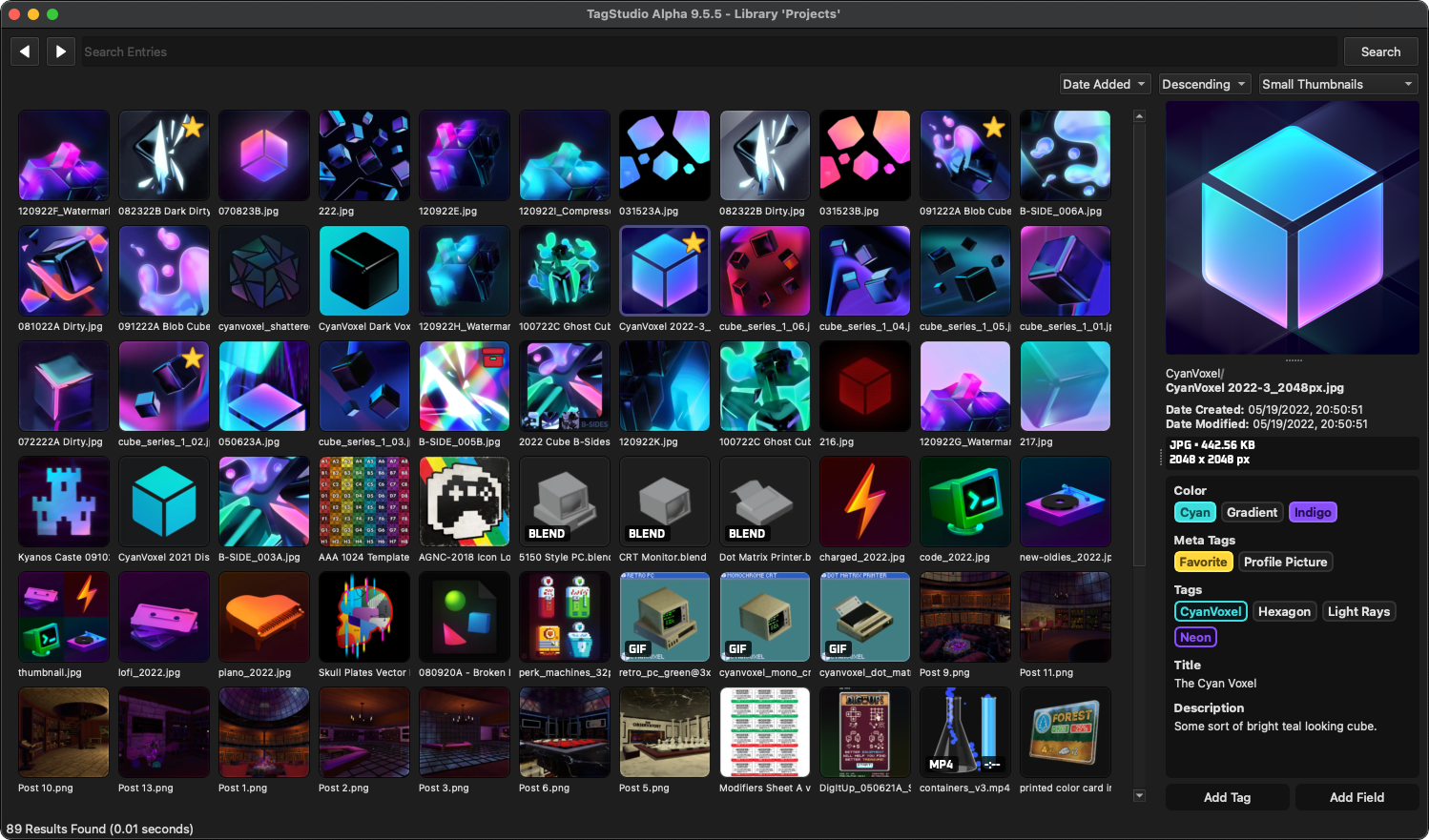
TagStudio Alpha v9.5.5 running on macOS Sequoia.
Contents
Translation hosting generously provided by Weblate. Check out our project page to help translate TagStudio!
Feature Highlights
Libraries
A TagStudio library contains all of your tags, fields for a set of files based on one of your system directories. Similar to how Obsidian vaults function, TagStudio libraries act as a layer on top of your existing folders and file structure, and don't require your to move or duplicate files.
TagStudio places a .TagStudio folder in the folder you open as a library. Files included in your library are referred to as "entries", and are kept track of inside of a SQLite database inside the .TagStudio folder along with tags and other library data.
File Entries
All file types are supported in TagStudio libraries, just not all have dedicated preview support. For a full list of filetypes with supported previews, see the "Supported Previews" page on the documentation site. There's also playback support for videos, audio files, and supported animated image formats.
For a generalized list of what's currently supported:
- Images
- Raster Images (JPEG, PNG, etc.)
- Vector (SVG)
- Animated (GIF, WEBP, APNG)
- RAW Formats
- Videos
- Plaintext Files
- Documents (If supported)
- eBooks (If supported)
- Photoshop PSDs, Blender Projects, Krita Projects, and more!
Tags and Fields
Tags represent an object or attribute - this could be a person, place, object, concept, and more. Unlike most tagging systems, TagStudio tags are not solely represented by a line of text or a hashtag. Tags in TagStudio consist of several properties and relationships that give extra customization, searching power, and ease of tagging that cannot be achieved by string-based tags alone. TagStudio tags are designed to be as simple or as complex as you'd like, giving options to users of all skill levels and use cases.
Tags currently consist of the following attributes:
- Name: The full name for your tag. This does NOT have to be unique!
- Shorthand Name: The shortest alternate name for your tag, used for abbreviations.
- Aliases: Alternate names your tag goes by.
- Color: The display color of your tag.
- Parent Tags: Other tags in which this tag inherits from. In practice, this means that this tag can be substituted in searches for any listed parent tags.
- Parent tags checked with the "disambiguation" checkbox next to them will be used to help disambiguate tag names that may not be unique.
- For example: If you had a tag for "Freddy Fazbear", you might add "Five Nights at Freddy's" as one of the parent tags. If the disambiguation box is checked next to "Five Nights at Freddy's" parent tag, then the tag "Freddy Fazbear" will display as "Freddy Fazbear (Five Nights at Freddy's)". Furthermore, if the "Five Nights at Freddy's" tag has a shorthand like "FNAF", then the "Freddy Fazbear" tag will display as "Freddy Fazbear (FNAF)".
- Is Category: A property that when checked, treats this tag as a category in the preview panel.
Fields, like tags, are additional pieces of custom metadata that you can add to your file entries. Fields currently have several hardcoded names (e.g. "Title", "Author", "Series") but custom field names are planned for an upcoming update.
Field types currently include:
- Text Lines: Single lines of text.
- Text Boxes: Multi-line pieces of text.
- Datetimes: Dates and times.
Search
- Search for file entries based on tags, file path (
path:), file types (filetype:), and even media types! (mediatype:). Path searches currently use glob syntax, so you may need to wrap your filename or filepath in asterisks while searching. This will not be strictly necessary in future versions of the program. - Use and combine boolean operators (
AND,OR,NOT) along with parentheses groups, quotation escaping, and underscore substitution to create detailed search queries - Use special search conditions (
special:untaggedandspecial:empty) to find file entries without tags or fields, respectively
Basic Usage
[!TIP] For more usage instructions, see the documentation site!
Creating/Opening a Library
With TagStudio opened, start by creating a new library or opening an existing one using File -> Open/Create Library from the menu bar. TagStudio will automatically create a new library from the chosen directory if one does not already exist. Upon creating a new library, TagStudio will automatically scan your folders for files and add those to your library (no files are moved during this process!).
Refreshing the Library
Libraries under 10,000 files automatically scan for new or modified files when opened. In order to refresh the library manually, select "Refresh Directories" under the File menu or by pressing Ctrl+R (macOS: ⌘ Command+R).
Creating Tags
Create a new tag by accessing the "New Tag" option from the Edit menu or by pressing Ctrl+T (macOS: ⌘ Command+T). In the tag creation panel, enter a tag name, optional shorthand name, optional tag aliases, optional parent tags, and an optional color.
Tag Manager
You can manage your library of tags from opening the "Tag Manager" panel from Edit -> "Tag Manager" or by pressing Ctrl+M (macOS: ⌘ Command+M). From here you can create, search for, edit, and permanently delete any tags you've created in your library.
Editing Tags
To edit a tag, click on it inside the preview panel or right-click the tag and select "Edit Tag" from the context menu.
Adding Tags to File Entries
Access the "Add Tag" search box by either clicking on the "Add Tag" button at the bottom of the right sidebar, accessing the "Add Tags to Selected" option from the File menu, or by pressing Ctrl+Shift+T (macOS: ⌘ Command+Shift+T).
From here you can search for existing tags or create a new one if the one you're looking for doesn't exist. Click the "+" button next to any tags you want to the currently selected file entries. To quickly add the top result, press the Enter/Return key to add the top-most tag and reset the tag search. Press Enter/Return once more to close the dialog box. By using this method, you can quickly add various tags in quick succession just by using the keyboard!
To remove a tag from a file entry, hover over the tag in the preview panel and click on the "-" icon that appears.
Adding Fields to File Entries
To add a metadata field to a file entry, start by clicking the "Add Field" button at the bottom of the preview panel. From the dropdown menu, select the type of metadata field you’d like to add to the entry
Editing Fields
Hover over the field and click the pencil icon. From there, add or edit text in the dialog box popup.