

TagSpaces
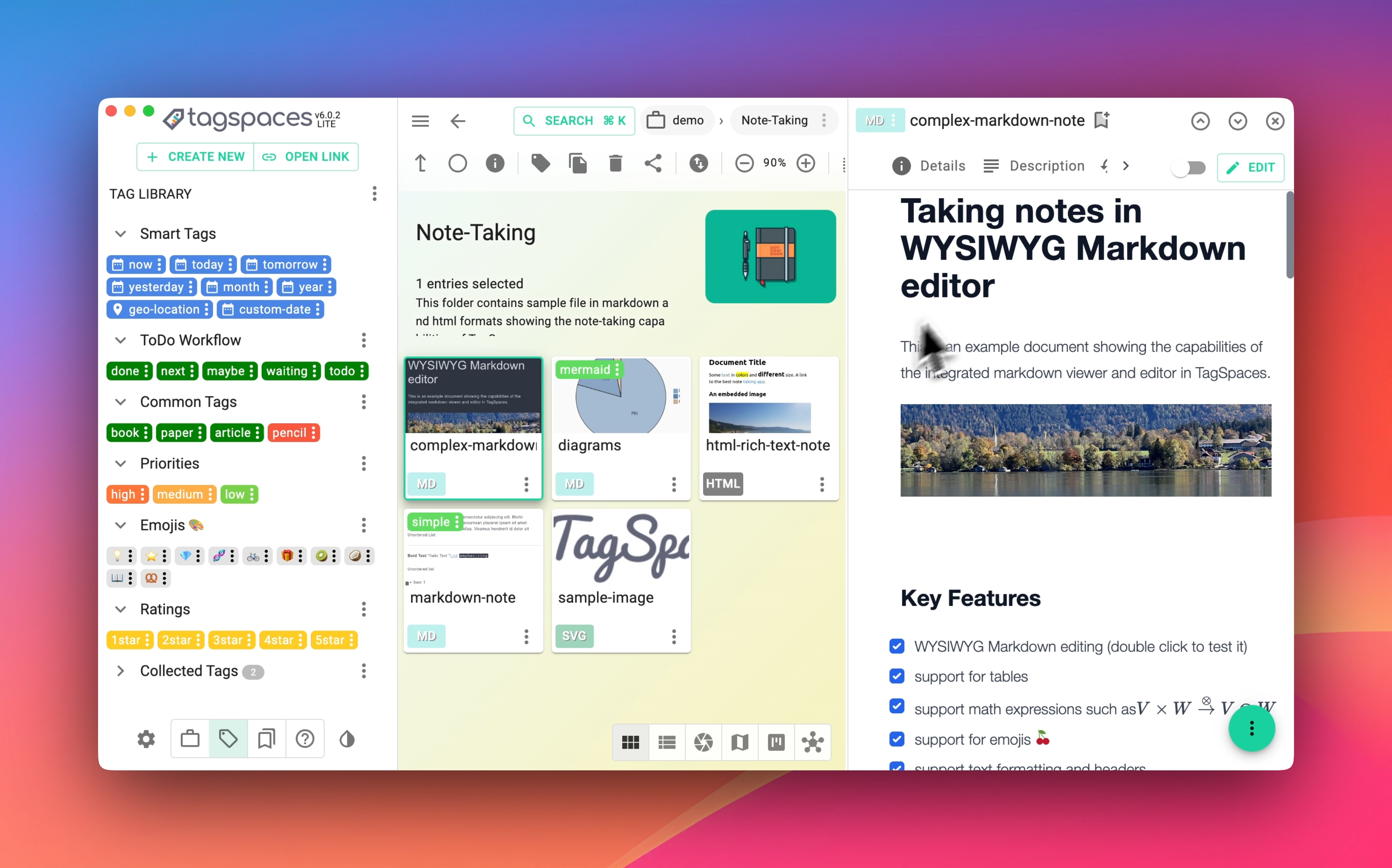
TagSpaces is a free and open-source platform for organizing, tagging, and managing your local files. It runs completely offline, with no need for cloud services, internet connection, or vendor lock-in. Available for Windows, Linux, and macOS, it also includes a browser extension (Web Clipper) for Firefox, Edge, and Chrome to capture online content as local files.
🌐 Learn More
- 🌍 Website
- 📰 Blog
- 📚 Documentation
- 💬 Community Forum
- 🐛 GitHub Issues
📦 Downloads
Grab the latest release from the GitHub Releases Page.
Check out the full changelog for recent updates.
🚀 Features at a Glance
- File & Folder Management – Browse, organize, and manage local files in a powerful interface.
- Tagging System – Add tags directly into filenames or use sidecar files for metadata storage.
- Flexible Search – Filter and find files by name or tags using fuzzy search.
- Offline First – 100% offline, serverless, and privacy-focused.
- Cross-platform – Runs seamlessly on Windows, Linux, and macOS.
- Note Taking – Create notes in TXT, Markdown, or HTML.
- To-Do Support – Manage task lists using the built-in HTML editor.
- Media Player – Play common audio and video formats directly within the app.
- Web Clipper – Save web pages or screenshots locally using our browser extension.
👩💻 Developer Guide
🛠️ Technologies
- Javascript Framework: React.js
- User Interface Styling: MUI
- Desktop App Framework: Electron
- Boilerplate: Electron React Boilerplate
📁 Project Structure
src/
  renderer/         # Core application logic
  main/             # Electron main process
  locales/          # Language translation files
  node_modules/     # TagSpaces extension modules

capacitor/          # Mobile (Android/iOS) build
dll/                # Live reload support for development
docker/             # Docker container setup
internals/          # Flow and ESLint configurations
resources/          # Images and build resources
scripts/            # NPM task-related scripts
test/               # Unit and E2E tests
web/                # Assets for web version
▶️ Running from Source
Prerequisites
Install the following tools:
Setup Steps
git clone https://github.com/tagspaces/tagspaces.git
cd tagspaces
git checkout develop  # or 'master' for stable release
npm install
Set Up Local Web Service
Create a .env file in release/app/ with a custom key to avoid conflicts:
The desktop version of the application uses a web service which is running locally as a separate process. The web service is responsible for the search index creation and the generation of the thumbnails for most of the images formats. A key is required in order for the main application to communicate with the web server. It should be generated from webpack script in the .env file located in release/app folder. This is an example for an .env file.
KEY=a_custom_key
Having a custom key, ensures that another instance of TagSpaces will not communicate with the web service of the initial instance, since it is always running on the same port.
Build & Start
npm run build
npm run start
Start in Development Mode
npm run dev
This will start a development server in background, which watches for changes in background and refreshes the application automatically once you have done some changes in the source code.
🧪 Testing
Run unit and integration tests:
npm run test-unit
npm run test-playwright
npm run test-playwright-web
💻 Packaging the Desktop App
Build native apps for each platform:
npm run package-win
npm run package-linux
npm run package-mac
npm run package-mac-arm64
The commands will create packages for Windows, Linux, Mac OS and Mac OS with the M1 processor respectively.
⚠️ Run npm run build before packaging.
📱 Mobile Build (Capacitor)
Build and run the Android or iOS app via Capacitor:
npm run run-android-cap
npm run run-ios-cap
🌐 Web Version
Start the web version locally:
npm run run-web
🔌 Extend with Custom Viewers & Editors
TagSpaces supports extension modules for opening and editing different file types. Learn more on our Extensions Page.
🤝 Contributing
We welcome contributions! See CONTRIBUTING.md, and review and sign the Contributor License Agreement (CLA) before submitting PRs.
🌍 Localization
TagSpaces is available in over 20 languages. Help us translate the app by joining our team on Transifex.
💡 Ideas & Suggestions
Have an idea or a feature request? Share it on our community forum and join the discussion.
🐞 Support & Bug Reports
If you encounter a bug or need help, open an issue on GitHub.
⚠️ Known Limitations
TagSpaces is not optimized for locations with more than 100,000 files.
📡 Feeds
📄 License
TagSpaces is dual-licensed under the AGPL (GNU Affero General Public License) v3 for open-source projects and a commercial license for vendors or resellers. Contact us if you're interested in using TagSpaces under different terms.
The TagSpaces Pro components (tagspacespro/) are proprietary and governed by a separate EULA. For the full picture — the open-source/proprietary boundary, how the combined builds are distributed, and third-party notices — see LICENSING.md.