


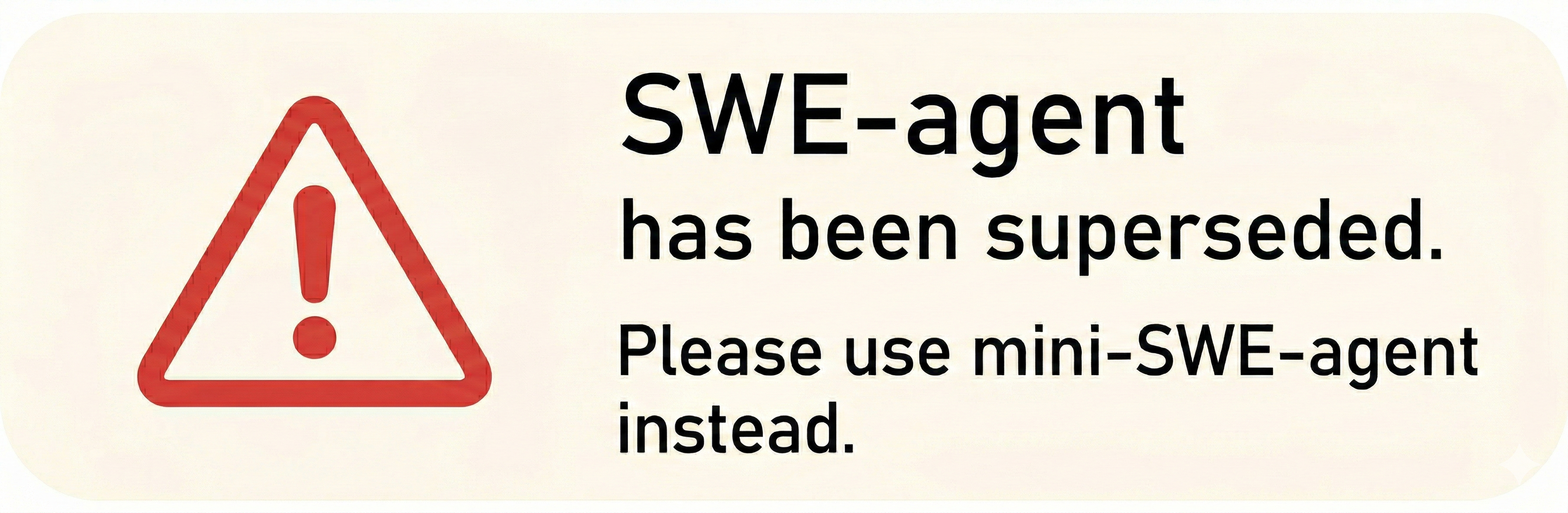
[!warning] Most of our current development effort is on mini-swe-agent, which has superseded SWE-agent. It matches the performance performance of SWE-agent, while being much simpler. See the FAQ for more details about the differences. Our general recommendation is to use mini-SWE-agent instead of SWE-agent going forward.
SWE-agent enables your language model of choice (e.g. GPT-4o or Claude Sonnet 4) to autonomously use tools to fix issues in real GitHub repositories, find cybersecurity vulnerabilities, or perform any custom task.
- ✅ State of the art on SWE-bench among open-source projects
- ✅ Free-flowing & generalizable: Leaves maximal agency to the LM
- ✅ Configurable & fully documented: Governed by a single
yamlfile - ✅ Made for research: Simple & hackable by design
SWE-agent is built and maintained by researchers from Princeton University and Stanford University.
📣 News
- July 24: Mini-SWE-Agent achieves 65% on SWE-bench verified in 100 lines of python!
- May 2: SWE-agent-LM-32b achieves open-weights SOTA on SWE-bench
- Feb 28: SWE-agent 1.0 + Claude 3.7 is SoTA on SWE-Bench full
- Feb 25: SWE-agent 1.0 + Claude 3.7 is SoTA on SWE-bench verified
- Feb 13: Releasing SWE-agent 1.0: SoTA on SWE-bench light & tons of new features
- Dec 7: An interview with the SWE-agent & SWE-bench team
🚀 Get started!
👉 Try SWE-agent in your browser: 
Read our documentation to learn more:
SWE-agent for offensive cybersecurity (EnIGMA)
SWE-agent: EnIGMA is a mode for solving offensive cybersecurity (capture the flag) challenges. EnIGMA achieves state-of-the-art results on multiple cybersecurity benchmarks (see leaderboard). Please use SWE-agent 0.7 while we update EnIGMA for 1.0.
In addition, you might be interested in our other projects:


Contributions
If you'd like to contribute to the codebase, we welcome issues and pull requests! For larger code changes, we always encourage discussion in issues first.
Citation & contact
SWE-agent is an academic project started at Princeton University by John Yang*, Carlos E. Jimenez*, Alexander Wettig, Kilian Lieret, Shunyu Yao, Karthik Narasimhan, and Ofir Press. Contact person: John Yang, Carlos E. Jimenez, and Kilian Lieret (Email: [email protected], [email protected], [email protected]).
If you found this work helpful, please consider citing it using the following:
SWE-agent citation
@inproceedings{yang2024sweagent,
  title={{SWE}-agent: Agent-Computer Interfaces Enable Automated Software Engineering},
  author={John Yang and Carlos E Jimenez and Alexander Wettig and Kilian Lieret and Shunyu Yao and Karthik R Narasimhan and Ofir Press},
  booktitle={The Thirty-eighth Annual Conference on Neural Information Processing Systems},
  year={2024},
  url={https://arxiv.org/abs/2405.15793}
}
If you used the summarizer, interactive commands or the offensive cybersecurity capabilities in SWE-agent, please also consider citing:
EnIGMA citation
@misc{abramovich2024enigmaenhancedinteractivegenerative,
      title={EnIGMA: Enhanced Interactive Generative Model Agent for CTF Challenges},
      author={Talor Abramovich and Meet Udeshi and Minghao Shao and Kilian Lieret and Haoran Xi and Kimberly Milner and Sofija Jancheska and John Yang and Carlos E. Jimenez and Farshad Khorrami and Prashanth Krishnamurthy and Brendan Dolan-Gavitt and Muhammad Shafique and Karthik Narasimhan and Ramesh Karri and Ofir Press},
      year={2024},
      eprint={2409.16165},
      archivePrefix={arXiv},
      primaryClass={cs.AI},
      url={https://arxiv.org/abs/2409.16165},
}
🪪 License
MIT. Check LICENSE.


