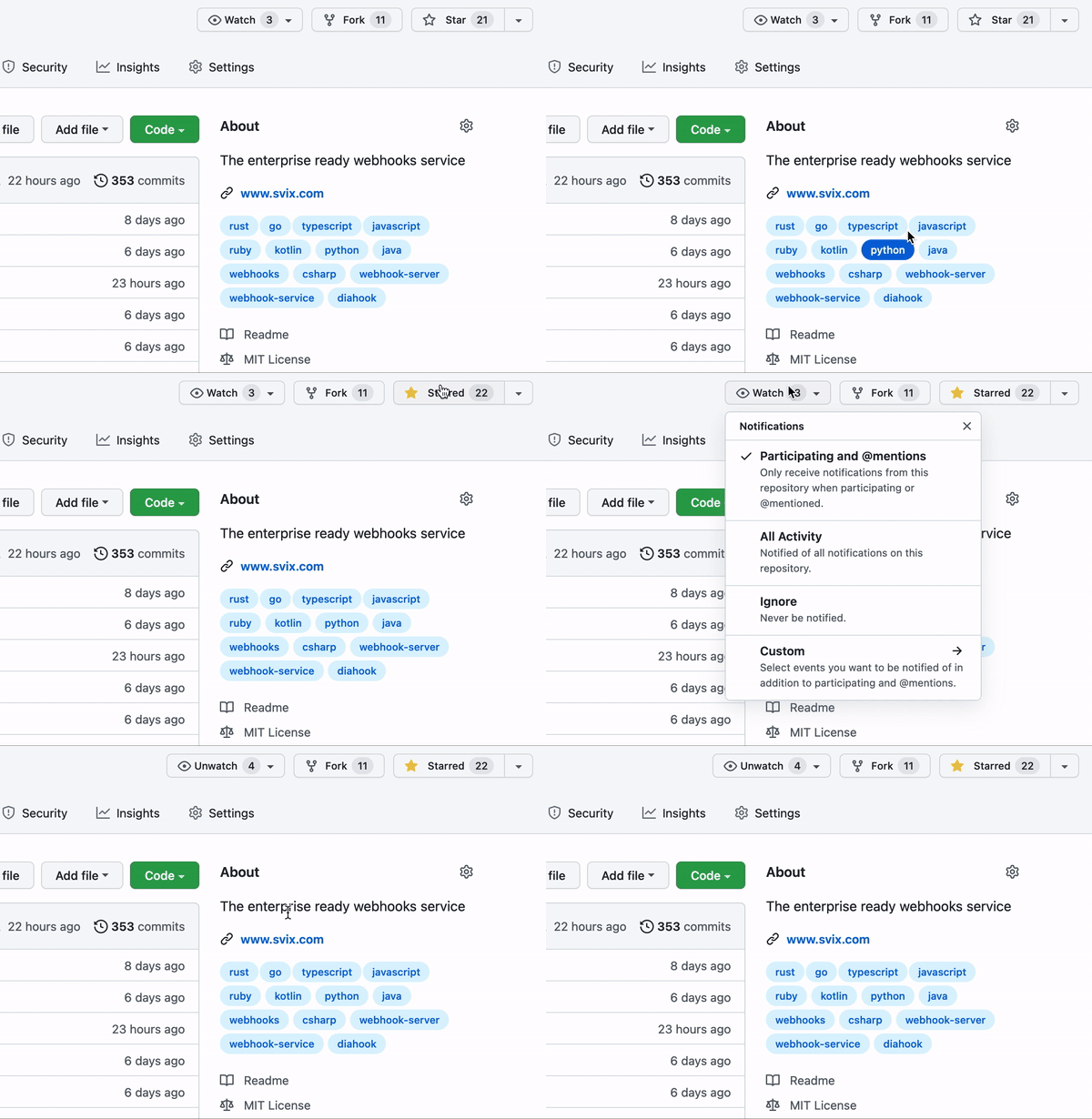
svix-webhooks is a free, open source databases project written in Rust and released under MIT. It has 3,407 GitHub stars, 280 forks and 62 open issues, and was last pushed 36 minutes ago. On this registry it ranks #172 of 203 tracked projects in Databases, with 5 head-to-head comparisons available.
What is svix-webhooks?
Svix is an open source, self-hostable webhook service written in Rust that lets a developer send webhooks with a single API call while the service handles deliverability, retries, and security, and it is aimed at backend and platform engineers who need reliable outbound event delivery without building that machinery themselves.
What it is
Svix is a webhook service, described in its own README as "Webhooks as a service" and as an "enterprise ready webhook service". Its core promise is narrow and concrete: a developer makes one API call, and Svix takes care of deliverability, retries, security, and more. The server is written in Rust, and the repository is licensed under MIT. The registry files it under Infrastructure & Operations / Databases, and its topic list places it in event-driven infrastructure alongside message queues, pub/sub, streams, background jobs, Kafka, RabbitMQ, and Redis.
The problem it solves is the delivery layer of outbound webhooks. Instead of hand-building retry logic, delivery guarantees, and request security around every event a product emits, a team points its application at the Svix API and lets the service own that path. The client ecosystem reflects the breadth of that job: official libraries exist for Go, Python, TypeScript/JavaScript, Java, Kotlin, Ruby, C#/.NET, Rust, and PHP, plus a Terraform provider. Each library supports both the API and webhook verification, which is the receiving side of the same problem.
Key capabilities
One API call per event, with deliverability, retries, and security handled by the service rather than by the caller.
Official client libraries for Go, Python, TypeScript/JavaScript, Java, Kotlin, Ruby, C#/.NET, Rust, and PHP, each supporting the API and webhook verification.
Terraform provider with API support; webhook verification is marked not applicable for Terraform.
svix-cli published on npm, runnable without installation via npx svix-cli --help or installed globally with npm install -g svix-cli.
Rust server that can be compiled into a static library for a variety of targets.
Official svix/svix-server Docker image published on Docker Hub.
Documented server configuration options for self-hosted deployments.
Who uses it and how
Teams deploying self-hosted webhooks with Docker, which the README calls the most common approach, using the official svix/svix-server image.
Teams compiling the Rust server into a static library for targets where a container is not the right delivery mechanism.
Backend and platform engineers sending events from applications written in any of the ten supported client languages, with webhook verification available on the receiving end.
Infrastructure teams managing configuration through the Terraform provider.
Developers scripting against the service through the svix-cli CLI, either via npx or a global npm install.
Getting started
Self-hosting starts from the official svix/svix-server Docker image on Docker Hub or from a source build of the Rust server, with the README pointing to the server configuration section for available settings. For CLI use, no installation is needed at all: run npx svix-cli --help.
How it compares
No comparable or paid products are named in the facts for this entry, so this project stands alone in this registry rather than being contrasted against an alternative. Anyone evaluating it will need to draw comparisons against other webhook tooling outside this registry.
When to use it — and when not to
Self-hosting means operating the Rust server and working through its server configuration options, and the README excerpt provided here is sparse: it defers general usage documentation and full API documentation to external sites, so those should be read before committing. A team that wants no operational surface should look at the hosted offering referenced by the project homepage rather than running the server itself. The repository is active, with the latest push in September 2026 and 62 open issues, but the licence is MIT and the code is yours to run, which also means delivery uptime, capacity, and upgrades become your responsibility.
project readme (upstream, from github) — read inline
Svix makes it easy for developers to send webhooks. Developers make one API call, and Svix takes care of deliverability, retries, security, and more. For more information, please refer to the Svix homepage.
Documentation
You can find general usage documentation at . For complete API documentation with code examples for each endpoint in all of our official client libraries head over to our API documentation site at .
The Svix CLI is published on npm as svix-cli. You can run it directly with npx without installing anything:
npx svix-cli --help
Or install it globally:
npm install -g svix-cli
svix-cli --help
Running the server
There are multiple ways to get the Svix server up running. Docker is probably the most common one, but you can choose the one that works best for you.
The Svix server is written in Rust 🦀, which means you can compile it into a static library for a variety of targets. Please refer to the building from source section below for more information.
Please refer to the server configuration section below for more information regarding the available settings.
Deployment
Docker
You can use the official Svix Docker image from Docker Hub. You can either use the latest tag, or one of the versioned tags instead.
You can either use the example docker-compose.yml file with docker compose (easiest), docker swarm (advanced), or run the container standalone.
With Docker Compose
This alternative is the easiest because it will also boot up and configure redis and postgresql.
This assumes you have Docker Compose v2 installed.
cd server
docker compose up
Standalone container
Running a standalone container is slightly more advanced, as it requires you to set some environment variables and have them pointing to your redis and postgres instances.
You can pass individual environment variables to docker using the -e flag, or just create a file like development.env and use the --env-file flag like in the example below:
The Svix server is written in Rust 🦀 and requires a Rust build environment.
If you already have one, you just need to run cargo build, otherwise, please please refer to the Svix server README for more information about building the server from source.
Runtime dependencies
The server requires the following runtime dependencies to work correctly:
A PostgreSQL server - for the storage of events.
An optional Redis server version 6.2.0 or higher - for the task queue and cache.
Redis/Valkey Considerations
Persistence
Please note that it's recommended to enable persistence in Redis so that tasks are persisted across Redis server restarts and upgrades.
Eviction Policy
Please ensure that your Redis instances are configured to not evict keys without explicit expire policies set. This means that maxmemory-policy should be set to noeviction or to any of the available volatile- policies. See Redis/Valkey documentation for further information.
Server configuration
There are three ways to configure svix-server: environment vars, .env file, and a configuration file.
Configuration file
You can put a file called config.toml in the current working directory of svix-server and it will automatically pick it up.
You can take a look at the example file for more information and a full list of supported settings: [config.toml](./server/svix-se
svix-webhooks is open source under the MIT licence. There is no licence fee and no seat count — you can self-host it or, where the project offers one, pay a vendor for a managed version instead.
What does svix-webhooks do?
The open source and enterprise-ready webhooks service 🦀
What is svix-webhooks written in?
svix-webhooks is primarily written in Rust. Its source is publicly available at https://github.com/svix/svix-webhooks, and it has 3,407 GitHub stars.













)
)