
Open-Source auth provider


Add secure login and session management to your apps. SDKs available for popular languages and front-end frameworks e.g. Node.js, Go, Python, React.js, React Native, Vanilla JS, etc.
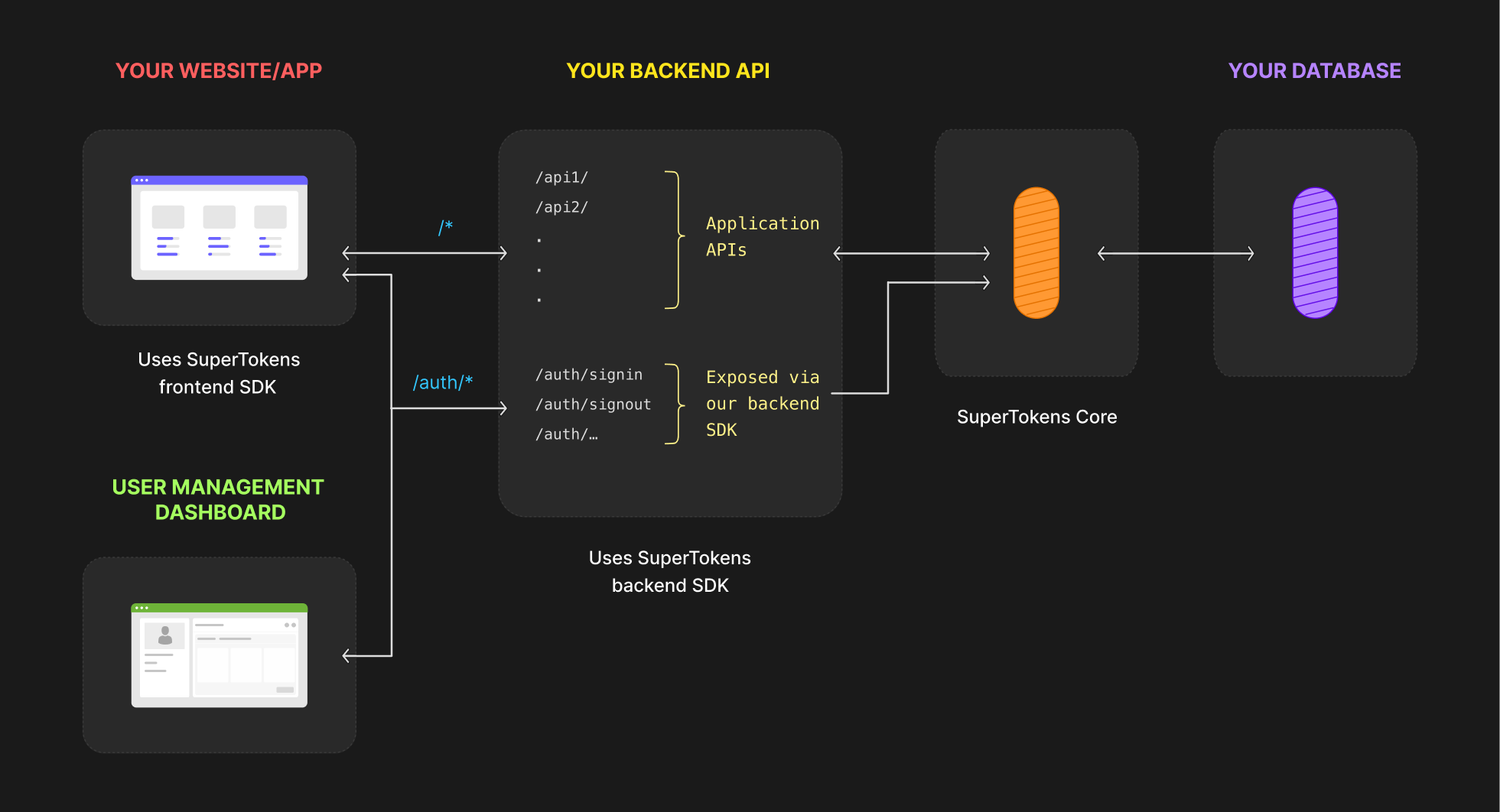 Supertokens architecture is optimized to add secure authentication for your users without compromising on user and
developer experience
Supertokens architecture is optimized to add secure authentication for your users without compromising on user and
developer experience
Three building blocks of SuperTokens architecture
- Frontend SDK: Manages session tokens and renders login UI widgets
- Backend SDK: Provides APIs for sign-up, sign-in, signout, session refreshing, etc. Your Frontend will talk to these APIs
- SuperTokens Core: The HTTP service for the core auth logic and database operations. This service is used by the Backend SDK
Features

- Passwordless Login
- Social Login
- Email Password Login
- Phone Password Login
- Session Management
- Multi-Factor Authentication
- Multi Tenancy / Organization Support (Enterprise SSO)
- User Roles
- Microservice Authentication
Learn more
- 🚀 What is SuperTokens?
- 🏗️ Architecture
- ☕ Why Java?
- ⌨️ User Management Dashboard
- 🔥 SuperTokens vs Others
- 🛠️ Building from source
- 👥 Community
- 👩💻 Contributing
- 📝 License
If you like our project, please :star2: this repository! For feedback, feel free to join our Discord, or create an issue on this repo
🚀 What is SuperTokens?
SuperTokens is an open-core alternative to proprietary login providers like Auth0 or AWS Cognito. We are different because we offer:
- Open source: SuperTokens can be used for free, forever, with no limits on the number of users.
- An on-premises deployment so that you control 100% of your user data, using your own database.
- An end-to-end solution with login, sign-ups, user and session management, without all the complexities of OAuth protocols.
- Ease of implementation and higher security.
- Extensibility: Anyone can contribute and make SuperTokens better!
Philosophy
Authentication directly affects the UX, dev experience, and security of any app. We believe that current solutions cannot optimize for all three "pillars", leading to many applications hand-rolling their own auth. This not only leads to security issues but is also a massive time drain.
We want to change that - we believe the only way is to provide a solution that has the right level of abstraction gives you maximum control, is secure, and is simple to use - just like if you build it yourself, from scratch (minus the time to learn, build, and maintain).
We also believe in the principle of least vendor lock-in. Your having full control of your user's data means that you can switch away from SuperTokens without forcing your existing users to logout, reset their passwords, or in the worst case, sign up again.
Click here to see the demo app.
- Please visit our website to see the list of features.
- We want to make features as decoupled as possible. This means you can use SuperTokens for just login, or just session management, or both. In fact, we also offer session management integrations with other login providers like Auth0.
Documentation
The docs can be seen on our website.
There is more information about SuperTokens on the GitHub wiki section.
🏗️ Architecture
Please find an architecture diagram here
For more information, please visit our GitHub wiki section.
☕ Why Java?
- ✅ Whilst running Java can seem difficult, we provide the JDK along with the binary/docker image when distributing it. This makes running SuperTokens just like running any other HTTP microservice.
- ✅ Java has a very mature ecosystem. This implies that third-party libraries have been battle-tested.
- ✅ Java's strong type system ensures fewer bugs and easier maintainability. This is especially important when many people are expected to work on the same project.
- ✅ Our team is most comfortable with Java and hiring great Java developers is relatively easy as well.
- ✅ One of the biggest criticisms of Java is memory usage. We have three solutions to this:
- The most frequent auth-related operation is session verification - this happens within the backend SDK (node, python, Go) without contacting the Java core. Therefore, a single instance of the core can handle several 10s of thousands of users fairly easily.
- We have carefully chosen our dependencies. For eg: we use an embedded tomcat server instead of a higher-level web framework.
- We also plan on using GraalVM in the future and this can reduce memory usage by 95%!
- ✅ If you require any modifications to the auth APIs, those would need to be done on the backend SDK level (for example Node, Golang, Python..). So you’d rarely need to directly modify/work with the Java code in this repo.
⌨️ User Management Dashboard
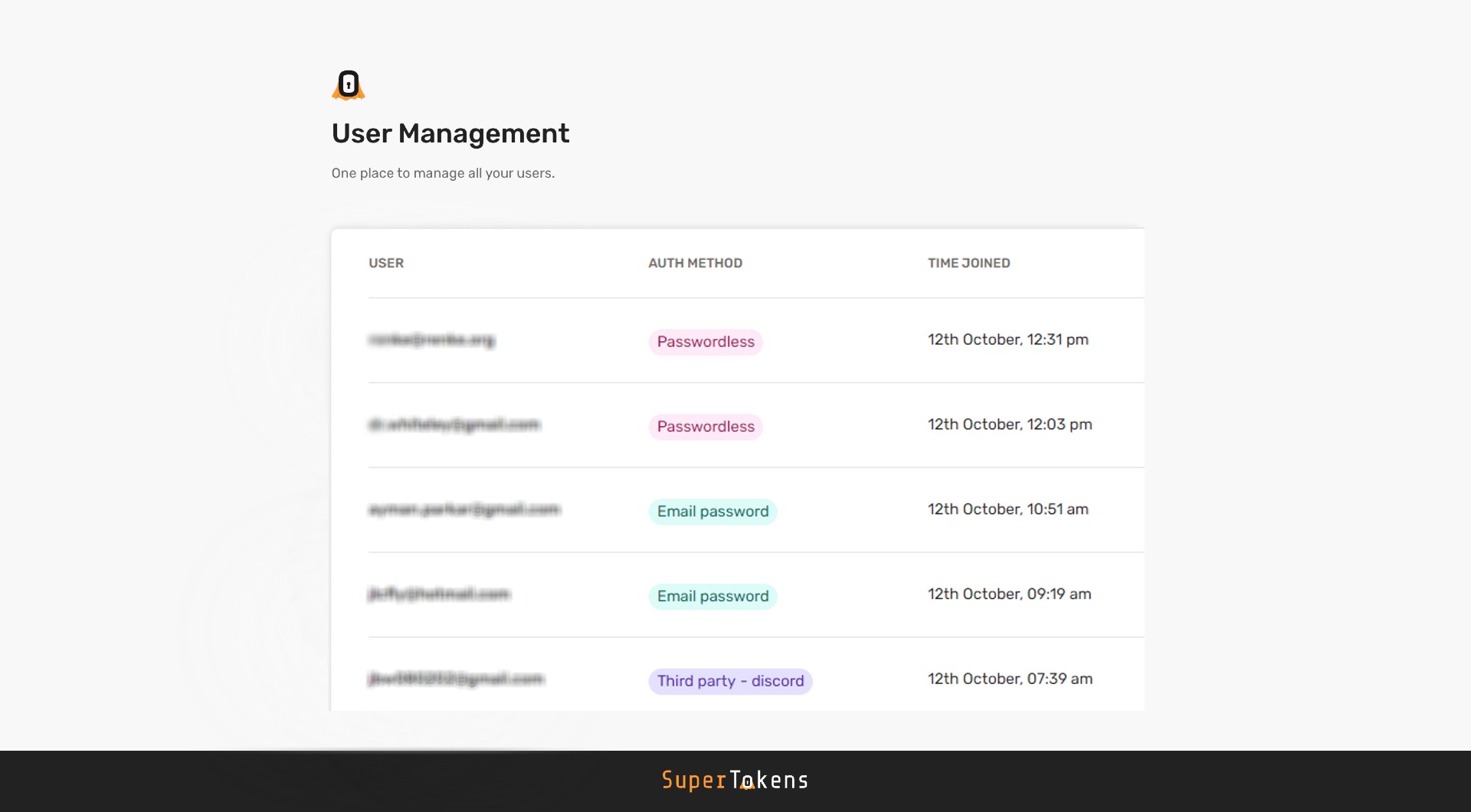
Oversee your users with the SuperTokens User Management Dashboard
List users
List all the users who have signed up to your application.
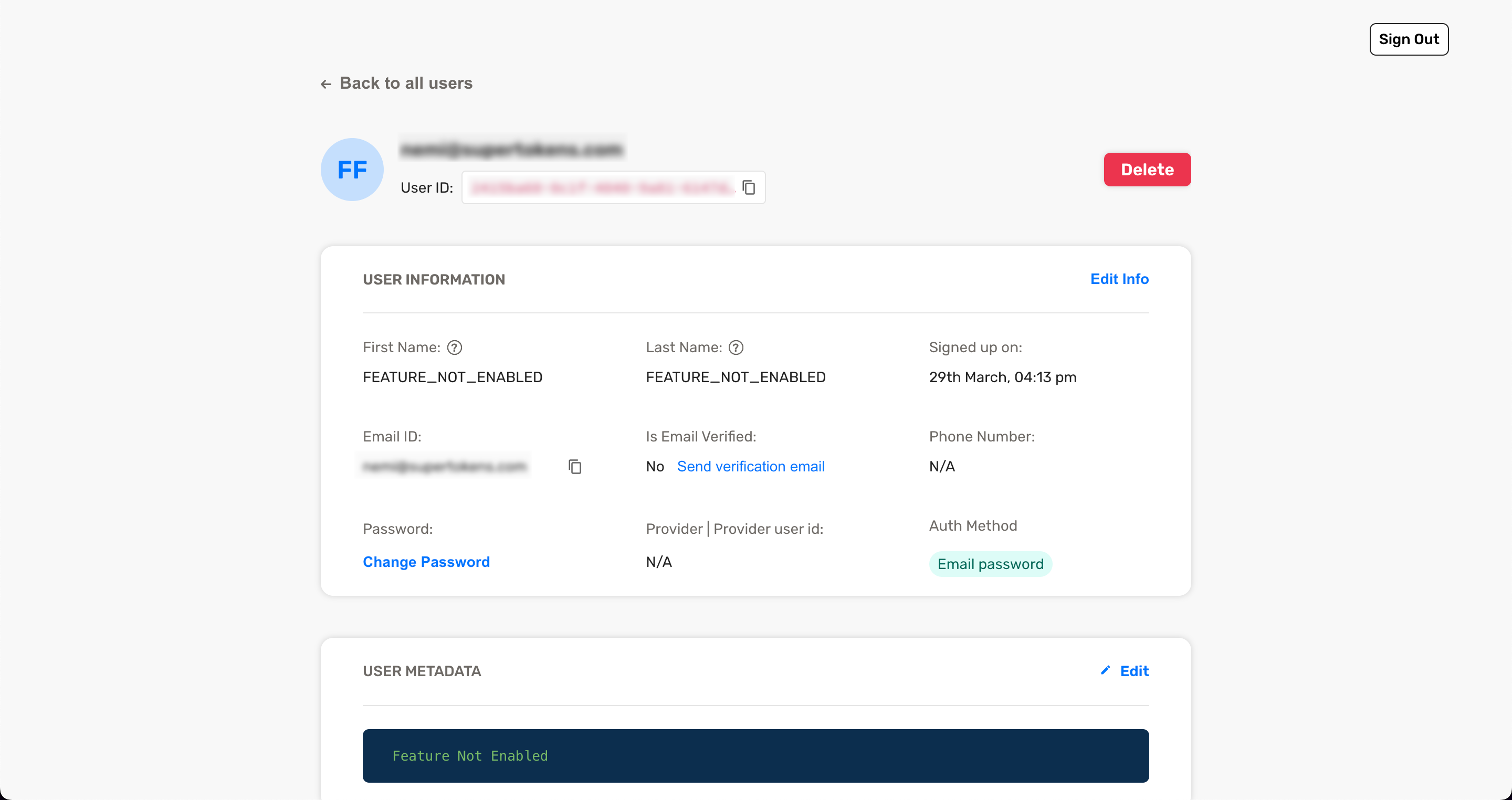
Manage users
Manage users by modifying or deleting their sessions, metadata, roles and account info.
🔥 SuperTokens vs others
Please find a detailed comparison chart on our website
🛠️ Building from source
Please see our wiki for instructions.
👥 Community
If you think this is a project you could use in the future, please :star2: this repository!
Contributors (across all SuperTokens repositories)
 Rishabh Poddar |
 Advait Ruia |
 Bhumil Sarvaiya |
 Joel Coutinho |
 Rakesh UP< readme truncated — read the full docs on github Frequently asked questionsIs SuperTokens free to use?SuperTokens is open source. There is no licence fee and no seat count — you can self-host it or, where the project offers one, pay a vendor for a managed version instead. What does SuperTokens do?Secure, customizable authentication for your applications What is SuperTokens written in?SuperTokens is primarily written in Java. Its source is publicly available at https://github.com/supertokens/supertokens-core, and it has 15,310 GitHub stars. |