
Kortix
The open-source AI Management System
The leading open-source alternative to Claude Cowork and ChatGPT Work.




Website · Documentation · Cloud · Manifesto
Agents that deliver finished work — reports, decks, code, replies, deployed changes — are now a product category. Every version of it runs inside a model lab, on that lab's model, with your company's brain on their side of the wall.
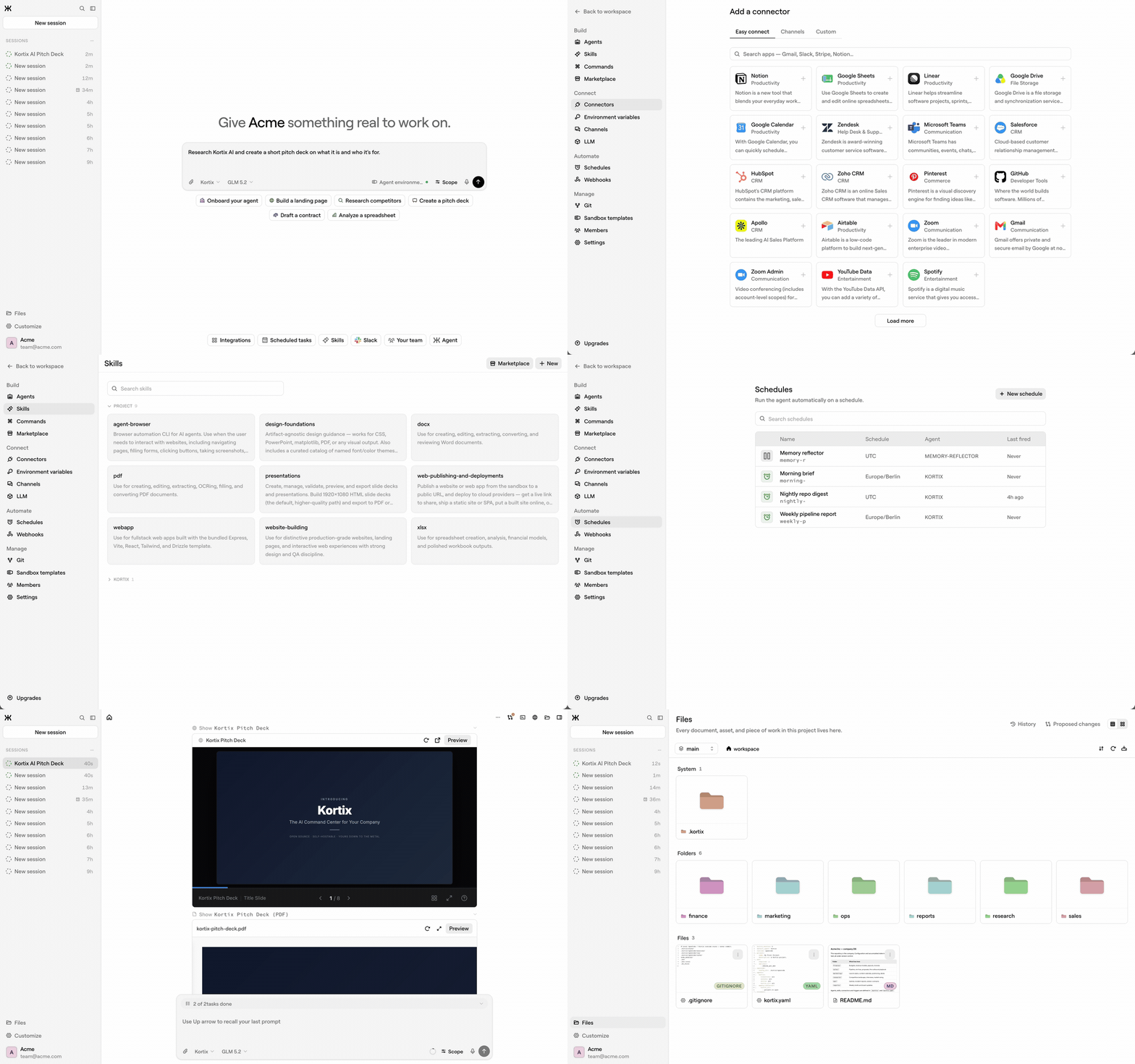
Kortix is the one you own. It's an open-source AI Management System: your agents, the skills they share, your company memory, and every connector live in one git repo — versioned, diffable, and shared by the whole company. The agents work on real cloud computers — an isolated sandbox per session, on its own branch — and land what they produce through a change request a human approves.
Any model, your own API keys, your own infrastructure or our managed cloud.
How it compares
| Claude Cowork | ChatGPT Work | Kortix | |
|---|---|---|---|
| Source | Closed | Closed | Open source — read it, fork it, audit it |
| Models | Anthropic only | GPT-5.6 only | Any provider, your own API keys |
| Where it runs | Anthropic's cloud, or Bedrock / Google Cloud / Microsoft Foundry — no self-host | OpenAI's cloud, no self-host | Our cloud, your VPC, or your own on-prem network |
| Your configuration | In their product | In their product | Files in a git repo you own |
| Access | Paid plans (Pro, Max, Team, Enterprise) | Paid plans, usage-metered | Self-host free · managed cloud $40/seat/mo + usage |
Competitor rows reflect publicly documented behavior as of July 2026.
Quickstart
Three commands. Build your company like a codebase, then bring it live.
# 1 · Install the CLI
curl -fsSL https://kortix.com/install | bash

# 2 · Scaffold a project — creates kortix.yaml + your agents, skills and runtime config
kortix init

# 3 · Ship it — pushes your repo and brings the whole thing live in the cloud
kortix ship
That's the loop. From here:
kortix sessions new --prompt "Summarize this week's commits and open a change request"
kortix cr ls          # review what an agent proposes — merge to keep it
kortix chat           # talk to a session's agent from your terminal
Prefer zero setup? Sign up at kortix.com, create a project, and start a session — nothing to install. Full command surface: CLI reference.
A company is going to be a git repository
Not as a metaphor — literally something you can clone. Inside it: your agents, the skills they've built up, the way the work actually gets done, every fact the company has learned, and the definition of the machines it all runs on. Versioned. Diffable. Owned outright.
project  (git repo + kortix.yaml)
   └─ session ──> cloud computer: an isolated sandbox on a branch named after the session
                     └─ the OpenCode agent works
                           └─ change request ──> you review & merge ──> main
- Every session gets its own cloud computer — a disposable, isolated Linux sandbox on its own branch. The agent can install, run and break anything; only what it commits survives.
- Work reaches
mainonly through a change request you approve, so the company self-improves one reviewed change at a time. - Run thousands of sandboxes in parallel on the same config, each fully isolated, each feeding work back through change requests.
You can grep your entire company.
What you manage
| Agents | OpenCode agents with a scoped reach into tools — markdown at the baseline, with the whole OpenCode lifecycle open to you. One per role or task, installable in a click, able to rewrite themselves. |
| Skills | Reusable know-how that encodes how your company does a job. Written once, shared into every session. |
| Memory | A living company brain — plain files today, a system that compounds what it learns over time. |
| Connectors | 3,000+ apps in a click — plus MCP, OpenAPI, GraphQL and raw HTTP. Credentials are brokered server-side through one scoped token and never enter the machine. |
| Secrets | Encrypted at rest, granted per agent, and injected into the sandbox at runtime. A granted secret is a real environment value inside that session. |
| Channels | Slack today, Microsoft Teams behind an operator switch, email and voice experimental. Install the Slack app, invite the bot to a channel, and @-mention it to start a session where your team already works. |
| Triggers | Cron and signed webhooks that spawn sessions automatically — every morning, or the instant something happens. |
Work runs three ways: on-demand (ask in chat, get it now), human-assisted (the agent works and checks in for the calls that matter), and automated (runs on a schedule or trigger, end to end).
Why Kortix
- Open & yours. Open source and self-hostable — your data, your models, your infrastructure. No lock-in, fully auditable.
- A workforce, not one assistant. Org-scale specialist agents that run in parallel and compound a shared memory.
- Real work, not chat. Agents run on real cloud computers and return finished deliverables — and take real actions in your tools.
- Everything is code. Versioned, reviewable, portable, governable — never a black box.
- Bring your own models. Any provider, your own keys — or the ChatGPT, Claude, or Cursor subscription you already pay for.
Self-host
Kortix runs on your own infrastructure — a laptop, a VPS, your own VPC, or your own on-prem network. Start a production-style local instance from Docker images, then switch the CLI between Cloud and your own hosts:
kortix self-host start
kortix hosts use selfhost  # ↔  kortix hosts use cloud
The first interactive setup asks only for the integration credentials that unlock managed git,
GitHub access, and Pipedream connectors — ports, local URLs, keys and Docker Compose defaults are
generated for you. Note that self-host start pulls its images from Docker Hub, so this is a
self-hosted install rather than a disconnected one.
Managed hosting is Kortix Cloud.
Enterprise & security
Built to survive a security review, not slip past one: one isolated machine per session · members, groups & roles that match your org · per-resource permissions for people and agents · connector credentials brokered server-side, so the raw key never reaches the sandbox · a secrets manager, encrypted at rest and injected at runtime · a full audit trail · merge that is deny-by-default for an agent · approval gates you switch on for the actions that matter · your own VPC or on-prem network.
Isolation is per provider: the Platinum provider runs microVMs, the default runs containers. Ask us and we'll tell you which one you're on.
Contributing
pnpm install
pnpm dev            # web + API (scripts/dev-local.sh)
pnpm dev:web        # web app only
pnpm dev:api        # API only
pnpm dev:sandbox    # build the local sandbox image
pnpm build          # build all packages
pnpm nuke           # tear down the local Docker environment
Apps live under apps/ (web, api, cli, desktop-electron, mobile, sandbox);
documentation source is in apps/web/content/docs. The whole platform ships under one version
(root VERSION) — API, frontend, CLI and desktop release together as vX.Y.Z.
Local secrets, test lanes, and the PR gate: CONTRIBUTING.md. Issues and pull requests are welcome.
We're building the thing that takes a company from human to AGI — and lets it keep every byte of itself on the way there.
kortix.com