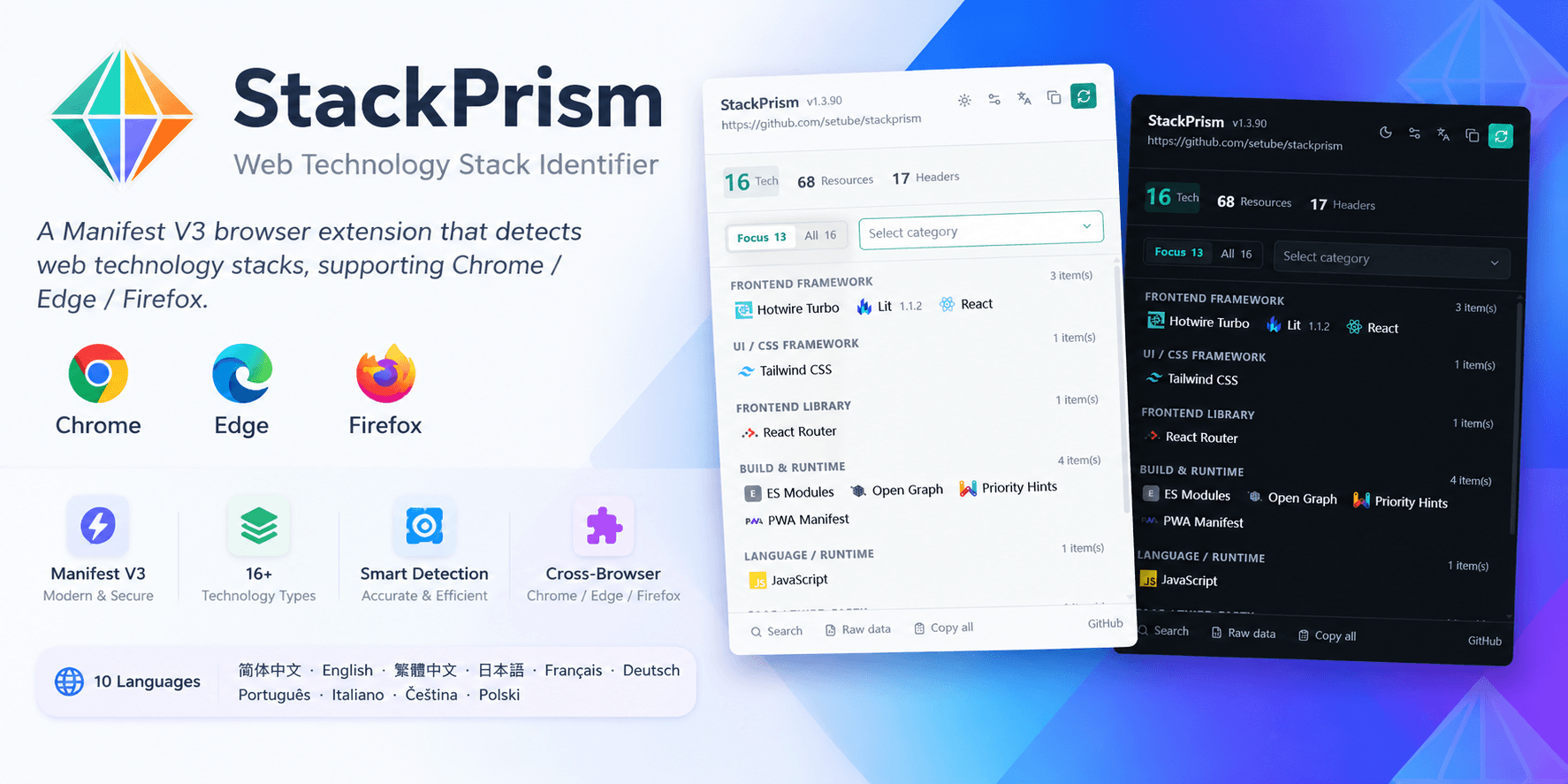
StackPrism — Web Tech Stack Detector
Collects clues from 6 dimensions — runtime globals, DOM, resource URLs, response headers, dynamic loading, and JS copyright comments — to identify and categorize the technologies powering any website.
简体中文 · English · 繁體中文 · 日本語 · Français · Deutsch · Português · Italiano · Čeština · Polski
Introduction • Features • Rule System • Caveats • Contributing • Sponsors • Star History • License





Introduction
StackPrism is a Manifest V3 browser extension for Chrome, Edge, and Firefox that identifies the tech stack used by any webpage.
Unlike most similar tools that only scan HTML resource URLs, StackPrism runs 4 independent detection channels in parallel:
- Static scan — on page load, an injected script scans the DOM, globals, CSS class names, CSS variables, and `` tags
- Response header observation — a Service Worker listens to
webRequest.onHeadersReceivedand captures response headers and HTTP version for the main document, XHR requests, and iframes - Dynamic resource monitoring — a content script uses
PerformanceObserver+MutationObserverto accumulate scripts, styles, iframes, and feeds loaded after user interaction - JS copyright comment scanning — the background asynchronously fetches the first few hundred bytes of main bundles to identify third-party dependencies packed into
index/main/vendorchunks via their copyright headers
Results from all 4 channels are merged and deduplicated, grouped into 50+ categories, with active suppression of spoofed headers, self-referential detections, and fuzzy false positives.
Technical Highlights
- MV3 service worker architecture — no persistent background process; event-driven, low memory footprint
- Rules as data — 50+ JSON rule files (
public/rules/) maintained centrally; at build time a precompiler injects__hints(top-3 longest literal segments) and__keywordCombined(merged regex) into each leaf rule, so the runtime only evaluates candidate matches
Detection Coverage
| Dimension | Category examples |
|---|---|
| Frontend | Frontend frameworks / UI frameworks / Frontend libraries / Build & runtime |
| Backend | Web servers / Backend frameworks / CDN & hosting / Languages |
| Content | CMS / Themes & templates / E-commerce / RSS |
| Third-party | SaaS / APM / AI models / Social login / Payments |
| Marketing | Ads / Marketing / Analytics / Tag managers |
| Security | WAF / HTTPS / HTTP/2 / HTTP/3 / CSP / Cookie consent |
UI Languages
The popup and settings page are available in 9 languages, auto-detected from your browser locale:
🇨🇳 简体中文 · 🇹🇼 繁體中文 · 🇯🇵 日本語 · 🇫🇷 Français · 🇩🇪 Deutsch · 🇧🇷 Português · 🇮🇹 Italiano · 🇨🇿 Čeština · 🇵🇱 Polski
You can also switch the language manually with the 🌐 button in the popup header.
Installation
Load from source (developer mode):
git clone https://github.com/setube/stackprism.git
cd stackprism
bun install
bun run build            # Chrome / Edge
bun run build:firefox    # Firefox
Chrome / Edge:
- Open
chrome://extensionsoredge://extensions - Enable "Developer mode" in the top-right corner
- Click "Load unpacked" and select the
dist/directory - Visit any webpage — the extension icon shows the detection count
Firefox:
- Open
about:debugging#/runtime/this-firefox - Click "Load Temporary Add-on" and select
dist-firefox/manifest.json - Or run
bun run build:firefoxand double-click the.xpiinrelease/
Development
bun run dev           # Dev mode + HMR
bun run typecheck     # vue-tsc type checking
bun run lint          # ESLint
bun run build         # Production build (includes rule precompilation)
bun run build:firefox # Firefox build + .xpi packaging
bun run docs:dev      # VitePress docs preview
Rule System
StackPrism's detection is data-driven — almost all changes require only editing the JSON rule files, not touching any code.
- Index — public/rules/index.json lists all rule files to load
- Page rules —
public/rules/page/*.jsonhandle page source, DOM, resource URLs, and dynamic resources - Header rules —
public/rules/headers/*.jsonhandle server response headers and cookies - Self-suppression — public/rules/self-host-suppress.json skips same-name detection when viewing a major tech site
- Tech links — public/tech-links.json maps tech names to their official URL so results are clickable
- Build-time prefilter —
precompileRulesPluginin vite.config.ts injects__hintsand__keywordCombinedinto each leaf rule at build time; the runtimerule-matcher.tsuses them as candidate filters
Rule schema:
{
  "name": "My Technology",
  "category": "Frontend Framework", // one of 50+ categories
  "patterns": ["regex-or-keyword"],
  "matchType": "regex", // or "keyword"
  "matchIn": ["html", "resources", "url", "headers", "dynamic"],
  "confidence": "高", // 高 / 中 / 低  (high / medium / low)
  "kind": "description",
  "selectors": ["CSS selector"],
  "globals": ["window global name"],
  "classPrefixes": ["class-prefix"]
}
Rule Quality Guidelines
- Prefer high-signal evidence: response headers, unique resource URLs, ``,
window., unique CSS selectors, copyright comments, official SDK package names - Avoid short or broad keywords (
spring,phoenix,column,container— these match competitor mentions, Bootstrap/Tailwind utility classes, and generic prose) - Prefer narrower
matchInscopes — useresources/url/headersrather than barehtmlto reduce false positives from page text
Caveats
- Backend detection is not exhaustive — many sites hide
Server/X-Powered-Byheaders; backend results are shown as "clues + confidence" - Spoofed headers — the extension actively detects scenes where ≥4 distinct identity headers coexist (suggesting a honeypot or spoofed response) and downgrades those categories to low confidence with a warning. Single spoofed headers cannot be detected, so use the clues alongside other signals
- Reload required on first install — the service worker needs to observe the main document response headers, which only works on a fresh page load
- Source search is a DOM snapshot — based on the current page's
outerHTML, not the original server-returned HTML - Chrome system pages / store pages / internal pages generally block content script injection
- Dynamic monitoring accumulates asynchronously — the content script accumulates resources loaded after user interaction; reopening the popup shows the merged result
Contributing
StackPrism ships 2000+ detection rules across 50+ categories, but the frontend ecosystem moves fast. New frameworks, new SaaS tools, false positives, and missed detections are all welcome:
- Bug / false positive / missed detection — Issues — the popup's "Report inaccurate detection" button auto-fills the issue template
- Rule contributions — click "Submit rule contribution" in Settings, or send a PR directly to
public/rules/ - Discussion and proposals — Discussions
Before submitting code, run bun run typecheck && bun run lint && bun run build and make sure all three pass.
Star History
If this is useful, a ⭐ helps others find the project.
License
MIT.
LINUX DO Community
Thanks to the Linux.do community for its support and contributions.