SRS(Simple Realtime Server)









SRS/8.0 (Free) is a simple, high-performance, AI-driven real-time media server. It supports RTMP, WebRTC, HLS, HTTP-FLV, SRT, MPEG-DASH, and GB28181 on Linux and macOS across x86_64, ARMv7, AArch64, Apple M1, RISC-V, LoongArch, and MIPS architectures. Supported codecs include H.264, H.265, AV1, VP9, AAC, Opus, and G.711. See the complete list of features.
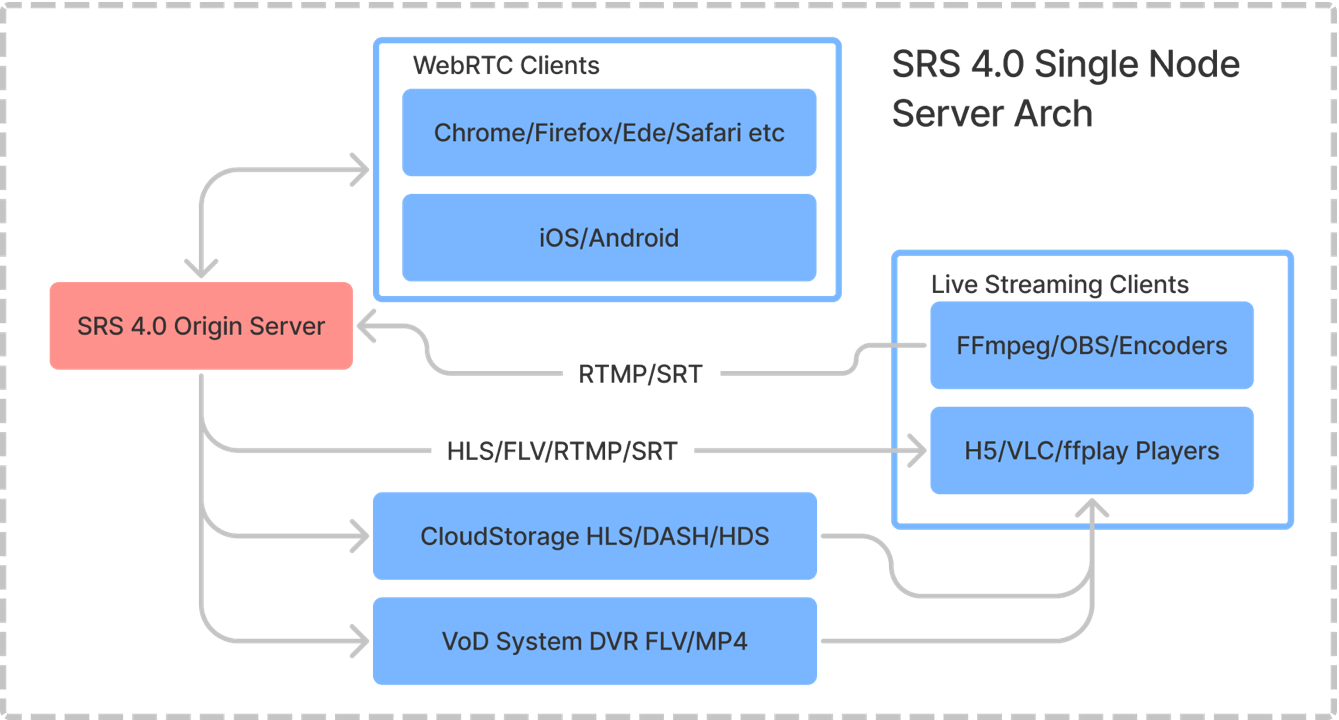
Note: For more details on the single-node architecture for SRS, please visit the following link.
SRS is licenced under MIT, and some third-party libraries are distributed under their licenses.
Usage
Please check the Getting Started guide in English or Chinese. We highly recommend using SRS with docker:
docker run --rm -it -p 1935:1935 -p 1985:1985 -p 8080:8080 \
    -p 8000:8000/udp -p 10080:10080/udp ossrs/srs:6
Tips: If you're in China, use this image
registry.cn-hangzhou.aliyuncs.com/ossrs/srs:6for faster speed.
Open http://localhost:8080/ to verify, and then stream using the following FFmpeg command:
ffmpeg -re -i ./doc/source.flv -c copy -f flv -y rtmp://localhost/live/livestream
Alternatively, stream by OBS using the following configuration:
- Service:
Custom - Server:
rtmp://localhost/live - Stream Key:
livestream
Play the following streams using media players:
- To play an RTMP stream with URL
rtmp://localhost/live/livestreamon VLC player, open the player, go to Media > Open Network Stream, enter the URL and click Play. - You can play HTTP-FLV stream URL http://localhost:8080/live/livestream.flv on a webpage using the srs-player, an HTML5-based player.
- Use srs-player for playing HLS stream with URL http://localhost:8080/live/livestream.m3u8.
If you'd like to use WebRTC, convert RTMP to WebRTC, or convert WebRTC to RTMP, please check out the wiki documentation in either English or Chinese.
To learn more about RTMP, HLS, HTTP-FLV, SRT, MPEG-DASH, WebRTC protocols, clustering, HTTP API, DVR, and transcoding, please check the documents in English or Chinese.
AI Agent
I recommend to use AI to understand and maintain your SRS, please follow the wiki AI Agent for details.
Contributing
The maintainers, and contributors are listed here. The maintainers who made significant contributions and maintained parts of SRS are listed below, ranked by the number of commits:
- Winlin: Founder of the project, focusing on ST and Issues/PR. Responsible for architecture and maintenance.
- XiaoZhihong: Concentrates on WebRTC/QUIC and SRT, with expertise in network QoS. Contributed to ARM on ST and was the original contributor for WebRTC.
- ChenHaibo: Specializes in GB28181 and HTTP API, contributing to patches for FFmpeg with WHIP.
- ZhangJunqin: Focused on H.265, Prometheus Exporter, and API module.
- XiaLixin: Specializes in GB28181, with expertise in live streaming and WebRTC.
- Jacob Su: Jacob Su has contributed to various modules of SRS.
- ShiWei: Specializes in SRT and H.265, maintaining SRT and FLV patches for FFmpeg. An expert in codecs and FFmpeg.
- ChenGuanghua: Focused on WebRTC/QoS and introduced the Asan toolchain to SRS.
- LiPeng: Concentrates on WebRTC and contributes to memory management and smart pointers.
- ZhaoWenjie: One of the earliest contributors, focusing on HDS. Has expertise in client technology.
- WuPengqiang: Focused on H.265, initially contributed to the FFmpeg module in SRS for transcoding AAC with OPUS for WebRTC.
A huge THANK YOU goes out to:
- All the contributors of SRS.
- All the friends of SRS who gave big support.
- Genes, Mabbott, and Michael Talyanksy for making and sharing State Threads.
We're really thankful to everyone in the community for helping us find bugs and improve the project. To stay in touch and keep helping our community, please check out this guide.
Of course, financial support is very important to us, so we can build the website and use AI tools to maintain the community. Please visit OpenCollective to become a backer or sponsor.
LICENSE
SRS is licenced under MIT, and some third-party libraries are distributed under their licenses.
Releases
- 2026-08-12, Release v7.0-d0, v7.0-d0, 7.0 dev0, v7.0.157, 313784 lines.
- 2026-08-12, Release v6.0-r1, v6.0-r1, 6.0 release1, v6.0.191, 171396 lines.
- 2025-12-03, Release v6.0-r0, v6.0-r0, 6.0 release0, v6.0.184, 170962 lines.
- 2025-11-03, Release v6.0-b3, v6.0-b3, 6.0 beta3, v6.0.183, 170957 lines.
- 2025-10-16, Release v6.0-b2, v6.0-b2, 6.0 beta2, v6.0.181, 170948 lines.
- 2025-09-15, Release v6.0-b1, v6.0-b1, 6.0 beta1, v6.0.177, 170611 lines.
- 2025-08-12, Release v6.0-b0, v6.0-b0, 6.0 beta0, v6.0.172, 170417 lines.
- 2025-05-03, Release v6.0-a2, v6.0-a2, 6.0 alpha2, v6.0.165, 169712 lines.
- 2024-09-01, Release v6.0-a1, v6.0-a1, 6.0 alpha1, v6.0.155, 169636 lines.
- 2024-07-27, Release v6.0-a0, v6.0-a0, 6.0 alpha0, v6.0.145, 169259 lines.
- 2024-07-04, Release v6.0-d6, v6.0-d6, 6.0 dev6, v6.0.134, 168904 lines.
- 2024-06-15, Release v6.0-d5, v6.0-d5, 6.0 dev5, v6.0.129, 168454 lines.
- 2024-02-15, Release v6.0-d4, v6.0-d4, 6.0 dev4, v6.0.113, 167695 lines.
- 2023-11-19, [Release v6.0-d3](https://github.com/