sqlkit is a free, open source databases project written in Rust and released under Apache-2.0. It has 505 GitHub stars, 12 forks and 2 open issues, and was last pushed 13 hours ago. On this registry it ranks #81 of 81 tracked projects in Databases, with 5 head-to-head comparisons available.

What is sqlkit?

SqlKit is an Apache-2.0 licensed, cross-platform desktop SQL client built in Rust on Tauri that combines a native GUI for more than 70 database engines with an agentic AI assistant, aimed at developers, data engineers, and analysts who work across many database systems and want a lightweight, privacy-first alternative to heavyweight commercial clients.

What it is

SqlKit is an agentic database client: it does more than execute SQL, reading schemas, writing queries from natural-language requests, optimizing slow statements, visualizing execution plans, and diagnosing errors. Built on Tauri v2 and Rust, it ships as a small native binary for macOS, Windows, and Linux without Electron, a bundled Chromium, or a Java runtime. The editor is Monaco, the engine behind VS Code, and the workbench adds a schema browser, query history, a results grid, a DDL viewer, and object search.

The concrete problem is tool sprawl and heavy runtime requirements. Database work often spans several engines at once, and the established clients in this category — DBeaver, Navicat, and DataGrip — are named in the README as the products SqlKit replaces. Where those tools commonly demand a Java runtime or a JetBrains license, SqlKit offers a single desktop download.

Key capabilities

  • Supports more than 70 engines through adapter strategies including native Rust (PostgreSQL, MySQL, SQL Server, SQLite), PostgreSQL wire compatibility (CockroachDB, Redshift, TimescaleDB), MySQL wire compatibility (MariaDB, TiDB, StarRocks), a JDBC bridge (Oracle, DuckDB, DB2, Snowflake, BigQuery), and an HTTP bridge (ClickHouse, Trino, RQLite, Turso).
  • Agentic Data Studio turns natural-language requests into schema-aware SQL and works with OpenAI, Anthropic, DeepSeek, and Ollama under a bring-your-own-key model.
  • Query optimization rewrites slow SQL and visualizes execution plans, and the agent diagnoses and fixes SQL errors.
  • Destructive operations require confirmation, and database credentials are never exposed to the language model.
  • Monaco supplies SQL syntax highlighting and autocomplete with multi-tab editing, while the schema browser shows databases, schemas, tables, columns, and indexes alongside a DDL viewer and object search.
  • Query history is auto-saved, searchable, and replayable, and the results grid is paginated and sortable with inline editing and CSV, JSON, and Markdown export.
  • Cross-engine transfer moves data between supported engines, such as PostgreSQL to ClickHouse or Oracle to SQL Server, without intermediate files.

Who uses it and how

  • Developers and analysts who work across engines such as PostgreSQL, MySQL, ClickHouse, and BigQuery keep one desktop app open instead of several.
  • Data engineers migrating or reconciling data between engines, for example PostgreSQL to ClickHouse or Oracle to SQL Server, avoid intermediate files.
  • Teams with data-residency rules point the agent at Ollama or a chosen provider key, since credentials stay out of the model.
  • Desktop users on macOS, Windows, and Linux install a small native binary instead of a Java runtime or a JetBrains-licensed editor.

Getting started

Download the native installer for macOS, Windows, or Linux from https://www.geekfun.club/download or the GitHub releases page for geek-fun/sqlkit, with distribution details documented in docs/DISTRIBUTION.md. No package manager or container image is listed, so installation is a direct desktop download.

How it compares

The README positions SqlKit against DBeaver, Navicat, and DataGrip, established clients that commonly require a Java runtime or a JetBrains license. SqlKit is Apache-2.0 licensed, runs as a local native binary rather than a hosted service, and leaves the model choice and its key with the user, so data stays on the machine and the cost model is a free download plus whatever the chosen provider charges.

When to use it — and when not to

Because SqlKit is a desktop client, there is no database, storage service, or SMTP server to operate; the only external dependency is a model provider or a local Ollama instance for the agentic features. Anyone wanting a fully hosted browser console should look elsewhere, and a user who queries a single engine with simple statements will not need the agentic layer. The project is also still small, with roughly 505 stars and a handful of forks, and its own materials disagree on reach: the tagline says 40 or more databases while the README claims more than 70.

project readme (upstream, from github) — read inline

SqlKit

Agentic cross-platform SQL database GUI client — your database agent for 70+ databases.

Privacy-first. Your data, your keys. Open source.

Release Downloads License Stars CI

Download · Docs · Website · Releases

English · 简体中文


SqlKit is an agentic database client — it doesn't just execute SQL, it understands your databases and acts on your behalf. Describe what you need in natural language and the agent writes queries, inspects schemas, optimizes SQL, and returns results. Built on Tauri (Rust), not Electron, it replaces heavyweight clients like DBeaver, Navicat, and DataGrip with a single native desktop app.
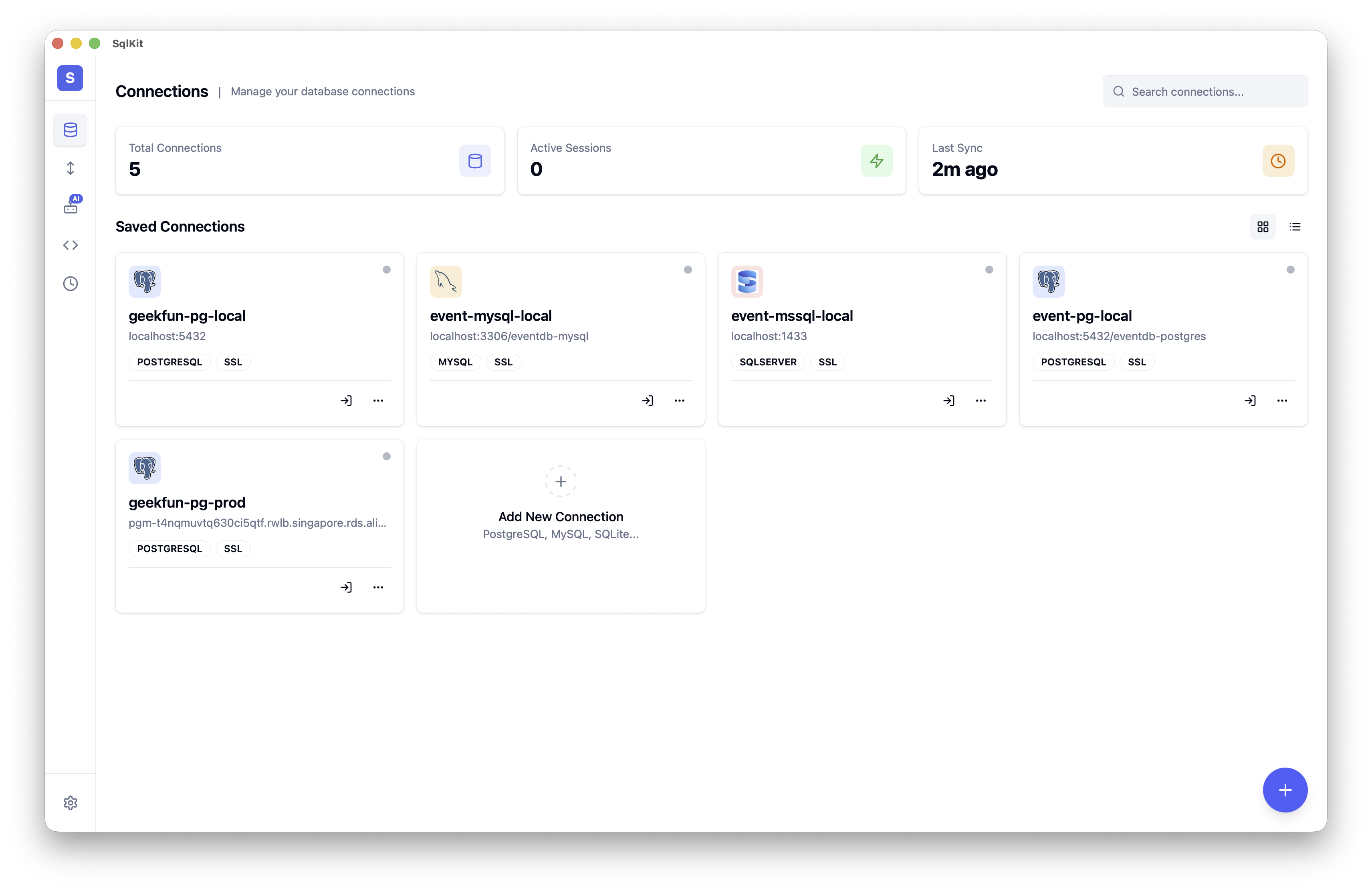


Installation

Download   Releases   Website

Features

Agentic Data Studio

Describe what you need in natural language — the agent reads your schema, writes queries, optimizes slow SQL, explains execution plans visually, and fixes errors on the spot. Supports OpenAI, Anthropic, DeepSeek, and Ollama. Bring your own key.

  • AI query generation — natural language to SQL with schema-aware context
  • SQL optimization — rewrite slow queries and visualize execution plans
  • Error fixing — agent diagnoses and fixes SQL errors automatically
  • Safety — destructive operations require confirmation; credentials never exposed to the LLM

Lightweight & Native Performance

Built with Rust + Tauri v2 — no Electron, no JRE, no bundled Chromium. Ships as a small native binary with native performance across macOS, Windows, and Linux. What other apps need a Java runtime or a JetBrains license for, SqlKit does in a single download.

All Your Databases, One App

SqlKit supports 70+ databases across four adapter strategies:

Strategy Databases
Native (Rust) PostgreSQL, MySQL, SQL Server, SQLite
PG-wire compat CockroachDB, Redshift, YugabyteDB, TimescaleDB, QuestDB, Vastbase, YashanDB, KingbaseES, GaussDB, HighGo, UXDB, OpenGauss, GBase8c, Greenplum, EnterpriseDB, CrateDB, Materialize, AlloyDB, CloudSQLPG, FujitsuPG
MySQL-wire compat MariaDB, TiDB, OceanBase, TDSQL, PolarDB, Doris, SelectDB, StarRocks, Databend, GoldenDB, ManticoreSearch, SingleStore, CloudSQLMySQL
JDBC bridge Oracle, DuckDB, Firebird, DB2, H2, Snowflake, TDengine, Derby, Hive, Databricks, Hana, Teradata, Vertica, Exasol, BigQuery, Informix, Kylin, Cassandra, Iris, Access, Dameng, XuguDB, GBase8a
HTTP bridge ClickHouse, Trino, Presto, RQLite, Turso

Product-Grade Editor

Powered by Monaco (VS Code engine) with full SQL syntax highlighting, autocomplete, and multi-tab support. Browse schemas visually, inspect DDL, and search objects across databases.

  • Monaco Editor — VS Code-grade SQL editing with syntax highlighting and autocomplete
  • Multi-tab — work on multiple queries simultaneously with tab management
  • Schema Browser — tree view of databases, schemas, tables, columns, indexes
  • Query history — auto-saved, searchable, replayable
  • Results grid — paginated, sortable, with inline editing and CSV/JSON/Markdown export
  • DDL viewer — view CREATE statements for any object
  • Object search — quickly find tables, views, and procedures across schemas

Large Data Transfer

Move data between any supported engines — PostgreSQL to ClickHouse, Oracle to SQL Server, or MySQL to BigQuery. No intermediate files required.

  • Cross-engine transfer — migrate data between different database types with automatic type mapping
  • Import / Export — CSV, JSON, JSONL formats
  • Bulk operations — handle millions of records with batch processing

Security & Connectivity

  • SSH Tunnel — connect through SSH with key or password authentication
  • Encrypted storage — credentials secured by OS keychain (macOS Keychain, Windows Credential Manager, Linux Secret Service)
  • SSL/TLS — encrypted connections to supported databases
  • Auto-reconnect — resilient connection handling

Cross-Platform

  • macOS (Apple Silicon & Intel) — native .dmg installer
  • Windows.exe installer
  • Linux.AppImage and .deb packages

Development

Prerequisites

Linux (Ubuntu/Debian):

sudo apt-get install -y libgtk-3-dev libwebkit2gtk-4.1-dev libayatana-appindicator3-dev librsvg2-dev libssl-dev

macOS:

xcode-select --install

Windows: Install Microsoft C++ Build Tools

Q

readme truncated — read the full docs on github

Frequently asked questions

Is sqlkit free to use?

sqlkit is open source under the Apache-2.0 licence. There is no licence fee and no seat count — you can self-host it or, where the project offers one, pay a vendor for a managed version instead.

What does sqlkit do?

Agentic SQL database manager for 40+ databases — PostgreSQL, MySQL, SQL Server, SQLite, DuckDB, ClickHouse, Oracle and more. Lightweight, privacy-first, AI-powe

What is sqlkit written in?

sqlkit is primarily written in Rust. Its source is publicly available at https://github.com/geek-fun/sqlkit, and it has 505 GitHub stars.



