Spug is a lightweight, agent-free automatic operations and maintenance platform for small and medium-sized enterprises, combining host management, batch execution, a browser terminal, file management, application release, pipelines, task planning, a configuration center, monitoring, and alerting in one AGPL-3.0 open-source system.
What it is
Spug is an open-source operations platform built on Django and React. The backend stack is Python 3.8+ with Django 4.2 and Redis 5.0+, and the frontend is Node.js 18+ with React 16.13. It is agent-free, meaning nothing needs to be installed and maintained on the managed hosts themselves. The interface is based on Ant Design and ships with a full English and Simplified Chinese UI, switchable from the header. The licence is AGPL-3.0.
The problem it addresses is fragmentation in small operations teams. Without a platform like this, host inventory, remote command execution, file distribution, scheduled jobs, release approval, and monitoring alerts are spread across SSH sessions, hand-written crontab entries, Jenkins jobs, and separate alerting scripts. Spug consolidates those into one system, with grouping for hosts, import from cloud providers or an Excel file, batch connectivity checks, a reusable command and template library, and an execution history. It sits in the Django-based operations tooling ecosystem and covers the CMDB, CI/CD, and ops-admin ground that a team usually assembles piece by piece.
Key capabilities
- Host management with grouping, import from cloud providers or an Excel file, and batch connectivity checks.
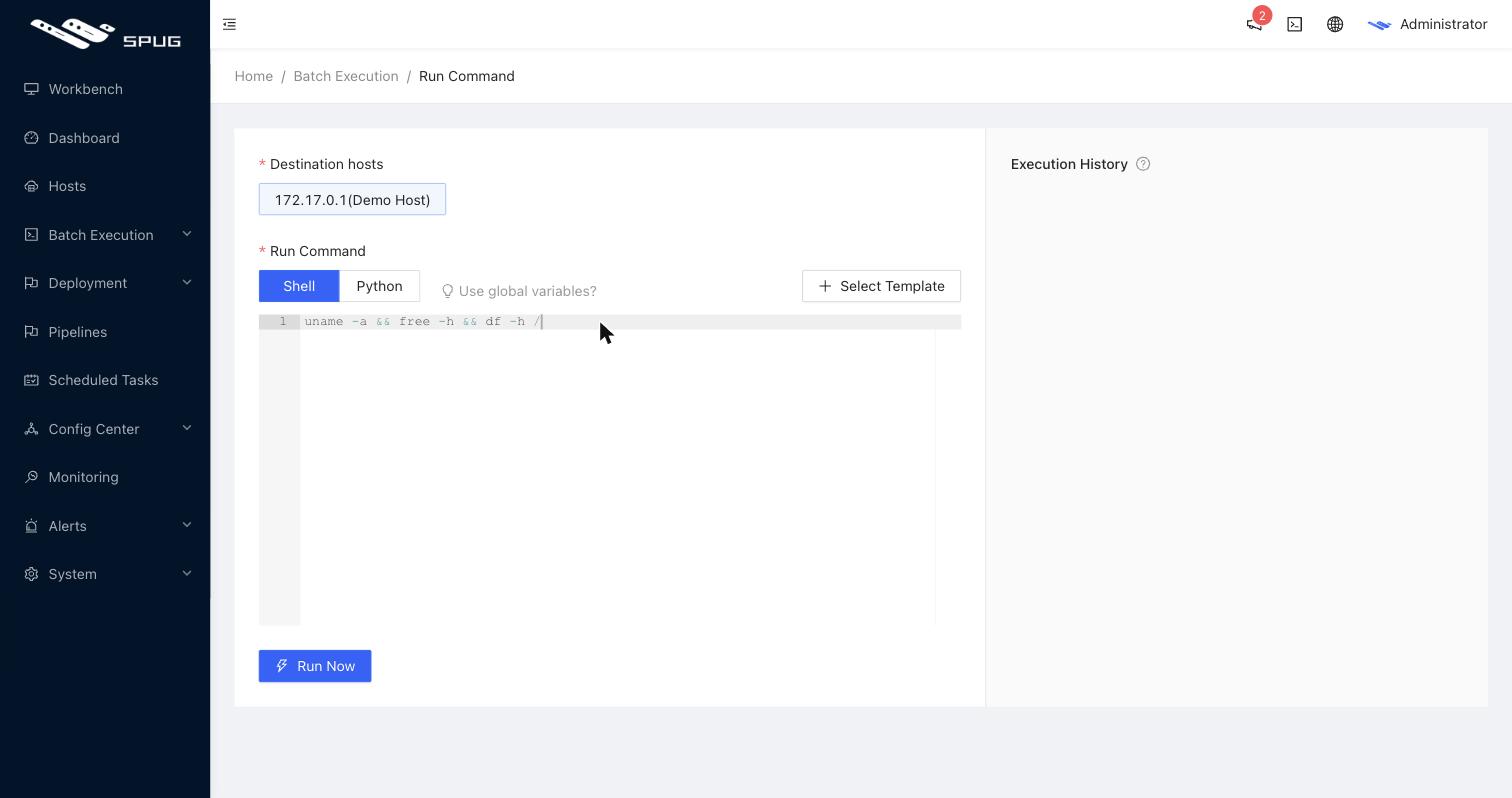
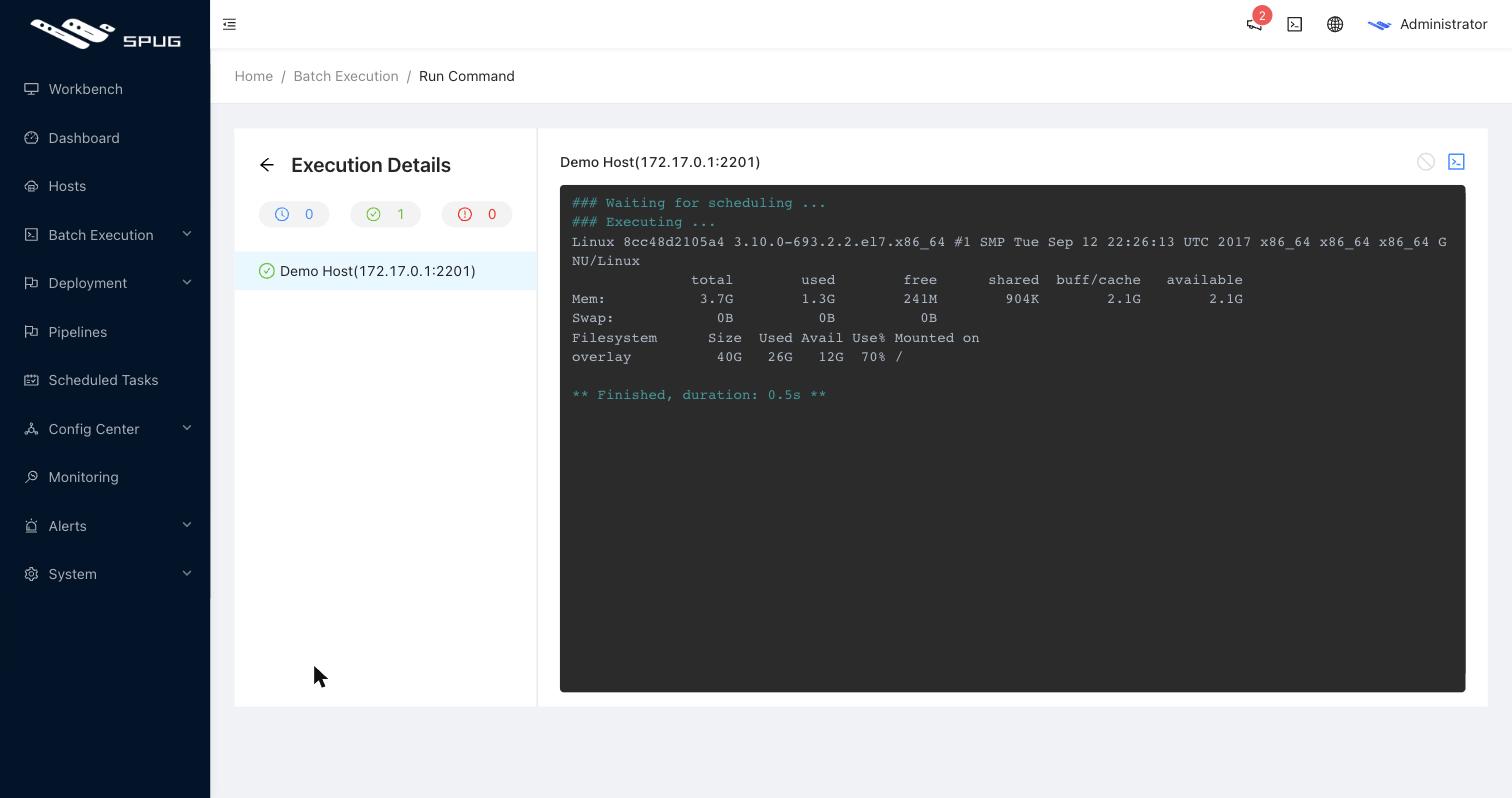
- Host batch execution with parameterized commands, reusable templates, and execution history.
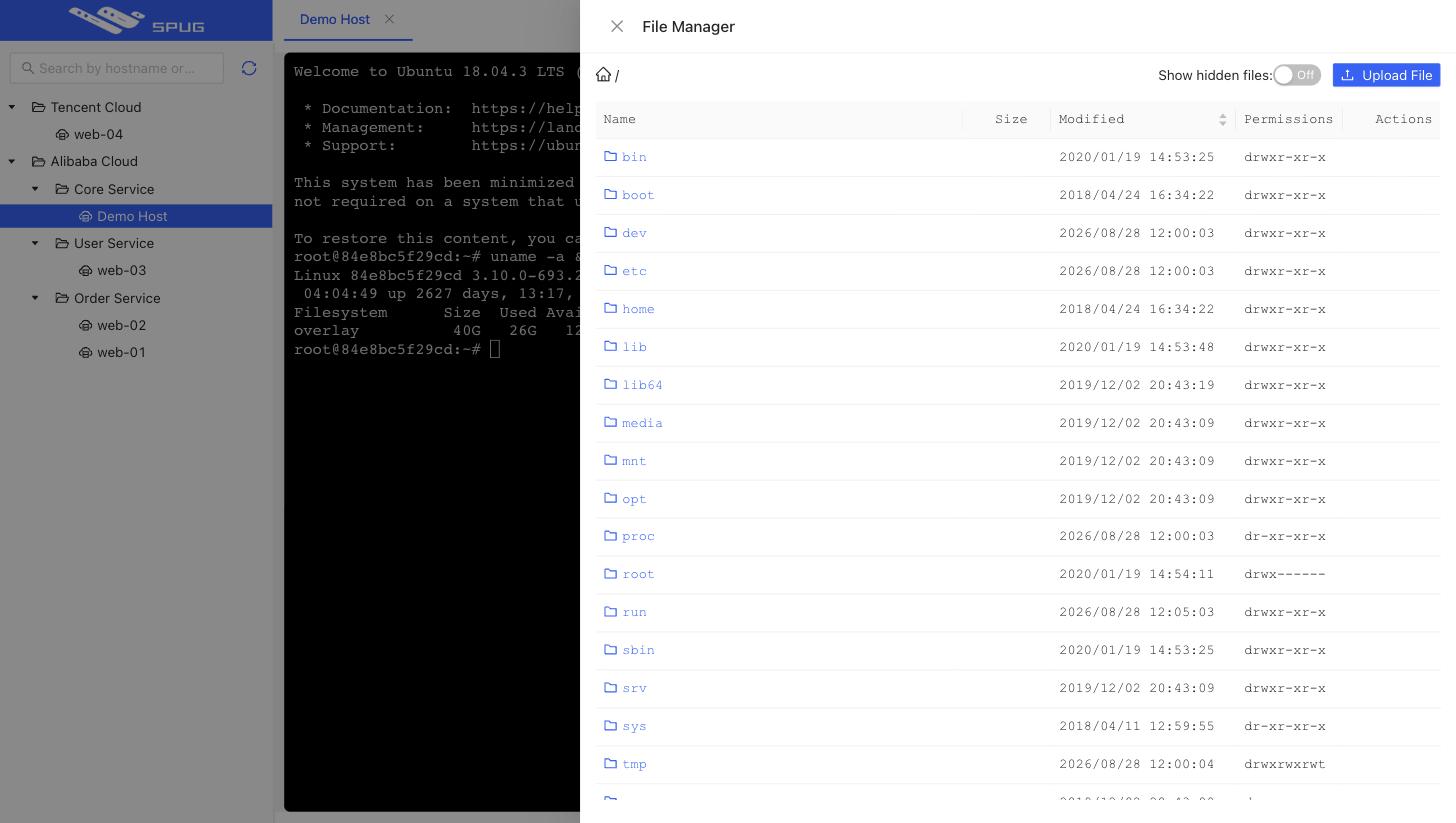
- Host online terminal for browser-based login, plus online file upload and download.
- File distribution from one host to many hosts, including directories.
- Build and deploy with a custom build step, review flow, canary release, and rollback.
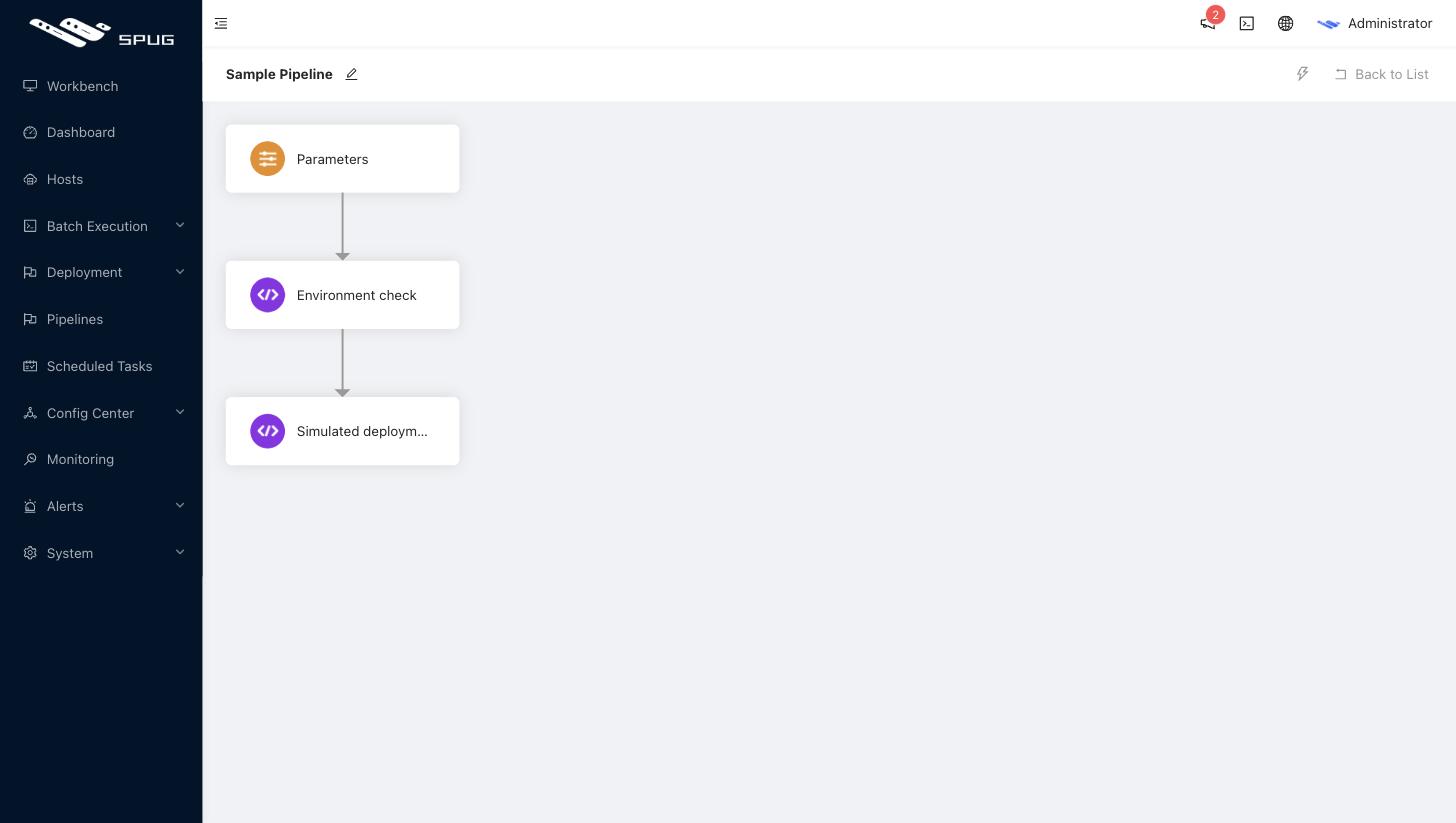
- Pipelines that orchestrate parameter, build, remote command, data transfer, data upload, and DingTalk, Feishu, WeChat Work, or Push Assistant notification nodes, with conditional branches and a live console.
- Task planning with online configuration of crontab and interval schedules, a configuration center supporting KV, text, and json, and a monitoring center covering site, port, process, ping, and custom scripts.
Who uses it and how
- Small and medium-sized enterprises that run production hosts without a dedicated platform engineering team, using grouped hosts and batch execution instead of ad-hoc SSH.
- Teams that need a release gate: deploy requests go through a review flow before canary release and rollback.
- Operations staff who need scheduled work configured online, using the crontab and interval schedules rather than editing crontab files per host.
- Teams routing alerts to email, WeChat, DingTalk, WeChat Work, or Feishu, and enterprises that need LDAP login and MFA with fine-grained role and permission control.
- Organisations already running Zabbix, Prometheus, or Nightingale can use Push Assistant, a related message push platform covering telephone, SMS, email, Feishu, DingTalk, WeChat, and WeChat Work, to add phone and SMS alarms.
Getting started
Installation is documented as a Docker deployment at https://ops.spug.cc/docs/install-docker/, with usage documentation, a change log, and an FAQ linked from https://ops.spug.cc. A hosted demo runs at https://demo.spug.cc, on the latest version with data reset every hour.
How it compares
The facts name no paid products that this project replaces, so the comparison sits among adjacent open-source tools. Jenkins appears in the topic list and covers pipeline and release automation, while Zabbix, Prometheus, and Nightingale are named as monitoring systems that pair with Push Assistant rather than being replaced by Spug. Spug's distinguishing point in that set is the combination of an agent-free model, an integrated host terminal and file manager, and release, scheduling, configuration, monitoring, and alerting in one codebase.
When to use it — and when not to
A self-hoster runs the Django application, Redis, and the React frontend, and configures whatever external channels the chosen alert and notification methods need. Teams that want a fully managed SaaS, or that will not operate a Python and Redis stack, should look elsewhere. The honest limitation is documentation depth: the README is an overview and points to an external docs site for installation, usage, the change log, and the FAQ, so evaluating it in detail means leaving the repository.
project readme (upstream, from github) — read inline
English | 简体中文
Spug
Spug is a lightweight agent-free automatic operation and maintenance platform designed for small and medium-sized enterprises. It integrates host management, host batch execution, host online terminal, file management, application release and deployment, pipelines, online task planning, configuration center, monitoring, alarm and so on.
Demo
Demo:https://demo.spug.cc
The demo environment runs the latest version and resets its data every hour, both the English and the Simplified Chinese interface are available from the globe icon in the header.
🔥Push Assistant
Push Assistant is a message push platform that integrates multiple channels such as telephone, SMS, email, Feishu, DingTalk, WeChat, and WeChat Work. It can realize telephone and SMS alarms of Zabbix, Prometheus, Nightingale and other monitoring systems in 3 minutes. Click to experience: https://push.spug.cc
Features
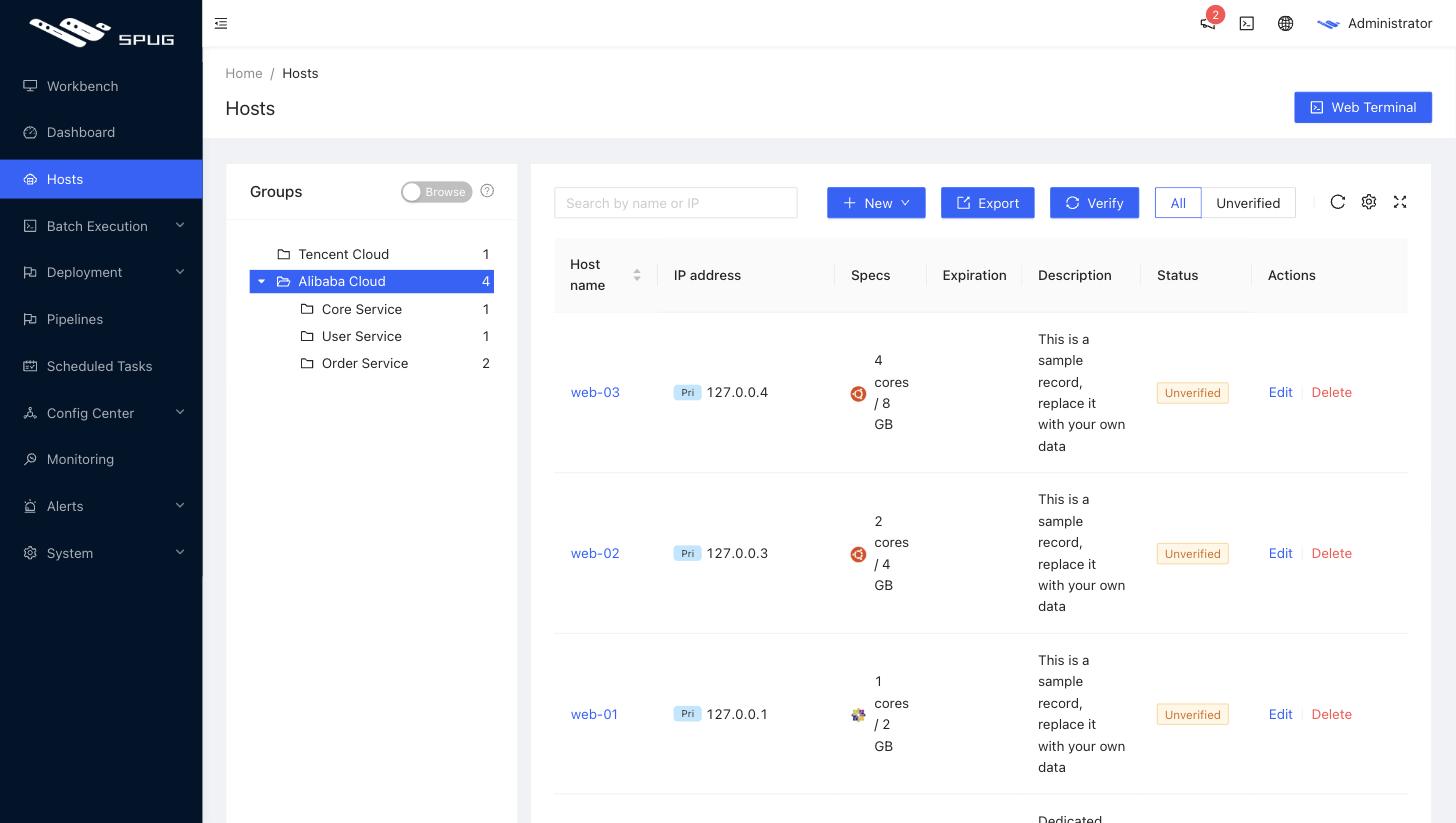
- Host Management: Manage hosts by group, import them from cloud providers or an Excel file, and check connectivity in batch
- Host Batch Execution: Support host batch online command execution, with parameterized commands, reusable templates and execution history
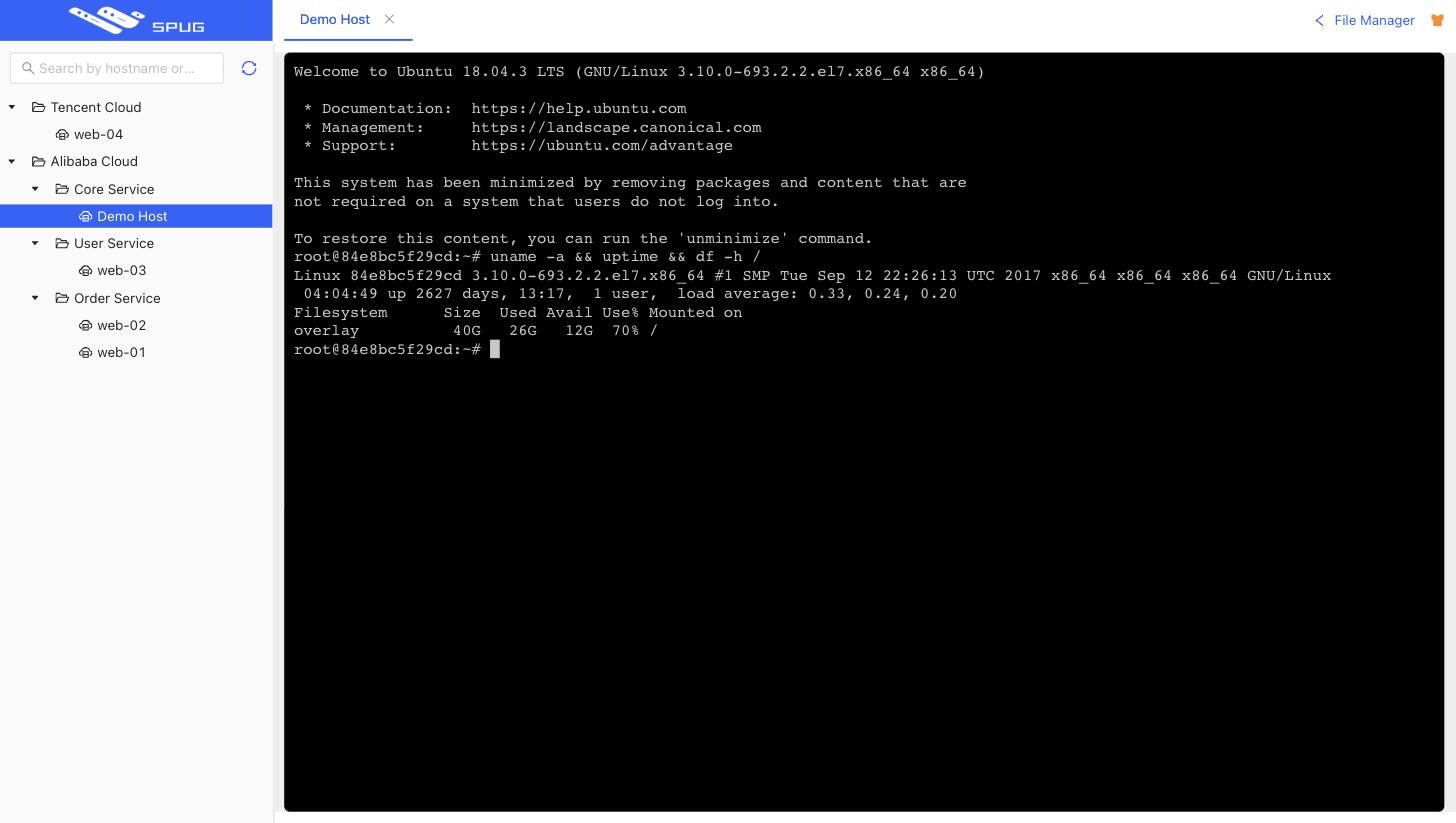
- Host Online Terminal: The host supports browser online terminal login
- Host File Management: Support host files online upload and download
- File Distribution: Distribute files and directories from one host to many hosts
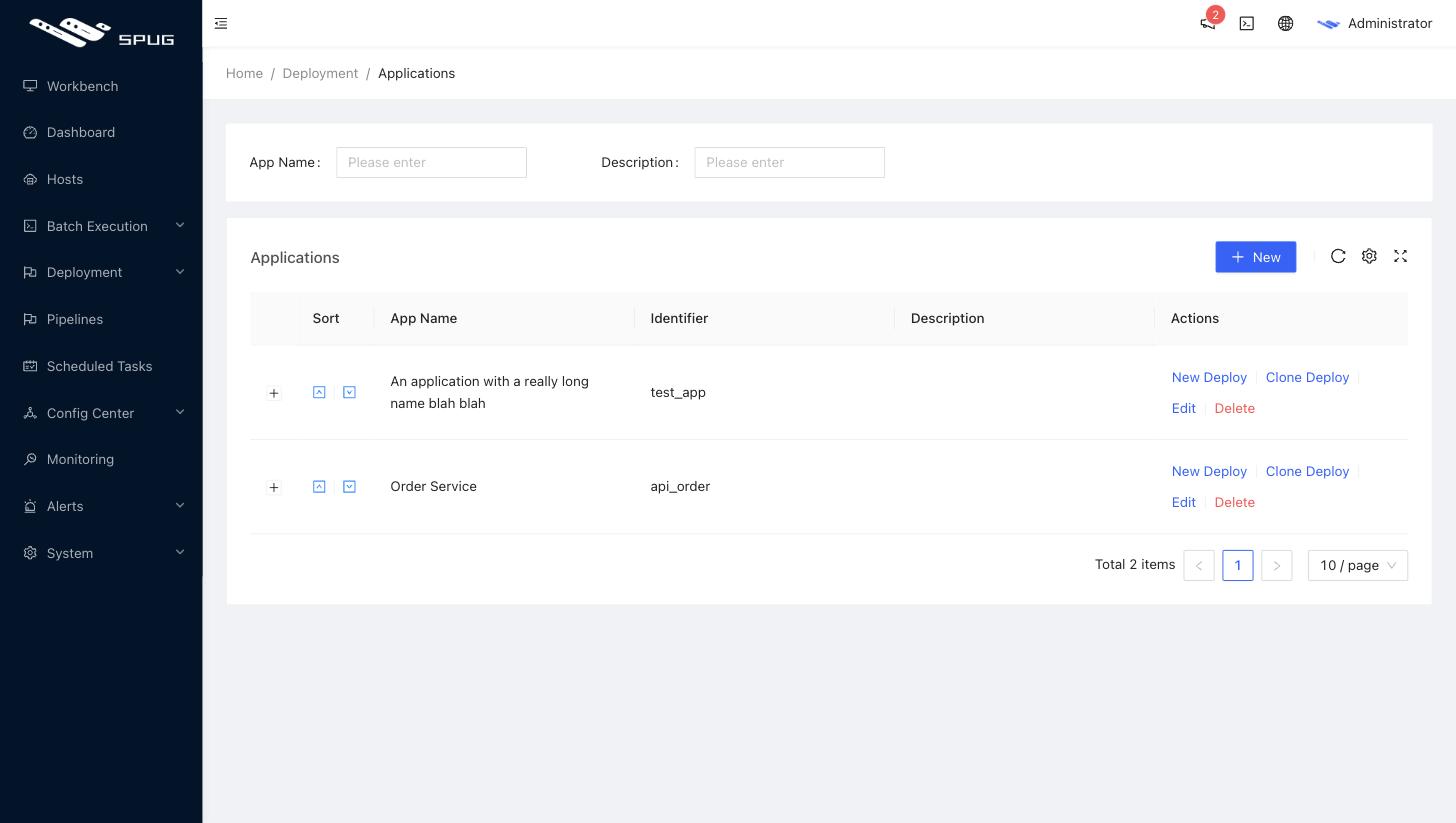
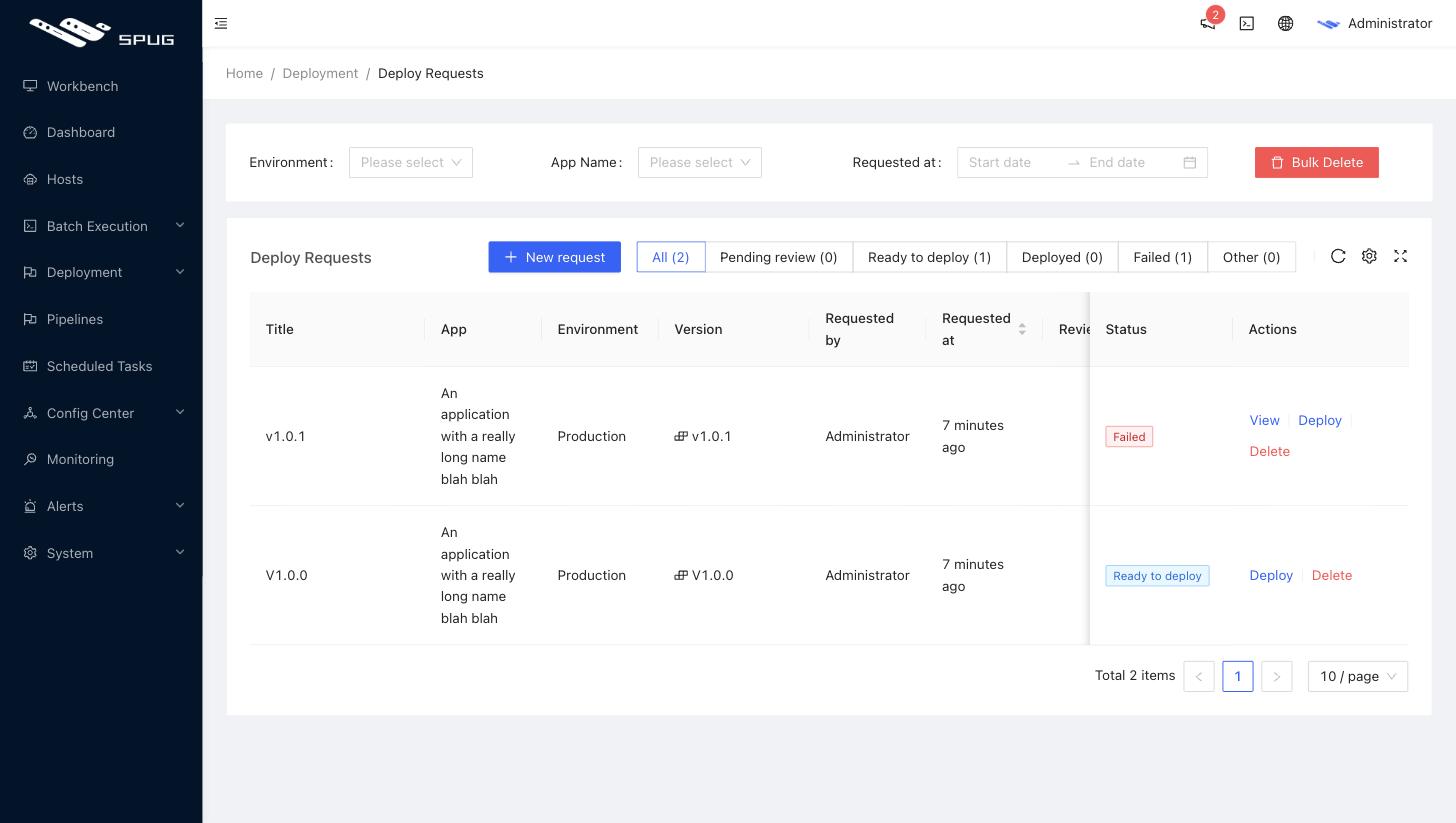
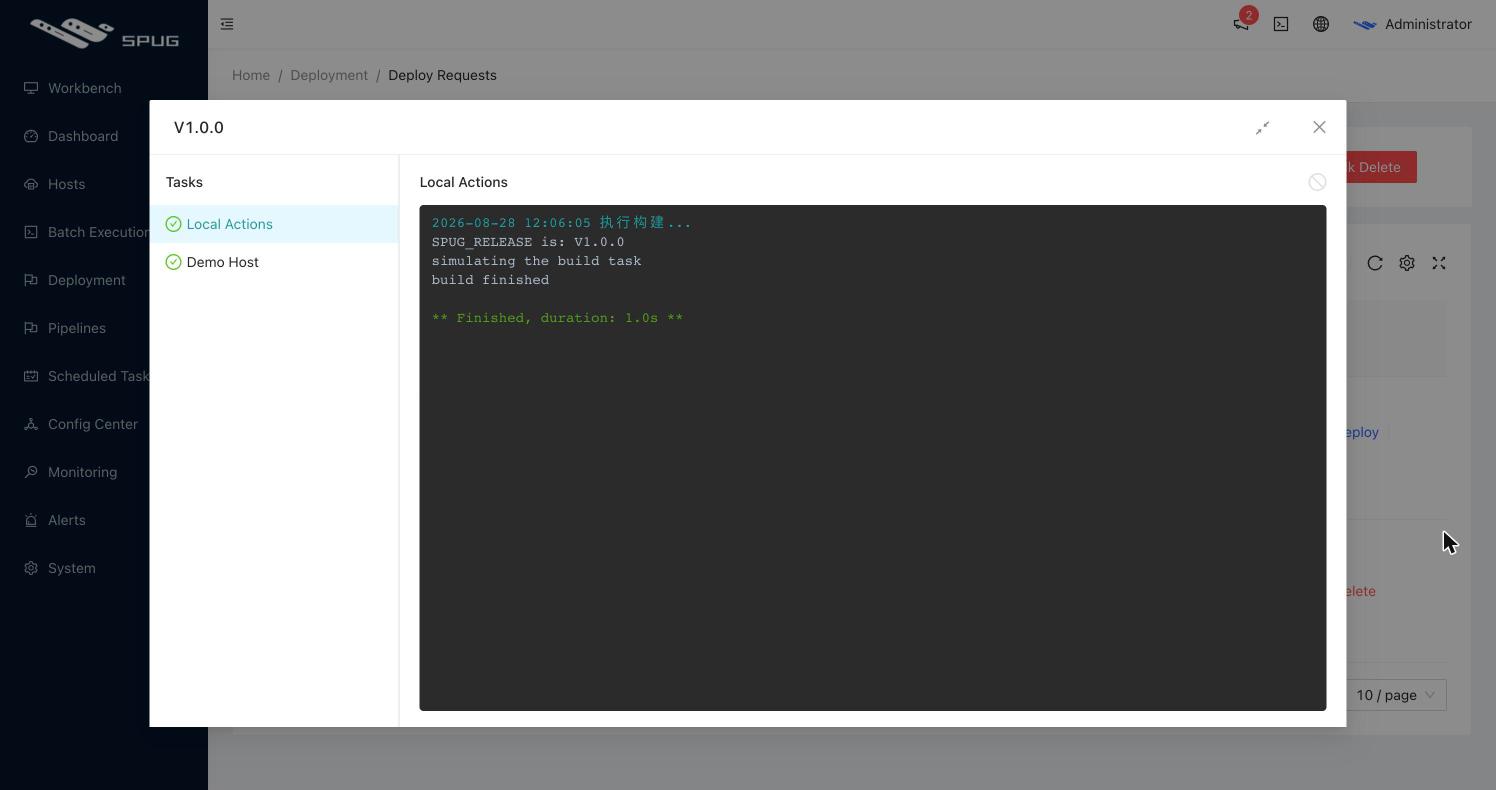
- Build and Deploy: Support application custom build deployment, with review flow, canary release and rollback
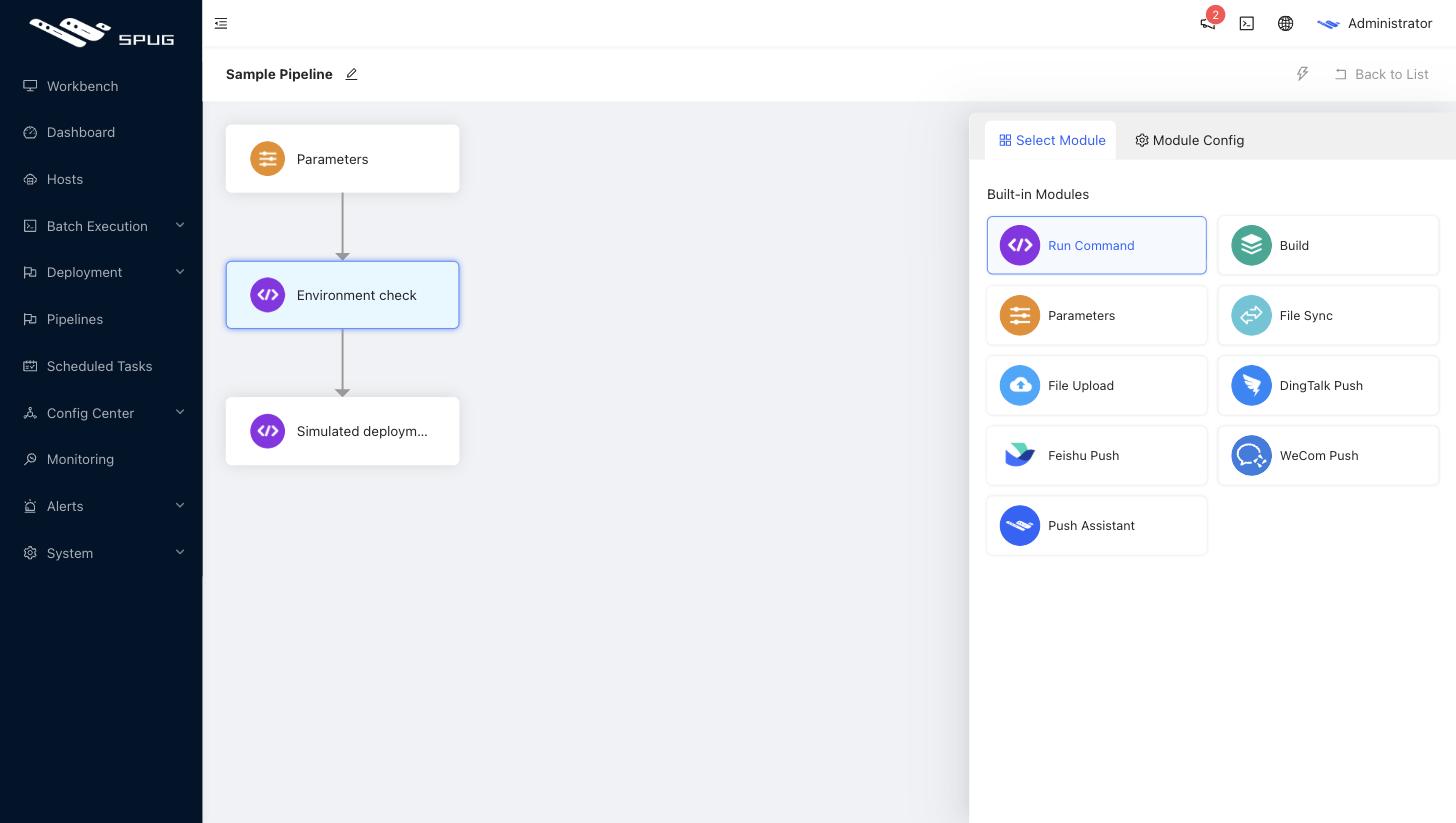
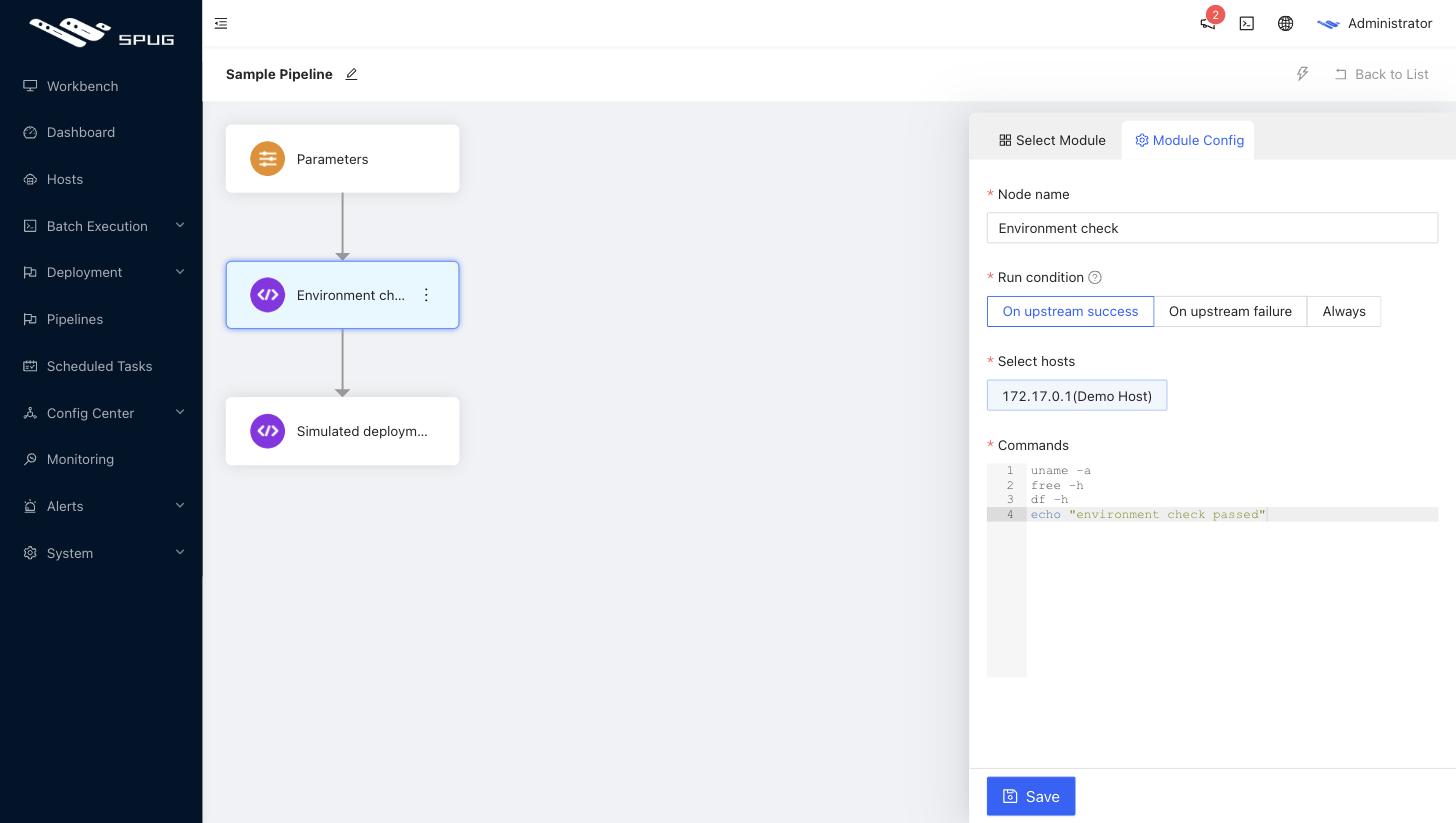
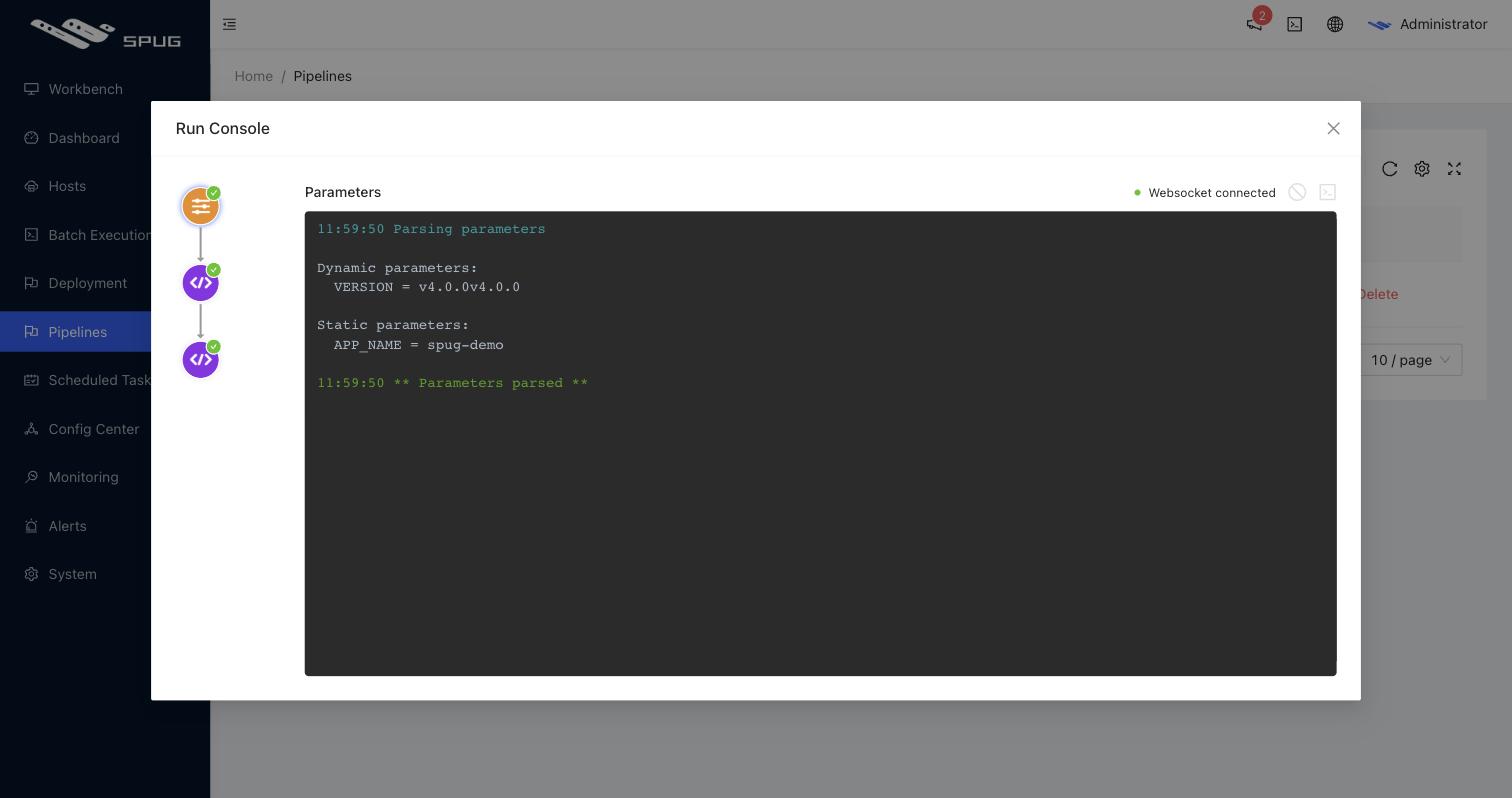
- Pipelines: Orchestrate parameter, build, remote command, data transfer, data upload and DingTalk / Feishu / WeChat Work / Push Assistant notification nodes into a workflow, with conditional branches and a live console
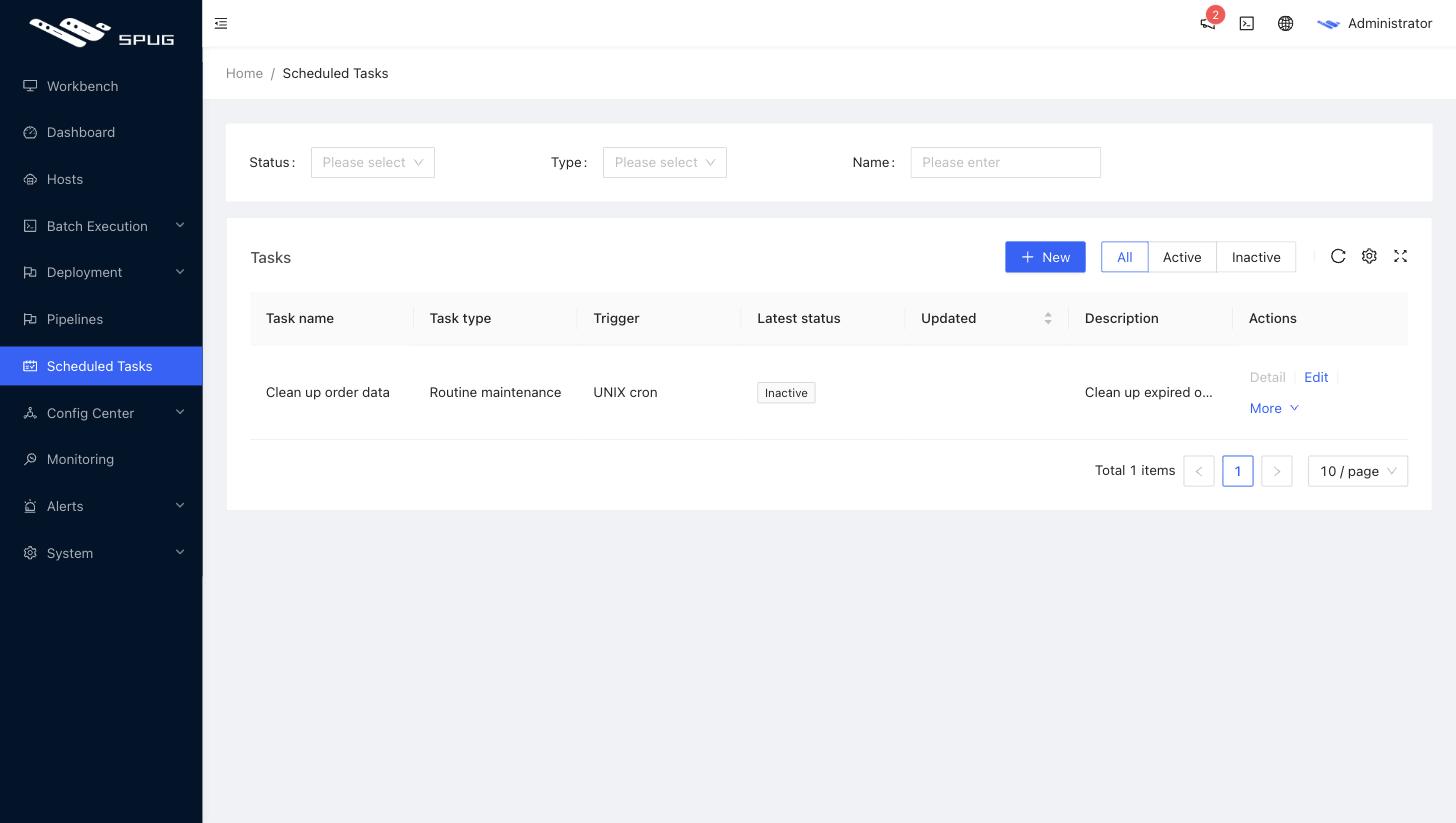
- Task Planning: It supports online configuration of crontab, interval and other task schedules
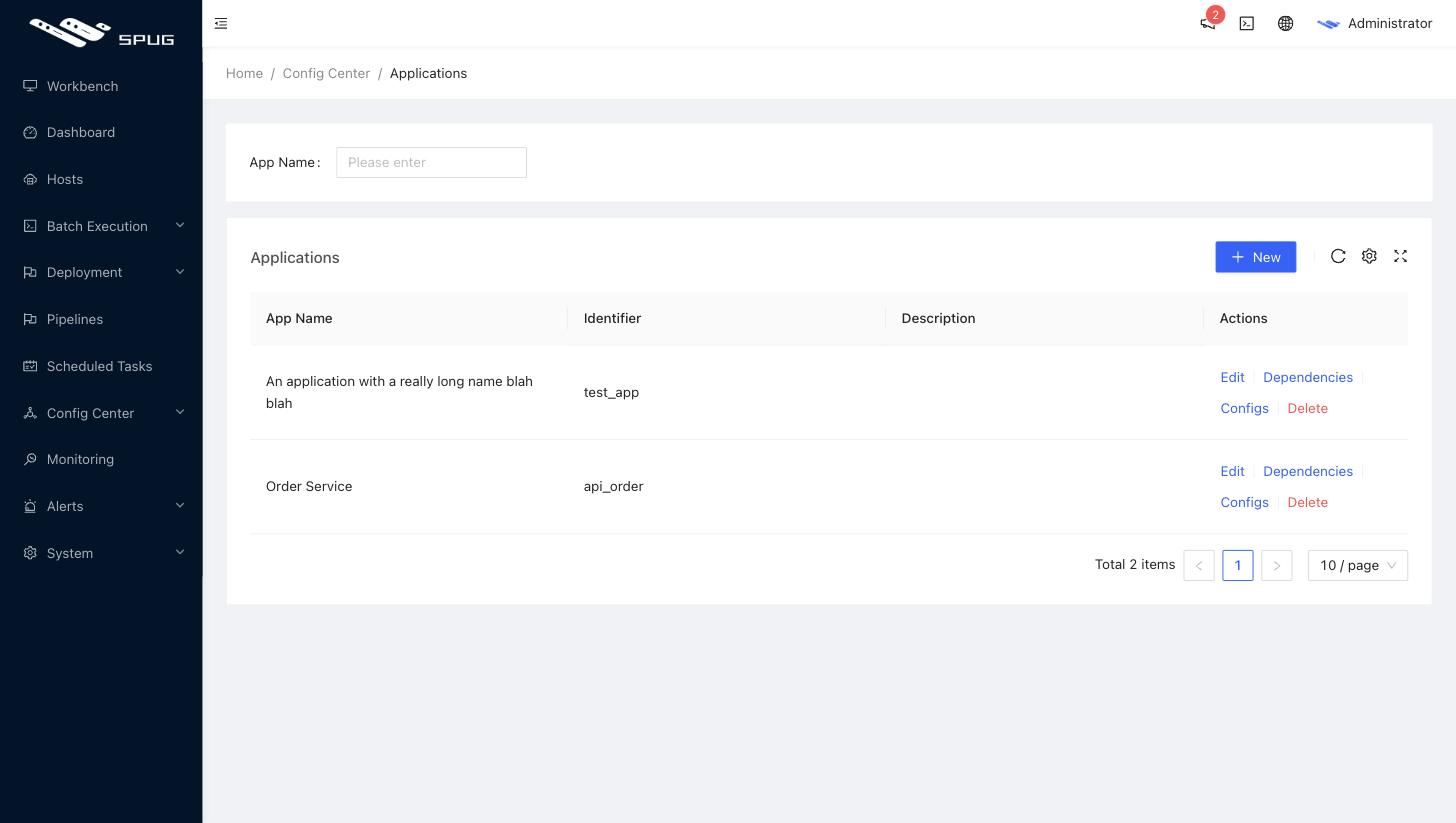
- Configuration Center: Support KV, text, json and other formats online configuration
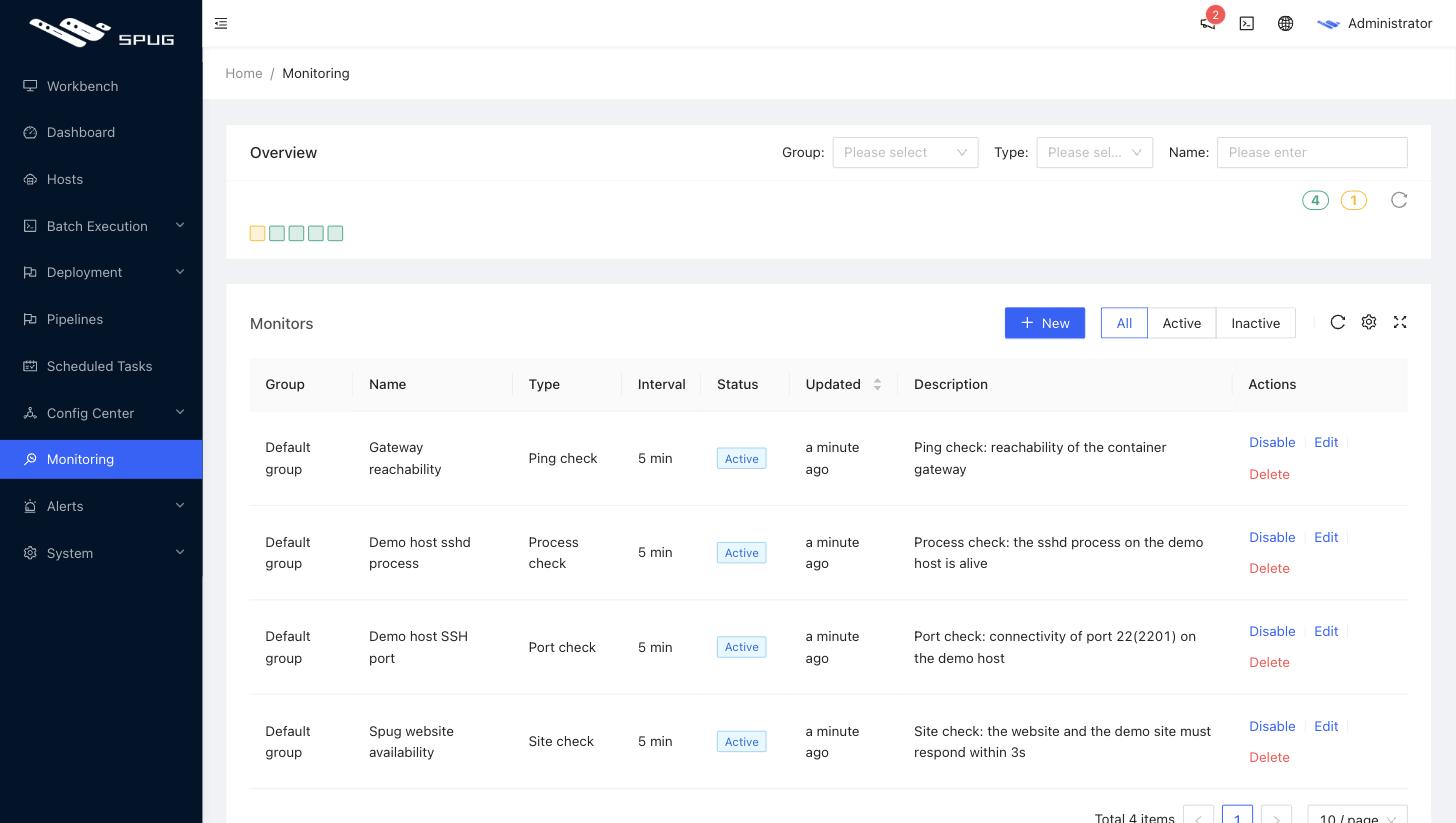
- Monitoring Center: Support site, port, process, ping, custom script and other monitoring
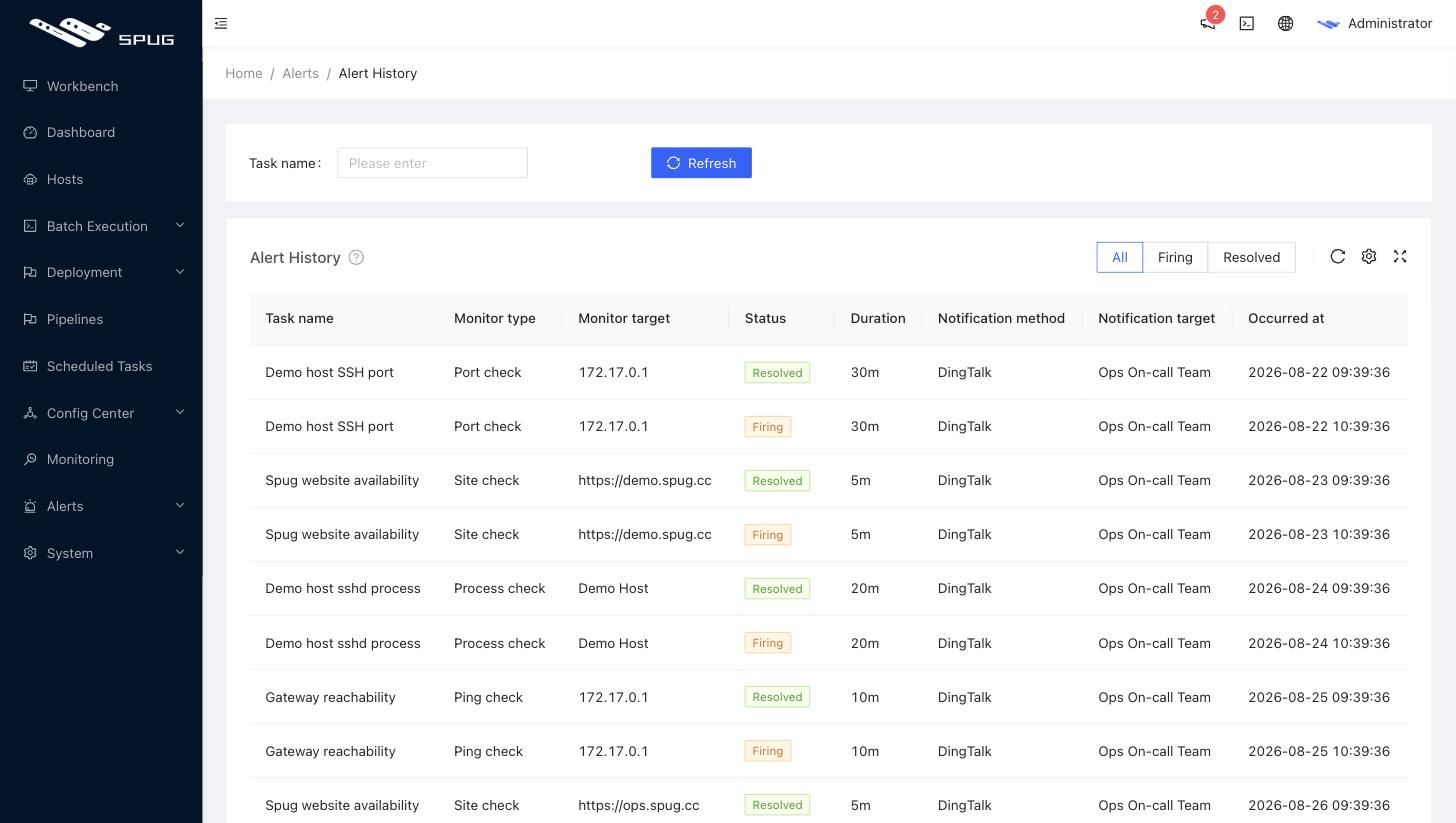
- Alarm Center: Support email, WeChat, DingTalk, WeChat Work, Feishu and other alarm methods
- Credential Management: Keep passwords and private keys in one place and share them across hosts
- Permission Control: Fine-grained role and permission control, LDAP login and MFA are supported
- Bilingual UI: Full English and Simplified Chinese interface, switchable from the header
- Elegant and beautiful: UI interface based on Ant Design
- Open source and free: The front-end and back-end code is completely open source
Environment
- Python 3.8+
- Django 4.2
- Node.js 18+
- React 16.13
- Redis 5.0+
Install Doc
Recommended
Yearning — MYSQL open source SQL statement review platform
PreView
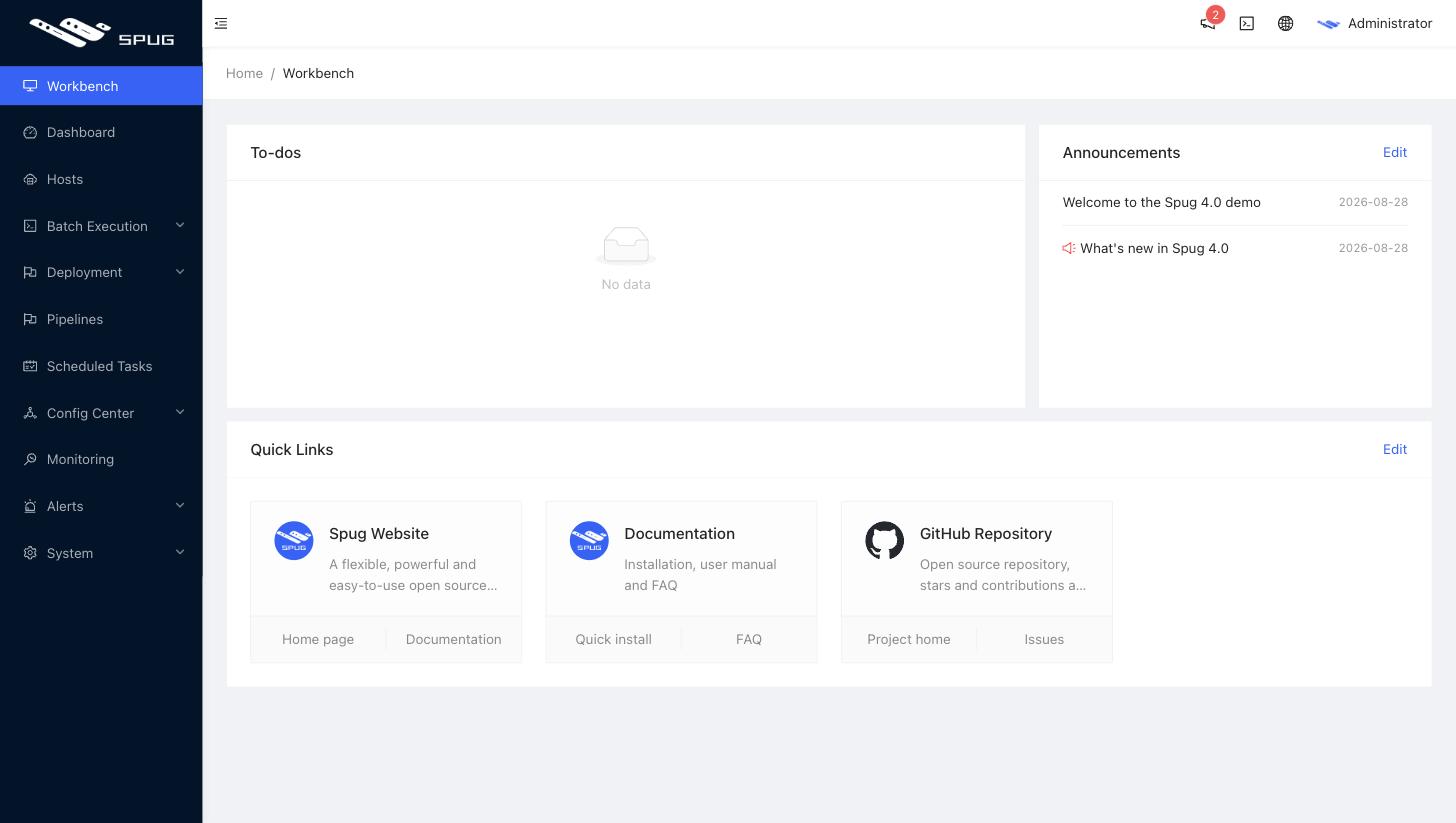
Workbench
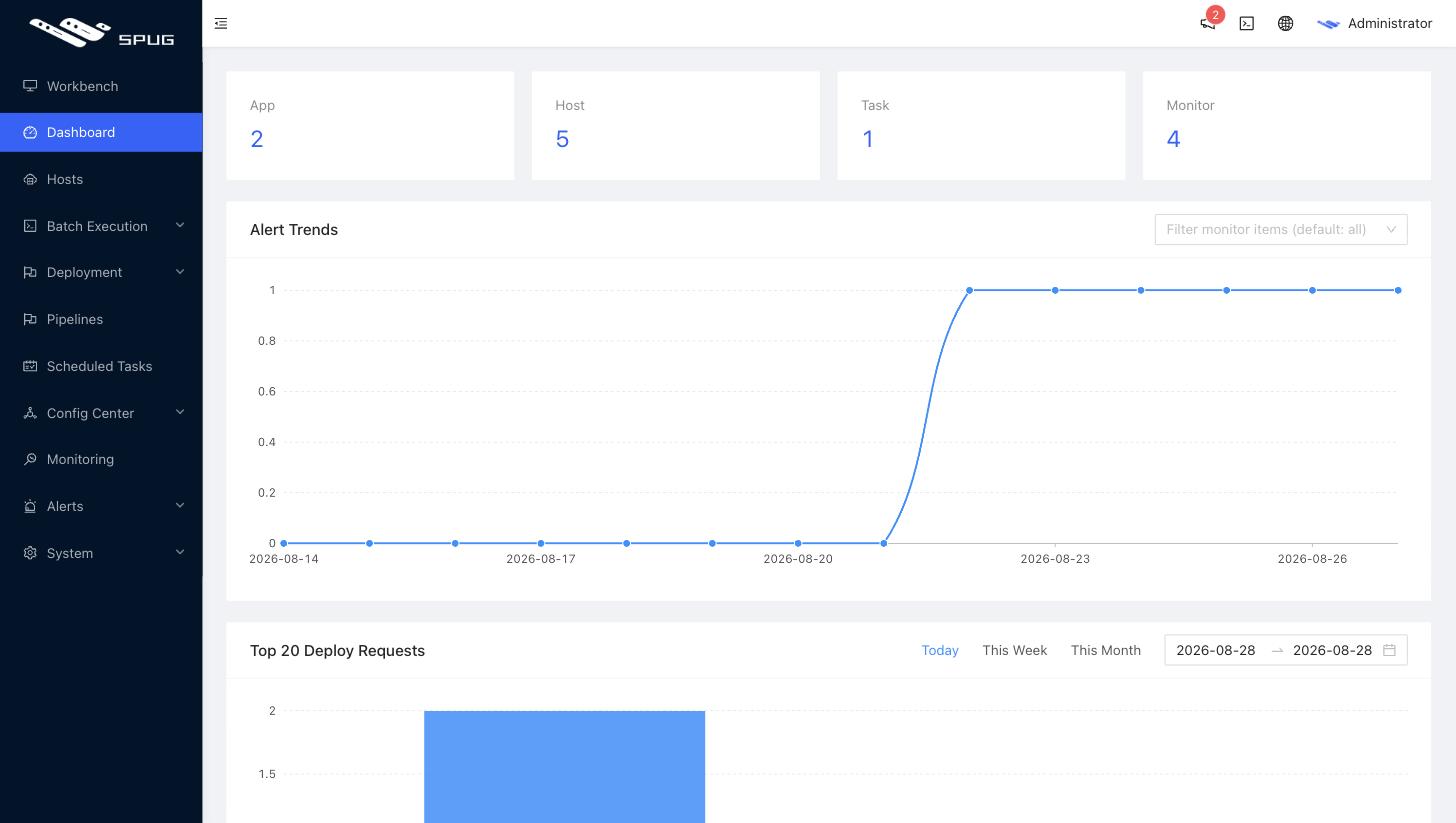
Dashboard
Host Management
Host Online Terminal
File Online Upload and Download
Host Batch Execution
Pipelines
Orchestrate build, command, data transfer, upload and notification nodes into a workflow.
Application Release
Task Planning
Configuration Center
Monitoring and Alarm
Sponsor
Developer Group
Follow the Spug operation and maintenance public number to add WeChat group, QQ group, and get the latest product dynamics

License & Copyright
AGPL-3.0