



springdoc-openapi is on Open Collective. If
you ❤️ this project consider becoming a sponsor.
This project is sponsored by





Table of Contents
- Full documentation
- Security contact information
- Versioning
- Introduction
- Getting Started
- Library for springdoc-openapi integration with spring-boot and swagger-ui
- Spring-boot with OpenAPI Demo applications.
- Integration of the library in a Spring Boot 4.x project without the swagger-ui:
- Error Handling for REST using @ControllerAdvice
- Adding API Information and Security documentation
- spring-webflux support with Annotated Controllers
- Using a separate management port (Spring Boot 4)
- When Spring Security is enabled
- Acknowledgements
Full documentation
Security contact information
To report a security vulnerability, please use the Tidelift security contact. Tidelift will coordinate the fix and disclosure.
Versioning
springdoc-openapi follows Semantic Versioning. MAJOR version increments are released in lockstep with Spring Boot MAJOR releases and may include incompatible/breaking changes. MINOR and PATCH releases follow standard SemVer conventions for backwards-compatible features and fixes, respectively. See CHANGELOG.md for the full release history.
Introduction
The springdoc-openapi Java library helps automating the generation of API documentation using Spring Boot projects. springdoc-openapi works by examining an application at runtime to infer API semantics based on Spring configurations, class structure and various annotations.
The library automatically generates documentation in JSON/YAML and HTML formatted pages.
The generated documentation can be complemented using swagger-api annotations.
This library supports:
- OpenAPI 3
- Spring-boot v4 (Java 17 & Jakarta EE 9)
- JSR-303, specifically for @NotNull, @Min, @Max, and @Size.
- Swagger-ui
- OAuth 2
- GraalVM native images
The following video introduces the Library:
For Spring-boot v4 support, make sure you use springdoc-openapi v3
This is a community-based project, not maintained by the Spring Framework Contributors ( Pivotal)
Getting Started
Library for springdoc-openapi integration with spring-boot and swagger-ui
- Automatically deploys swagger-ui to a Spring Boot 4.x application
- Documentation will be available in HTML format, using the official swagger-ui jars.
- The Swagger UI page should then be available at http://server:
port/context-path/swagger-ui.html and the OpenAPI description will be available at the
following url for json format: http://server:port/context-path/v3/api-docs
server: The server name or IPport: The server portcontext-path: The context path of the application
- Documentation can be available in yaml format as well, on the following path:
/v3/api-docs.yaml - Add the
springdoc-openapi-uilibrary to the list of your project dependencies (No additional configuration is needed):
Maven
   <dependency>
      <groupId>org.springdoc</groupId>
      <artifactId>springdoc-openapi-starter-webmvc-ui</artifactId>
      <version>last-release-version</version>
   </dependency>
Gradle
implementation 'org.springdoc:springdoc-openapi-starter-webmvc-ui:latest'
- This step is optional: For custom path of the swagger documentation in HTML format, add a custom springdoc property, in your spring-boot configuration file:
# swagger-ui custom path
springdoc.swagger-ui.path=/swagger-ui.html
Spring-boot with OpenAPI Demo applications.
Source Code for Demo Applications.
Demo Spring Boot 4 Web MVC with OpenAPI 3.
Demo Spring Boot 4 WebFlux with OpenAPI 3.
Demo Spring Boot 4 WebFlux with Functional endpoints OpenAPI 3.
Demo Spring Boot 4 and Spring Cloud Function Web MVC.
Demo Spring Boot 4 and Spring Cloud Function WebFlux.
Demo Spring Boot 4 and Spring Cloud Gateway.
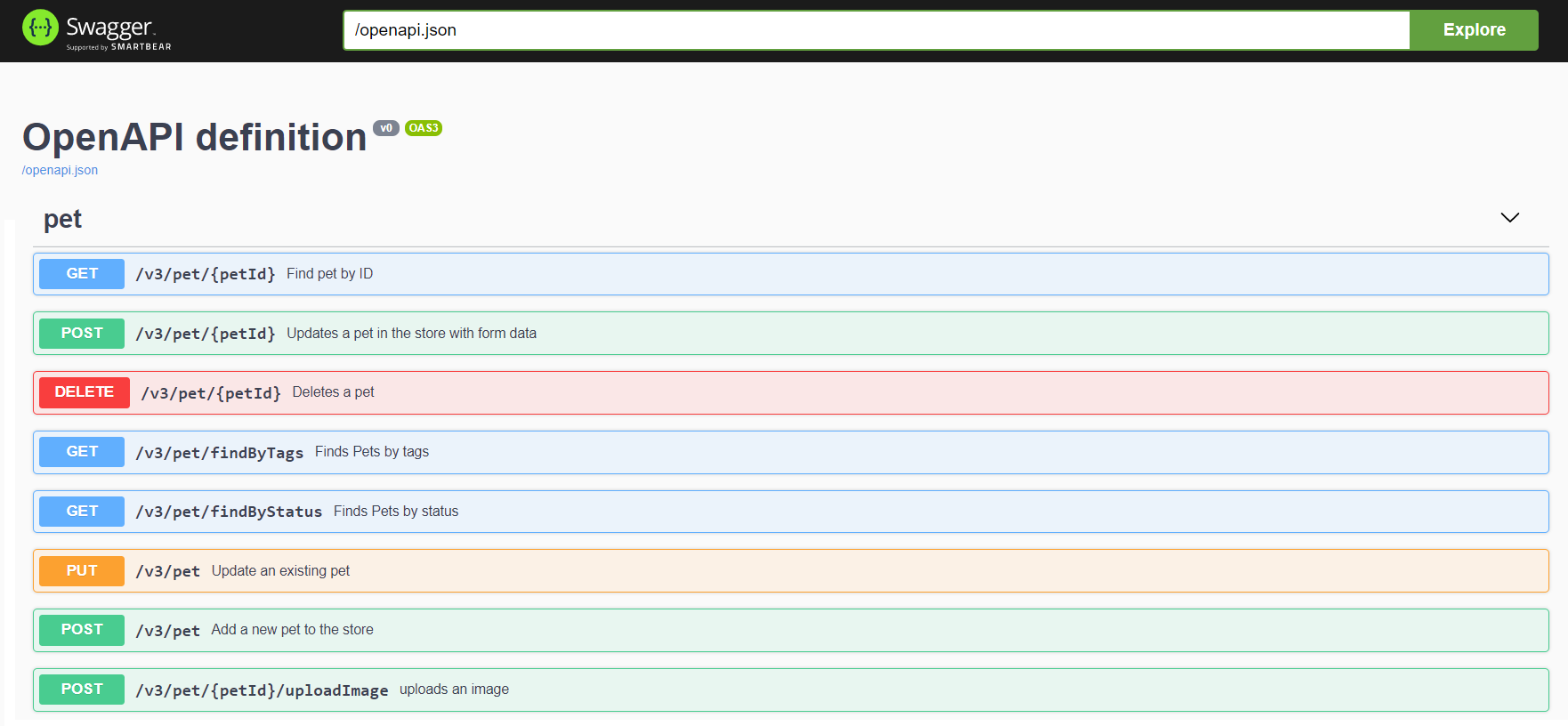
Integration of the library in a Spring Boot 4.x project without the swagger-ui:
- Documentation will be available at the following url for json format: http://server:
port/context-path/v3/api-docs
server: The server name or IPport: The server portcontext-path: The context path of the application
- Documentation will be available in yaml format as well, on the following
path :
/v3/api-docs.yaml - Add the library to the list of your project dependencies. (No additional configuration is needed)
Maven
   <dependency>
      <groupId>org.springdoc</groupId>
      <artifactId>springdoc-openapi-starter-webmvc-api</artifactId>
      <version>last-release-version</version>
   </dependency>
Gradle
implementation 'org.springdoc:springdoc-openapi-starter-webmvc-ui:latest'
- This step is optional: For custom path of the OpenAPI documentation in Json format, add a custom springdoc property, in your spring-boot configuration file:
# /api-docs endpoint custom path
springdoc.api-docs.path=/api-docs
- This step is optional: If you want to disable
springdoc-openapiendpoints, add a custom springdoc property, in yourspring-bootconfiguration file:
# disable api-docs
springdoc.api-docs.enabled=false
Error Handling for REST using @ControllerAdvice
To generate documentation automatically, make sure all the methods declare the HTTP Code responses using the annotation: @ResponseStatus.
Adding API Information and Security documentation
The library uses spring-boot application auto-configured packages to scan for the
following annotations in spring beans: OpenAPIDefinition and Info.
These annotations declare, API Information: Title, version, licence, security, servers,
tags, security and externalDocs.
For better performance of documentation generation, declare @OpenAPIDefinition
and @SecurityScheme annotations within a Spring managed bean.
spring-webflux support with Annotated Controllers
- Documentation can be available in yaml format as well, on the following path : /v3/api-docs.yaml
- Add the library to the list of your project dependencies (No additional configuration is needed)
Maven
   <dependency>
      <groupId>org.springdoc</groupId>
      <artifactId>springdoc-openapi-starter-webflux-ui</artifactId>
      <version>last-release-version</version>
   </dependency>
Gradle
implementation 'org.springdoc:springdoc-openapi-starter-webflux-ui:latest'
- This step is optional: For custom path of the swagger documentation in HTML format, add a custom springdoc property, in your spring-boot configuration file:
# swagger-ui custom path
springdoc.swagger-ui.path=/swagger-ui.html
The springdoc-openapi libraries are hosted on maven central repository.
The artifacts can be viewed accessed at the following locations:
Releases:
Snapshots:
Using a separate management port (Spring Boot 4)
Some Spring Boot apps run Actuator on a separate management port. In that case:
Application port (e.g.,
8080) serves your app and springdoc endpoints:http://localhost:8080/v3/api-docshttp://localhost:8080/swagger-ui/index.html
Management port (e.g.,
9090) serves Actuator:http://localhost:9090/actuatorhttp://localhost:9090/actuator/health
Minimal application.yml:
server:
  port: 8080

management:
  server:
    port: 9090
  endpoints:
    web:
      exposure:
        include: health,info

# springdoc is enabled by default with the starter;
# endpoints remain on the application port.
# (OpenAPI JSON = /v3/api-docs, Swagger UI = /swagger-ui/index.html)
When Spring Security is enabled
With Spring Boot 3, /v3/api-docs and Swagger UI are served on the application port, while Actuator runs on the management port.
If Spring Security is enabled, explicitly permit the docs paths on the application port:
@Bean
SecurityFilterChain api(HttpSecurity http) throws Exception {
  http
    .authorizeHttpRequests(auth -> auth
      .requestMatchers(
        "/v3/api-docs/**",
        "/v3/api-docs.yaml",
        "/swagger-ui/**",
        "/swagger-ui.html"
      ).permitAll()
      .anyRequest().authenticated()
    );
  return http.build();
}
Acknowledgements
Contributors
springdoc-openapi is relevant and updated regularly due to the valuable contributions from its contributors.
Thank you all for your support!
Additional Support
- Spring Team - Thanks for their support by sharing all relevant resources around Spring projects.
- JetBrains - Thanks a lot for supporting springdoc-openapi project.
