Sourcey
Docs straight from the source.
Sourcey turns OpenAPI, MCP, Doxygen XML, godoc, rustdoc, and Markdown into one static HTML site you own: reference, guides, changelog, roadmap, and llms.txt from the same build, deployable anywhere.
Everything renders at build time: no dashboard, no runtime, no API calls to render your own documentation.




npx sourcey init
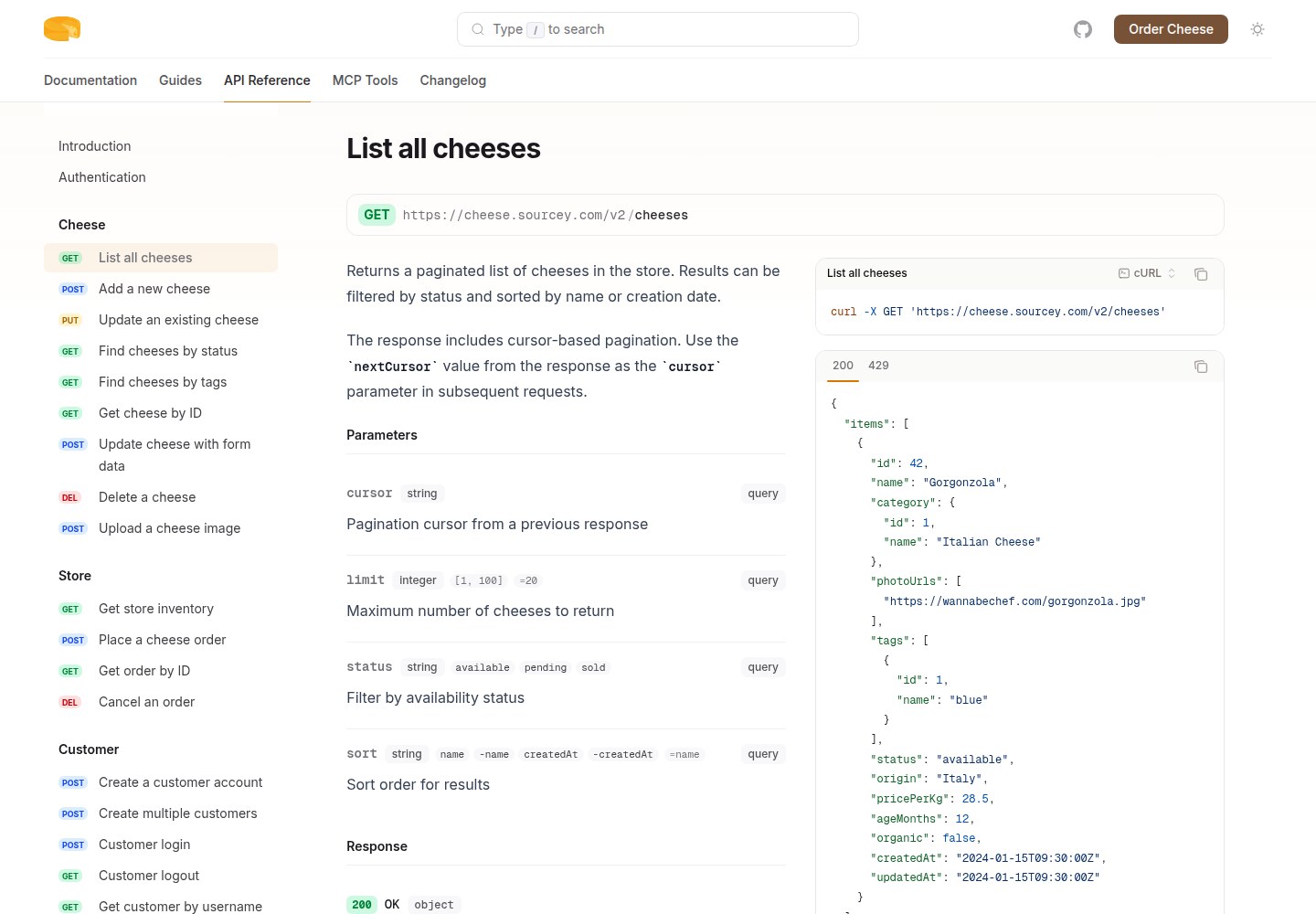
Live demo · Documentation · GitHub
Features
- OpenAPI 2.0, 3.0, 3.1, and 3.2: full spec coverage including
QUERYoperations, response summaries, hierarchical tags,deviceAuthorizationOAuth,querystringparameters, and$self-aware refs for multi-document APIs - API reference from OpenAPI: endpoints, parameters, request/response schemas, and auto-generated code samples across 10 supported languages. The default set is cURL, JavaScript, and Python; configure TypeScript, Go, Ruby, Java, PHP, Rust, and C# when you want them
- MCP server documentation: tools, resources, prompts rendered as browsable reference with JSON-RPC, TypeScript, and Python code samples. Color-coded method types, annotation badges, connection config cards
- Rich guides: markdown pages with steps, cards, accordions, syntax-highlighted code blocks, and prose alongside your API reference
- MkDocs source import: point a tab at
mkdocs.yml; Sourcey readsdocs_dirandnavso existing MkDocs markdown sites can render without hand-copying the sidebar structure - Product story pages: changelog, roadmap pages, examples, reference material, search, and portable context exports in one source-owned site
- C++ and Doxygen: feed Doxygen XML output, get modern searchable API docs with exact member search, source links, templates, qualifiers, examples, inherited members, and relationship sections. No new parser, no four-tool Breathe/Exhale/Sphinx pipeline
- Go and godoc: native package documentation extracted from Go source via the toolchain. Render Go modules as Sourcey tabs, generate standalone static Go docs sites, or commit
godoc.jsonsnapshots for JS-only docs hosts. No Doxygen detour - Rust and rustdoc: native API documentation from nightly rustdoc JSON, with doctests as a first-class extracted view. URL-encoded parametric impl anchors for deep-link parity with doc.rust-lang.org. Snapshot mode lets CI build on stable Rust toolchains. Aggregated doctests index across the workspace
- Context exports: auto-generate llms.txt and llms-full.txt alongside your HTML as alternate views of the same documentation graph
- TypeScript config:
sourcey.config.tswithdefineConfig()autocomplete; theme, navbar, CTA buttons, footer - Theme presets: default (sidebar + TOC), minimal (single column), api-first (Stripe-style three column); colors, fonts, layout dimensions, and custom CSS on top
- Vite dev server: SSR hot reload on every component and CSS change; spec and markdown changes trigger instant refresh
- Dark mode: semantic design tokens, light/dark logo variants, localStorage persistence
- Client-side search: instant fuzzy search across all pages and API operations; Cmd+K
- Static HTML output: no framework runtime, no vendor lock-in. Deploy to GitHub Pages, Vercel, Netlify, S3, anywhere
- Open source: AGPL-3.0. Self-host, fork, extend. Your docs, your infrastructure
Install
Sourcey CLI
The full Sourcey binary handles OpenAPI, MCP, Doxygen, godoc, rustdoc, MkDocs, and Markdown sources.
| Path | Command | Requires |
|---|---|---|
| npm | npm install -g sourcey |
Node 20+ |
| Homebrew | brew tap sourcey/tap && brew install sourcey |
macOS / Linuxbrew |
| Docker | docker run -v "$PWD":/docs sourcey/sourcey |
Docker |
| Nix | nix run github:sourcey/sourcey |
Nix (flakes) |
Then sourcey init to scaffold a new project, or sourcey build against an existing one. See docs/install.md for full Docker invocations (init / dev / build), the --host flag for containerized dev, Linuxbrew notes, and Nix profile install.
Standalone Go docs generator

For Go-only consumers without a JavaScript toolchain, sourcey-godoc ships as a separate native binary. It produces static Go docs sites or portable godoc.json snapshots.
| Path | Command |
|---|---|
| Go | go install github.com/sourcey/sourcey/go/sourcey-godoc/cmd/sourcey-godoc@latest |
| Homebrew | brew install sourcey/tap/sourcey-godoc |
| Scoop | scoop bucket add sourcey https://github.com/sourcey/scoop-bucket && scoop install sourcey-godoc |
Rust snapshot converter


The rustdoc() adapter consumes nightly rustdoc JSON through the sourcey companion crate and its sourcey-rustdoc converter, so CI can build Rust API docs from a committed snapshot on a stable toolchain. See docs/adapters/rustdoc.md.
Quick start
# Scaffold a project (detects OpenAPI specs and Doxyfiles)
npx sourcey init

# Dev server with hot reload
sourcey dev

# Build static HTML to dist/
sourcey build

# Quick build from a single OpenAPI spec
sourcey build api.yaml -o dist/
In CI, the sourcey/build-docs GitHub Action runs the build and deploys to GitHub Pages; see deploying.
Astro integration
Astro sites can mount Sourcey directly instead of running a separate docs CI job. The integration reads the same sourcey.config.ts, derives Sourcey's public siteUrl and baseUrl from Astro's site/base plus routeBase, serves docs in Astro dev, and writes docs into Astro's final build output.
// astro.config.ts
import { defineConfig } from "astro/config";
import sourcey from "sourcey/astro";

export default defineConfig({
  site: "https://sourcey.com",
  integrations: [
    sourcey({
      config: "./sourcey.config.ts",
      routeBase: "/docs",
    }),
  ],
});
You can also share an imported config object when you want one config module to feed both the CLI and Astro:
import { defineConfig } from "astro/config";
import sourcey from "sourcey/astro";
import docs from "./sourcey.config";

export default defineConfig({
  site: "https://sourcey.com",
  integrations: [sourcey({ config: docs, configDir: ".", routeBase: "/docs" })],
});
Configuration
Create sourcey.config.ts in your project root:
import { defineConfig, openapi } from "sourcey";

export default defineConfig({
  name: "My API",
  navigation: {
    tabs: [{ tab: "API Reference", source: openapi("./openapi.yaml") }],
  },
});
Each tab has one source, usually created with markdown(), mkdocs(), openapi(), mcp(), doxygen(), godoc(), or rustdoc(). Pages are referenced by slug (e.g. "quickstart" resolves to quickstart.md). See docs/configuration.md for theme, navbar, footer, logo, and full tab options.
Go documentation (godoc)
Render Go package docs as a tab inside your Sourcey site, branded and styled with the rest of your documentation. Native toolchain extraction (go list + go/parser + go/doc) feeds the same renderer as your OpenAPI, MCP, and Markdown tabs, so signatures, examples from *_test.go, and source links sit alongside your guides instead of bouncing readers to pkg.go.dev.
Live: scafld's Go API reference →
{ tab: "Go API", source: godoc(".") }
The shorthand expands to `{ module: ".", packag