SolidCraft
An open-source parametric 3D CAD application built in pure Rust.
Sketch, constrain, and build solids with a parametric feature timeline. Change a dimension and watch your model rebuild. Run it on your desktop, in your browser, or let AI agents model through the built-in MCP server. Part of the storytold "craft" family.
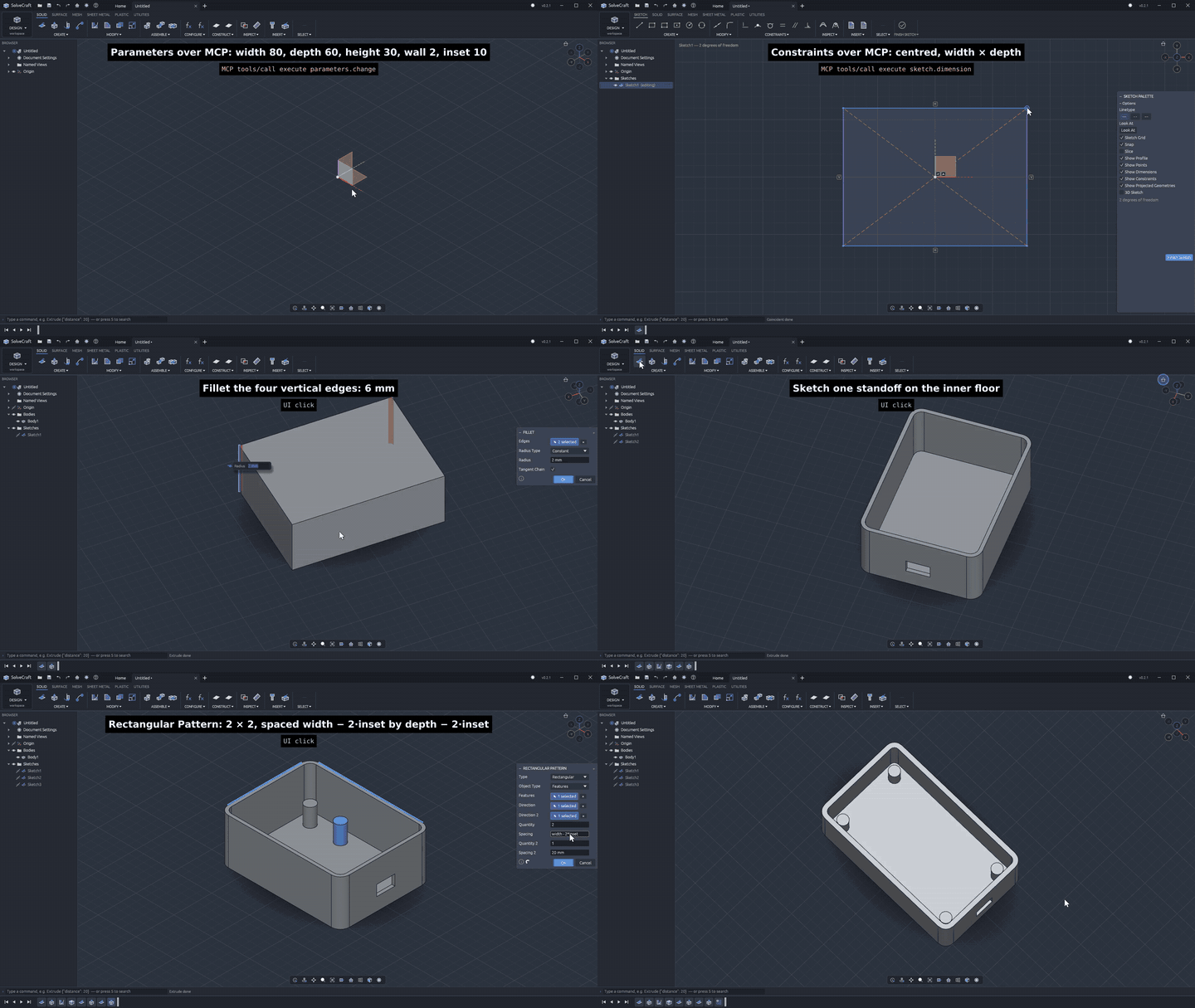
Start with an empty design and draw the original parametric electronics enclosure in the English desktop UI: rounded corners, a shell, a USB port sketched directly on the wall and a four-boss pattern. Change width from 80 → 100 mm and wall thickness from 2 → 3 mm in Parameters and watch it rebuild. Original animated pointer and click cues; 4× playback. Full video, generated with the demo script.
Documentation: the SolidCraft book (user guide, developer guide and command reference; sources in docs/book), and the web app to try it in the browser.
Linux Flatpak installation needs the Freedesktop runtime from Flathub as well as the SolidCraft application feed. See install and launch commands.
Status: early but usable for simple parts. The historical benchmark report records 76 of 76 reference parts matching volume, area and topology (docs/oracle.md). These checks do not establish complete geometric or workflow equivalence. Feature coverage is tracked in docs/parity.md and ROADMAP.md. Open work and known bugs are in GitHub issues, and help is welcome: see CONTRIBUTING.md.
Name and compatibility
SolidCraft was previously called SolveCraft. The product display name and repository are
changing; existing identifiers remain compatible: .solvecraft designs, solvecraft-cli,
Cargo package names, settings/recovery locations and package IDs keep their existing names.
Published 0.2.0 and 0.2.1 packages and demo recordings retain their original SolveCraft branding
and filenames.
Use the SolidCraft documentation and web-app URLs above. GitHub redirects links to the renamed repository; old-name Pages and Flatpak URLs are not maintained as permanent aliases.
What works
- Sketches on origin planes, offset planes or planar faces: lines, rectangles, circles, arcs, polygons, slots, ellipses, fit/control splines, conics and text; construction geometry, projection, trimming, fillets and chamfers, including corners at the origin. New face attachments retain supported construction identities and chosen occurrences; missing sources expose an explicit plane repair workflow. See face attachments. Explicitly closed fit splines and closed associative offsets use periodic C2 interpolation. Supported convex line-and-arc offsets retain their identity when an inset consumes corner arcs, and linked extrusions follow the current boundary. Breaking the association freezes the boundary and keeps existing extrusions usable. Curve drawing and picking adapt together to zoom and display scale, including small circles at Fit and sketches in placed components.
- Constraints and dimensions solved by our own solver (damped Gauss–Newton with degree-of-freedom analysis): coincident, horizontal/vertical, parallel, perpendicular, tangent, equal, concentric, collinear, midpoint, symmetry, fix; linear, aligned, horizontal, vertical, radius, diameter and angle dimensions driven by parameters. Over-constraining edits are rejected; fully constrained geometry turns black. Select a line or its two endpoints, type its dimension and press Enter to commit one undo step. Fit keeps sketch geometry clear of the palette and navigation controls.
- Profiles found automatically, including regions split by lines and holes inside outlines. Newly captured complete adaptive boundaries retain their outer and hole source identities when spline span counts change. Partial or ambiguous boundaries do not qualify.
- Features on a parametric timeline: extrude, revolve, sweep, loft, fillet/chamfer, shell, draft, holes, threads, patterns, mirror, split, combine, move and construction geometry. The timeline rebuilds incrementally; features can be edited, suppressed, renamed, reordered and deleted. Supported geometry and current limitations are described in ROADMAP.md. New revolves preserve symmetric and two-sided angular placement across reversed axes; older designs retain their saved convention when reopened or edited.
- Parameters and configurations with unit-aware expressions (
2 * width + 5 mm,angle / 2), ordered rules, feature suppression and per-row body materials/appearances. - Assemblies with nested components and occurrences, joints, motion studies, contact sets, interference and material-aware mass properties. Recorded body transfers preserve modelling history and world placement; 3D sketch wires retain their coordinate frames through edits.
- Sheet metal with flanges, hems, fold/unfold/refold, material cutouts, flat patterns, retained shallow prismatic pockets, exact line/arc/circle DXF outlines and bend tables; plastic enclosure features and rules. Pocket depth and side survive unfold/refold and appear separately from through-hole outlines in the flat preview and DXF.
- Files: designs as JSON (
.solvecraft), export to STEP (AP242 with body names, colours and components as assemblies; revolved faces as native planes, cylinders, cones, spheres and tori), IGES 5.3 (manifold solid B-reps with names and colours), 3MF, STL (binary/ASCII) and OBJ; 3MF, STL and OBJ import as mesh bodies (they render, measure, move and export; solid features need B-rep bodies); STEP import (AP203/AP214/AP242 solids, assemblies, units, names, colours) and IGES import (manifold solid B-reps, or trimmed and bounded surfaces sewn into solids) as a base feature that later features build on — open a.step/.stp/.igs/.igesfile, insert one into a design, or drop it on the window (docs/step-import.md). - Desktop app (egui + wgpu): toolbar with workspace tabs, browser, timeline, 3D viewport with axis view and navigation bar, sketch tools, feature dialogs, command palette, and a JSON-lines control channel so agents and tests can drive it. Feature errors and Help can open an editable Create Issue draft with relevant context and an optional reviewed screenshot; opening GitHub does not submit the report.
- Headless CLI
solvecraft-cli: run command scripts, measure (volume, area, centre of mass, face/edge/vertex counts), export, render PNG snapshots and replay reference recipes. - MCP server
solvecraft-cli mcp: AI agents model, measure and look at parts headless or in the running app (see below).
Build and run
cargo run --release -p solvecraft -- --sample          # desktop app with a sample part
cargo run --release -p solvecraft-cli -- commands      # the command registry
cargo run --release -p solvecraft-cli -- run examples/bracket.json --out bracket.step
cargo run --release -p solvecraft-cli -- snapshot examples/bracket.json --out bracket.png
cargo run --release -p solvecraft -- part.step          # open a STEP file as a new design
cargo run --release -p solvecraft-cli -- eval part.step # measure an imported STEP file
cargo xtask ci                                          # fmt, clippy, tests, assets, layers, wasm
Windows builds: cargo xwin build --release --target x86_64-pc-windows-msvc -p solvecraft.
On Windows, SolidCraft detects a connected 3Dconnexion SpaceNavigator or SpaceMouse through its multi-axis HID interface. Move the cap to pan and zoom, and tilt or twist it to rotate the 3D view. While editing a sketch, the cap pans and zooms without changing the sketch view. The Navigation page in Preferences has an on/off switch and a speed control for the 3D mouse.
In the browser: cd apps/solvecraft-web && trunk build --release --public-url ./ (WebGPU, or
WebGL2 with ?webgl; ?sample opens the sample part).
Scripts
A script is a JSON list of commands, the same ones the UI runs:
{"commands": [
  {"command": "sketch.create", "params": {"plane": "XY"}},
  {"command": "sketch.rectangle.two_point", "params": {"p0": [0, 0], "p1": [40, 30]}},
  {"command": "solid.extrude", "params": {"distance": 20}},
  {"command": "solid.fillet", "params": {"edges": [[0, 0, 10]], "radius": 3}}
]}
AI agents (MCP)
solvecraft-cli mcp is a Model Context Protocol server on
stdio. Headless it runs its own design session; with --connect 127.0.0.1:PORT it drives the app
started with solvecraft --control PORT, so you can watch the agent model. Tools:
list_commands, execute, batch, inspect_design, measure, body_topology,
set_parameter, screenshot (returns the image), export, undo, redo, new_design, open,
save. Claude Code: claude mcp add solvecraft -- solvecraft-cli mcp. Details, client
configuration and an example session: docs/mcp.md.
Architecture
| Layer | Crates | Role |
|---|---|---|
| L0 | geom |
vectors, planes, profiles, meshes and their measures |
| L1 | sketch, kernel, render |
constraint solver and profiles; the B-rep kernel boundary (truck); view math and CPU rasterizer |
| L2 | doc |
parameters, expressions, the feature timeline and its incremental evaluation |
| L3 | io |
design files, STL/OBJ/STEP/3MF export, STEP and 3MF/STL import features |
| L4 | engine |
the session and the command registry (everything is a command) |
| L5 | ui-egui, mcp |
the swappable desktop front end; the MCP server (headless or bridged to the app) |
| apps | solvecraft, solvecraft-cli |
desktop app, headless CLI |
Contributing
Coming from Autodesk Fusion? SolidCraft uses familiar parametric CAD workflows: constrained sketches, solid features, an editable timeline, parameters and assemblies. See the roadmap for supported operations and current limitations.
See CONTRIBUTING.md: how to build and test, the code map, the clean-room and licence rules, and where help is wanted most.
Licence
MIT OR Apache-2.0, at your option. Developed under the clean-room contribution rules; third-party code and assets retain their documented licences and attribution.
References to other products describe workflow comparisons and benchmark provenance. SolidCraft is not affiliated with, sponsored by or endorsed by Autodesk. Autodesk and Fusion are trademarks of Autodesk, Inc.