.. -- mode: rst --
.. The regions delimited by the skfolio-shared-*-start and skfolio-shared-*-end
comments are included verbatim in docs/index.rst. Do not rename or remove them.
Content placed outside those regions stays in the README only.
|Licence| |Codecov| |PythonVersion| |PyPi| |CI/CD| |Downloads| |Ruff| |Contribution| |Website| |JupyterLite| |Discord| |DOI|
.. |Licence| image:: https://img.shields.io/badge/License-BSD%203--Clause-blue.svg :target: https://github.com/skfolio/skfolio/blob/main/LICENSE

.. |Codecov| image:: https://codecov.io/gh/skfolio/skfolio/graph/badge.svg?token=KJ0SE4LHPV :target: https://codecov.io/gh/skfolio/skfolio

.. |PythonVersion| image:: https://img.shields.io/badge/python-3.10%20%7C%203.11%20%7C%203.12%20%7C%203.13%20%7C%203.14-blue.svg :target: https://pypi.org/project/skfolio/

.. |PyPi| image:: https://img.shields.io/pypi/v/skfolio :target: https://pypi.org/project/skfolio
.. |CI/CD| image:: https://img.shields.io/github/actions/workflow/status/skfolio/skfolio/release.yml.svg?logo=github :target: https://github.com/skfolio/skfolio/actions

.. |Downloads| image:: https://static.pepy.tech/badge/skfolio :target: https://pepy.tech/project/skfolio
.. |Ruff| image:: https://img.shields.io/endpoint?url=https://raw.githubusercontent.com/astral-sh/ruff/main/assets/badge/v2.json :target: https://github.com/astral-sh/ruff
.. |Contribution| image:: https://img.shields.io/badge/Contributions-Welcome-blue :target: https://github.com/skfolio/skfolio/blob/main/CONTRIBUTING.md
.. |Website| image:: https://img.shields.io/website.svg?down_color=red&down_message=down&up_color=53cc0d&up_message=up&url=https://skfolio.org :target: https://skfolio.org

.. |JupyterLite| image:: https://jupyterlite.rtfd.io/en/latest/_static/badge.svg :target: https://skfolio.org/lite

.. |Discord| image:: https://img.shields.io/badge/Discord-Join%20Chat-5865F2?logo=discord&logoColor=white :target: https://discord.gg/Bu7EtNYugS
.. |DOI| image:: https://zenodo.org/badge/731792488.svg :target: https://doi.org/10.5281/zenodo.16148630

=============== |icon| skfolio
.. |icon| image:: https://raw.githubusercontent.com/skfolio/skfolio/main/docs/_static/logo_animate.svg :width: 100 :alt: skfolio documentation

.. skfolio-shared-introduction-start
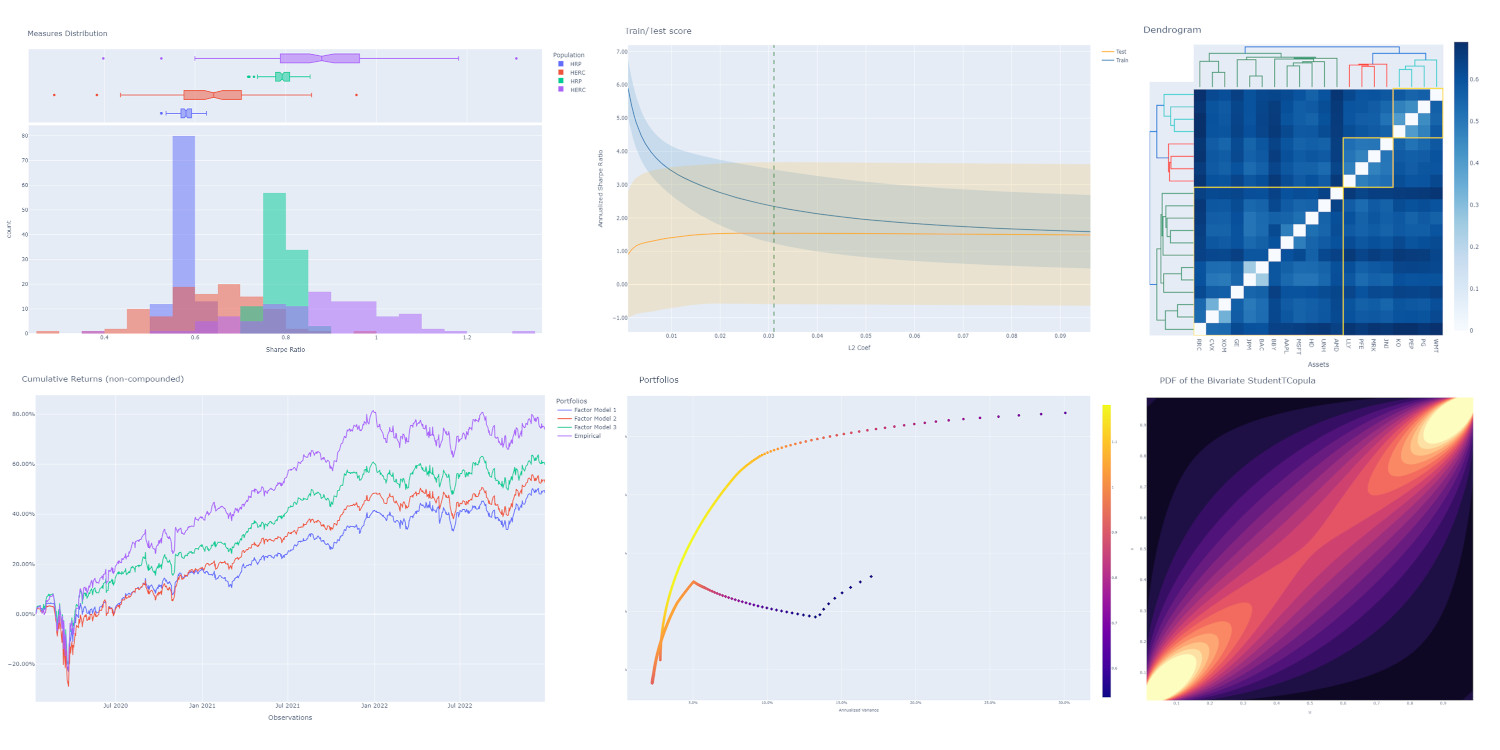
skfolio is a Python library for portfolio optimization, factor model construction, and risk management built on top of scikit-learn. It offers a unified interface and tools compatible with scikit-learn to build, fine-tune, cross-validate, and stress-test portfolio models.
It is distributed under the open-source 3-Clause BSD license.
skfolio is backed by Skfolio Labs _, which provides
enterprise support and SLAs for institutions.
.. skfolio-shared-introduction-end
.. image:: https://raw.githubusercontent.com/skfolio/skfolio/main/docs/_static/expo.jpg :target: https://skfolio.org/auto_examples/index.html :alt: examples
.. skfolio-shared-body-start
Important links
- `Examples `_
- `User Guide `_
- `API Reference `_
- `GitHub Repo `_
- `Enterprise Support `_

Featured in
~~~~~~~~~~~

* `Portfolio Optimization: Theory and Application `_ by Daniel P. Palomar, includes Python code examples using skfolio.

Installation
~~~~~~~~~~~~

.. |PythonMinVersion| replace:: 3.10

`skfolio` requires Python |PythonMinVersion| or later and can be installed with:

.. code:: bash

    pip install -U skfolio

See the `installation guide `_ for the full
dependency list, for conda-forge and for the mixed-integer solvers.

LLM-friendly documentation
The documentation follows the llms.txt convention _ and
provides token-efficient Markdown alongside the HTML site:
- Start with
llms.txt_ to find relevant pages. - Read only the Markdown pages needed by appending
.mdto their HTML URLs, for examplefactor_models.html.md_. - Use
llms-full.txt_ only when the complete documentation is required in a single file.
Contribution
We welcome contributions of all kinds. Whether it's reporting a bug, suggesting an
improvement, or submitting code, your input helps make `skfolio` better. See the
`contributing guide `_
to get started.

Key Concepts
Since the development of modern portfolio theory by Markowitz (1952), mean-variance optimization (MVO) has received considerable attention.
Unfortunately, it faces a number of shortcomings, including high sensitivity to the input parameters (expected returns and covariance), weight concentration, high turnover, and poor out-of-sample performance.
It is well-known that naive allocation (1/N, inverse-vol, etc.) tends to outperform MVO out-of-sample (DeMiguel, 2007).
Numerous approaches have been developed to alleviate these shortcomings (shrinkage, additional constraints, regularization, uncertainty set, higher moments, Bayesian approaches, coherent risk measures, left-tail risk optimization, distributionally robust optimization, factor model, risk-parity, hierarchical clustering, ensemble methods, pre-selection, etc.).
Given the large number of methods, and the fact that they can be combined, there is a need for a unified framework with a machine-learning approach to perform model selection, validation, and parameter tuning while mitigating the risk of data leakage and overfitting.
This framework is built on scikit-learn's API.
Available models
* Portfolio Optimization:
    * Naive:
        * Equal-Weighted
        * Inverse-Volatility
        * Random (Dirichlet)
    * Convex:
        * Mean-Risk
        * Risk Budgeting
        * Maximum Diversification
        * Distributionally Robust CVaR
        * Benchmark Tracker
    * Clustering:
        * Hierarchical Risk Parity
        * Hierarchical Equal Risk Contribution
        * Schur Complementary Allocation
        * Nested Clusters Optimization
    * Ensemble Methods:
        * Stacking Optimization

* Prior Estimator:
    * Empirical
    * Characteristics-Based Cross-Sectional Factor Model:
        * 46 descriptors across 17 families (e.g. value, size, momentum, profitability)
        * Factor Exposures
        * Cross-Sectional Regression
        * Alpha Estimators
        * Forecast Evaluation
        * Ex-post and Ex-ante Attribution
    * Time-Series Factor Model
    * Black & Litterman
    * Synthetic Data (Stress Test, Factor Stress Test)
    * Entropy Pooling
    * Opinion Pooling

* Expected Returns Estimator:
    * Empirical
    * Exponentially Weighted
    * Equilibrium
    * Shrinkage

* Covariance Estimator:
    * Empirical
    * Gerber
    * Denoising
    * Detoning
    * Exponentially Weighted
    * Regime-Adjusted Exponentially Weighted
    * Ledoit-Wolf
    * Oracle Approximating Shrinkage
    * Shrunk Covariance
    * Geodesic Shrinkage Covariance
    * Graphical Lasso CV
    * Implied Covariance

* Variance Estimator:
    * Empirical
    * Exponentially Weighted
    * Regime-Adjusted Exponentially Weighted

* Distance Estimator:
    * Pearson Distance
    * Kendall Distance
    * Spearman Distance
    * Covariance Distance (based on any of the above covariance estimators)
    * Distance Correlation
    * Variation of Information

* Seriation Estimator:
    * Hierarchical Seriation
    * Spectral Seriation

* Distribution Estimator:
    * Univariate:
        * Gaussian
        * Student's t
        * Johnson Su
        * Normal Inverse Gaussian
    * Bivariate Copula
        * Gaussian Copula
        * Student's t Copula
        * Clayton Copula
        * Gumbel Copula
        * Joe Copula
        * Independent Copula
    * Multivariate
        * Vine Copula (Regular, Centered, Clustered, Conditional Sampling)

* Uncertainty Set Estimator:
    * On Expected Returns:
        * Empirical
        * Circular Bootstrap
    * On Covariance:
        * Empirical
        * Circular Bootstrap

* Pre-Selection Transformers:
    * Non-Dominated Selection
    * Select K Extremes (Best or Worst)
    * Drop Highly Correlated Assets
    * Select Non-Expiring Assets
    * Select Complete Assets (handle late inception, delisting, etc.)
    * Drop Zero Variance

* Cross-Sectional Transformers:
    * Standard Scaler (z-score)
    * Percentile Rank Scaler
    * Gaussian Rank Scaler (rank gaussianization)
    * Winsorizer (percentile clipping)
    * Tanh Shrinker (smooth outlier shrinkage)

* Cross-Validation and Model Selection:
    * Compatible with all `sklearn` methods (KFold, etc.)
    * Walk Forward
    * Combinatorial Purged Cross-Validation
    * Multiple Randomized Cross-Validation
    * Covariance Forecast Evaluation
    * Online Predict and Online Score

* Hyper-Parameter Tuning:
    * Compatible with all `sklearn` methods (GridSearchCV, RandomizedSearchCV)
    * Online Grid Search and Online Randomized Search

* Risk Measures:
    * Variance
    * Semi-Variance
    * Mean Absolute Deviation
    * First Lower Partial Moment
    * CVaR (Conditional Value at Risk)
    * EVaR (Entropic Value at Risk)
    * Worst Realization
    * CDaR (Conditional Drawdown at Risk)
    * Maximum Drawdown
    * Average Drawdown
    * EDaR (Entropic Drawdown at Risk)
    * Ulcer Index
    * Gini Mean Difference
    * Value at Risk
    * Drawdown at Risk
    * Entropic Risk Measure
    * Fourth Central Moment
    * Fourth Lower Partial Moment
    * Skew
    * Kurtosis

* Optimization Features:
    * Minimize Risk
    * Maximize Returns
    * Maximize Utility
    * Maximize Ratio
    * Transaction Costs
    * Management Fees
    * L1 and L2 Regularization
    * Weight Constraints
    * Group Constraints
    * Budget Constraints
    * Tracking Error Constraints
    * Turnover Constraints
    * Cardinality and Group Cardinality Constraints
    * Threshold (Long and Short) Constraints

Quickstart
~~~~~~~~~~
The code snippets below are designed to introduce the functionality of `skfolio` so you
can start using it quickly. It follows the same API as scikit-learn.

Imports
-------
.. code-block:: python

    from sklearn import set_config
    from sklearn.model_selection import (
        GridSearchCV,
        KFold,
        RandomizedSearchCV,
        train_test_split,
    )
    from sklearn.pipeline import Pipeline
    from scipy.stats import loguniform

    from skfolio import RatioMeasure, RiskMeasure
    from skfolio.datasets import (
        load_factors_dataset,
        load_sp500_dataset,
        make_synthetic_characteristics,
    )
    from skfolio.descriptor import (
        BookToPrice,
        CashFlowToPrice,
        EWMarketBeta,
        EWMomentum,
        EWResidualVolatility,
        EWVolatility,
        LogMarketCap,
        SalesToPrice,
    )
    from skfolio.distribution import VineCopula
    from skfolio.factor_exposure import (
        DerivedFactor,
        FixedWeightedFactor,
        GlobalFactor,
        OneHotCategoricalFactors,
    )
    from skfolio.model_selection import (
        CombinatorialPurgedCV,
        WalkForward,
        cross_val_predict,
    )
    from skfolio.moments import (
        DenoiseCovariance,
        DetoneCovariance,
        EWMu,
        GerberCovariance,
        ShrunkMu,
    )
    from skfolio.optimization import (
        MeanRisk,
        HierarchicalRiskParity,
        NestedClustersOptimization,
        ObjectiveFunction,
        RiskBudgeting,
    )
    from skfolio.pre_selection import SelectKExtremes
    from skfolio.preprocessing import prices_to_returns
    from skfolio.prior import (
        BlackLitterman,
        CharacteristicsFactorModel,
        EmpiricalPrior,
        EntropyPooling,
        TimeSeriesFactorModel,
        OpinionPooling,
        SyntheticData,
    )
    from skfolio.uncertainty_set import BootstrapMuUncertaintySet

Load Dataset
------------
.. code-block:: python

    prices = load_sp500_dataset()

Train/Test split
----------------
.. code-block:: python

    X = prices_to_returns(prices)
    X_train, X_test = train_test_split(X, test_size=0.33, shuffle=False)


Minimum Variance
----------------
.. code-block:: python

    model = MeanRisk()

Fit on Training Set
-------------------
.. code-block:: python

    model.fit(X_train)

    print(model.weights_)

Predict on Test Set
-------------------
.. code-block:: python

    portfolio = model.predict(X_test)

    print(portfolio.annualized_sharpe_ratio)
    print(portfolio.summary())


Maximum Sortino Ratio
---------------------
.. code-block:: python

    model = MeanRisk(
        objective_function=ObjectiveFunction.MAXIMIZE_RATIO,
        risk_measure=RiskMeasure.SEMI_VARIANCE,
    )


Denoised Covariance & Shrunk Expected Returns
---------------------------------------------
.. code-block:: python

    model = MeanRisk(
        objective_function=ObjectiveFunction.MAXIMIZE_RATIO,
        prior_estimator=EmpiricalPrior(
            mu_estimator=ShrunkMu(), covariance_estimator=DenoiseCovariance()
        ),
    )

Uncertainty Set on Expected Returns
-----------------------------------
.. code-block:: python

    model = MeanRisk(
        objective_function=ObjectiveFunction.MAXIMIZE_RATIO,
        mu_uncertainty_set_estimator=BootstrapMuUncertaintySet(),
    )


Weight Constraints & Transaction Costs
--------------------------------------
.. code-block:: python

    model = MeanRisk(
        min_weights={"AAPL": 0.10, "JPM": 0.05},
        max_weights=0.8,
        transaction_costs={"AAPL": 0.0001, "RRC": 0.0002},
        groups=[
            ["Equity"] * 3 + ["Fund"] * 5 + ["Bond"] * 12,
            ["US"] * 2 + ["Europe"] * 8 + ["Japan"] * 10,
        ],
        linear_constraints=[
            "Equity = 0.1",
            "Europe >= 0.5 * Fund",
            "Japan `_ and the `Factor Models tutorials
`_.

Time-Series Factor Model
------------------------
.. code-block:: python

    factor_prices = load_factors_dataset()

    X, factors = prices_to_returns(prices, factor_prices)
    X_train, X_test, factors_train, factors_test = train_test_split(
        X, factors, test_size=0.33, shuffle=False
    )

    model = MeanRisk(prior_estimator=TimeSeriesFactorModel())
    model.fit(X_train, factors=factors_train)

    print(model.weights_)

    portfolio = model.predict(X_test)

    print(portfolio.calmar_ratio)
    print(portfolio.summary())

Time-Series Factor Model & Covariance Detoning
----------------------------------------------
.. code-block:: python

    model = MeanRisk(
        prior_estimator=TimeSeriesFactorModel(
            factor_prior_estimator=EmpiricalPrior(covariance_estimator=DetoneCovariance())
        )
    )

Black & Litterman Time-Series Factor Model
------------------------------------------
.. code-block:: python

    factor_views = ["MTUM - QUAL == 0.03 ", "VLUE == 0.06"]
    model = MeanRisk(
        objective_function=ObjectiveFunction.MAXIMIZE_RATIO,
        prior_estimator=TimeSeriesFactorModel(
            factor_prior_estimator=BlackLitterman(views=factor_views),
        ),
    )

Pre-Selection Pipeline
----------------------
.. code-block:: python

    set_config(transform_output="pandas")
    model = Pipeline(
        [
            ("pre_selection", SelectKExtremes(k=10, highest=True)),
            ("optimization", MeanRisk()),
        ]
    )
    model.fit(X_train)

    portfolio = model.predict(X_test)


K-fold Cross-Validation
-----------------------
.. code-block:: python

    model = MeanRisk()
    mpp = cross_val_predict(model, X_test, cv=KFold(n_splits=5))
    # mpp is the predicted MultiPeriodPortfolio object composed of 5 Portfolios (1 per testing fold)

    mpp.plot_cumulative_returns()
    print(mpp.summary())


Combinatorial Purged Cross-Validation
-------------------------------------
.. code-block:: python

    model = MeanRisk()

    cv = CombinatorialPurgedCV(n_folds=10, n_test_folds=2)

    print(cv.summary(X_test))

    population = cross_val_predict(model, X_test, cv=cv)

    population.plot_distribution(
        measure_list=[RatioMeasure.SHARPE_RATIO, RatioMeasure.SORTINO_RATIO]
    )
    population.plot_cumulative_returns()
    print(population.summary())


Minimum CVaR Optimization on Synthetic Returns
----------------------------------------------
.. code-block:: python

    vine = VineCopula(log_transform=True, n_jobs=-1)
    prior = SyntheticData(distribution_estimator=vine, n_samples=2000)
    model = MeanRisk(risk_measure=RiskMeasure.CVAR, prior_estimator=prior)
    model.fit(X)
    print(model.weights_)


Stress Test
-----------
.. code-block:: python

    vine = VineCopula(log_transform=True, central_assets=["BAC"], n_jobs=-1)
    vine.fit(X)
    X_stressed = vine.sample(n_samples=10_000, conditioning = {"BAC": -0.2})
    ptf_stressed = model.predict(X_stressed)


Minimum CVaR Optimization on Synthetic Factors
----------------------------------------------
.. code-block:: python

    vine = VineCopula(central_assets=["QUAL"], log_transform=True, n_jobs=-1)
    factor_prior = SyntheticData(
        distribution_estimator=vine,
        n_samples=10_000,
        sample_args=dict(conditioning={"QUAL": -0.2}),
    )
    factor_model = TimeSeriesFactorModel(factor_prior_estimator=factor_prior)
    model = MeanRisk(risk_measure=RiskMeasure.CVAR, prior_estimator=factor_model)
    model.fit(X, factors=factors)
    print(model.weights_)


Factor Stress Test
------------------
.. code-block:: python

    factor_model.set_params(factor_prior_estimator__sample_args=dict(
        conditioning={"QUAL": -0.5}
    ))
    factor_model.fit(X, factors=factors)
    stressed_dist = factor_model.return_distribution_
    stressed_ptf = model.predict(stressed_dist)

Entropy Pooling
---------------
.. code-block:: python

    entropy_pooling = EntropyPooling(
        mean_views=[
            "JPM == -0.002",
            "PG >= LLY",
            "BAC >= prior(BAC) * 1.2",
        ],
        cvar_views=[
            "GE == 0.08",
        ],
    )
    entropy_pooling.fit(X)
    print(entropy_pooling.relative_entropy_)
    print(entropy_pooling.effective_number_of_scenarios_)
    print(entropy_pooling.return_distribution_.sample_weight)

CVaR Hierarchical Risk Parity optimization on Entropy Pooling
-------------------------------------------------------------
.. code-block:: python

    entropy_pooling = EntropyPooling(cvar_views=["GE == 0.08"])
    model = HierarchicalRiskParity(
        risk_measure=RiskMeasure.CVAR,
        prior_estimator=entropy_pooling
    )
    model.fit(X)
    print(model.weights_)

Stress Test with Entropy Pooling on Factor Synthetic Data
---------------------------------------------------------
.. code-block:: python

    # Regular Vine Copula and sampling of 100,000 synthetic factor returns
    factor_synth = SyntheticData(
        n_samples=100_000,
        distribution_estimator=VineCopula(log_transform=True, n_jobs=-1, random_state=0)
    )

    # Entropy Pooling by imposing a CVaR-95% of 10% on the Quality factor
    factor_entropy_pooling = EntropyPooling(
        prior_estimator=factor_synth,
        cvar_views=["QUAL == 0.10"],
    )

    factor_model = TimeSeriesFactorModel(factor_prior_estimator=factor_entropy_pooling)
    factor_model.fit(X, factors=factors)

    # We retrieve the stressed distribution:
    stressed_dist = factor_model.return_distribution_

    # We stress-test our portfolio:
    stressed_ptf = model.predict(stressed_dist)

Opinion Pooling
---------------
.. code-block:: python

    # We consider two expert opinions, each generated via Entropy Pooling with
    # user-defined views.
    # We assign probabilities of 40% to Expert 1, 50% to Expert 2, and by default
    # the remaining 10% is allocated to the prior distribution:
    opinion_1 = EntropyPooling(cvar_views=["AMD == 0.10"])
    opinion_2 = EntropyPooling(
        mean_views=["AMD >= BAC", "JPM `_ and `cvxpy `_, as well as the contributors of the following resources:

    * PyPortfolioOpt
    * Riskfolio-Lib
    * scikit-portfolio
    * statsmodels
    * rsome
    * `Microprediction `_ (Peter Cotton)
    * `Portfolio Optimization Book `_ (Daniel P. Palomar)
    * *The Elements of Quantitative Investing* (Giuseppe Paleologo)
    * `quantresearch.org `_ (Marcos López de Prado)
    * gautier.marti.ai (Gautier Marti)


Citation
~~~~~~~~

If you use `skfolio` in a scientific publication, we would appreciate citations:

**The library:**

.. code-block:: bibtex

        @software{skfolio,
          title     = {skfolio},
          author    = {Delatte, Hugo and Nicolini, Carlo and Manzi, Matteo},
          year      = {2026},
          doi       = {10.5281/zenodo.16148630},
          url       = {https://doi.org/10.5281/zenodo.16148630}
        }

The citation above refers to skfolio across all versions. Its concept DOI resolves
to the latest version archived on Zenodo.

For reproducible research, we recommend citing the specific release you used. Visit
the `Zenodo project page `_, select that
release, and use its citation so that the DOI, version, and publication date
correspond to the same release.

**The paper:**

.. code-block:: bibtex

        @article{nicolini2025skfolio,
          title         = {skfolio: Portfolio Optimization in Python},
          author        = {Nicolini, Carlo and Manzi, Matteo and Delatte, Hugo},
          journal       = {arXiv preprint arXiv:2507.04176},
          year          = {2025},
          eprint        = {2507.04176},
          archivePrefix = {arXiv},
          url           = {https://arxiv.org/abs/2507.04176}
        }

.. skfolio-shared-body-end

Repository mirror
The project is also mirrored on AtomGit .
GitHub remains the primary repository for
development and contributions.