sim is a free, open source ai interaction & interfaces project written in TypeScript and released under Apache-2.0. It has 29,655 GitHub stars, 3,837 forks and 336 open issues, and was last pushed 3 hours ago. On this registry it ranks #22 of 76 tracked projects in AI Interaction & Interfaces, with 5 head-to-head comparisons available. It gained 14 stars over the last 3 tracked days.

What is sim?

What it is

Sim is an open-source collaborative workspace for building, deploying, and monitoring AI agents and workflows. It lives in the TypeScript ecosystem and is distributed under the Apache-2.0 license, with a repository that has accumulated roughly 29,600 stars and 3,800 forks over its two-year history. The project positions itself as a single surface where chat, workflows, tables, files, and knowledge coexist, whether accessed through a browser or a desktop application for macOS.

The concrete problem Sim addresses is fragmentation across the tooling required to assemble agentic systems. Rather than stitching together separate services for model access, integration connectors, file ingestion, structured data, and run monitoring, Sim consolidates these into one workspace. It connects over 1,000 integrations and every major LLM, and it lets builders construct agents visually, conversationally, or in code. Knowledge bases, uploaded files, and table data all reside in the same environment that the agents draw upon, which removes the need to reconcile memory and context across disconnected stores.

Key capabilities

  • Connects more than 1,000 integrations alongside every major LLM provider.
  • Ships native connectors for Slack, Notion, HubSpot, Salesforce, and databases.
  • Supports building agents visually, conversationally, or directly in code.
  • Ingests files, knowledge bases, and structured table data into the workspace.
  • Monitors runs, logs, schedules, and overall workflow activity.
  • Provides built-in Tables as a database and a shared Files store for teams and agents.
  • Runs local models through Ollama and vLLM.

Who uses it and how

  • Teams building agentic workflows that need Slack, Notion, HubSpot, or Salesforce connected to model calls.
  • Builders who prefer low-code visual composition but want to drop into code when needed.
  • Operators monitoring scheduled runs and inspecting logs for workflow activity.
  • Desktop users on macOS 12+ (Apple Silicon and Intel) who point the app at a self-hosted deployment.
  • Self-hosters running the published Docker Compose images behind their own infrastructure.

Getting started

Cloud-hosted access is available at sim.ai, and a macOS desktop build is offered for Apple Silicon and Intel. Self-hosting uses npx sim-setup, an interactive wizard requiring Node.js 20+ and Docker that provisions the database, generates secrets, writes .env, connects a Chat API key, and starts the published images via Docker Compose; inside a cloned repository, bun run sim-setup unlocks source-only local development and Kubernetes modes.

When to use it — and when not to

Sim replaces a stack of separate paid tools for agent orchestration

project readme (upstream, from github) — read inline

Sim.ai Documentation Slack X

Ask DeepWiki Set Up with Cursor

A workspace to build, deploy and manage AI agents and workflows.

Quickstart

Cloud-hosted: sim.ai

Open sim.ai

Self-hosted

npx sim-setup

Open http://localhost:3000

Desktop: macOS

Download Sim for macOS

macOS 12+, Apple Silicon and Intel. See the desktop docs to point it at a self-hosted deployment.
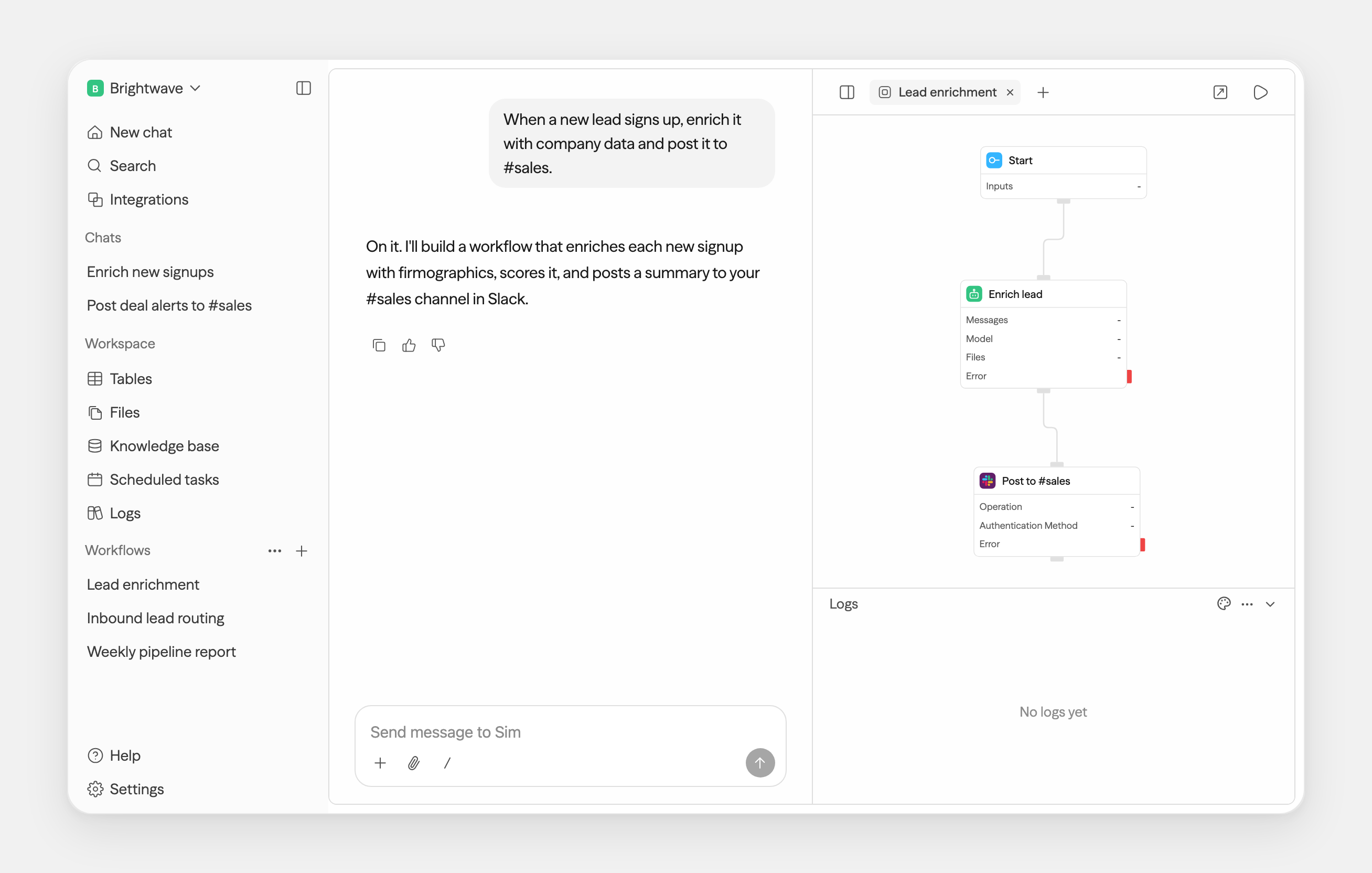
Capabilities

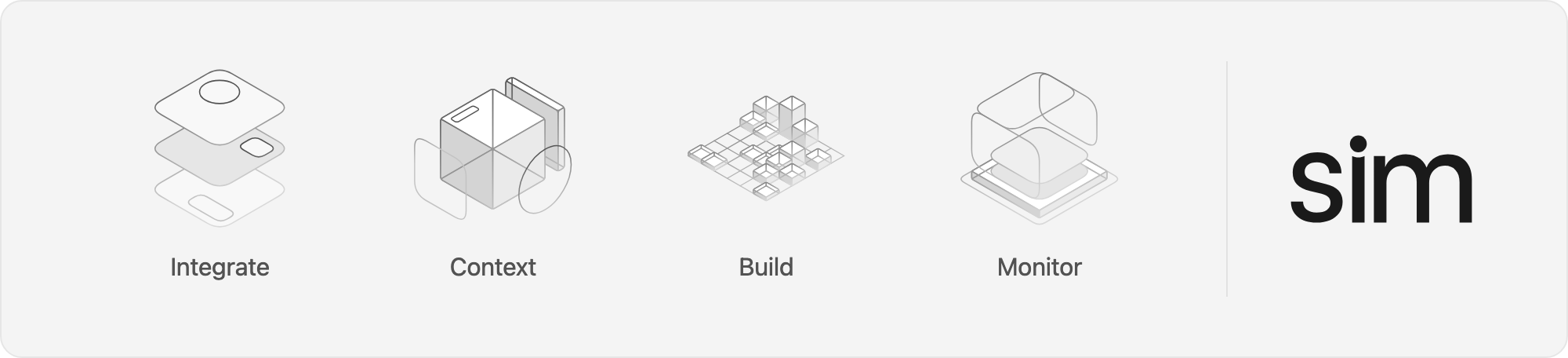
  • Connect 1,000+ integrations and every major LLM
  • Add Slack, Notion, HubSpot, Salesforce, databases, and more
  • Build agents visually, conversationally, or with code
  • Ingest files, knowledge bases, and structured table data
  • Monitor runs, logs, schedules, and workflow activity

One workspace, every surface

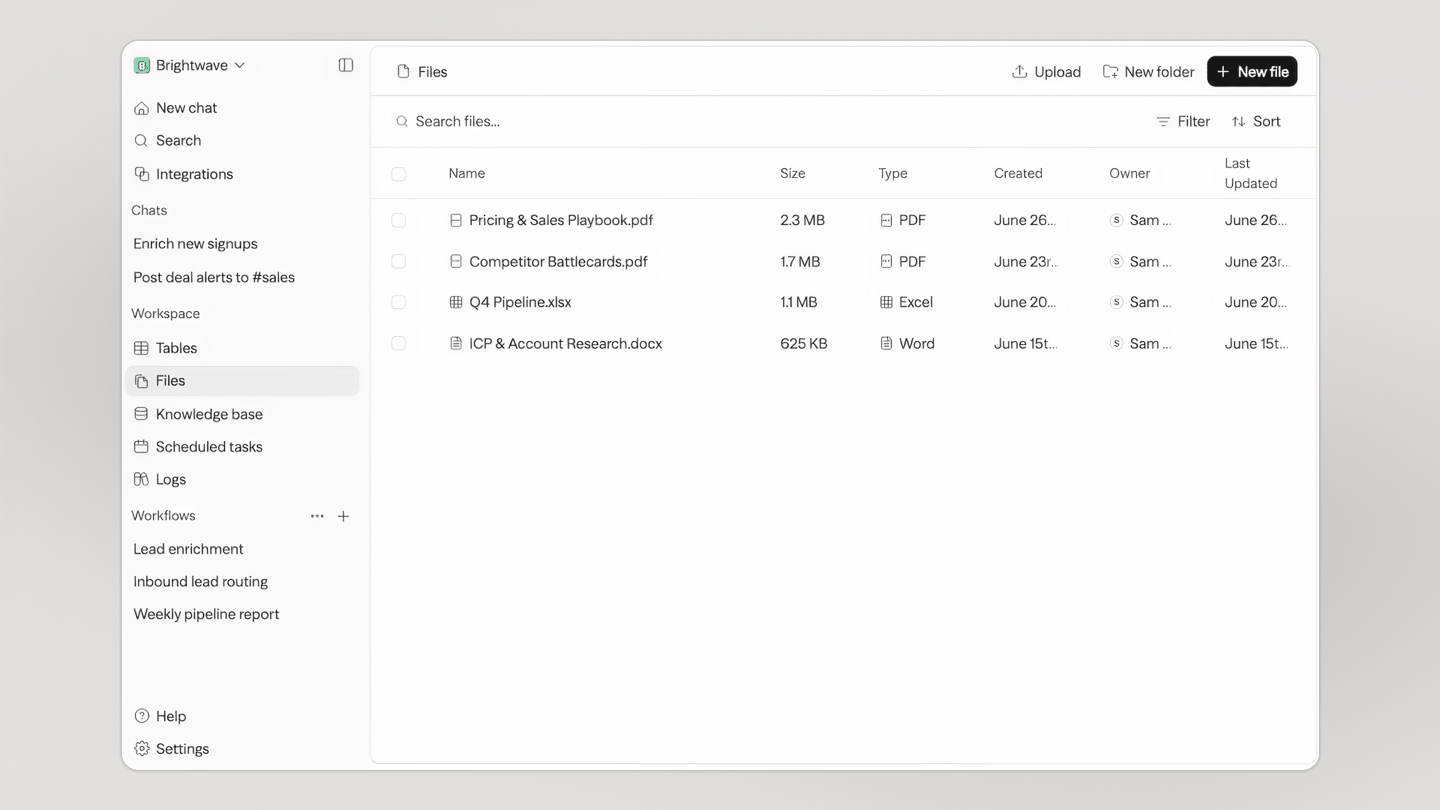
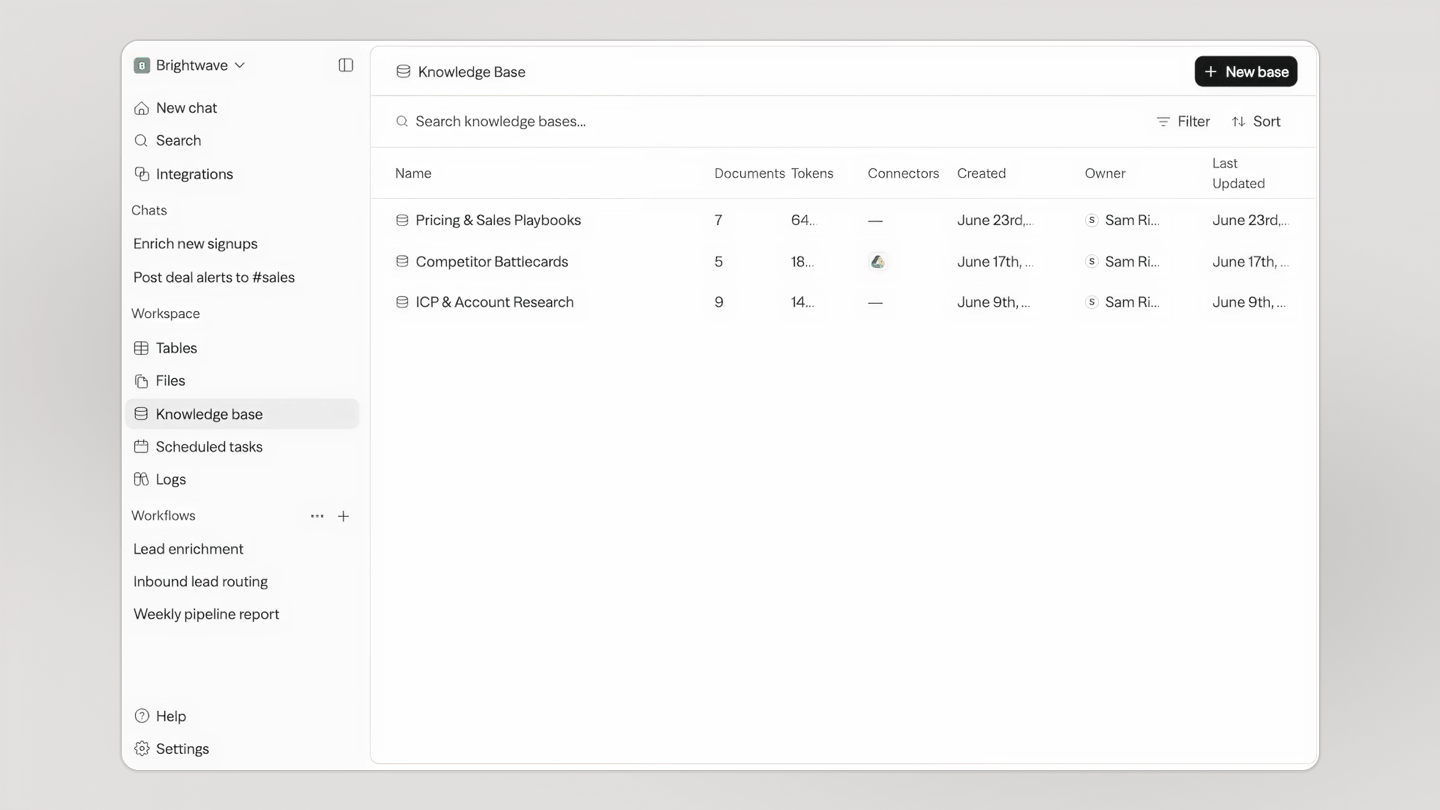
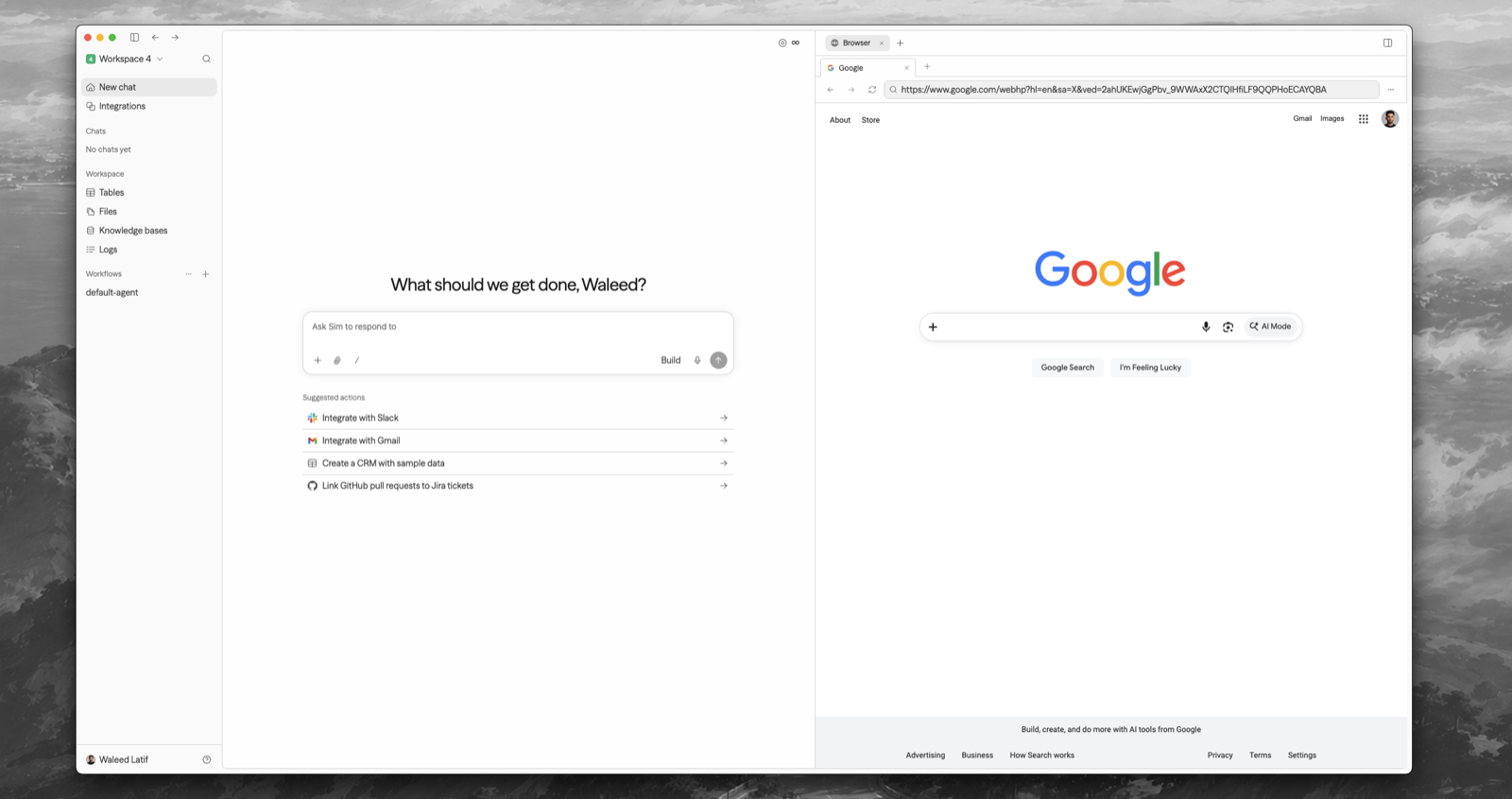
Chat and workflows are just the start — tables, files, and knowledge all live in the same workspace, in the browser or on your desktop.
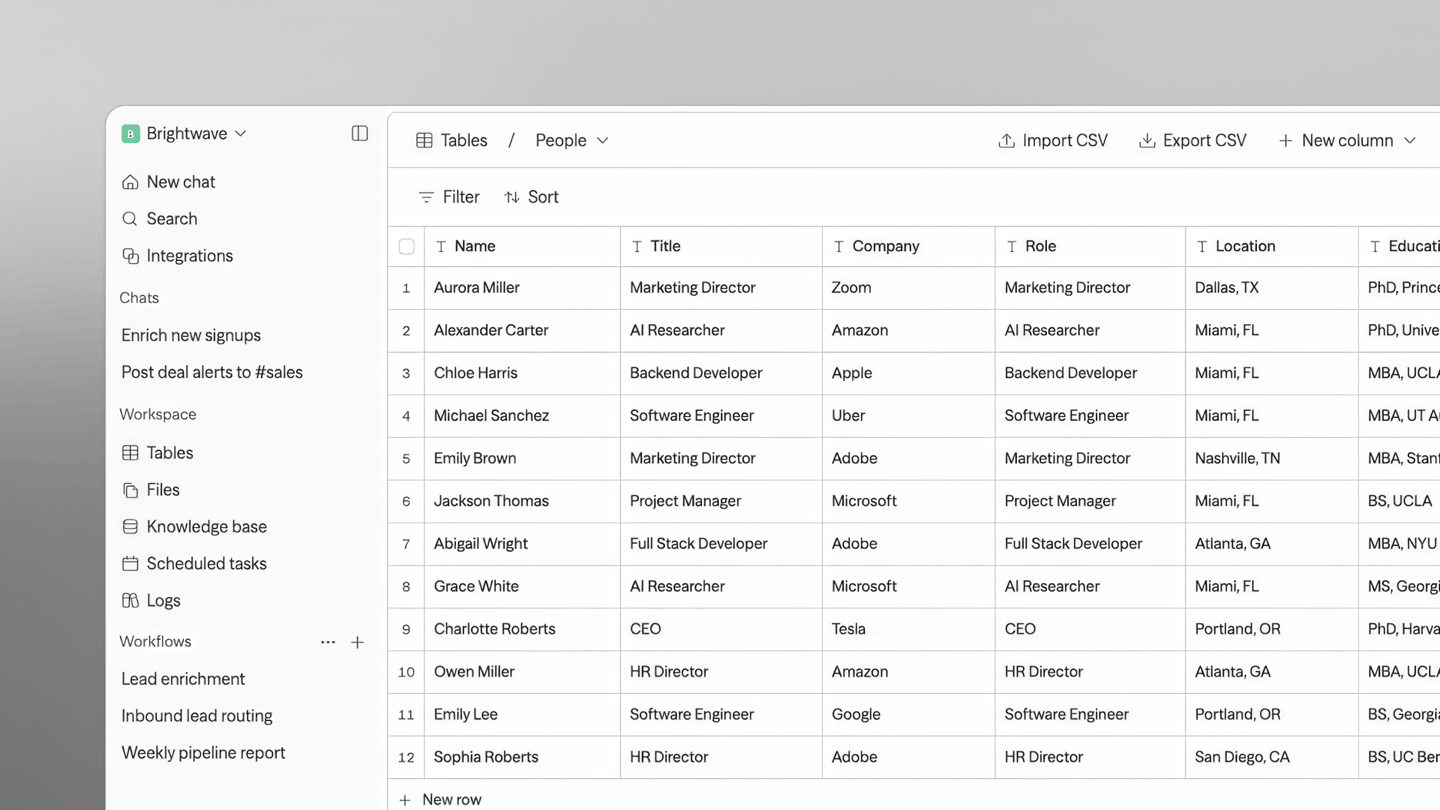
Tables — a database, built in

Files — one store for your team and every agent

Knowledge — your agents' memory

Desktop — Sim on your Mac, browser and terminal included

Self-hosting

Requirements: Node.js 20+ and Docker.

npx sim-setup is an interactive wizard that creates a small sim/ deployment directory, provisions the database, generates secrets, writes .env, connects a Chat API key, and starts the published Sim images with Docker Compose. It does not clone the repository.

When it finishes, open http://localhost:3000.

Inside a cloned Sim repository, run bun run sim-setup to unlock the source-only local development and Kubernetes modes.

Reconfigure an optional capability without rerunning the full wizard:

npx sim-setup config
npx sim-setup add email
npx sim-setup add storage
npx sim-setup add sandbox
npx sim-setup add jobs
npx sim-setup add cache
npx sim-setup add knowledge
npx sim-setup add chat
npx sim-setup add llm
npx sim-setup add integration slack

npx sim-setup config detects the effective local-dev, Docker Compose, or current-context Helm configuration and reports configured, missing, or invalid capabilities and OAuth integrations without printing credential values. This is separate from npx sim-setup status, which reports whether installed services are running and healthy.

Manage your install from its directory:

npx sim-setup start | stop | restart   # bring your install up / down / cycle
npx sim-setup update                   # pull and apply Compose images
npx sim-setup status                   # what's installed and healthy
npx sim-setup logs                     # follow logs
npx sim-setup doctor                   # diagnose configuration problems
npx sim-setup down                     # remove containers (data kept)
npx sim-setup reset                    # archive .env and wipe managed data

The setup package detects how you're running and acts accordingly. Use --dir to create or manage a deployment somewhere other than ./sim.

Sim also supports local models via Ollama and vLLM. See the self-hosting docs for details.

Chat API Keys

Chat is a Sim-managed service. npx sim-setup connects a Chat API key for you — sign in when it opens your browser and the key is stored automatically. To view, create, or revoke keys later, go to sim.ai/selfhost/settings/chat-keys.

Environment Variables

See the environment variables reference for the full list, or apps/sim/.env.example for defaults.

Tech Stack

Next.js · Bun · PostgreSQL · Drizzle · Better Auth · Tailwind — and the rest of the stack

readme truncated — read the full docs on github

Frequently asked questions

Is sim free to use?

sim is open source under the Apache-2.0 licence. There is no licence fee and no seat count — you can self-host it or, where the project offers one, pay a vendor for a managed version instead.

What does sim do?

Sim is the collaborative workspace to build, deploy, and monitor AI agents and workflows. Used by 100,000+ builders.

What is sim written in?

sim is primarily written in TypeScript. Its source is publicly available at https://github.com/simstudioai/sim, and it has 29,655 GitHub stars.